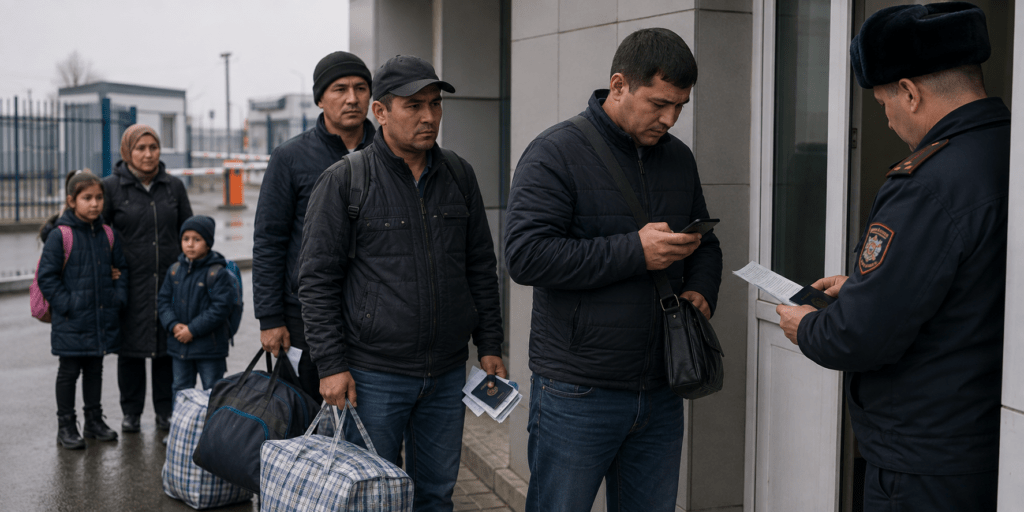
Russia remains the main destination for many Central Asian labor migrants, but its dominance is weakening. Since the start of the war in Ukraine, Western sanctions, tougher Russian migration rules, and rising hostility toward migrants have pushed workers from the region to look elsewhere. South Korea, the Gulf states, the United Kingdom, Poland, Belarus, and other destinations are increasingly competing with Russia for Central Asian labor. The result is not a collapse of the old migration model, but a visible diversification of flows as the geography of labor migration from the region expands.
Kazakhstan: From Destination Country to Source of Skilled Migrants
Since the collapse of the Soviet Union, most labor migrants from Central Asia have traveled to Russia in search of work. A shortage of local labor, relatively decent wages, familiarity with the language, and a similar mentality have driven many to seek jobs in major Russian cities.
Kazakhstan is an exception. It has not seen mass migration of its own citizens into lower-skilled jobs in Russia such as janitorial or construction work. Kazakhstan’s own economy offers such jobs, unemployment has remained low, and employers continue to report shortages in both manual work and skilled professions. The Bureau of National Statistics put unemployment at 4.5% in the first quarter of 2026. For this reason, Kazakhstan has also long been a destination for migrants from neighboring states, even if Russia has traditionally attracted larger flows.
Kazakh citizens working abroad generally aim for higher-paying jobs in sectors requiring qualifications. The government was already tracking this in 2024, when the Ministry of Labor and Social Protection reported, using Foreign Ministry data, that 137,000 Kazakh citizens were abroad for employment purposes. The largest numbers were in Russia, South Korea, Turkey, and the UAE, with smaller numbers in Europe, North America, and elsewhere.
A later Ministry report showed the same pattern, with Russia still dominant but alternatives clearly visible: of 126,000 Kazakh citizens employed abroad, 102,000 were in Russia, 15,000 in South Korea, and around 2,000 in the United Kingdom and European Union member states.
Those leaving include economists, lawyers, technical specialists, teachers, and medical workers. Although outward labor migration remains limited compared with Uzbekistan, Kyrgyzstan, or Tajikistan, it is adding to official concerns about the loss of qualified specialists. Officials believe Kazakhstan’s labor market is vulnerable to external competition, and a large share of those leaving have higher or technical vocational education. Salary gaps and differences in living standards make these destinations attractive.
Qatar has recently joined the list of preferred destinations for labor migration. This has been made possible in large part by intergovernmental agreements signed between Qatar and Kazakhstan. Qatar is now actively recruiting Kazakh specialists, particularly in the oil and gas sector. According to Arman Shokparov, co-founder of People Consulting, around 600-700 Kazakh white-collar professionals currently work in Qatar. Nearly half work in the oil and gas sector, mainly in engineering and production roles.
This trend does not mean Kazakhstan is only losing workers. It continues to attract immigrants and returnees, including ethnic Kazakhs under long-running resettlement programs, and the government is also trying to manage internal migration toward labor-short regions. Its new migration policy through 2030 prioritizes skilled migration and relocation to regions with shortages, underscoring that Kazakhstan is both a source and a destination in the region’s labor market.
Uzbekistan: Organized Recruitment Beyond Russia
According to Uzbekistan’s National Statistics Committee, as of January 1, 2026, the country’s permanent population stood at 38.2 million. Experts believe Uzbekistan can now claim to be the second-most populous post-Soviet state after Russia. Ukraine once held that position, but its population has declined significantly, and no census has been conducted there since 2000.
Uzbekistan’s migration balance remained negative: 1,159 people moved to the country for permanent residence, while 10,117 left. Most immigrants to Uzbekistan come from former Soviet states. Russia remains the main source, accounting for 34.1% of all arrivals in the first quarter of 2026. Another 19.7% came from Kazakhstan, and 12.2% from Tajikistan. Kyrgyzstan accounted for 4.9%, and Turkmenistan 3.7%. The remaining 25.4% came from other countries.
The number of Uzbek citizens working abroad reached 1.2 million, according to an official Migration Agency statement by director Behzod Musaev in May 2026. Unofficial estimates of the broader Uzbek population abroad are higher, but the categories differ and are not directly comparable.
Traditionally, Russia and Kazakhstan were the main destinations for Uzbek labor migrants, and Russia remains central. TCA reported that around 106,000 Uzbek citizens went to work in Russia in 2025 through organized recruitment programs. However, migration trends are gradually shifting: organized recruitment to South Korea, the United Kingdom, Germany, the United States, Canada, and other European or Asian destinations is becoming more visible. The reason for this shift is not only tougher migration legislation in Russia, but also the search for higher wages, safer legal channels, and more predictable working conditions.
Kyrgyzstan: Russia Still Dominates, but Alternatives Are Expanding
Between January and March 2026, around 3,400 people arrived in Kyrgyzstan for permanent residence, while 353 left. These figures come from the National Statistics Committee. Some analysts link this positive migration balance to relocants from Russia.
In 2022, 1.09 million Kyrgyz citizens were temporarily absent from their permanent place of residence. Of these, 964,600 people, or 88.1%, were away for work, meaning labor migrants accounted for 28% of the working-age population.
As recently as 2025, government official Bakyt Darmankul uulu confirmed the trend: the number of Kyrgyz migrants in Russia has significantly declined in recent years. According to him, around 600,000 Kyrgyz citizens were working abroad at that time, including 379,000 in Russia. In 2020, the number in Russia stood at around 680,000.
He said some returnees from Russia are now heading to other countries. Today, labor migration from Kyrgyzstan extends to 29 countries, with the United Kingdom currently the most in-demand destination. Most people going to Europe and Asia work in seasonal jobs. The UK has provided 40,000 quotas for foreign workers, 10,000 of them for Kyrgyzstan. Kyrgyz citizens also travel for work to Egypt, the UAE, Kazakhstan, Bahrain, Kuwait, Oman, Belarus, Estonia, Bulgaria, Austria, Hungary, South Korea, Turkey, and other countries.
The growth of alternative routes is creating a need for better oversight. TCA reported in 2026 that 159 private agencies in Kyrgyzstan held licenses to facilitate employment abroad, while interest in jobs in Europe and Southeast Asia had increased. These channels can make migration safer and more organized, but migrants still face risks when working conditions abroad do not match recruiters’ promises.
Turkmenistan and Tajikistan: Flows Are Changing
As always, official statistics for Turkmenistan and Tajikistan are mostly available only through foreign sources. Nevertheless, citizens of both countries are increasingly less likely to see Russia as their only realistic destination for work.
In Poland, for example, labor migration from Central Asia is growing. In the first quarter of 2026, Tajik citizens received around 6,000 work permits, according to Marta Jaroszewicz of the Centre of Migration Research at the University of Warsaw. She estimated that up to 30,000 Central Asian migrants now live in Poland, with most from Uzbekistan, followed by Kazakhstan, Kyrgyzstan, and Tajikistan.
According to Jaroszewicz, in the first quarter of 2026 Poland issued around 16,000 work permits to Uzbek citizens, 12,000 to Kazakhs, nearly 8,000 to Kyrgyz citizens, and 6,000 to Tajiks. She stressed that labor migration to Poland remains predominantly male. She also believes migration from Central Asia to Europe could grow substantially in the coming years, driven by demographics, population growth, and a large number of young people and students.
Belarusian sources point to a similar shift in Turkmen flows, though figures vary by period and category. One report citing Belarus’ Department of Citizenship and Migration said Turkmenistan had become the largest source of foreign labor migrants, with 23,050 Turkmen citizens, or 48% of the total. Another shorter-period figure reported 6,915 arrivals. The key point is the same: Belarus has become a more visible destination for Turkmen workers, especially in services, construction, and equipment maintenance.
Russian authorities also confirmed a significant decline in labor migration from Tajikistan in 2024. More recent reporting points to the same broader direction, with Tajikistan actively seeking new destinations for labor migrants. Tajik migration links with Russia remain deep, but some Russia-centered pathways are weakening as legal, political, and social conditions become more difficult.
Russia remains the largest destination for many Central Asian workers, but it is no longer the only choice. The emerging pattern is not a sudden break with the post-Soviet migration system, but gradual diversification, with other destinations now part of a broader labor-migration map. For Central Asian governments, this creates opportunities, including higher wages, remittances, and legal recruitment channels, as well as risks such as brain drain, worker vulnerability abroad, and stronger competition for skilled labor at home.