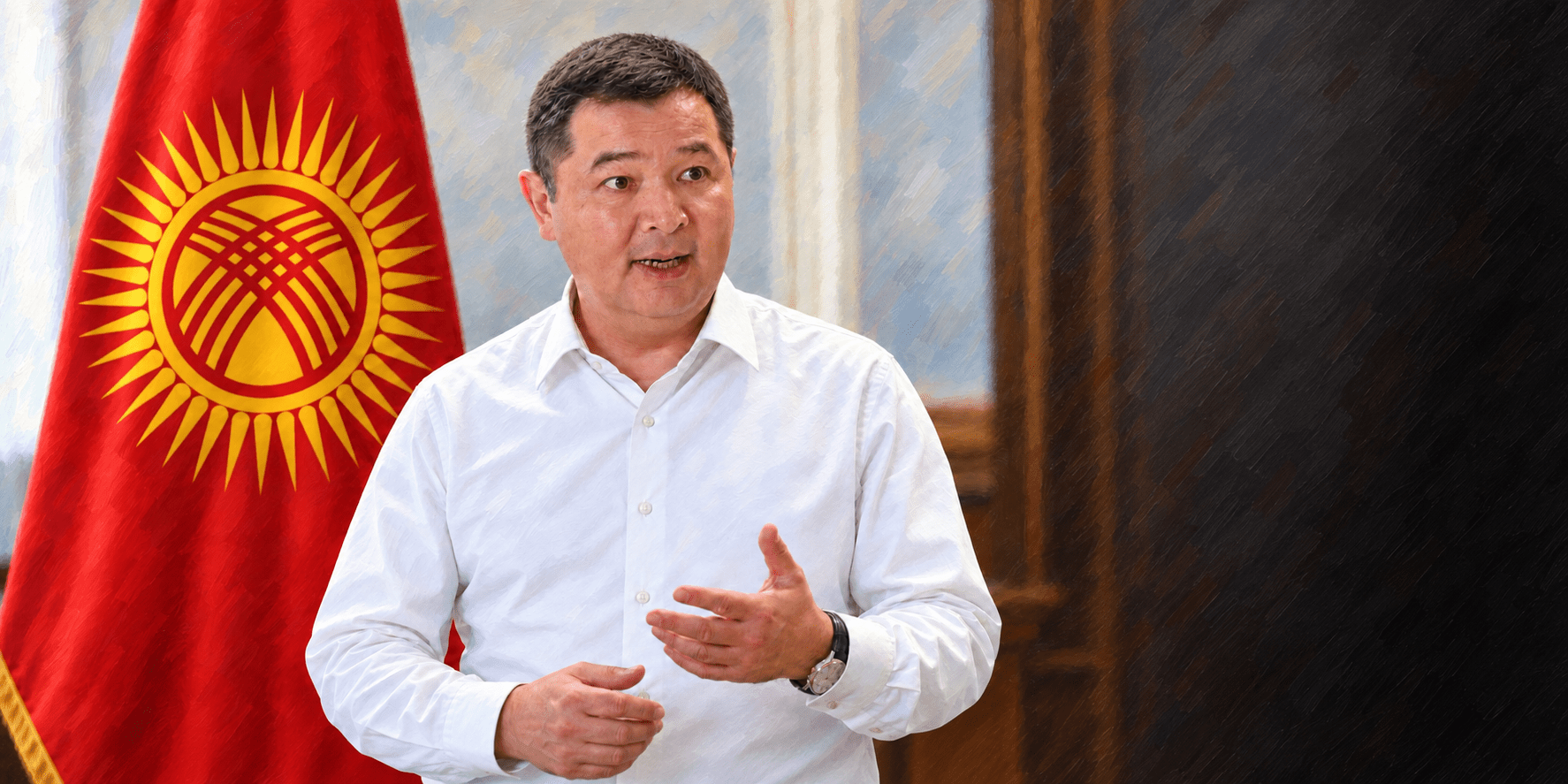
On September 2, the day after the Shanghai Cooperation Organization’s Heads of State Summit in Bishkek, The Times of Central Asia spoke with Bakyt Sydykov, Kyrgyzstan’s Minister of Economy and Commerce and Special Presidential Representative for Sanctions Policy. He outlined the government’s approach to sanctions compliance and protecting Kyrgyz businesses.
Sanctions exposure can affect Kyrgyz banks and businesses, as well as their international partners. U.S. secondary sanctions and EU and UK measures affecting foreign entities operate through different legal mechanisms. Some portions of the text have been edited for clarity.
TCA: The sanctions against Russia adopted by the U.S., EU, and UK are not UN Security Council-mandated. Is it correct that Kyrgyzstan’s compliance policy addresses these measures rather than UN-mandated sanctions?
Sydykov: That’s correct. Secondary sanctions can affect non-U.S., non-EU, and non-UK entities or persons who knowingly facilitate transactions involving sanctioned parties. Our focus is on establishing better and better mechanisms and frameworks that address this bilateral dimension, that is, Kyrgyzstan’s direct exposure through its relations with the sanctioning jurisdictions, in order to mitigate our exposure to potential secondary sanctions.
TCA: Kyrgyz citizens and businesses can face sanctions exposure through dealings with sanctioned parties, including the risk of U.S. secondary sanctions. What are Kyrgyzstan’s main challenges in improving its compliance regime, and how are you addressing them?
Sydykov: For technical reasons, our compliance regime is moving toward putting in place mechanisms that can flag or be anticipatory. I think you would agree that free markets are complicated and circumvention often comes to light only after it has occurred. We are largely equipped to manage these occurrences.
We are moving to put in place firewall-like frameworks which would allow the country to identify and respond to occurrences before the fact. It is a great challenge — and one that every country operating in a free-market economy faces — to develop such a capacity, namely, to anticipate and prevent circumvention before it happens. Despite our best efforts, this remains a structural limitation.
TCA: What concrete actions have you taken, or are you planning to take?
Sydykov: We have established working groups, task forces, and interagency committees capable of swiftly halting the operations of any company engaged in sanctions circumvention. We are also working closely with commercial banks on these efforts. The banks, for their part, have introduced internal compliance committees and, in some cases, adjusted the composition of their boards of directors to strengthen governance and decision-making around potential circumvention risks.
The banks are also developing a joint interbank blacklist of sanctioned entities, so that these entities are unable to operate through the banking system going forward. Those are steps to develop a working forward-looking, predictive approach — one that flags suspicious activity before it materializes – central to the comprehensive framework we are building.
TCA: Some foreign investors may be reluctant to invest in Kyrgyzstan because of sanctions exposure. How could the measures you are taking address those concerns?
Sydykov: Let me first say that we understand the rationale behind these concerns. It is our sovereign decision to keep bilateral economic activity within appropriate channels, avoid any appearance of sanctions evasion, protect Kyrgyz financial institutions and businesses from secondary-sanctions exposure, and preserve Kyrgyzstan’s access to the broader international financial and investment system. That much should be clear.
As to whether certain foreign investors have held back from investing or trading with Kyrgyz entities, that’s ultimately a question for them to answer, not me. But we assume some investors are hesitant for those reasons, and that’s one of several reasons why we’re working to strengthen our compliance regime.
With that in mind, let’s be clear about the main driver here. Strengthening our flagging and compliance systems is about us first and foremost; it’s about growing our commercial ties, opening up two-way investment, and creating capital flow opportunities for Kyrgyz businesses, joint ventures, and our partners here and abroad. This isn’t about calming foreign nerves — even though I hope that happens. My job is to protect Kyrgyz banks, Kyrgyz investors, and Kyrgyz businesses. That’s who I answer to.
Given that our businesses want to grow, expand abroad, or establish partnerships with foreign entities, strengthening our internal systems makes that process easier for them. It lowers the barriers to finding partners and forming joint ventures. We actively encourage Kyrgyz businesses to collaborate with international partners, and we want them to feel just as confident operating in global markets as they do at home.
To be clear, we are not undertaking all these costly and time-consuming efforts simply because it is being asked of us. We are doing it, as I said, because I want to serve Kyrgyzstan’s national interests and those of our businesses. We are a small economy but growing — a situation I want to continue without the economy overheating. That is a separate topic, but my priority, to repeat, is protecting the interests of our domestic institutions and economic actors. Macroeconomic management should remain at the technical level.
TCA: You are aware, of course, that the Enterprise Court of Brussels ruled in favor of Kyrgyzstan’s Bakai Bank in its case against the Open Dialogue Foundation, finding that the NGO’s 2023 allegations — that the bank facilitated sanctions circumvention and Russian capital flows — were not backed by adequate evidence. Given that outcome, what conclusions do you draw from this case?
Sydykov: I would say, first, that the Bakai Bank case illustrates a basic legal principle Kyrgyzstan insists on: that findings must rest on facts, not accusations or allegations. That’s precisely the point worth underscoring. Courts exist to weigh evidence, not to ratify assumptions. What the Brussels ruling confirms is something we’ve said consistently, namely that Kyrgyzstan welcomes scrutiny, but scrutiny grounded in fact. We have nothing to fear from that standard. If anything, we invite it.
TCA: Any final words?
Sydykov: Kyrgyzstan is putting real effort into Tamchy SFIT, a new financial center on the shores of Lake Issyk-Kul. The center is being built on English common law. We’re doing this precisely because we want a platform that meets the highest international standards. It reflects the same principle we’ve discussed throughout this conversation — that we should be judged by what we do, not by any other criteria. My hope is that as Tamchy SFIT matures, investors and businesses, whether in Kyrgyzstan or abroad, will engage with it on its actual merits, e.g., its design, compliance, and governance standards.