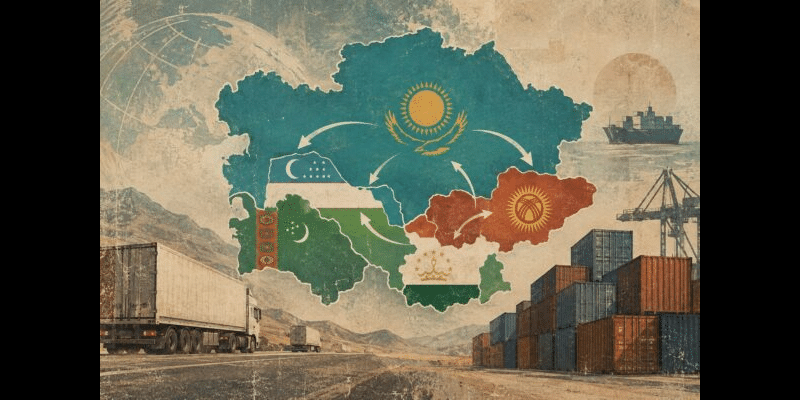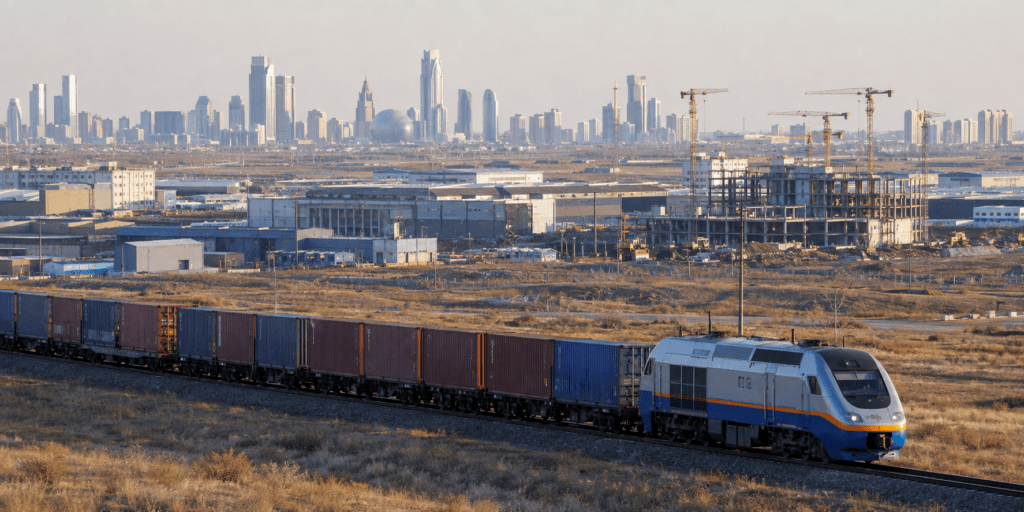
For several years, interest in the Middle Corridor has risen sharply amid the war in Ukraine, tensions around Iran, sanctions, instability on maritime routes, and governments’ efforts to diversify supply chains. The route runs through Central Asia, the Caspian Sea, and the South Caucasus.
The way the issue is framed is now changing. The debate over whether this route is needed is moving into the background. A more important question is whether the Middle Corridor can develop from a politically attractive alternative into a sustainable transport and economic system that businesses will use not because of geopolitical circumstances, but because it is competitive.
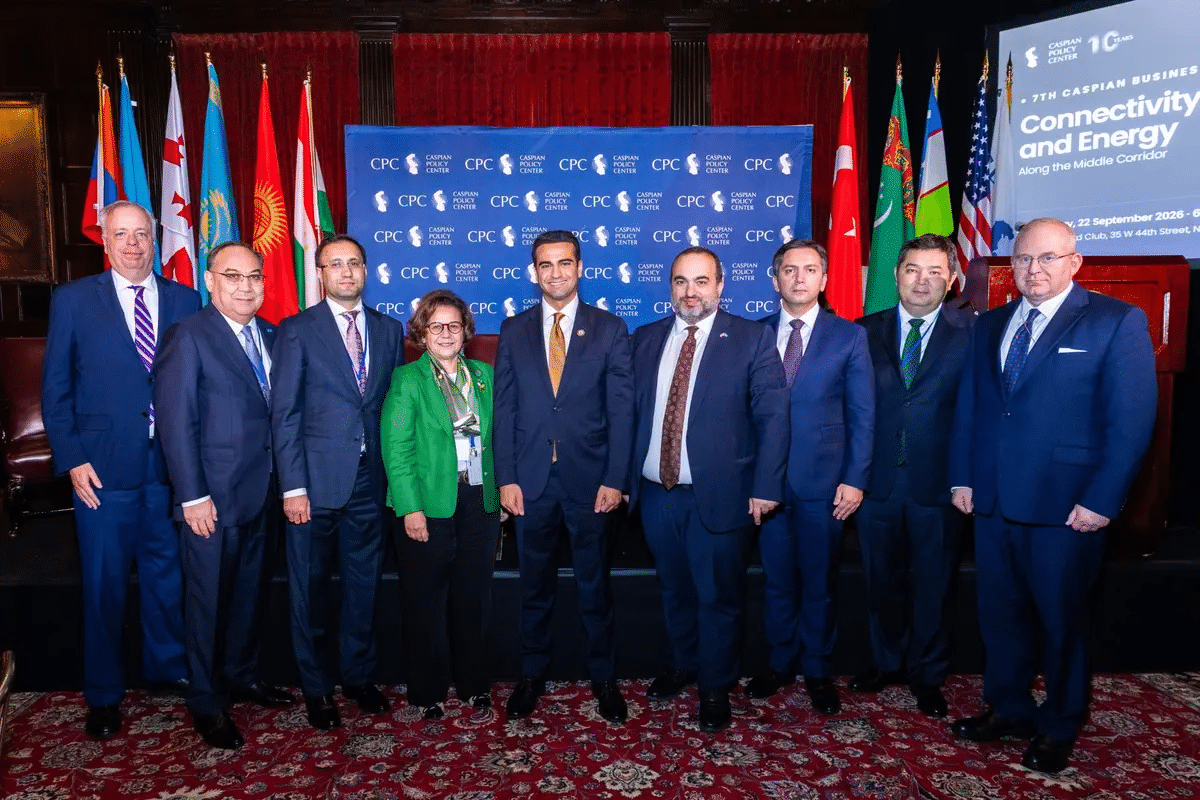
In this context, the 7th Caspian Business Forum, held in New York on September 22 and organized by the Caspian Policy Center (CPC), provided a useful snapshot of this shift. Representatives of the United States, Kazakhstan, Kyrgyzstan, Azerbaijan, Georgia, Turkey, and major businesses took part. The discussions focused on the Middle Corridor, the Trump Route for International Peace and Prosperity (TRIPP), energy, critical minerals, and attracting private capital.
Freight volumes on the Trans-Caspian International Transport Route rose from 0.8 million tons to 4.5 million tons in the seven years to 2025, according to Kazakhstan’s Ministry of Transport. The route carried about 77,000 twenty-foot equivalent units of containerized cargo in 2025, and Kazakhstan aims to raise that total to 300,000 by 2029.
These volumes are substantial, but they show the limits of the Middle Corridor’s current capacity. It has not yet become a replacement for all traditional overland routes between China and Europe.
The World Bank has noted that the Middle Corridor is more than a transit bridge between China and the European Union (EU). Growth in trade among the countries along the route, as well as their trade with Europe, could be equally important. With the necessary investment and organizational reforms, it estimates, trade flows could triple and transport times could roughly halve by 2030.
The route passes through several countries, crosses the Caspian Sea, requires transfers between different modes of transport, and depends on coordination among railway operators, ports, customs services, and tariff policies.
A study of transport connectivity between Europe and Central Asia by the European Bank for Reconstruction and Development, at the request of the European Commission, identified 33 priority investment needs in physical infrastructure and seven soft-connectivity measures, ranging from the digitalization of transport documents to the harmonization of tariffs, customs, and border procedures. The CPC forum addressed these issues as well.
CPC President Efgan Nifti put it this way: “For the Corridor to reach its full potential, it must increasingly function as one integrated system – with harmonized border procedures, coordinated ports and railways, and digitalized documentation.”
Kazakhstan’s position reflects this approach. The country’s presidential representative for negotiations with the United States, Erzhan Kazykhan, called the Middle Corridor a “strategic investment in the future” connecting Kazakhstan with the South Caucasus, Turkey, and Europe. He said Astana views TRIPP as a logical extension of the system that could shorten the route to European markets by about 1,000 km. He identified infrastructure connectivity, simplifying cross-border transportation, and securing long-term financing as the next priorities.
For Kazakhstan, the corridor is no longer only about selling transit services between China and Europe. It is becoming a tool for the country’s own external economic connectivity.
An undersea fiber-optic cable between Kazakhstan and Azerbaijan shows that the corridor could support digital links as well as freight transport. The most complex stage of laying it across the Caspian Sea was completed in August. The cable is now being connected to shore infrastructure and tested as part of a planned digital link between Asia and Europe.
TRIPP also belongs in this discussion. It is sometimes presented as a new route that could change the transport map of the South Caucasus, but there is not yet enough basis for that conclusion.
TRIPP is primarily intended to create an additional connection through Armenian territory between Azerbaijan and Nakhchivan, with further access to Turkey. For the Middle Corridor, this could mean another western leg after crossing the Caspian Sea and Azerbaijan.
The United States and Armenia are developing the institutional framework for the TRIPP Development Company, a joint structure intended to oversee the project. The United States International Development Finance Corporation has a proposed controlling stake through a U.S.-owned subsidiary, but as of September, the parties were still working on the company’s charter and shareholders’ agreement.
TRIPP’s potential emergence would not displace the existing route through Georgia and the Baku-Tbilisi-Kars railway, as some discussions of “alternative corridors” suggest. Azerbaijan remains the key western entry and exit point for the Trans-Caspian route. From there, cargo could continue through Georgia to Turkey or the Black Sea, or eventually use the Armenian TRIPP route.
Deputy Foreign Minister Berris Ekinci made a similar point in New York, saying that TRIPP should not be viewed as a separate or competing corridor and that its significance would depend on how well it integrates with existing railways, roads, and port infrastructure.
Financing is another issue. The EU recently announced plans to mobilize up to €12 billion in public and private investment through its Global Gateway program for the Middle Corridor linking Central Asia and the South Caucasus with the European market.
U.S. involvement increased in 2026 with the creation of the Trans-Caspian Enterprise Fund. Backed by $201 million in U.S. government funding, the fund supports investment in projects along the Middle Corridor. At the forum, U.S. representatives presented it as a way to demonstrate individual projects’ commercial viability and attract private capital alongside public funding.
Potential funding sources for the Middle Corridor include governments’ own resources, the World Bank, European financial institutions, U.S. mechanisms, and private capital. The challenge is turning those sources into viable projects.
Jamshid Ehsani, head of global principal structured finance at Apollo Global Management, said the problem was not necessarily a lack of capital but how projects are structured to attract the appropriate forms of long-term financing. Kimberly Harrington, head of U.S. international affairs at bp America, noted that projects in the Caspian region compete with opportunities around the world for finite private capital.
The discussion is shifting from geopolitics toward economics. Geopolitical interest can accelerate investment in the route, but its long-term future will depend on the cost, speed, and reliability of transportation.
The Middle Corridor is increasingly discussed not as a geopolitical line on a map but as a complex economic system linking railways, ports, digital infrastructure, energy, and finance.