For centuries, nomadic tribes across the steppe that now forms modern Kazakhstan absorbed outside influences and adapted them to local conditions, creating something uniquely Kazakh.
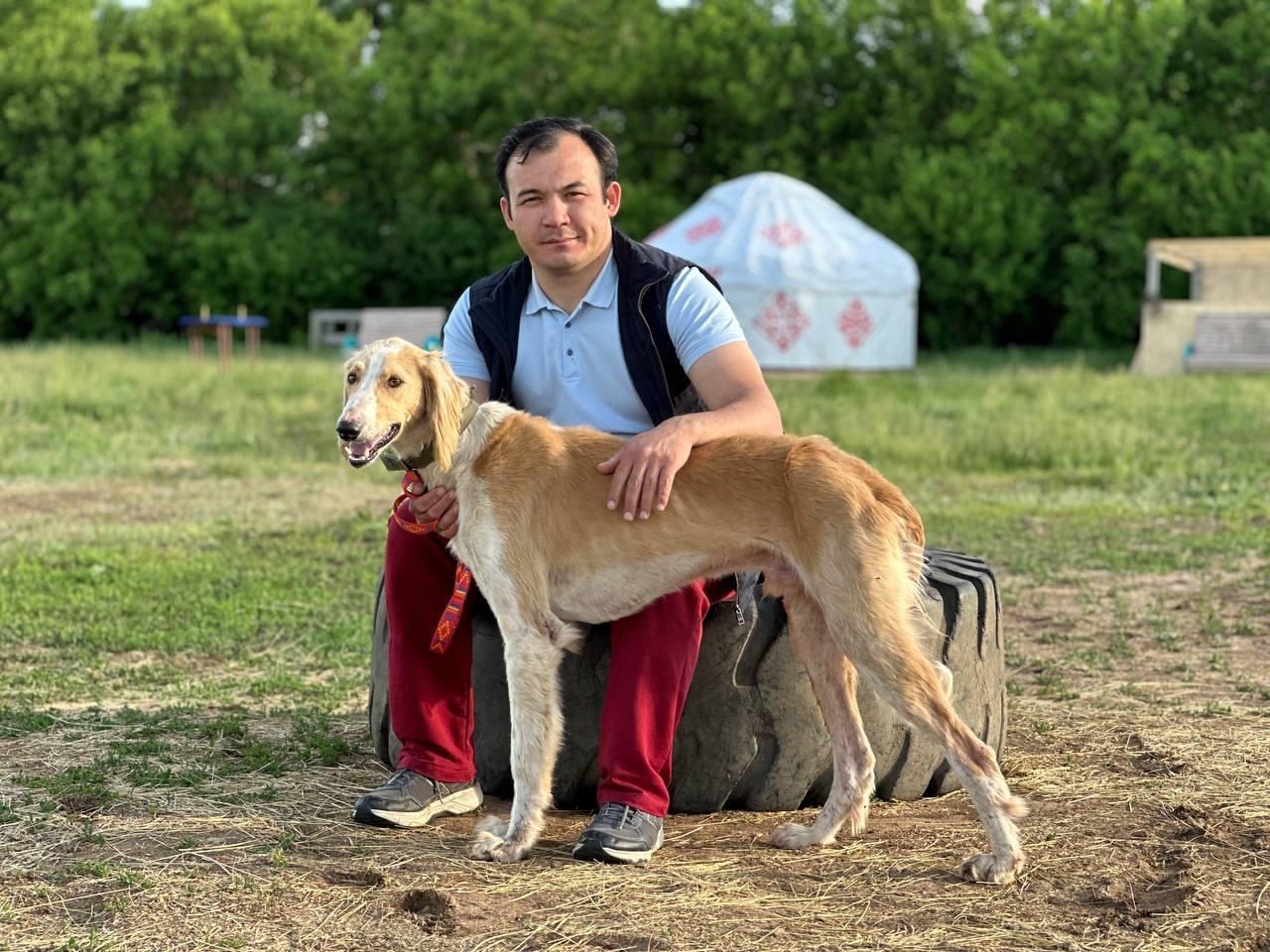
This adaptability is evident in many aspects of steppe life, including the development of the Tazy, the Kazakh greyhound. Bred over generations to protect what nomads valued most, their livestock, the Tazy is now considered one of the seven national treasures of Kazakhstan.
“If we look at history, we can say that the progenitor of the Kazakh breed, the Tazy, was the Arabian greyhound saluki,” said breeder Abzal Dosyman in an interview with The Times of Central Asia. “Arab missionaries brought it to our lands. The Tazy and the saluki are similar, but over time, given the needs of the nomads and the harsh climate of the steppe, the breed adapted and transformed. Here, their descendants were trained to guard livestock and protect people from wolves.”
Dosyman described the unique methods traditionally used to raise Tazys for such a role. As soon as puppies were born, wolf skin was placed nearby so they would learn the predator’s scent. At four or five months, the young dogs were taken on hunts, but only after a brief starvation period. They were then fed wolf meat, which, after the fast, was considered a delicacy.
“Some may see this as cruel,” he acknowledged. “But this is how hunters were raised who dared to face wolves on the steppe. For centuries, Tazys helped Kazakhs protect their herds, which were their livelihood.”
Though known for their gentle nature, Tazys transform during a hunt, becoming fast, fearless, and relentless. “They are friendly toward people and non-aggressive with other animals, but they are implacable toward the grey predator,” Dosyman said.
He noted that many countries have their own hunting greyhounds. Russia has the Borzoi, Kyrgyzstan the Taigan, meaning “graceful,” and Spain the Galgo. All descend, like the Tazy, from the ancient Arabian saluki. But it was in Kazakhstan that the Tazy acquired its distinct characteristics, shaped by the local way of life. In 2024, the General Committee of the Fédération Cynologique Internationale granted provisional recognition to the Kazakh Tazy as an official breed, confirming Kazakhstan as the holder of its breed standard. The FCI currently recognizes 350 breeds worldwide.
Tazy Diplomacy
Following independence, Kazakh enthusiasts began reviving the Tazy and promoting national traditions. In 2019, Dosyman presented a Tazy puppy to President Kassym-Jomart Tokayev, who named it Ronnie. He later received Nancy, and another dog named Nauryz was gifted by breeder Anna Zakharova.
These steps helped draw state-level support for efforts to preserve and expand the Tazy population. A photograph of the grown Tazys at a reception hosted by the French president for the King of Denmark even appeared in international media, symbolizing what Dosyman calls “Tazy diplomacy.”
“This is the moment the Kazakh greyhound becomes a national brand,” he said. “The French have the rooster, the Chinese the panda. Remember when China gifted a panda to another country and it later died due to improper care? The Chinese Foreign Ministry protested. Kazakhstan must also protect its national treasures.”
Created for Hunting, Not for Entertainment
Despite its revered status, the Tazy faces a modern threat: the loss of its inherent hunting instinct, Dosyman warned.
“A new trend unknown to earlier generations is emerging in Kazakhstan: dog racing and coursing. These are spectacular events where dogs chase mechanical or live lures, and spectators admire their speed and agility. There’s nothing wrong with that per se. In Europe, coursing built joyful communities of dog lovers. But in countries where this became an industry, problems followed.”
European-style entertainment is spreading in Kazakhstan, where dogs have traditionally been valued not only as companions but also as protectors. However, Dosyman cautioned that, as in Europe, some now treat dogs as sports equipment.
“A puppy that performs gets training, vet care, and competition entries. But if injured or slowed, the dog is cast off. Some go to shelters, others are simply abandoned. That’s how hundreds of ‘former athletes’ appear, now cared for not by trainers, but by animal rights activists.”
As a result, some countries have imposed regulations or even banned dog racing altogether. “The focus has shifted from ‘how beautifully a greyhound runs’ to ‘what happens to it after the applause ends,’” he said.
Do We Need Coursing?
There is also a lesser-known downside to coursing, Dosyman warned. Unlike real hunts, dogs do not chase live game but artificial lures. “For a true hunting dog, the goal is to catch the prey, to complete the hunt and receive its reward. Without that, the dog performs a series of unfulfilled tasks.”
He continued: “If we raise hunting breeds exclusively for this format, within 10 to 20 years, we could produce lines of dogs whose instinct has faded. Motivation fades when there is no satisfaction in the outcome. Outwardly, they may still run fast, but the internal hunting ‘program’ is being erased.”
If Kazakhstan focuses only on speed and spectacle, he warned, the country could soon face the same controversies seen elsewhere, including protests, scandals, and the abandonment of injured or retired animals.
“We still have time to do things differently,” Dosyman said. “As we develop the sport, we must also talk about rules, about owner responsibility, veterinary oversight, what happens after a dog’s career ends, and who helps rehome former ‘athletes.’ We need not just regulations, but a culture of respect for the Tazy, our national treasure.”