• KGS/USD = 0.01144 0%
  • KZT/USD = 0.00196 -0%
  • TJS/USD = 0.10899 -0%
  • UZS/USD = 0.00008 -0%
  • TMT/USD = 0.28490 0%
  • KGS/USD = 0.01144 0%
  • KZT/USD = 0.00196 -0%
  • TJS/USD = 0.10899 -0%
  • UZS/USD = 0.00008 -0%
  • TMT/USD = 0.28490 0%
  • KGS/USD = 0.01144 0%
  • KZT/USD = 0.00196 -0%
  • TJS/USD = 0.10899 -0%
  • UZS/USD = 0.00008 -0%
  • TMT/USD = 0.28490 0%
  • KGS/USD = 0.01144 0%
  • KZT/USD = 0.00196 -0%
  • TJS/USD = 0.10899 -0%
  • UZS/USD = 0.00008 -0%
  • TMT/USD = 0.28490 0%
  • KGS/USD = 0.01144 0%
  • KZT/USD = 0.00196 -0%
  • TJS/USD = 0.10899 -0%
  • UZS/USD = 0.00008 -0%
  • TMT/USD = 0.28490 0%
  • KGS/USD = 0.01144 0%
  • KZT/USD = 0.00196 -0%
  • TJS/USD = 0.10899 -0%
  • UZS/USD = 0.00008 -0%
  • TMT/USD = 0.28490 0%
  • KGS/USD = 0.01144 0%
  • KZT/USD = 0.00196 -0%
  • TJS/USD = 0.10899 -0%
  • UZS/USD = 0.00008 -0%
  • TMT/USD = 0.28490 0%
  • KGS/USD = 0.01144 0%
  • KZT/USD = 0.00196 -0%
  • TJS/USD = 0.10899 -0%
  • UZS/USD = 0.00008 -0%
  • TMT/USD = 0.28490 0%
08 December 2025

Central Asia Grapples with Fuel Shortages Amid Market Volatility

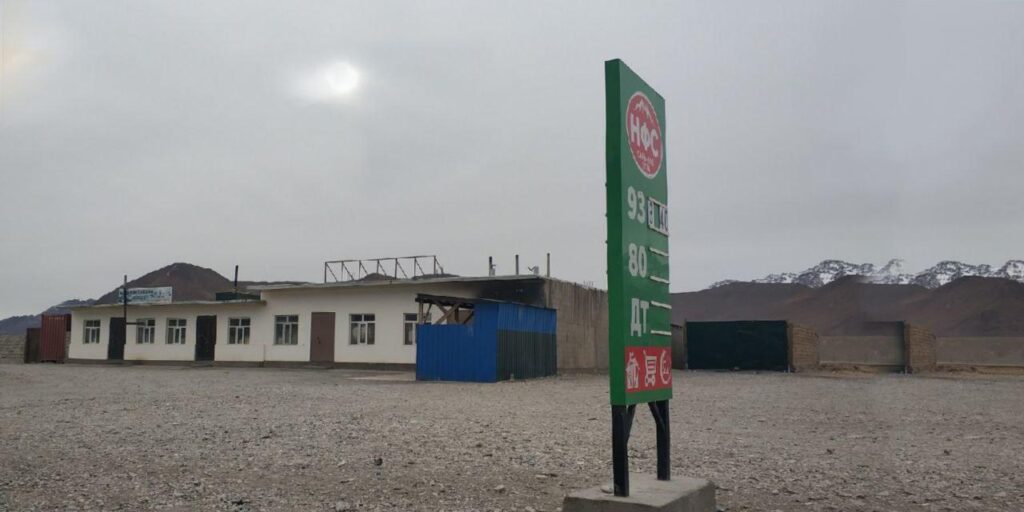
The heavy reliance on fuel imports from Russia is placing Central Asian countries in an increasingly precarious position. Disparities in pricing and exchange rates are driving a surge in illicit fuel resales, exacerbating supply challenges across the region.

Gasoline and diesel prices continue to climb, and shortages are being felt widely. This dependence on Russian supplies is particularly concerning following U.S. President Donald Trump’s ultimatum to Moscow: end the war in Ukraine within ten days or face 100% tariffs on countries trading oil and petroleum products with Russia. The tariffs could take effect as early as next week, placing Central Asian states in a hugely vulnerable position.

Kazakhstan: Shortages and Shadow Exports

In early July, motorists across Kazakhstan reported widespread shortages of AI-95 gasoline, particularly along the Karaganda-Balkhash and Astana-Pavlodar highways and in the country’s western regions. Some filling stations restricted purchases of AI-95 to 30 liters per vehicle, and AI-98 was only available via coupons. The Ministry of Energy attributed the shortages to increased tourist and transit traffic.

Price caps on gasoline were lifted in January 2025, after which they began to steadily rise. According to the Ministry of Energy, fuel in Kazakhstan remains significantly cheaper than in other Eurasian Economic Union (EAEU) member states, prompting the government to gradually align prices with the regional market. Forecasts suggest gasoline prices could rise by up to 50%, further fueling inflation and impacting all sectors of the economy.

The government argues that maintaining artificially low fuel prices would require substantial budget subsidies. The resulting price differentials have made illegal fuel exports more profitable, aggravating domestic shortages. To combat speculation, Kazakhstan imposed a ban in January on exporting gasoline and diesel by road and rail.

Despite the country’s ongoing efforts to expand domestic production, Kazakhstan is expected to import substantial volumes from Russia in 2025: 285,000 tons of motor gasoline, 300,000 tons of jet fuel, 450,000 tons of diesel, and 500,000 tons of bitumen. Experts caution that significant increases in domestic output may not materialize until 2030.

Russia’s decision on July 28 to tighten its gasoline export ban to include large producers is further complicating the situation. The embargo, introduced amid record-high exchange prices, is expected to last through August.

Nevertheless, Energy Minister Erlan Akkenzhenov insists the Russian export restrictions will not affect Kazakhstan, citing a standing intergovernmental agreement that exempts the country from such measures.

The Rise of Grey Market Schemes

Despite official reassurances, fuel prices continue to rise. Energy expert Olzhas Baidildinov warns of a growing shadow market, driven in part by the weakening of the Kazakh tenge against the Russian ruble. With the exchange rate at 6.6 tenge per ruble, the economic incentive for illicit exports from Kazakhstan remains strong. Baidildinov predicts further shortages by the autumn if this trend continues.

Kyrgyzstan: Growing Dependence

Kyrgyzstan, which has faced repeated fuel shortages in recent years, has seen prices rise sharply. Over the past decade, the cost of AI-92 has climbed by 52%, AI-95 by 57%, and diesel, used in agriculture and transport, by 66%.

Kyrgyz officials assert that Russia’s export embargo will not affect supplies, thanks to a duty-free agreement similar to Kazakhstan’s. According to the Association of Oil Traders, Russia is expected to supply Kyrgyzstan with 650,000 tons of gasoline and 550,000 tons of diesel in 2025, though this still falls short of the estimated annual demand of 1.5 million tons.

Uzbekistan: Skepticism and Shifting Supply

Uzbekistan has also signed agreements with Russia, which should protect it from the effects of Moscow’s export restrictions. However, economist Otabek Bakirov warns that smaller importers excluded from such agreements are exiting the market, allowing monopolies to exploit the situation by raising already-high prices.

A critical turning point is the planned discontinuation of AI-80 gasoline, which accounts for 80% of domestic consumption. Uzbekneftegaz intends to halt production of AI-80 by September 2025 and transition to higher-octane fuels. Although AI-80 is considered environmentally harmful and outdated, its phaseout may lead to additional price and supply pressures, given that Uzbekistan currently produces only a fraction of its fuel needs domestically.

Tajikistan and Turkmenistan: Chronic Shortages and Smuggling

Tajikistan remains heavily dependent on Russian fuel. In 2024, imports rose 14.3%, with over 524,000 tons of petroleum products and liquefied gas delivered from Russia.

Turkmenistan, meanwhile, is struggling with rampant fuel smuggling. Domestic fuel is significantly cheaper than in neighboring states, leading to theft and resale. Long lines at gas stations have become common, and local media report that some staff are charging up to 200% above official rates and pocketing the difference. Fuel meant for local consumption is reportedly being rerouted to Uzbekistan and Afghanistan.

Stark Choices

Regional governments now face a stark dilemma: raising fuel prices to curb smuggling risks social unrest, while maintaining subsidies threatens to deplete public finances amid slowing economic growth. Analysts warn that if U.S. tariffs are imposed and Russian exports remain constrained, Central Asia could experience a cascade of disruptions — persistent shortages, surging inflation, and a deepening reliance on shadow markets. Without swift investment in refining capacity and diversification of supply, the region may enter the winter of 2025 with its most severe fuel crisis in decades, forcing governments to choose between fiscal stability and political stability.


Russia Seeks to Boost Oil Transit to China via Kazakhstan

Russia has proposed increasing its oil transit to China through Kazakhstan’s Atasu-Alashankou pipeline by 2.5 million tons annually, Kazakhstan’s Energy Minister Yerlan Akkenzhenov announced at a recent government briefing.

The initiative was submitted by Russian pipeline operator Transneft and is currently under review by Kazakhstan-China Pipeline LLP, which oversees the Atasu-Alashankou route. The Kazakh operator is KazTransOil JSC, while the Chinese side is represented by CNODC (China National Oil and Gas Exploration and Development Corporation).

“Preliminary studies have begun. We expect to soon determine whether additional oil pumping stations are required or if the increased volume can be handled using specialized additives,” Akkenzhenov said.

The Atasu-Alashankou pipeline spans 965 kilometers and has a design capacity of 20 million tons per year. It facilitates the export of both Kazakh and Russian crude to China.

In 2024, roughly 10 million tons of Russian oil were transported through this route, generating an estimated $150 million in transit fees for Kazakhstan, calculated at $15 per ton.

If approved, the volume of Russian oil transported via this corridor could rise to 12.5 million tons annually.

Akkenzhenov also noted that Kazakhstan plans to expand oil exports via the Baku-Tbilisi-Ceyhan (BTC) pipeline. “Last year, we shipped approximately 1.4 million tons through the BTC. In 2025, we aim to increase this to 1.7 million tons. So far this year, about 800,000 tons have already been transported,” he said.

The BTC pipeline, with a design capacity of 50 million tons per year, currently accommodates a Kazakh quota of 1.5 million tons. In 2022, Azerbaijan expressed willingness to raise this quota to 2.2 million tons.

The prospect of increasing Kazakh oil flows through the BTC was also discussed during a bilateral meeting between President Kassym-Jomart Tokayev and Turkish President Recep Tayyip Erdoğan in Ankara.

Kyrgyzstan Introduces Meat Price Regulation Amid Export Surge

In response to rising domestic meat prices and increasing livestock exports, Kyrgyzstan has introduced state regulation of meat pricing. The directive was issued by Bakyt Torobaev, Minister of Water Resources, Agriculture, and Processing Industry.

According to the minister, the state will now monitor meat prices, track livestock movements, and impose restrictions on meat exports to neighboring countries. Torobaev also instructed the Antimonopoly Regulation Service (ARS) to maintain continuous oversight of price trends and conduct market analysis across the country. Ministry specialists are expected to carry out inspections and engage with vendors to prevent unjustified price hikes.

The Ministry of Agriculture stated that all relevant departments have been mobilized to implement the directive. Veterinary, livestock, and pasture authorities have been tasked with strengthening sanitary oversight of livestock transportation. These efforts will be coordinated with the Border Service to combat smuggling.

Unregulated livestock exports, particularly of native Kyrgyz sheep breeds, have long been a concern for authorities. Strong demand from neighboring countries has created domestic supply shortages, contributing to annual price increases of approximately 10%.

Uzbekistan remains the primary destination for Kyrgyz meat and livestock exports. In addition to meat products, Uzbekistan imports live sheep for breeding purposes. According to the National Statistical Committee, Kyrgyzstan exported 233,000 live goats and sheep valued at $23.5 million and 130,000 head of cattle worth $24.5 million to Uzbekistan in 2024.

Some of this livestock is subsequently transported from Uzbekistan to Tajikistan. The new price regulation measures are part of broader government efforts to ensure national food security and stabilize prices in the domestic market.

The First Kazakh Comic and Its Cultural Significance

In the early 20th century, educated Kazakh thinkers were known as Alash intellectuals. Disillusioned by the Russian Empire’s growing control over the Kazakh people, they sought to establish an independent Kazakh state and protect their nation from imperial oppression. Their political and cultural struggle laid the foundation for modern Kazakhstan’s independence.

The Alash Orda, a successor to the 19th-century Kazakh enlightenment movement, evolved into a more politically assertive and nationalist organization representing Kazakhs in southern Central Asia. Formed in March 1917 by prominent figures including Alikhan Bokeikhanuly, Akhmet Baitursynuly, Mirzhakyp Dulatuly, and Khalel Dosmukhameduly, the group participated in the Pan-Muslim Congress in Moscow that May. However, the congress, largely driven by Tatar leaders, failed to address Kazakh concerns, further alienating them. As a result, the Kazakhs withdrew from future congresses and focused on developing their own political structures. The Alash movement ultimately became the leading force guiding the Kazakh people during this turbulent era.

Zhusipbek Aimauytov with his daughter; image: alash.semeylib.kz

Zhusipbek Aimauytov, one of the prominent members of the Alash movement, authored important literary works such as Kartkózha, Akbilek, and Kúnékéýdiń jazyq dalasy. He was also a statesman and cultural figure who fell victim to Soviet repression, accused of nationalist sympathies. Arrested in 1929, he was sentenced to death in absentia in 1931. Despite his short life, Aimauytov left a lasting mark on Kazakh culture and literature. His writings consistently emphasized that national progress requires sacrifice, effort, and resistance against ignorance and injustice.

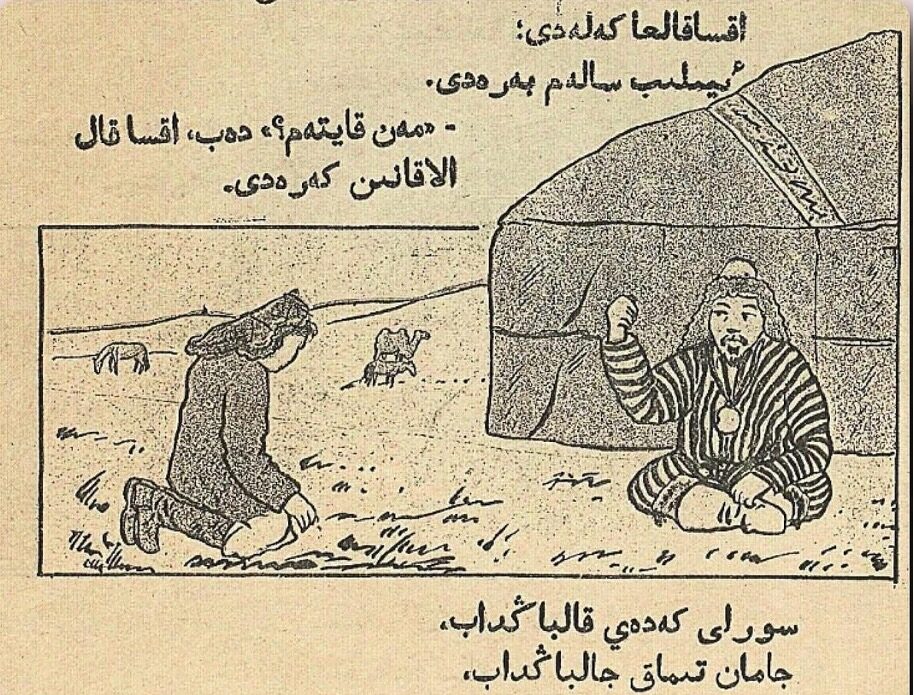
Cover page of Aimauytov`s comic book published in 1929

One of Aimauytov’s lesser-known yet significant contributions was the first Kazakh comic book, Ugly Headwear, which was written for children. Published in 1929 by the Kazidat publishing house, the work is composed in verse and meant to both entertain and educate young readers. The story explores timeless themes such as social injustice, class conflict, and moral reasoning.

The tale begins with a poor villager and his family — a frail wife and three strong sons. They own little: one brown horse and a single cow. When the village head visits and demands taxes, he takes the family’s only cow by force and beats the father. This dramatic opening immediately draws the reader in and sets the tone for the rest of the story, which critiques the social conditions of the time.

The motif of the marginalized challenging the dominant recurs across many world literatures. Known for addressing political and societal issues in his work, Aimauytov continues this in Ugly Headwear. The village leaders, religious figures, and even the wealthy refuse to help the poor man, claiming taxes are mandated by the Tsar and must be paid. Eventually, the desperate man turns to the Russian district chief, only to be humiliated and chased away.

In a symbolic scene, the man’s hat — the “ugly headwear” — becomes the central object of the story. It is lost, found by a dog, taken to a barn, and later discovered by someone who returns it to the Russian administration. When the Russian army collapses, the hat is “freed.” This metaphor serves as a powerful image: justice is restored, and oppression is reversed. As Aimauytov wrote:

Too many people crowded the street.
He was startled to spot the hat.
In an instant, all eyes were on it:
A Kazakh chasing the Russian troops.
Even his translator was seized.

In that moment, it seemed
the ugly hat brimmed with life.
Suddenly, it spun and glanced about,
then smacked itself and tumbled down.
That Russian officer got his beating
from the one who had made the poor man weep.

The last known photo of Aimauytov.

The final scenes of the story see crowds in the streets witnessing the fall of the Russian regime. The return of the hat to its owner, who once suffered under the same system, symbolizes the return of dignity and justice to the Kazakh people. It reflects the hope for a future in which all members of society are treated equally.

In essence, Zhusipbek Aimauytov created the first Kazakh comic nearly a century ago, during a period of severe political repression. Writing a socially critical, allegorical work during Soviet rule required exceptional courage. As a representative of the Alash movement, he remained committed to advancing Kazakh culture and education through literature. The Ugly Headwear stands as a testament to that mission — a small book with a powerful message and an enduring legacy.

What Will Kazakhstan Make of the Novorossiysk Constraint?

Russia’s July decree requiring FSB approval for foreign vessels entering Novorossiysk introduces a new procedural constraint into the regional export environment. Modest in scope, the measure nevertheless grants Moscow a latent mechanism for influencing Kazakhstan’s primary oil export route via the CPC pipeline, and by extension, its westward orientation. The CPC terminus, long treated as infrastructurally neutral, has been “recoded” as a site of discretionary oversight.

This development coincides with the gradual erosion of the energy governance model inaugurated by foreign concessions at Tengiz, Karachaganak, and Kashagan, where Production Sharing Agreements (PSAs) created juridical islands largely external to domestic legal and fiscal regimes. It is possible that a new phase is emerging whereby infrastructural flows are re-anchored in sovereign discretion, as an accumulation of procedural instruments favors regional currencies and reduces Western intermediation.

Kazakhstan’s energy model was built on upstream Western capital and downstream Russian transit. The fragility of that erstwhile equilibrium has now been revealed, even though the disrupter is not a single actor but a convergence of pressures. This dual-dependency now appears more vulnerable, unsettled by converging geopolitical and institutional pressures. The superficial continuity of physical infrastructure masks deeper shifts in logistical autonomy, fiscal sovereignty, and international alignment.

Structural Exposure and Strategic Compression

The fiscal layer exposes the shifts. Revenues from Western-operated concessions are routed into the National Fund, which reinvests them into foreign debt instruments, often issued by the same economies that operate Kazakhstan’s extractive infrastructure. Kazakhstan’s export of physical assets and reinvestment into external liabilities constitutes a structural contradiction. The state’s constitutional control over subsoil resources is not matched by operational authority.

The CPC pipeline, though formally multinational, is routed entirely through Russian territory. The new decree does not immediately alter its function, but it inserts a potential instrument of political leverage. The bargaining terrain has consequently already shifted: what was previously a matter of contractual detail is now entangled with external discretion. For the present, the decree’s practical impact is limited, but it reveals the current system’s embedded asymmetry.

Moscow’s move signals a readiness to formalize political leverage. It lays the groundwork for a possible reconfiguration of Eurasian energy flows under post-conflict conditions. In this vision, transactions would be conducted through sovereign institutions, denominated in rubles, tenge, or other regional currencies. The intent is clear: to reduce reliance on Western frameworks and to re-anchor Russia’s “peripheries” within its institutional orbit.

The maneuver unfolds within a broader context of strategic adjustment. Europe is searching for non-Russian energy inputs. Turkey is expanding corridor-based integration. China’s Belt and Road Initiative continues to institutionalize long-term infrastructural absorption. Kazakhstan has become a contested node within overlapping geopolitical networks that pull it in different vectorial directions.

Against this backdrop, the once legal-technical re-negotiations over Tengiz, Karachaganak, and Kashagan are situated within a tectonically shifting geopolitical matrix. Trans-Caspian connectors, digital corridors, and regulatory frameworks are coalescing into a new infrastructural logic. The decree has little practical effect for now, but it points to a deeper condition where sovereignty is declared but not yet enacted.

Yet this exposure, if it is not deflected or buried, can become the surface on which Kazakhstan begins to act — rather than react — within its own architecture.

This cannot be accomplished without risk. Investor sentiment remains fragile. All the known variables argue for caution: budgetary dependence on foreign-operated fields, legal vulnerabilities in existing agreements, and infrastructure routed through neighboring jurisdictions. Yet the juncture also makes basic readjustment possible. The question, if there is one, is not simply how to adapt, but how to shape what comes next.

Buffering and Rebalancing in the Near Term

In the near term, three possibilities present themselves. First, Kazakhstan can modestly increase export volumes via the Aktau–Baku maritime corridor, feeding into the Baku–Tbilisi–Ceyhan (BTC) pipeline. This westward route provides some diversification, though its utility is bounded by throughput constraints, weather variability on the Caspian Sea, and high transport costs. It remains a redundancy mechanism rather than a primary conduit.

Second, Kazakhstan can activate provisional rail routes to Georgia or China, and engage in short-term oil swap deals with regional partners such as Uzbekistan. These are operationally complex and financially inefficient, but useful for short-term flexibility.

Third, contractual adjustments within the CPC framework may reduce exposure to procedural risk. Measures such as liability segmentation, export volume guarantees, or pre-clearance protocols can buffer volatility, though they do not address the underlying structural dependency.

The forthcoming renegotiations over Kazakhstan’s major oil fields offer an opportunity for cautious rebalancing. Revisions to local content rules, taxation structures, and dispute resolution mechanisms could incrementally restore state influence, provided they are framed to maintain commercial confidence. Concurrently, a portion of National Fund assets might be reallocated from Western debt instruments to domestic infrastructure or regional financial instruments, improving capital retention while preserving macroeconomic stability.

Realigning in the Medium Term

Over the medium term, the agenda must expand from mitigation to structural repositioning. The most consequential move would be to co-develop a scalable Trans-Caspian energy corridor via a sub-sea pipeline or expanded maritime capacity. This would require significant capital investment and multilateral diplomacy, but it offers the only realistic vector for shifting Kazakhstan’s energy flows away from Russian territory.

Domestically, investment in refining and storage infrastructure would reduce Kazakhstan’s reliance on pipeline-based crude exports. Such an investment would enable more flexible trade in processed fuels, and it would also support industrial development.

Geopolitically, Kazakhstan can deepen its trilateral coordination with Turkey and Azerbaijan through joint corridor development, digital trade integration, and regulatory convergence. Simultaneously, it must increase the institutional firmness driving its role within China’s Belt and Road Initiative (BRI). In particular, it must ensure that the latter’s infrastructure presence is matched by oversight, co-financing, and mechanisms to prevent passive absorption.

Finally, in new resource projects, Kazakhstan may consider evolving its frameworks beyond full concessions toward joint ventures or equity-sharing models. Such a shift would preserve technical partnerships while enhancing domestic control over revenue and governance. To enable this, Kazakhstan must cultivate development banks, long-term investment funds, and pension vehicles that would be able to absorb and recirculate national capital within its own economy.

Coda

By itself, the Novorossiysk decree does not remake the system, but it allows the observer to see what has already begun to shift. It clarifies the asymmetries already in play in Kazakhstan’s geoeconomic position, and it underscores the urgency of a systemic response. The decree does not so much act as an immediate threat as it activates a diagnostic prompt. What matters now is not the decree itself, but how Kazakhstan uses this newly clarified strategic visibility to reconsider the terms on which its sovereignty is exercised, structured, and sustained.

The View From Ankara – President Tokayev’s Working Visit to Turkey

The official visit of President of Kazakhstan Kassym-Jomart Tokayev to Turkey on July 29, 2025, carries a multidimensional and strategic significance that extends far beyond the boundaries of diplomatic protocol. This engagement stands out as part of an ongoing multidimensional process of transformation marked by deepening regional alliances in the fields of science, energy, and logistics. Invited by President Recep Tayyip Erdoğan, Tokayev co-chaired the fifth meeting of the Turkey-Kazakhstan High-Level Strategic Cooperation Council. As a result of this summit, 20 bilateral agreements were signed, encompassing new frameworks of regional integration, especially in the fields of mining, energy, transportation, and higher education.

Energy Diplomacy and Resource Geopolitics

One of the most striking dimensions of the visit was the negotiation of new cooperation mechanisms aimed at transporting Kazakh oil to global markets via Turkey. According to President Tokayev, currently 1.4 million tons of Kazakh oil are transported annually through the Baku–Tbilisi–Ceyhan pipeline. Under the newly signed memoranda of understanding, the parties aim to increase this volume. This development not only strengthens Turkey’s ambition to become a regional energy hub but also holds critical importance for Kazakhstan’s strategy to diversify export routes and secure access to safe ports. Furthermore, the expressed intent of Turkish Petroleum Corporation (TPAO) to operate in Kazakhstan signals that the collaboration may extend beyond transport into production processes as well.

Kazakhstan’s reserves of rare earth elements and strategic minerals are of considerable value to both European and Asian economies prioritizing green energy transitions. In this context, the agreements signed in the mining sector may herald a new phase — one that mandates not only commercial but also technological and scientific R&D collaborations.

Strategic Dimensions of the Middle Corridor

Another key agenda item during the visit was the development and activation of the Trans-Caspian International Transport Route, commonly referred to as the ‘Middle Corridor.’ According to data shared by Tokayev, approximately 85% of road freight transported between China and Europe passes through Kazakhstan. This positions Kazakhstan as the backbone of the region’s logistics infrastructure. Turkey’s central role in the Middle Corridor makes it a decisive actor in the route’s integration with Europe. In this regard, Kazakhstan’s efforts to modernize its rail and road infrastructure, alongside its revival of maritime transport on the Caspian Sea, when combined with Turkey’s port capacity and transportation infrastructure, offer significant synergistic potential. These developments also underscore the strategic importance of the Zangezur Corridor and reinforce the value of uninterrupted transportation from China to Europe via Turkey, bypassing the Iranian route.

Education and Academic Diplomacy

The visit also drew attention for its scientific and cultural dimensions, in addition to its economic focus. Joint initiatives such as Gazi University’s planned establishment of a branch within the South Kazakhstan Pedagogical University can contribute to aligning the Turkish higher education model with Kazakhstan’s ongoing education reforms.

Moreover, the Turkish Maarif Foundation’s new school initiatives in Kazakhstan signify a broadening and institutionalization of bilateral cooperation in education. These efforts may extend beyond student exchange programs to encompass joint research projects, health technologies, distance education systems, and academic mobility, laying the groundwork for a multifaceted partnership.

Rising Investment Intensity

Bilateral economic relations have gained significant momentum – the trade volume between the two countries has reached $5 billion. Kazakh investments in Turkey amount to approximately $1.5 billion, while Turkish investments in Kazakhstan are nearing $5 billion. According to President Tokayev, around 4,000 Turkish companies are currently operating in Kazakhstan, having undertaken projects worth a total of $6 billion. The involvement of these companies in sectors such as energy, construction, agriculture, industry, infrastructure, and healthcare illustrates Turkey’s capacity to transfer its development experience to the region.

A Multi-Layered Partnership Model

The comprehensive cooperation platform established along the axes of energy, transportation, education, and science during the Tokayev-Erdoğan summit could, if institutionalized within a strategic framework, significantly contribute to realizing the two countries’ shared goal of reaching a bilateral trade volume of $15 billion.

As part of the visit, President Erdoğan awarded President Tokayev the State Order of the Republic of Turkey — an act that symbolizes the deepening of bilateral relations not merely on the basis of strategic interests but also through a shared sense of fraternal affinity, thereby adding a distinct and positive momentum to the partnership.