How The New York Times Came to Publish an Obituary for Kazakh writer Mukhtar Auezov

While browsing old issues of The New York Times, we wondered: “Is there anything here about the Kazakhs or Kazakhstan?” One edition stood out, the June 28, 1961 issue. On page 35, alongside obituaries for several prominent figures, was one for our great writer, Mukhtar Auezov.

“Winner of Lenin Prize in 1959 for 2-Volume Work Dies Mukhtar O. Auezov, the Kazakh poet and philosopher whose two-novel work, ‘Abai’ and ‘The Road of Abai,’ earned a Lenin Prize two years ago, died yesterday in Alma-Ata.”
The article went on to note that Mukhtar Auezov was born and raised in the Shyngystau region (known today as the Abai District), and later wrote a major work about the life of Abai. It also mentioned that he studied at Leningrad University and authored numerous literary works. In 1960, Auezov visited several U.S. states as part of a Soviet writers’ delegation. Upon returning home, he expressed in interviews his admiration for the towering skyscrapers of New York City.
What pleased us even more was that The New York Times included a photograph of Auezov alongside the obituary. This shows that even in the 1960s, American literary circles recognized and took notice of a Kazakh writer. In other words, Auezov left a lasting impression on the American public. Other articles about him may have appeared in the U.S. press, but so far this obituary is the only one we have been able to find.
Mukhtar Omarkhanuli Auezov holds the distinction of being the first known Kazakh writer to set foot on American soil. His official visit was well covered by the U.S. press and known to the American public at the time. This likely explains why such a major publication honored him with a dedicated obituary, informing readers around the world of his passing. The gesture reflects a significant level of respect and recognition.
Mukhtar Auezov indeed visited the United States from February 17 to March 17, 1960, as part of a delegation of Soviet writers. This trip was part of the “Agreement Between the United States of America and the Union of Soviet Socialist Republics on Exchanges in the Cultural, Technical, and Educational Fields.” According to the agreement, four American writers visited the USSR in 1959, and in return, a Soviet delegation traveled to the U.S. in February/March 1960.
To give readers a closer look at his journey, we are sharing excerpts from Mukhtar Auezov’s diary, where he reflects on the trip. The entries were later published in a bilingual edition, Mukhtar Auezov: Impressions of America, in 2021, in both Kazakh and English.

Below are a few details from Auezov’s impressions of the U.S.:
That day we toured Washington, D.C. It’s a very beautiful city. No two houses look alike. Even the cars are all different, though there are many, they never repeat.
We visited the old part of the city, the area known as ‘Georgetown.’ All the houses here are old, yet highly stylish, elegant two-story homes. There is one house built in 1762, which they showed us.
After having lunch, we departed. The train station is large, though there’s only one. We boarded a train to New York. The cars are long, the floors carpeted, and all the seats are armchairs — thirty chairs arranged around a central rotating column. The entire train is like this. This is first class. In the third class, the chairs are in pairs. There’s a restaurant and a café-bar on board. The train was delayed because of the high number of passengers — it was Friday, and Saturday is a day off here, as is Sunday. Many people were traveling to New York. After four hours, we arrived late at night. We checked into the ‘Barbizon Plaza Hotel.’ The rooms are small but cozy. We’re on the 18th floor.
February 19
The Shakespeare Library – this is the largest library in the world. The director gave us a tour. We have a schedule here. We pay our own expenses for tours and research visits. There are many sources on British history from the 16th to the 12th centuries. We assist scholars. This theater represents a Shakespeare-era playhouse. It’s a replica of Shakespeare’s own theater (the stage has two levels, with curtains). Two-level stage, three rows of balconies with divan-style seating. The theater is a copy of the original Shakespeare theater. In the past, there were no roofs, no seats. The trap doors are long – actors would descend and shout from below; there were no curtains. This current theater was built in 1932.

Auezov in the U.S. with a Russian writer delegation; photo: abaicenter.org
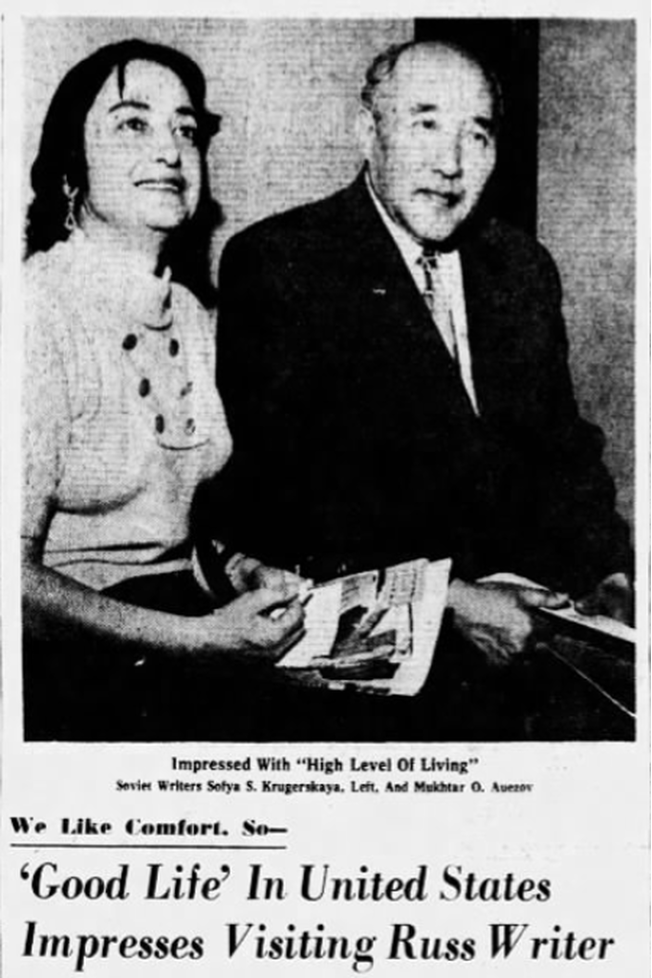
Mukhtar Auezov in the American press; photo: abaicenter.org