• KGS/USD = 0.01144 0%
  • KZT/USD = 0.00210 0%
  • TJS/USD = 0.10438 0%
  • UZS/USD = 0.00008 0%
  • TMT/USD = 0.28490 0%
  • KGS/USD = 0.01144 0%
  • KZT/USD = 0.00210 0%
  • TJS/USD = 0.10438 0%
  • UZS/USD = 0.00008 0%
  • TMT/USD = 0.28490 0%
  • KGS/USD = 0.01144 0%
  • KZT/USD = 0.00210 0%
  • TJS/USD = 0.10438 0%
  • UZS/USD = 0.00008 0%
  • TMT/USD = 0.28490 0%
  • KGS/USD = 0.01144 0%
  • KZT/USD = 0.00210 0%
  • TJS/USD = 0.10438 0%
  • UZS/USD = 0.00008 0%
  • TMT/USD = 0.28490 0%
  • KGS/USD = 0.01144 0%
  • KZT/USD = 0.00210 0%
  • TJS/USD = 0.10438 0%
  • UZS/USD = 0.00008 0%
  • TMT/USD = 0.28490 0%
  • KGS/USD = 0.01144 0%
  • KZT/USD = 0.00210 0%
  • TJS/USD = 0.10438 0%
  • UZS/USD = 0.00008 0%
  • TMT/USD = 0.28490 0%
  • KGS/USD = 0.01144 0%
  • KZT/USD = 0.00210 0%
  • TJS/USD = 0.10438 0%
  • UZS/USD = 0.00008 0%
  • TMT/USD = 0.28490 0%
  • KGS/USD = 0.01144 0%
  • KZT/USD = 0.00210 0%
  • TJS/USD = 0.10438 0%
  • UZS/USD = 0.00008 0%
  • TMT/USD = 0.28490 0%

Kazakhstan Factories Under Strain as Costs Bite, Economy Shows Mixed Signals

Kazakhstan’s manufacturing sector slipped further in August, with the latest Purchasing Managers’ Index (PMI) falling to 47.9. That was down from 49.9 in July and 49.7 in June, keeping the index below the neutral 50 mark for a third straight month. It also marked the sharpest deterioration in manufacturing activity since March 2022, according to S&P Global and Freedom Holding Corp.

From Highs to Lows

The striking downturn comes on the heels of a banner year. In December 2024, the PMI reached a record 53.9, capping 11 straight months of expansion. Buoyed by post-pandemic recovery and government support, manufacturing output grew by 6.8% in 2024, the fastest pace since 2011, helping push GDP growth to 5%.

But momentum cooled as 2025 began. The PMI slipped to 51.5 in January, reflecting slower expansion after the year-end surge. By June and July, it hovered just under 50, signaling stagnation. Seasonal shutdowns for repairs in August contributed to weaker output, but analysts say the slide points to deeper structural pressures.
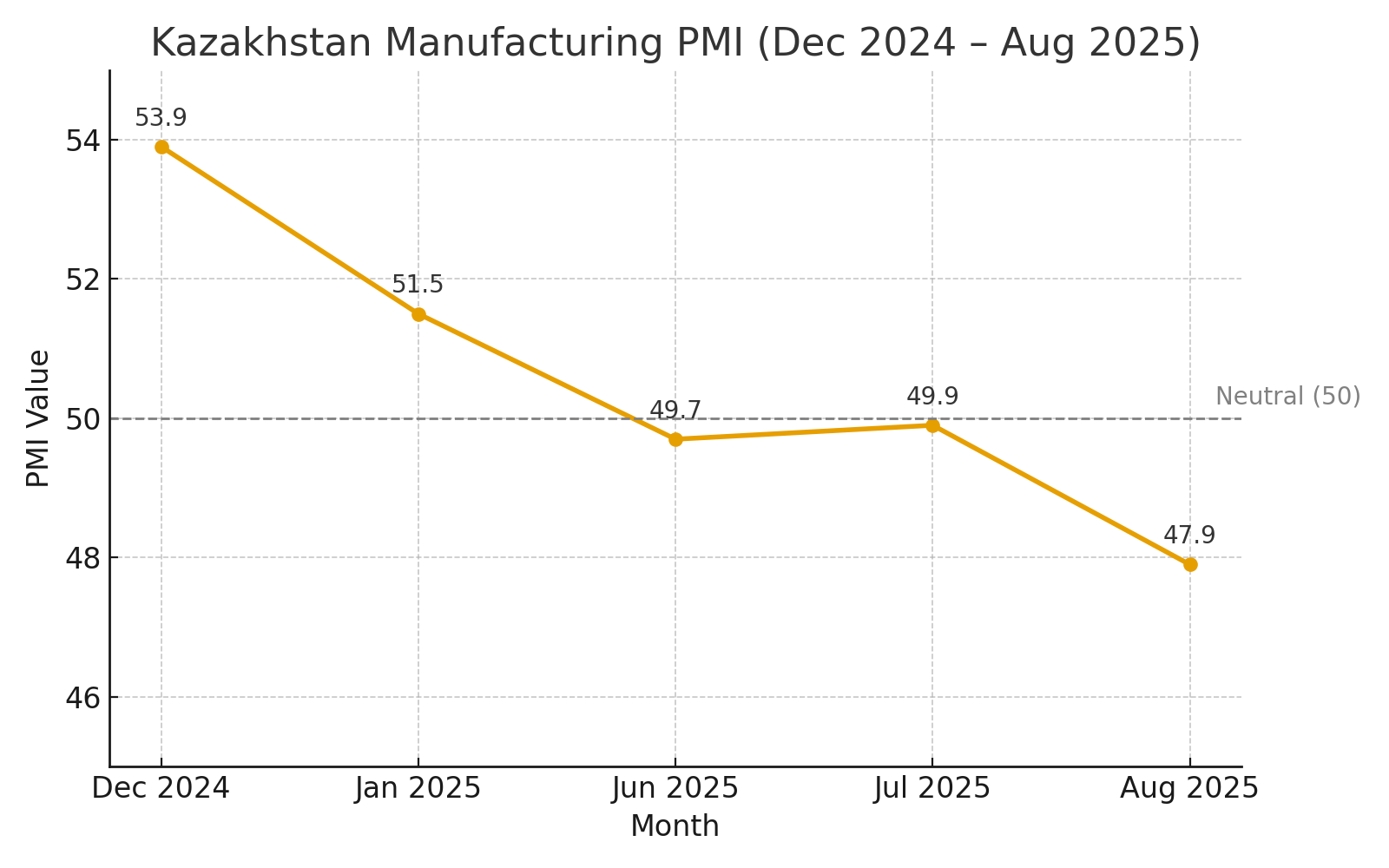
Kazakhstan’s PMI peaked at 53.9 in December 2024 but slid steadily through 2025, falling into contraction territory below 50 by mid-year and hitting 47.9 in August — the sharpest deterioration since March 2022.

Orders Dry Up, Costs Rise

The August report revealed broad-based weaknesses. New orders fell for the first time in 19 months, ending a growth streak that began in early 2024. The decline reflected lower demand from both domestic and export markets. With fewer orders, factories scaled back staffing and cut input purchases.

At the same time, costs surged. A weak tenge and fuel inflation made imports more expensive, while logistics delays lengthened supplier delivery times. These pressures forced firms to raise output prices at a faster pace, risking competitiveness.

“August saw another sharp decline in business activity in Kazakhstan’s manufacturing sector,” said Yerlan Abdikarimov of Freedom Finance Global, which partners with S&P on the survey. He cited weak demand, volatile commodity markets, rising costs, and currency and tax pressures.

Taxes have indeed become a burden. A new code passed in mid-2025 raised the extraction royalties on metals, hitting downstream metallurgy. Inflation stood at 12.2% in August 2025, with the National Bank keeping its policy rate high at 16.5% in a bid to tame prices. That leaves financing costly for businesses, resulting in squeezed margins and thinning confidence. The August survey showed business confidence at its lowest since 2021. While firms still expect growth over the next year, their optimism is increasingly cautious.

Industry Responses and Government Initiatives

Some executives see hope in the government’s industrial policy. A $400 million cotton-to-textile cluster is under construction with Chinese partners in Turkestan, aiming to process domestic cotton into textiles at scale. Officials say the project, due to start production by late 2025, will create thousands of jobs and expand exports. Light industries, such as textiles and apparel, posted strong growth in the first half of 2025, with clothing up about 5.6% and textiles 5.7% according to official data. Chemicals and construction materials also expanded, though these gains risk being overshadowed if the overall PMI remains in contraction.

In the meantime, many companies appear to be conserving cash and pushing for reforms such as tax relief or export incentives. The government has emphasized macro stability while promoting diversification projects, a balancing act that may not provide immediate relief.

Regional Comparisons

Kazakhstan’s struggles stand out in the region. Uzbekistan reported its industrial sector grew by about 6.5% in the first quarter of 2025, as overall GDP rose 6.8% year-on-year, while forecasts for the year remain firm at around 6.5–6.7% growth. Construction, services, and exports have been expanding, with the Center for Economic Research and Reforms reporting that Uzbekistan’s Business Activity Index jumped 15.9% in July 2025 and a further 2.9% in August, indicating sustained momentum.

Kyrgyzstan has also reported robust growth, with its composite business-activity index rising to 60.9 in spring 2025, powered by strong performances in agriculture, trade, and services. While not a pure manufacturing PMI, the index signals broad economic momentum and underscores the contrast with Kazakhstan’s manufacturing downturn.
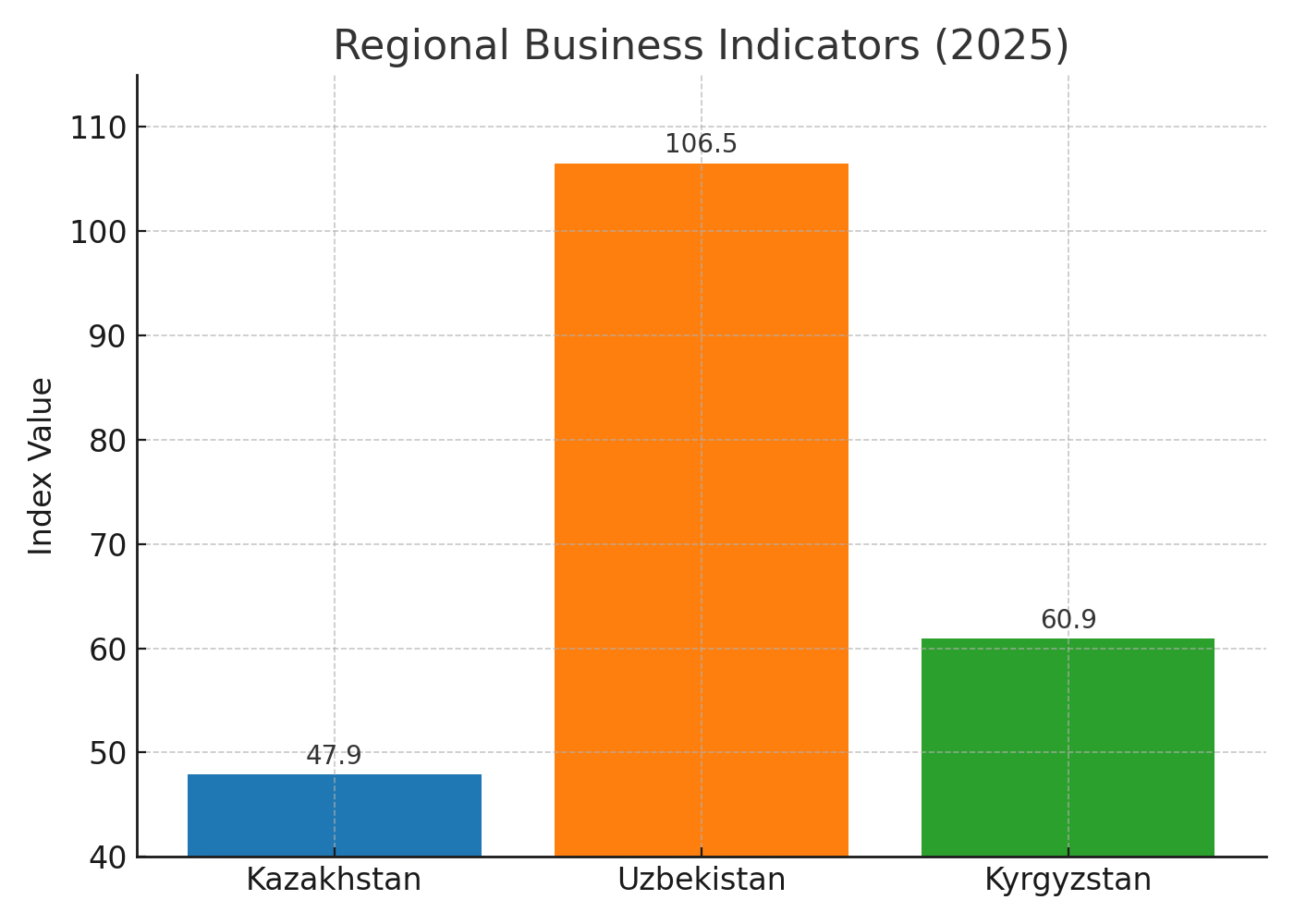
Kazakhstan’s PMI of 47.9 contrasts with Uzbekistan’s 6.5% industrial growth index (106.5) and Kyrgyzstan’s business activity index of 60.9, highlighting the country’s relative slowdown compared with its Central Asian neighbors.

The difference lies partly in structure. Kazakhstan’s manufacturing is heavily tied to metals and heavy industry, leaving it vulnerable to global price swings and taxes, while its neighbors benefit from more diversified or service-led growth. This structural gap means that while Kazakhstan’s factories are exposed to volatility in commodities; over half of its exports are oil-based, while its neighbors are seeing growth driven more by services, construction, and manufacturing, which smooths out external shocks.

Outlook: Balancing Risk and Opportunity

The International Monetary Fund projects Kazakhstan’s GDP growth at 4.9% in 2025, backed by strong mining and industrial output. Government plans include implementing 190 new industrial projects in 2025 worth about 1.5 trillion tenge ($2.78 billion) and expected to create more than 23,000 permanent jobs, with dozens already launched in metallurgy, chemicals, and special economic zones. Services and construction also remain resilient, helping to offset pressure in manufacturing. External conditions may provide some relief: global commodity prices have steadied, and the tenge regained ground in early September. A rebound in Russian or Chinese demand could also support factory orders.

Despite weak PMI readings, recent macro data paints a more nuanced picture. Industrial output expanded by 6.9% in the first seven months of 2025, driven by mining and manufacturing. Mining expanded 8.5% in the first seven months of 2025, though there are indications that growth could moderate later in the year. Overall GDP grew by 6.5% through the first eight months of 2025, supported by trade, industry, construction, and services. At a policy level, the government has introduced a Register of State Support Measures with over 100 tools to assist businesses, while reforms to special economic zones and new investments in rare-earth production reflect efforts to diversify and add value.

Significant risks remain, however. Persistently high inflation could keep borrowing costs elevated, limiting investment, while any downturn in global markets would weigh on exports. Analysts caution that recovery will depend on stabilizing the macroeconomic environment and ensuring that planned projects move from blueprints to production.

For now, the August PMI data serves as a wake-up call. A sector that was expanding just months ago is now under pressure from weaker demand, rising costs, and tighter financing. Kazakhstan’s path forward will depend on whether policymakers can restore stability while accelerating diversification, turning long-term industrial plans into real output gains.


Kyrgyz Energy Ministry Rejects Concerns About Seismic Safety of Future Kambarata-1 HPP

The Kyrgyz Ministry of Energy has dismissed concerns raised by leading seismologists about the seismic safety of the planned Kambarata-1 Hydropower Plant (HPP), a flagship regional energy project jointly backed by Kyrgyzstan, Kazakhstan, and Uzbekistan.

Speaking at a parliamentary committee meeting on September 9, Kanatbek Abdrakhmatov, President of Kyrgyzstan’s National Academy of Sciences and Director of the Institute of Seismology, warned that the future dam may be vulnerable to strong earthquakes due to its proposed location.

Seismic Warnings from Scientists

“The dam is planned in a dangerous area, surrounded by mountains,” Abdrakhmatov said. “It may not withstand a powerful earthquake.” He stressed that preliminary seismic micro-zoning studies had not been conducted and said his institute had written twice to the Ministry of Energy requesting such research, but received no response.

He warned that the destruction of Kambarata-1 in the event of a major earthquake could trigger cascading failures downstream, including at the existing Kambarata-2 HPP and other facilities.

Ministry and International Experts Respond

In a formal statement issued on September 10, the Ministry of Energy rejected the criticism and pointed to a recent review conducted by Swiss engineering consultancy AFRY, which is responsible for updating the feasibility study for the project.

According to the ministry, AFRY commissioned a team of international experts, including renowned dam safety specialists Dr. Martin Wieland and Dr. Stefan Ehlers, to carry out a comprehensive seismic analysis of the proposed site. The assessment used geological, tectonic, and seismic data, as well as satellite imagery and historical earthquake records.

The experts recommended constructing a curved gravity dam, which they said would improve both the structural stability and hydraulic performance of the plant. AFRY concluded that the dam would withstand projected seismic loads and stated that “its overall behavior in terms of load-bearing capacity is safe.”

Ongoing Safety Measures

The ministry also stated that further detailed safety studies are planned. These include the creation of a seismic micro-zoning map and the installation of three to five seismic monitoring stations at strategic points: along the dam’s axis, on both riverbanks, at the crest level, and upstream from the site.

The Kambarata-1 HPP is expected to become the largest hydropower facility in Kyrgyzstan. With a projected capacity of 1,860 megawatts and average annual generation of 5.6 billion kilowatt-hours, the $4 billion project is seen as a critical step in alleviating chronic electricity shortages in the country.

Construction Preparations Underway

The Ministry of Energy has reported steady progress in preparatory works. Infrastructure projects currently underway include the construction of access roads, power transmission lines, a substation, a bridge across the Naryn River, and a shift camp for construction workers.  

Central Asia’s Cotton Harvest: Between Reform, Coercion, and Economic Strain

The 2025 cotton harvest is underway across Central Asia, revealing the region’s ongoing struggle to reconcile long-promised reforms with persistent coercion and deepening economic pressure. Once the crown jewel of Soviet central planning, cotton, long dubbed “white gold”, remains a politically sensitive and economically vital crop from Turkmenistan to Tajikistan.

Turkmenistan: Forced Mobilization Persists

In Turkmenistan, mass mobilization for the cotton harvest continues largely unchanged. Chronicles of Turkmenistan reported that during a September cabinet meeting, President Serdar Berdimuhamedov ordered all regions to begin picking on September 10. Just two days earlier, the Ministry of Health had instructed medical institutions to send doctors, nurses, orderlies, and even technical staff to the fields, each assigned a daily quota of 45 kilograms.

In the town of Turkmenabat, hospital workers said doctors were expected to go to the fields immediately after overnight shifts. Those who refuse must hire substitutes at their own expense, paying about 50 manats ($14) per day. As a result, up to two-thirds of monthly salaries are spent covering these unofficial harvest duties. While younger staff are dispatched to the fields, older employees are left to maintain hospital operations with minimal support.

Uzbekistan: Reform, but Lingering Coercion

Uzbekistan, by contrast, has officially ended Soviet-style forced labor. The government abolished child and public-sector mobilization, scrapped state cotton quotas in 2020, and partnered with the International Labour Organization (ILO) to monitor the transition. In March 2022, the Cotton Campaign, a global coalition of rights groups, unions, and apparel brands, lifted its boycott of Uzbek cotton, citing the end of systemic forced labor. The campaign, which began in 2011, had gained the support of more than 330 global brands, including H&M and Zara.

Yet coercion has not entirely disappeared.

In a recent video published by Kun.uz, Dilfuza Tashmatova, deputy hokim (governor) for family and women’s affairs in the Surkhandarya region’s Sariosiyo district, was seen berating mahalla (local governance body) employees for failing to recruit enough pickers. She demanded that each “women’s activist” find five to ten additional laborers, totaling 150 people, and threatened dismissal for non-compliance. “Are you even a woman? Shameless! Unscrupulous! If you don’t want to work, then leave!” she shouted from a cotton field.

According to the U.S. Department of Agriculture, approximately 70% of Uzbekistan’s cotton is still harvested by hand, despite recent gains in mechanization. Labor shortages have plagued the past two harvests as fewer people are willing to take on the physically demanding work for low wages. Mahalla councils are often pressured to mobilize unemployed or low-income residents.

Following public backlash, Uzbekistan’s Ministry of Poverty Reduction and Employment fined Tashmatova 20.6 million UZS (about $1,660) under Article 51 of the Administrative Code, which prohibits forced labor.

From Soviet Monoculture to Market Reforms

Uzbekistan’s long history of forced cotton labor dates back to its designation as the Soviet Union’s cotton monoculture. For decades, students, teachers, and medical staff were sent into the fields to meet state quotas. After independence, the system endured until international scrutiny spurred reforms.

The ILO hailed the end of the boycott in 2022 as one of the most significant labor rights victories in recent history. Still, as the 2025 harvest reveals, dismantling deeply embedded systems of coercion remains an ongoing challenge.

Tajikistan: Cotton’s Harsh Economics

While Uzbekistan and Turkmenistan grapple with labor practices, Tajikistan faces a stark economic crisis in its cotton sector. As previously reported by The Times of Central Asia, farmers are being forced to sell raw cotton at 6-6.5 somoni ($0.66-0.72) per kilogram, well below the estimated production cost of 7-8 somoni ($0.77-0.88). Farmers say they need at least 10 somoni ($1.10) per kilogram to break even.

“If we don’t sell for at least 10 TJS, we will go bankrupt,” a grower in Khamadoni district told The Times of Central Asia, urging government intervention.

Production is in steep decline. Tajikistan harvested 404,700 tons in 2022, but only 253,200 tons in 2024, a nearly 40% drop. Heavy spring rains delayed planting by more than two months, pushing this year’s harvest into late September or even December. Labor shortages are also intensifying, as cotton picking pays just 1.5 somoni ($0.16) per kilogram, far less than wages in construction or labor migration abroad.

Despite these challenges, cotton remains a strategic export. Iran, Turkey, and China are Tajikistan’s main buyers, with Iran alone accounting for 68% of exports. The government has launched a 2040 strategy to revive the industry, promising subsidies, processing plants, and preferential loans. But for now, many of these plans remain unimplemented.

Experts warn that without meaningful reform, including access to export markets and modern agricultural equipment, Tajikistan’s cotton sector could collapse under the weight of outdated systems and unsustainable pricing.

Kazakhstan Sees Record Water Recovery in Northern Aral Sea

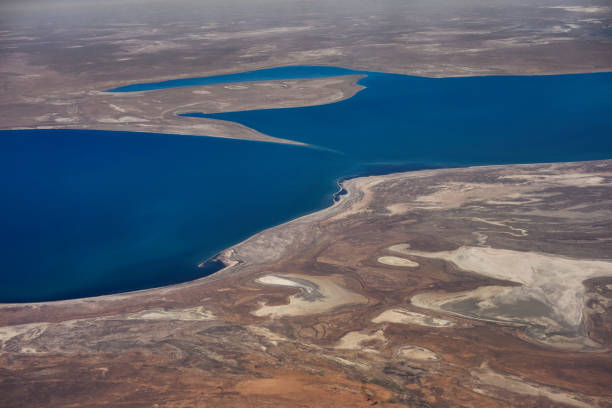
Kazakhstan’s Ministry of Water Resources and Irrigation has reported a record increase in the volume of water in the Northern Aral Sea, exceeding national and international expectations.

Water Returns to the Sea

Since 2023, approximately 5 billion cubic meters of water have flowed into the basin, bringing the total reserve to 24.1 billion cubic meters. This figure surpasses the target set under Kazakhstan’s Water Resources Management Concept, which had aimed for only 20.6 billion cubic meters by 2025. The current level was not expected to be reached before 2029.

Minister of Water Resources and Irrigation Nurzhan Nurzhigitov said that with the support of a World Bank grant, a feasibility study is underway to raise the Kokaral Dam by two meters and construct a new hydraulic facility. The project is designed to stabilize water levels in the Akshatau and Kamystybas lake systems.

“The project aims to increase both the volume and quality of water in the Northern Aral Sea, restore the Syr Darya delta, reduce salt dispersion from the exposed seabed, develop the fishing industry in the Kyzylorda region, and improve living conditions for local communities,” the minister stated.

International Cooperation

Deputy Minister Nurlan Aldamzharov has said the second phase of the initiative envisions raising the Northern Aral’s capacity to 35 cubic kilometers. He emphasized the critical role of regional cooperation, particularly with Kyrgyzstan, Tajikistan, and Uzbekistan, as the sea’s recovery depends on sustained inflows from the Syr Darya River.

Ministry spokesperson Moldir Abdualyeva attributed the recent progress to “water diplomacy, effective resource allocation, and conservation efforts.”

Environmental and Social Impact

The increase in water volume has led to a corresponding expansion of the sea’s surface area. As of February 2025, the Northern Aral covered 3,065 square kilometers, an increase of 111 square kilometers over the past three years. This has reduced salinity levels and enabled the return of 22 fish species to the ecosystem. The annual fish catch now totals around 8,000 tons, offering renewed economic opportunities for local communities.

To further support the region, Kazakhstan has raised subsidies for farmers implementing water-saving technologies, increasing compensation rates from 50% to 80%. Officials say the measure is intended to conserve water while promoting sustainable agriculture in surrounding areas.

The Small Aral Sea, or Northern Aral, was formed in 1987 during the broader desiccation of the Aral Sea and preserved following the construction of the Kokaral Dam. In 2012, it was added, alongside the Syr Darya delta, to the Ramsar List of Wetlands of International Importance.

Kazakhstan assumed the rotating chairmanship of the International Fund for Saving the Aral Sea (IFAS) in 2024, further strengthening its leadership role in regional water cooperation and ecosystem restoration.

Melting Glaciers Threaten Tajik Agriculture

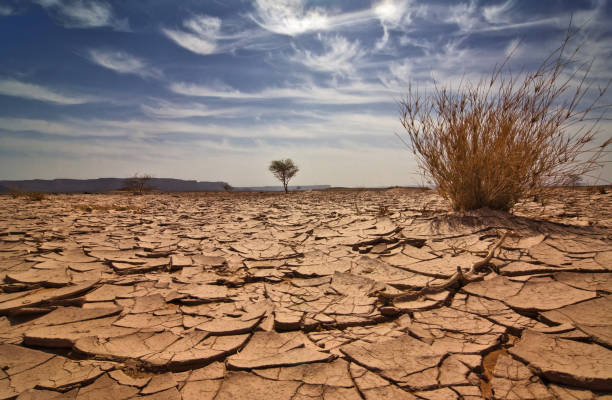
Climate change in Tajikistan is no longer a future concern, it is an immediate crisis. Farmers across the country are grappling with the effects of melting glaciers, prolonged heatwaves, and dust storms that are disrupting traditional agricultural cycles.

In Vahdat district, the Usto Murod farm has adopted a dual-harvest strategy to mitigate risk. “If one crop fails, the second helps cover the costs,” says farmer Galatmo Alieva. But increasingly rapid glacier melt has doubled irrigation needs from three rounds per season to six. Heatwaves and dust storms have further damaged crops, while honey yields have plummeted from 25 kilograms per hive to just five.

To cope, Alieva’s family installed a biogas plant with support from the United Nations Development Programme (UNDP), saving between $550 and $1,100 annually. However, broader adaptation measures remain financially out of reach. Loan interest rates hover around 31%, and water-efficient drip irrigation is used only in greenhouses.

Unequal Access, Dwindling Resources

Other farmers face even harsher realities. Rain-fed plots deliver meager returns, pastures are drying up, and water distribution remains inequitable. “Those at the canal head take all the water,” laments farmer Bakhtiyor.

Engineer Alexander Pirov warns that accelerating glacier melt threatens not only agriculture but also the country’s hydropower sector. By 2080, Tajikistan is expected to experience 12 additional days per year with temperatures exceeding 40°C, compared to the 1986-2005 average.

Already, 70% of Tajikistan’s arable land is considered degraded.

High Costs, Limited Support

Water-saving technologies could significantly improve crop yields and farmer incomes, yet the upfront costs, estimated at $5,000 or more, remain prohibitive for most rural families.

As climate risks intensify, Tajikistan’s rural population is increasingly vulnerable. Without targeted investments in adaptation, infrastructure, and equitable resource distribution, the country’s agricultural backbone may begin to fracture under the weight of a rapidly changing environment.

Kazakhstan Labor Ministry Increases Pressure on Employers Paying “Gray” Salaries

Kazakhstan’s Ministry of Labor and Social Protection has drafted legislation aimed at eliminating the widespread practice of paying employees off the books, known locally as “gray” salaries, Minister Svetlana Zhakupova announced this week.

According to ministry estimates published earlier this summer, approximately 30% of Kazakhstan’s employed population fails to contribute to the Unified Accumulative Pension Fund (UAPF), a clear indicator that they may be receiving unreported wages.

Data from the Bureau of National Statistics shows that in the second quarter of 2025, 9.3 million people were employed across the country. Of these, 7.1 million were salaried employees (76.8%) and 2.2 million were self-employed (23.2%).

This suggests that more than 3 million workers may be receiving wages outside the official system, avoiding both income tax and social contributions.

Targeting the Shadow Economy

The ministry plans to focus first on those who make no contributions at all. “We have cases where highly qualified employees officially receive the minimum wage of 85,000 KZT (about $159),” Zhakupova said. “To avoid taxes, employers declare the minimum wage on paper and pay the rest in cash.”

This practice, she added, creates striking wage disparities among employees with the same qualifications and roles. “In some instances, workers in identical positions earn between 229,000 KZT ($426) and 1.2 million KZT ($2,200), depending on the employer,” Zhakupova noted. These discrepancies are particularly acute in Kazakhstan’s mining and metallurgical sector.

Digital Oversight and Industry Agreements

To address the issue, the ministry is negotiating industry-wide wage agreements and requiring companies to declare their staffing structures. A digital tool for this purpose is available on the enbek.kz platform.

“About 20 to 25 major organizations, including several under our jurisdiction, have already submitted their staffing schedules in a pilot project,” said Zhakupova.

She believes the initiative will help ensure a more equitable distribution of company profits. “We’ve seen cases where salaries have risen, yet labor productivity has not. That contradicts basic economic logic. Our digital system identifies such ‘red zones’ for inspection,” she explained.

Legislative Timeline

The draft law is currently under interagency review and has received support from both the government and the presidential administration. It is expected to be submitted to Kazakhstan’s parliament, the Mazhilis, for consideration in the near future.

In the meantime, the ministry has begun flagging suspicious labor contracts, particularly those listing highly skilled workers, such as mechanical engineers, at or near the minimum wage.

More than 1.1 million people in Kazakhstan currently earn wages at or below the legal minimum. “When we see such contracts, it’s clear these companies are operating in the shadow economy,” Zhakupova said during a recent government briefing. “Inspectors are now actively working with such employers.”

As The Times of Central Asia previously reported, the government has also decided to freeze the minimum wage in 2026, despite earlier pledges to raise it.