• KGS/USD = 0.01144 0%
  • KZT/USD = 0.00196 -0%
  • TJS/USD = 0.10904 0%
  • UZS/USD = 0.00008 0%
  • TMT/USD = 0.28490 0%
  • KGS/USD = 0.01144 0%
  • KZT/USD = 0.00196 -0%
  • TJS/USD = 0.10904 0%
  • UZS/USD = 0.00008 0%
  • TMT/USD = 0.28490 0%
  • KGS/USD = 0.01144 0%
  • KZT/USD = 0.00196 -0%
  • TJS/USD = 0.10904 0%
  • UZS/USD = 0.00008 0%
  • TMT/USD = 0.28490 0%
  • KGS/USD = 0.01144 0%
  • KZT/USD = 0.00196 -0%
  • TJS/USD = 0.10904 0%
  • UZS/USD = 0.00008 0%
  • TMT/USD = 0.28490 0%
  • KGS/USD = 0.01144 0%
  • KZT/USD = 0.00196 -0%
  • TJS/USD = 0.10904 0%
  • UZS/USD = 0.00008 0%
  • TMT/USD = 0.28490 0%
  • KGS/USD = 0.01144 0%
  • KZT/USD = 0.00196 -0%
  • TJS/USD = 0.10904 0%
  • UZS/USD = 0.00008 0%
  • TMT/USD = 0.28490 0%
  • KGS/USD = 0.01144 0%
  • KZT/USD = 0.00196 -0%
  • TJS/USD = 0.10904 0%
  • UZS/USD = 0.00008 0%
  • TMT/USD = 0.28490 0%
  • KGS/USD = 0.01144 0%
  • KZT/USD = 0.00196 -0%
  • TJS/USD = 0.10904 0%
  • UZS/USD = 0.00008 0%
  • TMT/USD = 0.28490 0%
08 December 2025

Fast Now, Feast Later: The Culinary Traditions of Ramadan in Uzbekistan

You hear the darkness before you see it. As the late winter sky pales over Tashkent, the noise of thousands of motorbike engines, bicycle bells, and apartment buzzers mounts to a crescendo.

Those who haven’t ordered in battle their way past the onrushing delivery drivers towards the nearest restaurant. At Xadra, in the city’s Chilonzor district, tables fill rapidly. Dates, walnuts, sweetened milk, and bottles of water await their parched and starved customers. Many eye their watches carefully, waiting for the moment, at precisely 18.17, when they can begin to eat.

Ramadan, or ramazon in Uzbek, is the ninth month of the Islamic calendar. From dawn until sunset, Muslims must refrain from eating, drinking, and other physical needs, only breaking their fast at sundown with a meal known as iftar.

Though one might imagine a month of fasting would see a lull in activity across Tashkent’s catering sector, on the contrary, Ramadan is a month that is very much about food.

Dates and milk are a traditional fast-breaking snack for starved stomachs; image: Joe Luc Barnes

The not-so-strict fast

While the vast majority of the population are Muslim, Uzbekistan is a secular country, and there are no laws requiring restaurants or bars to close during daylight hours. Nevertheless, “cafes and restaurants are definitely less crowded; they’re at no more than 30 or 40% capacity during the daytime,” said Saodat Umarova, an economic analyst at the Center for Progressive Reforms.

Shavkat, a kebab shop owner, observes a sharp decline in daytime custom. “I’m still open, but it’s certainly a more relaxed pace,” he said, pausing the film on his phone to talk to TCA. While a nearby university provides some business, his regular clients remain committed to their fasts.

When asked if he finds it difficult being around food when he himself is fasting, Shavkat says that he does not mind. “On the first day or two, it is difficult, but you get used to it. This year is not such a difficult year.”

He is referring to the season: in 2025, Ramadan began on March 1 and will end on March 30; the fasting period is a little over 12 hours, and the weather is mild. “When Ramadan falls in summer, you have long days, and it’s forty-degrees [104F], that’s when you really get tested.”

Corporate accommodation

The rhythm of business operations also shifts during the holy month. Oybek Shaykhov, Secretary General of the Uzbekistan-European Association for Economic Cooperation, tells TCA that while the economy doesn’t typically slow down, the nature of business meetings changes.

“Breakfasts, lunches, and dinners are central to the business community, and during Ramadan, these gatherings shift towards Iftar, which is more of a group engagement rather than bilateral discussions,” he said. “Many companies try to ease workloads for employees, particularly if Ramadan falls during the hotter months, to accommodate fasting”

Gulmira, a lawyer at a construction company, echoes this sentiment. “The only real difference is the lunch hour; everyone who is fasting works through it and then gets to go home early for iftar,” she said.

Regional Solemnity

Uzbekistan’s approach to Ramadan varies by region. In Tashkent, the city’s multicultural fabric means that not everyone fasts, leading to a more relaxed atmosphere. In contrast, the more conservative Ferghana Valley observes Ramadan with heightened seriousness.

“The eastern part of Uzbekistan seems to be more sensitive for religious rules and rituals,” said Umarova. “In this society, it’s more customary to fast. Sometimes, even young children might join their parents in fasting. Islam has a special meaning for the valley’s population, which makes people very connected and united; fasting is considered as something that makes your spirit stronger.”
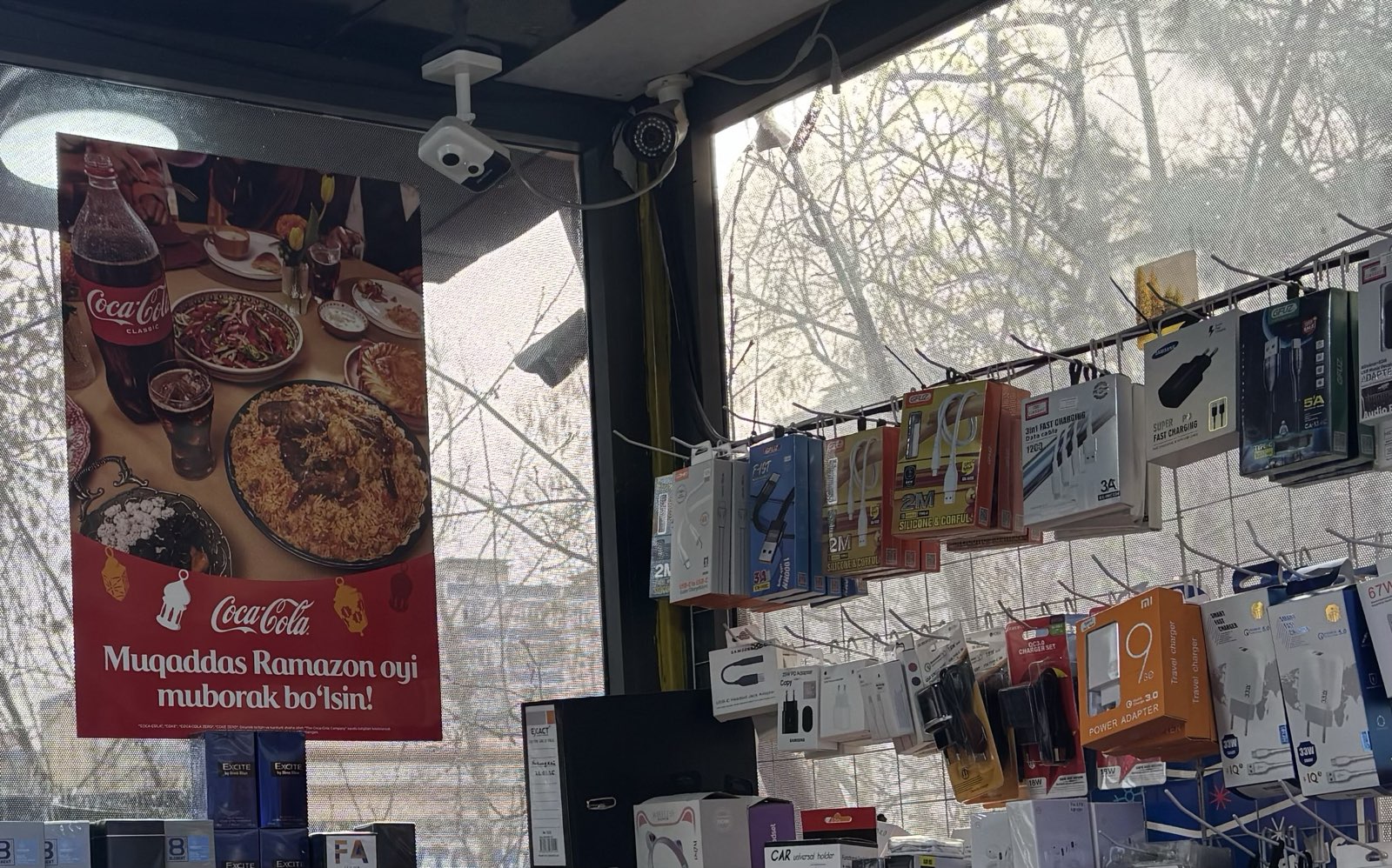
“Happy Holy Month of Ramadan!” – from Coca-Cola; image: Joe Luc Barnes

Creeping Commercialism

While restaurants’ daytime revenues may decline, business booms in the evening hours. Restaurants prepare special iftar menus, and some extend their hours to accommodate the influx of customers after sunset. Traditional Ramadan staples are ordered in especially: according to EastFruit analysts, up to 75% of the annual consumption of dates in Uzbekistan occurs during the holy month.

“People definitely appreciate their food more,” said Umarova, adding that it’s also a time for giving and enjoying food with friends, even when they are far away. “For example, my dad lives on the other side of the city, but I’ve ordered him a delivery for when he breaks his fast this evening. This is not something I do throughout the rest of the year!”

More controversially, the singular daily meal is often viewed as an excuse for lavish feasts. Indeed, under former president Islam Karimov, the government banned “ostentatious feasting” for iftar in 2010, and state employees were ordered not to attend communal dinners during Ramadan in 2013.

In 2016, Uzbekistan’s religious leadership told believers not to celebrate iftar meals, stressing that the feast should be to encourage empathy with the needy rather than an excuse for revelry. Uzbekistan is not alone in overindulging – in Egypt, a reported 60% of food goes to waste during Ramadan.

But cleric and mandarin alike are up against a powerful business lobby. As with religious festivals everywhere, Ramadan has become increasingly commercialized. Brands use it for marketing, recognizing that when people go without food all day, they are more likely to treat themselves in the evening.

Supermarket chain Korzinka gives out a Ramadan calendar along with your shopping, detailing the precise times of sahar and iftar, which drift further apart as the month progresses.

Meanwhile, the assistant at Gavalli Chocolates and Delights, a store selling Turkish baklava and other luxury treats, says that Ramadan is one of their busiest periods.

“We do a lot of extra business off people saying to themselves ‘I’ve earned that extra bit of luxury,’” he said.

Gavalli is not shy of going all out to associate itself with Ramadan. The store has been festooned with enough holy decorations to make a customer claustrophobic.

Gaudy Gavalli; image: Joe Luc Barnes

Festive Season

Adding to the bonanza are two other non-Islamic festivals that take place this month. The first, International Women’s Day on March 8, an historically important day across many former Communist states, sees restaurants booked up weeks in advance. The Embar restaurant in Tashkent’s Intercontinental Hotel is offering a Women’s Day set menu; given the demand, it is making customers pay over a million som ($77) up front for a table.

Later in March is the traditional Central Asian festival Spring festival, Nowruz, the country’s most significant holiday.

“Nowruz means new day, where we celebrate the spring and prospect of good weather,” said Umarova. “We usually have sumalak, which is our traditional food.”

The wheat-based pudding takes twenty-four hours to prepare, but this dish is only part of what is set to be another period of celebration, with festivities set to last at least three days.

And where celebrations take place, commercial opportunities are never far behind.

Foreign E-Commerce Platforms in Central Asia Face New Tax Burdens

Local business owners argue that foreign marketplaces enjoy unfair competitive advantages. To address this, Central Asian authorities plan to impose new tax requirements. For consumers, this move could mean higher inflation.

Unequal Conditions

In February, members of Kazakhstan’s Mazhilis highlighted that foreign marketplaces pay four times less in taxes than their local counterparts.

Deputies from the Ak Zhol party, which advocates for business interests, have proposed requiring foreign e-commerce platforms to register with Kazakhstan’s tax authorities and pay value-added tax (VAT) on revenue from local buyers. This proposal targets major marketplaces such as Temu, Amazon, and AliExpress.

In 2023, foreign marketplaces contributed just 4.8% of their turnover to Kazakhstan’s treasury, leading to an estimated budget shortfall of tens of millions of dollars. By contrast, Kazakhstani marketplaces face a significantly higher fiscal burden, paying an average of 16.3% in taxes. Local entrepreneurs using domestic platforms may pay up to 62% in various fees and levies, lawmakers claim. They argue that this imbalance undermines the competitiveness of local businesses, leading to factory closures and job losses.

A study by the Alliance of Technological Companies Qaztech found that 20% of Kazakhstani consumers currently shop exclusively on foreign platforms. Without government intervention, this share could exceed 50% by 2029, resulting in substantial budgetary losses.

“Pay Up or Leave”

In January, Prime Minister Olzhas Bektenov proposed increasing VAT while reducing social tax and pension contributions for employers. The plan includes raising the basic VAT rate to 16%, though certain businesses may receive exemptions.

In March, National Economy Minister Serik Zhumangarin confirmed that the VAT increase would also apply to online marketplaces.

“We set rules and laws, and marketplaces must either comply or exit our market. As far as I know, Temu and Pinduoduo have already conditionally registered here and are VAT payers,” Zhumangarin stated. He emphasized that the government is not imposing a special tax on specific platforms but rather enforcing equal treatment across all e-commerce players.

Zhumangarin acknowledged that the VAT hike might cause a short-term inflationary spike, estimating an additional 3% increase. Overall inflation, he noted, could return to double digits, reaching 12–14%.

Uzbekistan Follows Suit

Uzbekistan is also moving to curb foreign e-commerce dominance. Beginning March 20, the country will restrict access to Temu unless the platform registers for tax purposes. Authorities argue that some foreign marketplaces evade national tax regulations, creating unfair competition for local businesses.

Uzbek analyst Timurmalik Elmuradov suggests that Temu has two options: establish a subsidiary in Uzbekistan or register as a VAT payer. The Chinese platform’s estimated monthly sales in Uzbekistan amount to $8-9 million.

Online marketplaces are a relatively new phenomenon in Uzbekistan, with Temu operating in the country for only about six months. Should foreign e-commerce platforms withdraw, the cost of imported goods could rise by 10-12%. Meanwhile, Kazakhstan has around 50 domestic online marketplaces, though they struggle to compete with larger foreign rivals. While Chinese, Russian, and Western platforms offer a vast selection and lower prices, local businesses emphasize faster and more reliable delivery.

How Trump’s Trade War on China Affects Central Asia

When elephants fight, it is the grass that suffers. U.S. President Donald Trump’s decision to impose tariffs on China and the European Union could have severe consequences not only for Brussels and Beijing, but also for economies around the world. Central Asia is no exception, as it could easily be caught in the crossfire.

Although no country in Central Asia sees the United States as its major economic partner, Trump’s trade war with the EU and China is expected to impact all Central Asian nations in one way or another. Their strong economic ties with China and the growing EU presence in the region were once seen as a strategic advantage. Now, it seems to represent a double-edged sword. 

As a result of the Russian invasion of Ukraine, all Central Asian states have sought to strengthen economic relations with Beijing and Brussels. Their partnerships with China and the EU have grown through trade and investments, but Washington’s tariffs on Chinese and European goods could result in a reduction in demand for various items in Central Asia. 

Trump’s tariff policy could also give Beijing certain leverage over Washington in the strategically important region. According to Mark Temnycky, Nonresident Fellow at the Atlantic Council Eurasia Center, as a way to counter the impact of U.S. tariffs, the Chinese could increase their trade and energy relations with the countries of Central Asia.

“This would further accelerate China’s relationship with Central Asia, and it could result in the regional states becoming more dependent on the Chinese for trade. Given the proximity of China to Central Asia, this may also result in the regional nations reducing their trade relations with the European Union as well as with the United States, as they favor Chinese prices,” Temnycky told The Times of Central Asia in an interview. 

U.S. bilateral trade in the region has never been particularly strong. The exception is Kazakhstan – the region’s largest economy – which is the only country in Central Asia whose trade with the U.S. exceeds one billion dollars. According to official statistics, in 2024 America’s total goods trade with Kazakhstan was estimated at $3.4 billion. Uzbekistan, Kyrgyzstan, Tajikistan, and Turkmenistan combined have a lower trade volume with the United States than Kazakhstan. But all that is just a drop in the ocean compared to the $89.4 billion trade China reached with Central Asian in 2023.

“Trump’s tariff policy could lead to an even greater Central Asian states’ dependency on China, potentially creating a Chinese monopoly on Central Asian trade and energy. In other words, regional countries would no longer have a diversified economy and market, thus tightening China’s control over the area,” Temnycky stressed.

That, however, does not necessarily mean that Beijing will, in the long term, benefit from Washington’s tariff policy. According to Tyler Schipper, an economist and Associate Professor at the University of St. Thomas, China is “arguably at one of its economically weakest points in the last several decades,” which means that any trade war with the United States will “further weaken its economy and reduce its demand for energy and mineral exports from Central Asia.” 

“Both the Biden and Trump administrations have focused on creating relationships to secure access to rare earth minerals. Couple this desire with the current administration’s transactional approach to foreign policy, and there may be some potential to forge new trade relationships between the U.S. and Central Asian economies,” Schipper told The Times of Central Asia.

Kazakhstan, with its 15 rare earth deposits and significant raw material base, has a notably larger reserve compared to Ukraine, where rare earth minerals — though less prominent — have been a topic in U.S.-Russia peace negotiations. In fact, it could surpass China. Uzbekistan is also becoming a vital rare earth supplier, partnering with the EU to expand critical material production for green energy and tech.

Given that Central Asia is known for its rare earth minerals and energy exports, the United States has been proactive in strengthening ties with Central Asian nations, likely aiming to diversify its critical minerals supply chain and reduce dependency on Beijing. That is why the region, according to Pini Althaus, Chairman and Chief Executive Officer at Kaz Resources, holds significant geopolitical importance to Washington.

“In the early days of the Trump administration, executive orders have been issued as it pertains to obtaining critical minerals from mineral-rich countries. The C5 countries (Kazakhstan, Kyrgyzstan, Tajikistan, Turkmenistan, and Uzbekistan) are the ‘lowest-hanging fruit’ for the United States due to the deposits that exist there, and the wide range of various critical minerals essential for advanced manufacturing, national security and renewable energy,” Althaus explained in an interview with The Times of Central Asia

In his view, U.S. Secretary of State Marco Rubio’s recent phone call with Uzbekistan’s Foreign Minister, Bakhtiyor Saidov, in which critical minerals and the C5 were discussed and prioritized, further demonstrates that the region remains of strategic importance to the United States. Does that mean that Trump’s tariffs on the EU and Chinese goods will lead to a growing American economic presence in Central Asia?

“Current tariffs are part of a broader isolationist mood in Washington. It seems unlikely that private U.S. investment will materially increase in Central Asia under such conditions,” Schipper said.

As he sees it, the potential for additional tariffs against American trade partners, both big and small, will further deter new investment in markets with less U.S. presence, such as Central Asia. 

“This will leave China, and potentially Russia – if it concludes its war in Ukraine – as the most likely sources of foreign direct investments in the region,” Schipper added.

There is no doubt that further economic decoupling between the U.S. and China will have consequences for Central Asia. It remains to be seen who will be the primary beneficiary of this shift – Washington, Beijing, Russia, or perhaps other emerging powers in the region.

Tokayev and Putin Talk Trade, Their Offices Say

President Kassym-Jomart Tokayev of Kazakhstan and Russian President Vladimir Putin spoke by telephone on Thursday, a relatively routine occurrence that came at an extraordinary time of growing rifts in the Western alliance and U.S. pressure on Ukraine to make a peace deal with Russia. 

After the call, the offices of Tokayev and Putin made no reference to the rapidly moving events and disruption that U.S. President Donald Trump has triggered since he began his second term in January, instead releasing the kind of statement that their neighboring nations have issued on many other occasions.  

The two leaders “emphasized the dynamic growth of bilateral relations, built on friendship, good neighborliness, and alliance,” Kazakhstan’s presidential press office said on social media. “The discussion also covered trade and economic collaboration, emphasizing the successful implementation of agreements reached at the highest level.”

The Kremlin said they discussed “joint projects in trade, economy, and energy in light of the agreements reached during the Russian President’s November 2024 state visit to Kazakhstan.”

Still, the call coincided with what appears to be a promising moment for Putin after three years of war in Ukraine and blows to the Russian economy from Western sanctions. The U.S. has suspended intelligence-sharing and military aid to Ukraine, which has relied on U.S. support in its fight against Russian forces. European countries say they will continue to support Ukraine. 

Tokayev and other Central Asian leaders have looked for balance in their relationships with the various powers. The Kazakh president spoke early in the war about the importance of sovereignty, a remark widely viewed as sympathetic to Ukraine. More recently, Tokayev has said Russia is “militarily invincible” and that negotiations are the only way to end the conflict.

Dams Threaten Central Asia’s Rare Fish and River Ecosystems

A recent study by the international environmental coalition Rivers Without Boundaries has identified key river basins in Central Asia critical for biodiversity. However, many of these ecosystems face significant threats due to dam construction and small hydroelectric power plants, which disrupt natural habitats and endanger migratory fish species.

Using geographic information system (GIS) technology based on the ArcGIS platform, researchers found that only 12% of Central Asia’s rivers remain in their natural state, supporting rare and endemic fish species. Another 7% of heavily altered freshwater areas are classified as critical habitats for endangered species, including the Amu Darya Shovelnose and Ili Marinka.

Endangered Fish and Disrupted Ecosystems

“We analyzed more than 50 endemic fish species across five major river basins in Central Asia,” said Eugene Simonov, lead researcher and international coordinator of Rivers Without Boundaries.

“Of these, 21 species are now classified as threatened on the International Union for Conservation of Nature (IUCN) Red List. Our study also examined the condition of tugai forests, rare floodplain plants, and key water-dependent species such as the Asian otter.”

The river network in Central Asia is increasingly fragmented due to dam construction, with the study documenting data on 650 existing and planned dams. As a result, migratory fish species are losing access to their spawning grounds. Some species, such as the Syr Darya false killer whale and Aral salmon, may have already disappeared.

Conservation Efforts and Solutions

To prevent further environmental damage, experts have developed a GIS-based tool to assess the impact of hydraulic structures on river ecosystems.

“This technology can help plan conservation strategies and protect valuable river systems,” said Eugene Egidarev, a GIS specialist at Rivers Without Boundaries.

Environmental scientists emphasize the urgent need to protect the remaining intact river sections, where rare fish species still survive. They also call for the preservation of floodplains and riparian ecosystems, which are essential for maintaining biodiversity.

Conclusion

As hydropower projects expand across Central Asia, balancing energy needs with environmental conservation remains a critical challenge. Experts warn that without stronger protection measures, the region risks losing more of its unique freshwater biodiversity, including species that have existed for millennia.

Kazakhstan Agrees to Increase Oil Transit Through Azerbaijan

Kazakhstan’s KazMunayGas and Azerbaijan’s SOCAR have agreed to increase the transit of Kazakh oil through the Aktau-Baku-Ceyhan route in 2025. The decision was made during a meeting in Baku between KazMunayGas Chairman Askhat Hasenov and SOCAR President Rovshan Najaf, where they reviewed progress on the 2022 oil transportation agreement​.

At the end of 2024, the volume of Kazakh oil transported through Azerbaijan reached 1.4 million tons. Under the new plan, this figure is set to increase to 1.7 million tons in 2025. The expansion will enhance the transit potential of both Kazakhstan and Azerbaijan, while boosting Kazakhstan’s access to global energy markets.

Focus on Decarbonization and Energy Cooperation

During the talks, the two companies also discussed their strategic partnership on decarbonization, which was formalized at the 29th UN Climate Change Conference (COP-29) in Azerbaijan. The agreement focuses on:

  • Introducing low-carbon technologies in the oil and gas sector.
  • Reducing harmful emissions from energy production.

Additionally, discussions covered joint exploration projects, oil and gas production, investment opportunities, and the digitalization of industrial processes.

“SOCAR is a key partner of KazMunayGas. Together, we will continue to contribute to global energy security and the stability of hydrocarbon supplies. This partnership will create new transit opportunities through the Caspian region,” said Hasenov​.

Kazakhstan and Azerbaijan’s Broader Cooperation

Beyond oil transit, Kazakhstan and Azerbaijan recently signed an agreement to construct an underwater fiber-optic communication line across the Caspian Sea. The deal was finalized during Kazakh Prime Minister Olzhas Bektenov’s recent visit to Baku​.

This project, along with the expanded oil transit, highlights the deepening economic and strategic partnership between the two Caspian nations.