Railways in Central Asia have always played an important political and economic role, but amid the current geopolitical turbulence, they have become a crucial means of transporting goods from China to Europe and the Middle East, bypassing sanctioned Russia. But what is the state of Central Asia’s railway industry, and is it up to the new challenges?
The history of rail transport in Central Asia dates back to the end of the 19th century. In 1874, a special commission of the Russian Empire recognized the need to construct a line from Orenburg to Tashkent. Later, however, strategic considerations forced a change of plan and to ensure a stable connection between the Turkestan and Caucasus regions, the first steel highway in Central Asia would be built to connect Tashkent with the eastern coast of the Caspian Sea.
This was an active period of the so-called Great Game, when Russia and Great Britain competed in Central Asia. Since then, the geopolitical importance of railways in the region, which lacks access to oceans, has not decreased whatsoever. Indeed, amid armed conflicts in the Middle East and between Russia and Ukraine, railways have become even more important given their role in ensuring the movement of goods along the Trans-Caspian International Transport Route (TITR) and the International North-South Transport Corridor (INSTC). Against this backdrop, Kazakhstan’s President Kassym-Jomart Tokayev has tasked the national railway company Kazakhstan Temir Zholy (KTZ) with leading the transformation of the country into a transport and logistics hub.
Kazakhstan: A story of steady development
The length of Kazakhstan’s mainline rail network is over 16,000 km, with over 800 stations and crossing points. The freight car fleet exceeds 120,000 units, while locomotives number more than 1,700. Kazakhstan’s railways account for 70% of freight traffic, and 60% of passenger traffic in the country. Just under 1% of the country’s population is employed in the rail industry.
According to the KTZ’s annual report in 2023, container transit rose 14% year-over-year to 1.282 million TEU (twenty-foot equivalent units), which drove a 30.6% year-on-year rise in operating income to KZT1.934 trillion, while net profit came in at KZT136.8 billion ($286.8 million). The volume of freight transported between Kazakhstan and China was also up 22% to 28 million tons.
In addition, KTZ reported the completion of large-scale track repairs in 2023, with 1,443 km of railway track repaired, double the figure achieved in 2022. The start of large infrastructure projects was also noted. In particular, construction was launched of the Darbaza–Maktaaral and Bakhty–Ayagoz lines (with a third border crossing with China set to be opened in 2027), while construction of the bypass line around Almaty also commenced. Over 300 km of the second track was laid on the Dostyk-Moyynty railway section. Finally, a Kazakh transport and logistics terminal was opened in the Chinese dry port of Xi’an.
Uzbekistan: First high-speed rail in Central Asia
O’zbekiston Temir Yo’llari (UTY), Uzbekistan’s national rail carrier, was founded on November 7, 1994, taking over the lines of the Soviet-era Middle Asian Railway on Uzbekistan’s territory. As of the start of 2024, the length of the mainline rail network operated by UTY was 7,400 kilometers, with 2,500 kilometers being electrified. UTY employs 91,000 people.
Rail accounts for about 25% of the country’s total freight turnover. In Uzbekistan, transportation accounts for 6.4% of GDP, 7.4% of total investment, and 29.5% of the total service market. Experts assume that by 2030, the capacity of Uzbekistan’s transit potential will increase by 4.4 times to 6.04 billion tons.
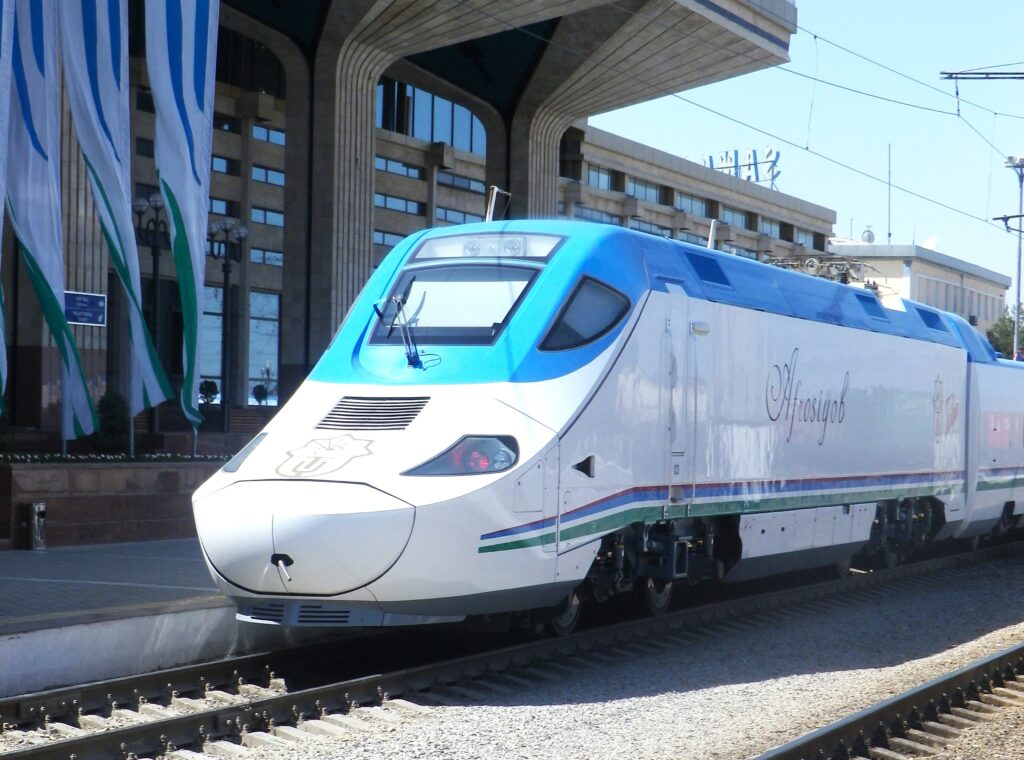
Even though Kazakhstan is the clear leader in Central Asia in terms of rail transport, it was Uzbekistan that became the second country in the CIS after Russia to launch high-speed passenger trains, (called Afrosiyob after an ancient archaeological site near Samarkand) on a special line rebuilt for this purpose from Tashkent to Samarkand, the third largest city in the country. The line was later extended to Bukhara.
Tajikistan: Recovering from Uzbek blockade
The main rail operator in Tajikistan is the state-owned Rochi Ohani Tochikiston (Tajik Railways), but there is also the Mehrobod–Suluktu narrow-gauge railway, which is owned by the Jabbor Rasulov District transport authority, and is the only electrified railway in Tajikistan and Kyrgyzstan (note: Suluktu is in Kyrgyzstan). Tajikistan’s public track totals 680 km.
The rail network consists of two separate parts. In 2011, the southern section was left isolated after Uzbekistan took steps to shut down the Ghalaba–Amuzang railway, forcing Tajikistan into building several lines to break the Uzbek blockade. The first line stretched north, from Tajikistan through Kyrgyzstan and Kazakhstan to Russia, while the second ran from China through Kyrgyzstan and Tajikistan to Afghanistan, Turkmenistan, and Iran. In addition, the construction of the Vahdat–Yavan railway, started in March 2009, was accelerated. It was later commissioned in August 2016, opening the way to the Afghan border, and the first passenger train traveled south on this line in February 2017.
Later, at the beginning of 2018, after Shavkat Mirziyoyev took over as president of Uzbekistan and launched a policy of cooperation with the country’s Central Asian neighbors, the border section of the Ghalaba–Amuzang railway, which had been dismantled back in 2012, was rebuilt, with the first train from Tajikistan to Moscow departing in March of that year.
Kyrgyzstan: New hopes centered around China and Uzbekistan
There are obvious problems with rail transport in Kyrgyzstan. When the country gained independence, the rail network of this mountainous nation consisted of several sections inherited from the USSR which were not connected to each other. The situation remains unchanged, and the rail network still consists of scattered dead-end lines. Separate lines connect the north of the country with Kazakhstan and the south with Uzbekistan. Other lines run through Kyrgyzstan’s southwestern regions, connecting the country’s large industrial and populated areas with the Ferghana Valley.
The state carrier, Kyrgyz Temir Zholy (Kyrgyz Railways), renamed in 2005, is the legal successor to the Kyrgyz Railway Administration, which, in turn, until 1992, was the Frunze Branch of the Alma-Ata Railway Bureau. In 1994, Bishkek made a frantic attempt to realize a trans-Kyrgyz railway from Balykchy to Jalal-Abad, which would have finally connected the south and north of the country. Construction began in 1998, but was soon halted, and two years later the project was scrapped.
During the early 1990s, the Kyrgyz Railway Administration was awash with ideas, and in 1996 mooted another ambitious project; a China–Kyrgyzstan–Uzbekistan railway.
This turned out to be ahead of its time, but in 2022 the proposal was resurrected and presented as a response to the disruption of global supply chains caused by international sanctions against Russia. The first agreement to build the railway was signed in September 2022 during the Shanghai Cooperation Organization summit in Samarkand. The media reported that the new railway would begin at the Torugart Pass in Kyrgyzstan, where there is already a line from China, and run north through the villages of Arpa and Makmal to Jalal-Abad, connecting with Uzbekistan’s rail network.
In January 2023, a joint project office was opened in Bishkek to coordinate the construction of the railway, staffed with transport ministry officials from Uzbekistan and Kyrgyzstan, and experts from China. Then, at the China-Central Asia summit in Xi’an in May of last year, China, Uzbekistan and Kyrgyzstan signed a trilateral document outlining the next steps in the railway’s construction.
Kazakh experts, however, remain skeptical about whether the project will ever come to fruition. Kazakhstan currently has a virtual monopoly on shipping goods from China through Central Asia and onward to Iran. In 2014, thanks to the completion of a railway through Turkmenistan, Kazakhstan “reached” the Persian Gulf. This is part of the INSTC, which is increasingly under discussion.
Regarding the chances of the railway project between Beijing, Bishkek, and Tashkent being realized, Kazakh political analyst Eduard Poletaev believes that whilst offering an important alternative for Uzbekistan and Tashkent, it will not have a major impact in terms of Central Asia’s transit potential. “I have doubts that it will be built at all”, ventured Poletaev. “They project that it will be built in six years – and if they say six, it will be 26. This is definitely not a competitor for Kazakhstan.”
Turkmenistan
Turkmenistan has a rail network spanning 4,980 kilometers, making it the 37th largest in the world. The state-owned company, Türkmendemirýollary, operates this extensive system under the Ministry of Railways of Turkmenistan. Ambitiously, the country plans to expand its railways by an additional 5,256 kilometers by 2025, aiming for a total of over 10,236 kilometers of track.
Turkmenistan has plans for a route running through Afghanistan to Pakistan via Turgundi—Herat—Kandahar—Spin Buldak, and recently ran a test container train on the China-Kazakhstan-Turkmenistan-Iran route. This project, which provides a fast transportation corridor between East and West, is the result of negotiations between representatives of the railway departments of China, Kazakhstan, Turkmenistan, and Iran.
Conclusion
Looking ahead, a breakthrough in the development of Central Asia’s rail transport will require a significant injection of finance. Even then, however, each country has its own focus: for Uzbekistan, it is high-speed trains to support tourism, while Kazakhstan is betting on freight transit. Meanwhile, passenger traffic is subsidized to keep fares low, leading to low-quality passenger trains and some routes still being served by trains manufactured in Soviet times. In short, investment is needed, and at this point, only China is showing the readiness to provide it.



 Sergey Kwan