• KGS/USD = 0.01144 0%
  • KZT/USD = 0.00212 0%
  • TJS/USD = 0.10456 0.19%
  • UZS/USD = 0.00008 0%
  • TMT/USD = 0.28490 0%
  • KGS/USD = 0.01144 0%
  • KZT/USD = 0.00212 0%
  • TJS/USD = 0.10456 0.19%
  • UZS/USD = 0.00008 0%
  • TMT/USD = 0.28490 0%
  • KGS/USD = 0.01144 0%
  • KZT/USD = 0.00212 0%
  • TJS/USD = 0.10456 0.19%
  • UZS/USD = 0.00008 0%
  • TMT/USD = 0.28490 0%
  • KGS/USD = 0.01144 0%
  • KZT/USD = 0.00212 0%
  • TJS/USD = 0.10456 0.19%
  • UZS/USD = 0.00008 0%
  • TMT/USD = 0.28490 0%
  • KGS/USD = 0.01144 0%
  • KZT/USD = 0.00212 0%
  • TJS/USD = 0.10456 0.19%
  • UZS/USD = 0.00008 0%
  • TMT/USD = 0.28490 0%
  • KGS/USD = 0.01144 0%
  • KZT/USD = 0.00212 0%
  • TJS/USD = 0.10456 0.19%
  • UZS/USD = 0.00008 0%
  • TMT/USD = 0.28490 0%
  • KGS/USD = 0.01144 0%
  • KZT/USD = 0.00212 0%
  • TJS/USD = 0.10456 0.19%
  • UZS/USD = 0.00008 0%
  • TMT/USD = 0.28490 0%
  • KGS/USD = 0.01144 0%
  • KZT/USD = 0.00212 0%
  • TJS/USD = 0.10456 0.19%
  • UZS/USD = 0.00008 0%
  • TMT/USD = 0.28490 0%

Seventeenth-Century Gilded Vessel Joins Permanent Exhibition at Uzbekistan’s Islamic Civilization Center

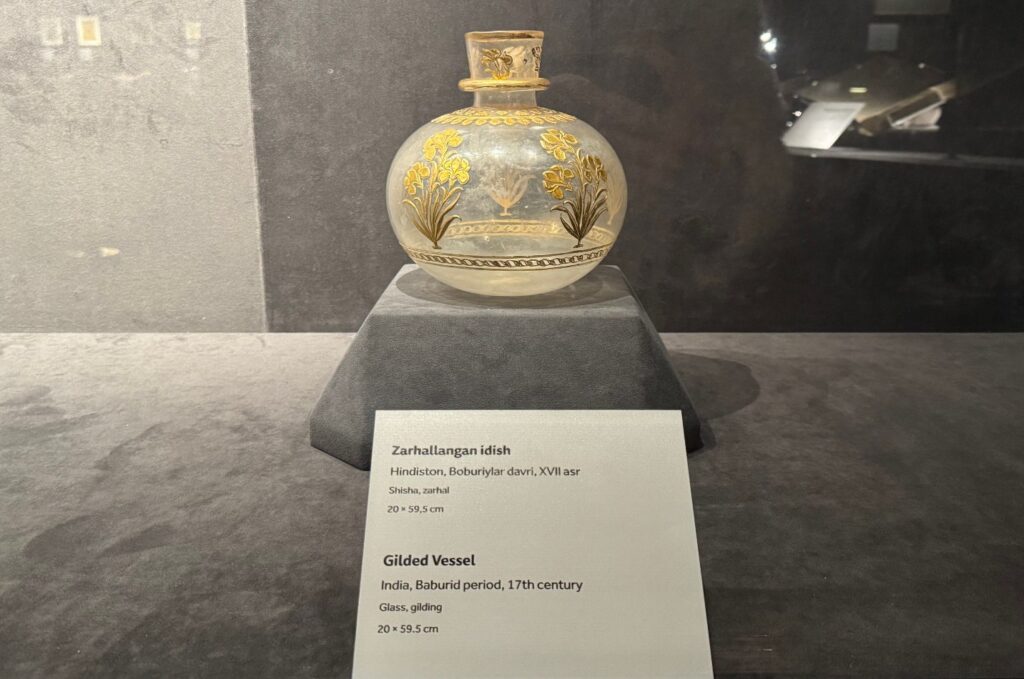
A rare gilded decorative vessel dating to the seventeenth century has been added to the permanent exhibition of the Islamic Civilization Center in Uzbekistan, the Center announced. Acquired from the British auction house Christie’s at the initiative of the president, the artifact is being presented to the public for the first time in Tashkent.

According to the Islamic Civilization Center, the vessel is notable for its refined form, gold-leaf ornamentation, and exceptional craftsmanship, offering insight into the aesthetic sensibilities of its time. Experts describe it as a rare luxury object intended for elite or courtly use, rather than for everyday function.

Rustam Jabborov, Scientific Secretary of the Center, said the vessel is approximately 400 years old and features a carefully balanced design. “The object has a spherical body with cylindrical workmanship. The lower section is adorned with a braided floral ornamental band, while five blooming yellow lotus flowers are arranged above it in a circular pattern to create compositional unity,” Jabborov explained.

He noted that the surface of the vessel was polished and gilded, with gold-leaf decorations that have retained their artistic appeal over centuries. “The gilding enhances both the sense of splendor and the impression of antiquity. The yellow lotus flower, used as the central decorative motif, adds both symbolic and aesthetic meaning to the overall composition,” he said. According to Jabborov, the manufacturing technique, ornamental style, and state of preservation all attest to the object’s historical significance.

The Islamic Civilization Center stated that the inclusion of the vessel in its exhibition reinforces its status as a rare cultural artifact recognized at the international level.

In February last year, the Center announced plans to host an international exhibition in Tashkent featuring Uzbek cultural masterpieces housed in Italian museums and private collections. The event is scheduled to coincide with the opening of the Center for Islamic Civilization.

As part of those preparations, a delegation led by the Center’s director, Firdavs Abdukhalikov, visited Italy, where they held talks with museum representatives and private collectors who expressed support for the project. Elmira Gul, scientific coordinator of the Cultural Heritage of Uzbekistan in the Collections of the World project, noted that collections of Uzbek artifacts in Italian museums have already been documented in published volumes, reflecting the global reach of Uzbekistan’s cultural legacy.

Kyrgyzstan Draws International Attention to Climate Risks for Lake Issyk-Kul

Speaking at the World Governments Summit in Dubai on February 4, Bakyt Torobaev, Kyrgyzstan’s Deputy Chairman of the Cabinet of Ministers and Minister of Water Resources, Agriculture, and Processing Industry, highlighted the growing threat climate change poses to Lake Issyk-Kul, the country’s largest lake, a unique ecological reserve, and one of Central Asia’s leading tourist destinations.

Torobaev described Issyk-Kul as a unique ecosystem of regional significance and a vital socioeconomic and environmental resource for Kyrgyzstan. However, in recent decades, the lake has experienced serious climate-related pressures, according to the Ministry of Water Resources.

Since the mid-19th century, the lake’s water level has dropped by nearly 14 meters, while its total volume has decreased by approximately 85 billion cubic meters. The number of rivers flowing into the lake has also significantly declined, largely due to melting glaciers and increased agricultural water use. Torobaev warned that further declines in Issyk-Kul’s water level could lead to severe environmental and socioeconomic consequences, including threats to biodiversity, the lake’s tourism potential, and the well-being of the local population.

Kyrgyzstan, he said, sees the preservation of Issyk-Kul as part of the broader global climate and water agenda, calling for a shift from short-term measures to long-term, science-based, and investment-driven solutions.

He urged the international community to strengthen partnerships in sustainable water resource management, integrate climate, water, and ecosystem approaches, and support joint initiatives aimed at preserving ecologically significant natural sites.

In December 2025, Kyrgyzstan’s Cabinet of Ministers approved the Concept for the Sustainable Development of the Ecological and Economic System of Lake Issyk-Kul until 2030, along with a corresponding Action Plan. The initiative aims to safeguard the lake and its surrounding biosphere from mounting environmental and human pressures while enhancing long-term economic resilience in the region.

Torobaev also addressed the broader issue of water scarcity, which is becoming an increasingly critical factor for regional stability, food security, and sustainable development in the context of climate change. As a mountainous country that serves as a key source of Central Asia’s rivers, Kyrgyzstan bears particular responsibility for the sustainability of the region’s water ecosystems, he said, and consistently advances the water agenda at international forums.

Also on February 4, Torobaev participated in a Global Councils on SDGs meeting at the summit, where he proposed greater global attention to the challenges facing mountain regions.

He said that mountain ecosystems are among the most vulnerable to climate change. Melting glaciers, shifting precipitation patterns, and more frequent extreme weather events pose long-term risks to water resources, agriculture, and energy security in Central Asia and beyond.

Kyrgyzstan, he said, advocates for recognizing mountain regions as special zones for sustainable development and ensuring their prioritized access to climate finance, adaptation technologies, and environmental monitoring systems.

According to Torobaev, the sustainability of mountain regions is directly linked to the water and food security of millions of people, underscoring the need for systemic and coordinated international responses.

Tajikistan Seeks to Expand the Geography of Labor Migration

Tajikistan has stepped up efforts to expand destinations for labor migration, including countries in Europe and East Asia. The announcement was made by Minister of Labor, Migration and Employment Soleha Kholmahmadzoda at a press conference summarizing the ministry’s work in 2025.

According to the Kholmahmadzoda, a memorandum of cooperation with relevant agencies of the Kingdom of Belgium was signed in November last year and is currently undergoing internal approval procedures.

The agreement provides for the possibility of organized employment for Tajik citizens in the Benelux countries, namely Belgium, the Netherlands, and Luxembourg. The most in-demand sectors include agriculture, construction, social services, and healthcare.

The Ministry of Labor said the initiative is intended to create transparent and legal employment channels, enhancing protection for migrant workers and reducing the risks associated with illegal employment.

Cooperation with Japan is also advancing. The ministry has established a special working group and developed a mechanism to attract Tajik citizens as “specially qualified” workers.

Relevant documents have been sent to the Tajik Embassy in Japan for publication on the website of the Japan International Training Cooperation Organization (JITCO).

In addition, the Agency for Employment Abroad has prepared a draft agreement with Japanese employers. As a result, the first 10 citizens of the republic have already secured jobs.

Special attention is also being given to cooperation with South Korea. In 2025, the Korean side allocated 800 quotas for labor migrants from Tajikistan. After completing professional training and passing the EPS-TOPIK exam, 21 people were employed through the Korean job portal, while documentation is still being processed for 12 additional candidates.

Despite the expansion of destinations, Russia remains the primary labor market for Tajik citizens.

According to the Ministry of Labor, in 2025, 30 licensed entities sent 35,747 citizens abroad through organized channels, an increase of 18,805 compared with the previous year. Of these, more than 31,000 were employed in Russia, Deputy Minister of Labor, Migration and Employment Norzoda Sharif Sanginmurod said.

These figures broadly correspond with estimates from the Russian side. Official data indicate that more than 1 million Tajik citizens are currently working in Russia, mainly in construction, housing and utilities, transport, and logistics.

Kazakhstan’s Draft Constitution and the Reordering of State Authority

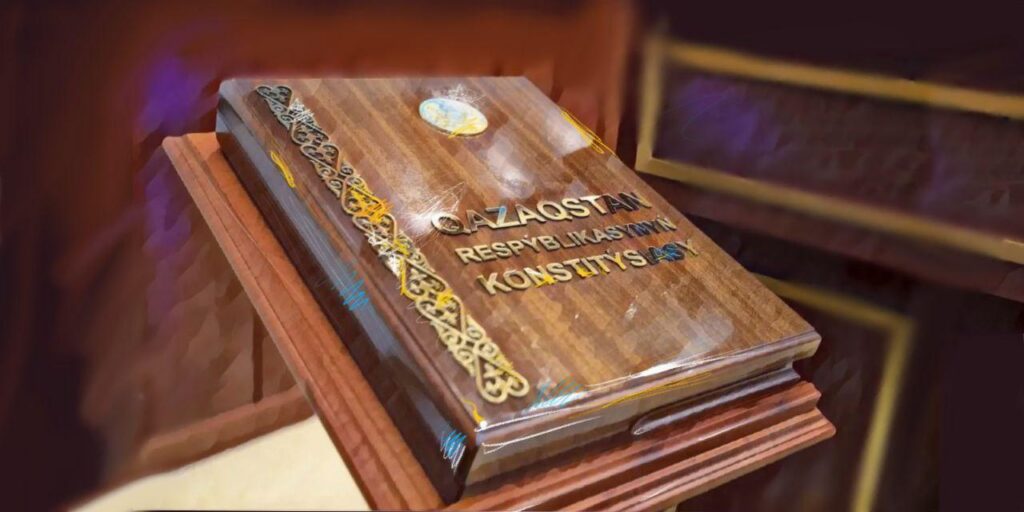
Kazakhstan’s current constitutional reform is no longer limited to parliamentary redesign. A draft updated basic law has been released for public discussion, and it presents the effort as a review of the state’s political architecture culminating in a nationwide referendum. The draft is described as the product of months of work initiated by President Kassym-Jomart Tokayev, with large-scale changes proposed for the country’s political system. A replacement-style text, an explicit state-architecture rationale, and a referendum endpoint together signal a reform agenda that reaches beyond legislative mechanics to the overall distribution of authority, the protection of fundamental rights, and strengthening of the rule of law.

Kazakhstan’s current constitution was adopted by referendum in August 1995, replacing the January 1993 basic law. It has been amended repeatedly, including significant revisions in 1998, 2007, 2011, and 2022. The 2022 referendum package was a particularly extensive set of amendments. It presented a model of a presidential republic with a strong parliament, redistributed selected powers from the presidency to parliament, and created new parliamentary mechanisms. It also strengthened the ombudsman, enabled direct citizen appeals to the Constitutional Court, established a commissioner framework for socially vulnerable categories, established a ban on the death penalty, and set a single seven-year presidential term without the possibility of reelection.

From Proposal to Draft Basic Law

The current draft emerged from a process launched under Tokayev in late 2025. In September 2025, he proposed moving to a unicameral parliament, which set the reform’s initial direction. A working group was established in October 2025 to develop proposals, and in January 2026, a commission was formed to carry the work forward. The commission was chaired by Elvira Azimova, head of the Constitutional Court of Kazakhstan, linking the drafting process to the institution that reviews the basic law.

The commission’s work moved beyond incremental amendments. It reviewed proposals affecting seventy-seven constitutional articles, about 84% of the current text, and that breadth drove the decision to prepare a fundamentally new basic law rather than another package of revisions. Rewriting most of the operative text shifts the reform from a parliamentary adjustment to a redesign of the state’s governing framework. The resulting draft is structured as a replacement-style document, with an updated preamble and a reorganization into eleven sections and ninety-five articles.

The institutional centerpiece of the draft is a shift from a two-chamber parliament to a single chamber and to proportional representation for electing deputies. The proposed supreme legislative body, the Kurultai, would have 145 deputies, slightly fewer than the combined 148 members of the current Mazhilis and Senate of Kazakhstan. The draft also grants the Kurultai expanded powers, pairing structural consolidation with a change in how legislative authority is organized, including oversight, political accountability, and approval of key state appointments and conciliation procedures.

Alongside the proposed legislature, the draft creates a national dialogue platform, the People’s Council of Kazakhstan, described as the highest advisory body representing citizens’ interests and granted the right of legislative initiative. This adds a second channel for agenda-setting with a formal pathway into lawmaking. In that context, the reform is framed as enhancing institutional resilience within a redesign broader than a parliamentary upgrade. It intends in this way to secure a new configuration of political authority through a clearer allocation of responsibility across branches of government

The draft constitutionalizes a Vice President as the designated successor, with the stated aim of making executive transfer more rule-bound and predictable. Parliamentary involvement in the appointment is meant to locate the office within the system of institutional counterweights rather than treat it as an exclusively presidential device. It then specifies a new line of succession—Vice President, Chair of the Kurultai, then Prime Minister—in place of the current default under which the Senate chair assumes presidential powers. By entrenching that order in the constitution, the reform reduces ambiguity over interim authority and lowers the risk of a temporary institutional vacuum.

Rights, Values, and Governance Boundaries

The draft’s preamble elevates language about rights to a first-order constitutional commitment. For the first time, it declares that human rights and freedoms are the state’s main priority. It identifies sovereignty, independence, the unitary character of the state, and territorial integrity as immutable values, and it defines the foundations of statehood to comprise unity, solidarity, and interethnic and interfaith harmony. By placing these commitments in the preamble, the draft treats the reform as a statement not only about how institutions will operate but about what the state is for and what it holds to be inviolable. It reaffirms freedom of expression, the prohibition of censorship, and an unconditional ban on torture and cruel or degrading treatment as basic constitutional norms. All this is framed by the accountability of public authority within a law-based state.

The draft constitutionalized foreign policy by extending statehood principles to Kazakhstan’s external orientation. It defines foreign policy as peaceful and pragmatic, reaffirms commitment to the UN Charter and international law, and emphasizes strategic stability. Regionally, it frames Kazakhstan as a responsible Central Asian actor, prioritizing stability, transit connectivity, and energy security. By embedding these commitments in the basic law, the draft treats foreign policy as an element of constitutional identity and aims to increase predictability for external partners and investors by constraining policy shifts.

Alongside rights and statehood commitments, the draft adds programmatic priorities to the basic law. It introduces the principles of justice, law, and order into the constitution for the first time. It also elevates education, science, culture, and innovation as constitutional priorities, linking these values to long-term human-capital development.

The draft constitution makes environmental protection and the responsible use of natural resources state responsibilities, bringing sustainability into the core of state obligations.

The new draft also puts procedural constraints on state power directly into the constitutional text, tightening legal safeguards. It bars the retroactive application of new laws that would increase punishment or otherwise penalize citizens, and it establishes the double-jeopardy rule that citizens cannot be repeatedly prosecuted for the same offense. It also introduces direct procedural guarantees upon detention (including access to legal counsel and clear notification of rights) and, for the first time, a dedicated article on the legal profession, giving it constitutional standing. It treats access to qualified legal representation as a constitutional matter, and not an administrative detail. The same package reinforces the protection of intellectual property and guarantees of private property and the freedom of entrepreneurship, enhancing the legal certainty and predictability for investors.

The draft also uses constitutional text to define boundaries in social policy and modern governance. It reinforces the separation of religion and the state and affirms the secular character of education and upbringing. It defines marriage as a voluntary and equal union of a man and a woman, placing this norm in the basic law rather than leaving it to ordinary legislation. For the first time at the constitutional level, it also introduces a norm on protecting citizens’ rights in the digital environment, including personal data protection and privacy.

Regime Renewal and Referendum Legitimacy

The political meaning of the current reform becomes clearer when juxtaposed with the 2022 referendum package and the subsequent effort to unwind Nursultan Nazarbayev-era constitutional arrangements. The 2022 amendments already modified relations among key state institutions, strengthened rights-protection channels, and established a single seven-year presidential term without reelection, reducing the likelihood of excessive concentration of power. Later de-Nazarbayevization measures removed Nazarbayev’s special constitutional status and restricted his relatives’ access to high office, indicating that regime renewal accompanied institutional redesign. Far beyond any refinement of parliamentary procedure, the replacement-style basic law, to be adopted by referendum, is intended to establish a higher order of legitimacy for a new allocation of authority and a revised set of state values.

The draft limits constitutional amendments to nationwide referenda requiring territorially balanced support, increasing long-term legal predictability for international partners.

With a replacement-style draft now in public discussion, Kazakhstan is moving toward a referendum that would adopt a new basic law. The package combines institutional redesign with programmatic constitutional content: a restructured legislature and electoral system, new agenda-setting mechanisms, and a preamble that elevates rights and statehood commitments, alongside provisions that strengthen procedural guarantees, give the legal profession explicit constitutional standing, protect private property and freedom of entrepreneurship, and address rights in the digital environment. The result makes clear that parliamentary restructuring is only one component of a broader effort to define authority, responsibility, policy predictability, and the state’s declared priorities.

What the U.S. Really Wants in Central Asia: Behind the B5+1 Forums

The B5+1 business forum continued in Kyrgyzstan’s capital on February 5, as government officials, regional business leaders, and a sizable U.S. delegation met to discuss trade, investment, and regulatory barriers shaping economic ties between Central Asia and the United States.

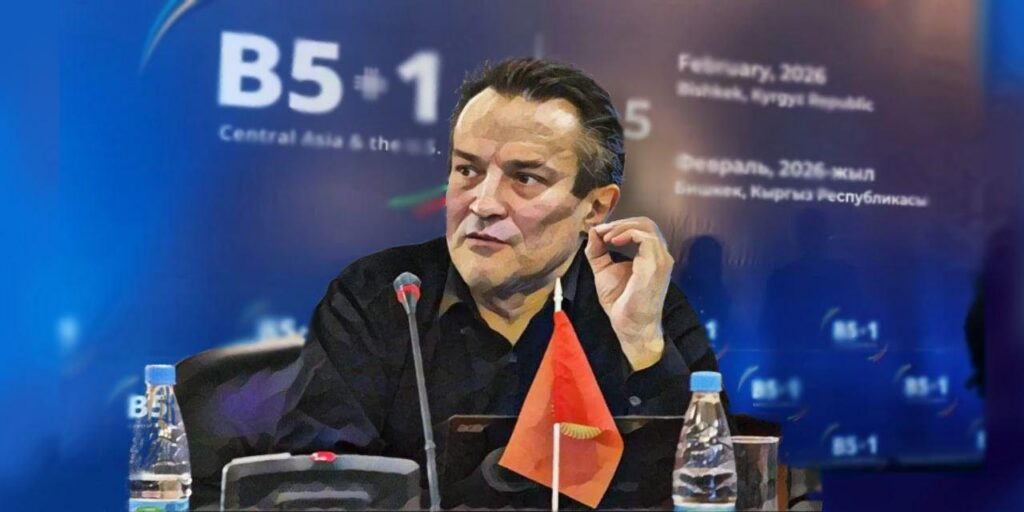
As Washington signals a more pragmatic, commercially driven approach to the region, questions persist over why U.S. investment has lagged behind political engagement and which markets are truly seen as priorities. The Times of Central Asia spoke with Dmitry Orlov, director of the Strategy: East–West analytical center, about the structural obstacles deterring American capital, the shift in U.S. policy thinking, and how Central Asian states are positioned within Washington’s evolving economic calculus.

TCA: What serious U.S. capital investments in Central Asia can we talk about today?

ORLOV: It is important to understand the main point. Talk of large investments, the arrival of American business, and long-term economic cooperation only makes sense in one case: if the U.S. repeals the Jackson-Vanik amendment, which was adopted back in the 1970s and extended to all former Soviet republics after the collapse of the USSR. Today, it remains a formal and, in many ways, psychological obstacle to a fully-fledged business partnership.

At the same time, it is necessary to establish contacts at a business level right now. This is because if the amendment is repealed – and such statements are regularly heard in Washington – it is difficult to predict which countries in the region will receive investment flows and in what volumes.

Recent international forums, including Davos, have shown that Kazakhstan and Uzbekistan are of the greatest interest to the U.S. in Central Asia. Their economies are developing more dynamically, and they can offer large-scale projects and a clear export base. The other countries in the region, Kyrgyzstan, Tajikistan, and Turkmenistan, are still perceived by investors as lower priorities.

TCA: Previously, the U.S. actively promoted a political agenda in the region, including human rights and freedom of speech. Now these are rarely mentioned. Why do you think this is the case?

ORLOV: The approach has become more pragmatic. The history of U.S. foreign policy shows that strategic and economic interests have always taken precedence. If a territory is attractive in terms of resources or transit routes, a format for cooperation will be found.

In Europe, relatively speaking, the rule of law prevails. In Asia, the situation is different, and the Americans understand this perfectly well. Issues of ideology and human rights can move to the background if economic expediency comes first. This is especially true in Central Asia, where many issues are resolved through personal agreements and informal connections. Washington understands this.

TCA: What exactly can Central Asia offer the U.S.?

ORLOV: In terms of individual countries, Kazakhstan and Uzbekistan are again in the lead. They offer oil, gas, and, no less importantly, control over transit routes.

There is currently a lot of discussion about rare earths and critical minerals, but their development is always long and expensive. As a result, interest in them is largely political and declarative. First and foremost, it is about signaling presence and intent. It may take decades before such projects actually materialize.

Kyrgyzstan and Tajikistan also have a resource base, but developing deposits there is difficult and costly. Turkmenistan stands apart as a special case. A significant share of its gas volumes has already been contracted by China in exchange for earlier infrastructure loans. At the same time, it has a petrochemical industry, transport arteries, and logistics potential.

TCA: What does Central Asia expect from the U.S.?

ORLOV: Beyond investment and technology, political balance is important for the region. Against the backdrop of talk about possible EU sanctions against Kyrgyzstan, diplomatic activity has intensified. In my view, the key question for the U.S. is what it can offer that Russia and China, already deeply integrated into the region’s economy, cannot.

U.S. trade turnover with Kyrgyzstan, for example, does not even rank in the top ten. Therefore, there is not only economic but also political logic at work, an attempt to strengthen its presence in the region.

Central Asia today is a space where the interests of China, Russia, Iran, and the West intersect. None of these actors has a monopoly on influence. That is why the region remains an area of balance.

American and European companies extract oil in Kazakhstan. Chinese companies do as well. Russian companies are also present. So far, these interests have not come into direct conflict. As a result, we should not expect open confrontation between global players, at least in the near future.

TCA: How realistic is it that repealing the Jackson-Vanik amendment could change the investment landscape in Central Asia?

ORLOV: For now, it is more of a political signal than an economic calculation. Western media have barely discussed potential investment volumes in the event of its repeal. No concrete figures are being cited.

This resembles a situation in which a decision has ostensibly been “made,” but real steps remain distant. The amendment has been discussed since the Clinton administration, yet it has never progressed beyond declarations. In essence, it remains a carrot dangling in front of a donkey.

TCA: Would it be fair to say, then, that regional forums, including the B5+1, are largely symbolic?

ORLOV: Exactly. The first forum in Almaty in 2024 was a stage of familiarization and mutual assessment. The meeting in Bishkek is an attempt to outline the contours of possible cooperation. The key questions for both sides today are extremely pragmatic: what are we being offered, and what can we get in return?

Rubio Hosts Critical Minerals Meeting; Central Asia Is Key to U.S. Vision

The United States welcomed delegations from dozens of countries to a meeting in Washington, D.C. on Wednesday that was aimed at strengthening and diversifying supply chains for critical minerals. With large reserves of these minerals, Central Asia is emerging as a key player in U.S. plans to secure components deemed necessary for advances in technology, economic development, and national security.

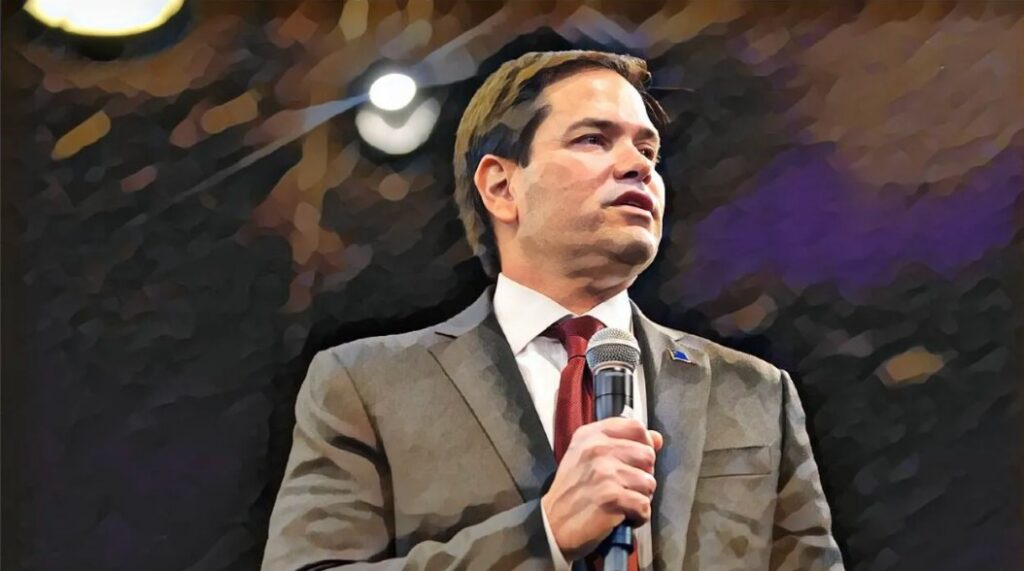
“I don’t need to explain to anybody here that critical minerals are vital to the devices that we use every single day,” U.S. Secretary of State Marco Rubio said in his opening remarks at the minister-level conference. “They power our infrastructure, our industry, and our national defense… Our goal is to have a global market that’s secure, a global supply that’s enduring and is available to everyone, every nation, at an affordable price.”

U.S. Vice President JD Vance also spoke at the event, saying the United States wants to form a trading bloc among allies and partners that expands production of critical minerals in an environment of stable prices and supply chains immune from disruption.

“By regulating imports to preserve free and fair competition within the preferential trading zone, we will elevate our nation’s miners and refiners, our investors and producers alike,” Vance said. “We are all on the same team, and we need to create the economic incentives that reward people for investing and building in our countries.”

The United States is seeking to counter China’s dominance of the critical minerals market. China is a key trading partner for Central Asia, whose countries aim to diversify their relationships among the major powers.

Foreign Minister Yermek Kosherbayev of Kazakhstan was among those slated to attend the critical minerals conference in the United States. The visit follows intensifying discussions involving the United States and Central Asian countries on how to develop trade and investment. On Wednesday, business leaders and government officials from Central Asia and the United States gathered in Kyrgyzstan’s capital, Bishkek, for the start of the second B5+1 Business Forum.