• KGS/USD = 0.01144 0%
  • KZT/USD = 0.00194 0%
  • TJS/USD = 0.10841 -0.37%
  • UZS/USD = 0.00008 0%
  • TMT/USD = 0.28571 0.28%
  • KGS/USD = 0.01144 0%
  • KZT/USD = 0.00194 0%
  • TJS/USD = 0.10841 -0.37%
  • UZS/USD = 0.00008 0%
  • TMT/USD = 0.28571 0.28%
  • KGS/USD = 0.01144 0%
  • KZT/USD = 0.00194 0%
  • TJS/USD = 0.10841 -0.37%
  • UZS/USD = 0.00008 0%
  • TMT/USD = 0.28571 0.28%
  • KGS/USD = 0.01144 0%
  • KZT/USD = 0.00194 0%
  • TJS/USD = 0.10841 -0.37%
  • UZS/USD = 0.00008 0%
  • TMT/USD = 0.28571 0.28%
  • KGS/USD = 0.01144 0%
  • KZT/USD = 0.00194 0%
  • TJS/USD = 0.10841 -0.37%
  • UZS/USD = 0.00008 0%
  • TMT/USD = 0.28571 0.28%
  • KGS/USD = 0.01144 0%
  • KZT/USD = 0.00194 0%
  • TJS/USD = 0.10841 -0.37%
  • UZS/USD = 0.00008 0%
  • TMT/USD = 0.28571 0.28%
  • KGS/USD = 0.01144 0%
  • KZT/USD = 0.00194 0%
  • TJS/USD = 0.10841 -0.37%
  • UZS/USD = 0.00008 0%
  • TMT/USD = 0.28571 0.28%
  • KGS/USD = 0.01144 0%
  • KZT/USD = 0.00194 0%
  • TJS/USD = 0.10841 -0.37%
  • UZS/USD = 0.00008 0%
  • TMT/USD = 0.28571 0.28%
17 December 2025

Kazakhstan Hosts FIDE Chess Tournament for Players with Disabilities

Chess is a “great equalizer,” says Henry Lopez, a player from the Philippines. “It’s for everybody.”

Lopez, who uses a wheelchair because of polio, is among dozens of competitors from around the world who are participating this week at the 2nd Chess Olympiad for People with Disabilities in Astana. The event is organized by FIDE, the international governing body of chess, and hosted by the Kazakhstan Chess Federation, which is making a big push to introduce the game in schools across the country, as well as cultivate high performers at the elite level.

The weeklong competition, whose closing ceremony is on Saturday, features 34 teams from 29 countries. There are teams from Europe, Asia, the Americas and Africa. The players have visual, hearing, and physical impairments. The event is taking place at the Paralympic Training Centre, whose facilities are designed to help people with disabilities.

In an interview posted on YouTube by FIDE, Lopez said he was taking part in the second edition of the event. The first, won by Poland, was held in Belgrade, Serbia in 2023. The Philippines came third in Belgrade and will try for the top spot again in Astana.

“Chess for me now is my source of living in the Philippines,” Lopez said. “I’m a national player and we have stipend every month from the government.”

FIDE President Arkady Dvorkovich said the contest has drawn more teams and more countries this time around, and was consistent with the organization’s goal of providing access to top level events to as many people as possible, according to a FIDE interview.

“We do believe that chess is inclusive and we have to make sure that it’s inclusive indeed,” Dvorkovich said.

Shantel Panashe Gweshe, a player from Zimbabwe, told FIDE that the Astana event had inspired her.

“When I go back to Zimbabwe, first thing, I’m going to make sure that I’m going to empower other people with disabilities to ensure inclusivity and participation,” she said.


Trade in Central Asia: China Deepens Influence, Europe Expands Presence, Region Seeks New Markets

Central Asia remains a theater of active economic competition, with countries in the region striving to diversify external partnerships and reduce dependence on traditional power centers, Russia and China. While both continue to dominate foreign trade, Kazakhstan, Uzbekistan, Kyrgyzstan, and Tajikistan are increasingly exploring new directions.

The region’s evolving trade dynamics reflect each country’s economic characteristics. Kazakhstan is driven by energy and metals exports, Uzbekistan by manufacturing and resource processing, while Kyrgyzstan and Tajikistan rely heavily on remittances and raw material exports.

Amid global shifts and intensified competition for markets, Central Asian states are gradually shaping more multipolar trade strategies, opening up new routes and partnerships. Turkmenistan is excluded from this analysis due to the opacity of its national statistics.

Kazakhstan

As Central Asia’s largest economy, Kazakhstan relies heavily on natural resource extraction. Its main exports include oil, gas, metals, coal, grain, and agricultural products. Imports consist primarily of machinery, chemicals, vehicles, and consumer goods.

Key export partners include Italy (21.6%), China (18.6%), Russia (10.2%), the Netherlands (7.4%), Turkey (4.7%), and Uzbekistan (4.3%). On the import side, China (29%) and Russia (28.8%) dominate, followed by Germany (4.8%), South Korea (3.7%), the United States (3.6%), and Turkey (2.5%).

Kazakhstan has maintained a positive trade balance, buoyed by consistent demand for raw materials. In January-July 2025, the country’s foreign trade turnover totaled $78.18 billion, down 2.6% from the same period in 2024. Exports declined by 6.4% to $43.58 billion, while imports rose by 2.6% to $34.6 billion.

Uzbekistan

Uzbekistan’s economy is focused on agriculture, textiles, natural resources, and manufacturing. Major exports include textiles, gold, gas, automobiles, cotton, and fruit. Imports are led by machinery, equipment, chemicals, and petroleum products.

In the first half of 2025, foreign trade turnover reached $44.4 billion, up 19.9% year-on-year. Exports rose 34.9% to $20.1 billion, while imports increased 9.9% to $24.29 billion, leaving a trade deficit of $4.18 billion.

Uzbekistan trades with 197 countries. Its largest trade partners are China (18.2%), Russia (16.1%), Kazakhstan (5.9%), Turkey (3.6%), and South Korea (2.2%). Export destinations include Russia (12.3%), China (5.5%), Kazakhstan (4.0%), Afghanistan (3.7%), Turkey (3.0%), France (2.6%), the UAE (1.8%), Kyrgyzstan (1.6%), Tajikistan (1.4%), and Pakistan (1.2%).

Imports mainly come from China (28.7%), Russia (19.3%), Kazakhstan (7.6%), Turkey (4.1%), South Korea (3.9%), Germany (2.8%), and India (2.6%).

Kyrgyzstan

Kyrgyzstan, with limited natural resources, is heavily dependent on foreign trade. Its economy is rooted in agriculture, mining, and textiles. Key exports include gold and agricultural products, while imports are dominated by machinery, vehicles, petroleum products, and chemicals.

From January to June 2025, foreign trade turnover fell 12.4% year-on-year to $6.99 billion. Exports made up only 15% of total trade, underscoring a continued trade deficit. Main partners remain Kazakhstan, Russia, and China.

Tajikistan

Tajikistan’s economy is centered on agriculture, hydropower, textiles, and mining. In January-August 2025, foreign trade turnover rose 16.8% year-on-year to $6.73 billion. Exports totaled $1.63 billion, while imports reached $5.1 billion, more than triple the export volume.

Main exports are aluminum, textiles, agricultural goods, and minerals; imports include petroleum products, machinery, chemicals, and food.

Trade with China hit $1.66 billion, up 40% year-on-year. Tajik exports to China stood at $270 million, while imports from China reached $1.39 billion. China now accounts for 25% of Tajikistan’s total trade, overtaking Russia for the first time. Trade with Russia totaled $1.44 billion (21.4%), while trade with Kazakhstan fell 13.1% to $758 million.

Still in the Grip of Giants?

Despite growing interest in European markets, China and Russia remain dominant trade partners. Trade with the US remains limited, constrained by geography and Washington’s protectionist trade stance.

Sanctions, ongoing conflicts in Ukraine and the Middle East, and shifting logistics continue to shape regional trade patterns. In this context, diversification is crucial for Central Asia’s economic resilience. Yet efforts to escape Beijing’s and Moscow’s economic gravitational pulls remain tentative.

Kazakh economist Serik Belgibaev notes that while Central Asia has long pursued a multi-vector foreign policy, balancing external ties has proven elusive. “Previously, overreliance on Russia created excessive dependency from labor markets to energy exports. Now, a new imbalance is emerging in China’s favor. China’s trade with Central Asia has reached $95 billion and continues to grow. The region is increasingly tied to Chinese markets and capital. Debt is just one indicator: in Kyrgyzstan, debt to China accounts for about 40% of total external debt; in Tajikistan, more than 25%; and in Kazakhstan, around 3.5% of GDP, which remains relatively manageable,” he says.

Belgibaev warns that China could demand repayment on its terms. He cites the example of Sri Lanka’s Hambantota Port, which was leased to China for 99 years in exchange for debt relief. “In 2021, President Sadyr Japarov acknowledged that if Kyrgyzstan failed to repay loans from the Export-Import Bank of China, key infrastructure, including the Bishkek thermal power plant, power lines, and roads, could be at risk,” Belgibaev adds.

He argues that China is expanding its influence “gently but purposefully,” using investment and aid to build long-term dependence.

Still, Uzbek political analyst Zakir Usmanov highlights Central Asia’s growing strategic value, thanks to its critical mineral reserves and emerging transport corridors. “Global competition for regional influence between the US, China, and Russia is intensifying. This presents a rare opportunity to benefit from the interest of multiple major powers. While challenges remain, the trajectory is clear: Central Asia is moving toward greater economic self-sufficiency,” he says.

Saudi Company to Launch 200 MW Power Plant in Samarkand

Saudi private company Pemco is set to begin construction of a new 200-megawatt gas-piston power plant in Samarkand by the end of this year, Uzbekistan’s Minister of Energy Jurabek Mirzamahmudov announced in an interview with the “Uzbekistan 24” TV channel.

“The new power station will significantly strengthen the energy supply in the Samarkand region and support Uzbekistan’s efforts to ensure a stable electricity supply amid growing demand,” Mirzamahmudov said, following President Shavkat Mirziyoyev’s recent meeting with leading Saudi business representatives.

The minister also outlined a range of ongoing energy projects in partnership with Saudi firms. “Together with ACWA Power, we have launched the first major thermal power plant,” he said. “Additionally, a solar power facility is operating in the Qibray district of Tashkent region, two large wind farms have started operations in Bukhara, and the first 100-megawatt wind power plant has been commissioned in Karakalpakstan.”

Several new renewable energy initiatives are also in progress. “We have already begun practical steps on new wind and solar stations, and we plan to launch the first large-scale battery storage system in Parkent,” Mirzamahmudov added.

He further noted that Uzbekistan is preparing to support operations at the new Tashkent airport with the production of renewable aviation fuel. This will be facilitated through a partnership between Saudi Arabia’s Vision Invest and U.S.-based Air Products, who have signed an agreement to develop a sustainable aviation fuel (SAF) plant.

These developments come as Uzbekistan works to diversify its energy mix in anticipation of future demand. As previously reported by The Times of Central Asia, the country aims to bring a high-capacity nuclear power plant fully online by 2035. The first small modular reactor is expected to begin operations in 2029 in the Jizzakh region, followed by additional units in the early 2030s, according to Uzatom Director Azim Akhmedkhadjaev.

Aliyev, Tokayev Pledge Deeper Cooperation as Azerbaijan Lifts Armenia Transit Ban

Azerbaijan’s President Ilham Aliyev began a state visit to Kazakhstan on Monday with a series of high-level meetings and a significant policy shift: Baku is lifting all restrictions on the transit of goods to Armenia. The move, announced during joint talks with Kazakh President Kassym-Jomart Tokayev in Astana, is one of the most concrete regional gestures since the end of the Second Karabakh War.

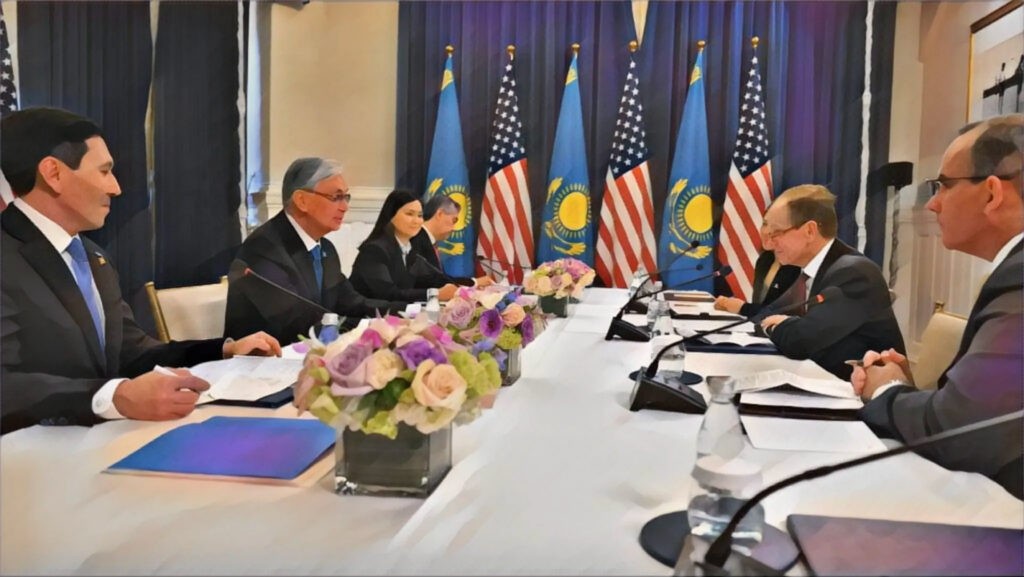
The visit began with an official welcoming ceremony at Akorda Presidential Palace in Astana, where Presidents Kassym-Jomart Tokayev and Ilham Aliyev reviewed an honor guard before holding bilateral talks and chairing the second meeting of the Kazakhstan–Azerbaijan Supreme Intergovernmental Council.

Speaking at a joint press briefing after the meeting, Aliyev confirmed that, “All restrictions on the transit of goods from Azerbaijan to Armenia and from third countries to Armenia through Azerbaijan have been lifted.” While no formal agreement was signed on Monday, the announcement is being viewed as a confidence-building measure at a moment of cautious diplomacy in the South Caucasus.

Tokayev welcomed the development and stressed the importance of expanding cooperation between Kazakhstan and Azerbaijan in key sectors such as transport and energy.

Ties on a Strategic Track

Aliyev’s visit comes as Kazakhstan and Azerbaijan are expanding cooperation in multiple areas, including rail, ports, digital infrastructure, and energy. Monday’s talks produced several new accords and project announcements, including commitments to expand freight flows along the Trans-Caspian International Transport Route (Middle Corridor) – a logistics network connecting China to Europe via Central Asia, the Caspian Sea, and the South Caucasus. Since Russia’s 2022 invasion of Ukraine upended established overland trade routes, the corridor’s importance has surged, with Astana and Baku positioning themselves as key actors in a reconfigured Eurasian logistics network that bypasses Russian territory.

In his welcoming address, Tokayev framed Aliyev’s state visit as of “critically important significance for the further development of our strategic partnership.” Tokayev described the relationship as “allied in nature,” calling Azerbaijan “a regional power that has strengthened its authority on the international stage.” He emphasized that developing multifaceted cooperation “remains a priority” and highlighted trade, economic, and political partnership as key goals.

“Azerbaijan is a special country for Kazakhstan, a fraternal state,” Tokayev stated. “We are united by common historical roots, a rich spiritual and cultural heritage, and, ultimately, a shared mentality and outlook on developments. On this unshakable foundation, we are successfully developing our multifaceted cooperation.”

Aliyev, in turn, praised Kazakhstan’s ongoing political and economic reforms, saying his country “fully supports [Tokayev’s] course of modernization” and is aiming to “strengthen cooperation in all areas”

In a related development, Azerbaijan’s state energy firm SOCAR and Kazakhstan’s sovereign wealth fund Samruk-Kazyna are expected to deepen their collaboration in upstream energy projects and petrochemical exports, though no new energy deals were signed on Monday.

Transit Opening to Armenia: Why Now?

Aliyev’s announcement on transit restrictions – made in Astana, not Baku – was notable not just for its content, but its timing and setting.

Since the end of the 2020 Second Karabakh War and the more recent 2023 military operation that led to the full integration of Nagorno-Karabakh into Azerbaijan, the region has remained tense. Armenia has accused Azerbaijan of restricting transit and access, with Prime Minister Nikol Pashinyan remarking that, “Azerbaijan wants the roads of Armenia to be usable for itself, but at the same time for Armenia to continue being blockaded.”

By publicly lifting transit restrictions, Baku appears to be signaling its readiness to normalize regional trade under specific conditions.

A Broader Regional Agenda

Beyond Armenia-related developments, the Supreme Interstate Council session reflected the expanding partnership between two states increasingly aligned on trade, connectivity, and diplomatic messaging. The two sides share strong cultural ties, and both are active members of the Organization of Turkic States, which held its 12th Summit in Gabala, Azerbaijan, on October 6–7, 2025.

At Monday’s meeting, the two presidents reviewed progress in energy, transport, and digital connectivity, highlighting cooperation in renewable energy and industrial modernization, and instructing their governments to accelerate work on a Trans-Caspian fiber-optic cable to enhance digital links between the two countries.

President Tokayev noted that bilateral trade turnover exceeded $550 million in 2024, adding that Kazakhstan and Azerbaijan aim to raise that figure to about $1 billion in the near future. In his speech, Aliyev stated that much of that expected growth will come from energy cooperation, transport, and logistics.

The Middle Corridor in Focus

Central to the talks was the Middle Corridor, which carried about 2.7 million tons in 2023 and 4.5 million tons in 2024, as traffic shifted away from traditional northern routes. To this end, the two leaders participated in a presentation of the “Middle Corridor Development” project, which included information about steps to increase the efficiency and competitiveness of the route. According to details presented at Akorda, freight currently moves from the Chinese border to Georgian ports in 15–18 days, and forecasts suggest cargo volumes along the Middle Corridor could triple by 2030. The briefing outlined measures to boost efficiency and competitiveness and further elevate the corridor’s role within the Eurasian transit network

Independent assessments have previously highlighted specific bottlenecks, including limited ferry capacity and unpredictable schedules on the Caspian crossing, port throughput constraints, border/customs frictions, and fragmented standards that slow transit.

The Middle Corridor Development project underscores ongoing joint work to raise capacity and efficiency. Concrete steps include financing and infrastructure upgrades. On September 30, 2025, the EBRD announced a €35 million loan with a prospective EU grant to expand container handling at Kazakhstan’s Port of Aktau.

A Calculated Signal

While the lifting of transit restrictions was the headline, Monday’s meetings pointed to a broader evolution: a deeper, more practical partnership between two energy-rich, transport-critical states at a time of geopolitical flux. Astana continues to cast itself as a neutral, multi-vector actor engaging with China, Russia, the EU, the U.S., and regional partners, while Baku sees Kazakhstan as a pivotal Central Asian gateway and a partner in east–west logistics.

The message from Astana – including the signal toward Yerevan – is that Azerbaijan and Kazakhstan intend to keep shaping the next phase of the Middle Corridor through targeted investments and policy coordination. How Armenia responds to Baku’s transit opening, and how quickly Middle Corridor upgrades ease bottlenecks, will determine whether 2025 ends with momentum toward a regional thaw or another period of stasis.

New Partnerships Aim to Turn Kyrgyz Students into Entrepreneurs

On October 20, the investment fund Central Asia Capital signed strategic cooperation agreements with Jusup Balasagyn Kyrgyz National University (KNU) and the Kyrgyz-Russian Slavic University (KRSU) to promote practice-oriented education, support student startups, and create new employment opportunities.

The partnerships aim to bridge the gap between academia and industry by providing students with hands-on business experience, mentorship, and pathways to entrepreneurship.

“Our agreements with KNU and KRSU are a major step toward creating conditions where students not only gain knowledge but also apply it in real business settings. This is a strategic investment in the future of Kyrgyzstan’s economy,” said Anton Sobin, Chairman of the Board of Directors at Central Asia Capital.

A flagship initiative under the agreements will be the launch of an Acceleration School, where students can develop business projects, receive expert mentorship, and compete for investment grants. “We want young people to see that they can build successful businesses in Kyrgyzstan without going abroad,” Sobin emphasized.

Under the agreement with KNU, the fund will support curriculum modernization, scholarship programs, and internship placements within its subsidiaries and partner firms.

The KRSU partnership emphasizes innovation and startup support, along with infrastructure development. Planned upgrades include a new innovation lab, enhanced sports facilities, and improvements to the university campus. Central Asia Capital will also assist in the renovation of KRSU’s educational and recreational complex at Lake Issyk-Kul.

Natural Barriers: Kyrgyzstan Fights Disasters with Reforestation

Kyrgyzstan’s Ministry of Emergency Situations, in collaboration with representatives of the World Bank, has surveyed floodplain areas in the Jalal-Abad region to identify zones most vulnerable to erosion and flooding. The ministry’s press service reported that environmental protection efforts will soon begin in these areas, aimed at strengthening soil stability and reducing the risk of natural disasters.

The Forestry Institute had earlier designated the region as a pilot site for environmental initiatives. Emergency services personnel and forestry specialists plan to plant trees to establish protective forest belts. The trees’ root systems are expected to reinforce the soil and serve as natural barriers against landslides and mudflows.

Last year, the region suffered severe rainfall, triggering mudslides that nearly destroyed two villages. A 10-year-old child lost their life, and over 300 families were evacuated. The disaster also inundated a section of the Bishkek-Osh highway, paralyzing traffic for several hours.

“Visiting the ravines allowed us to assess their current condition and identify the areas most vulnerable to erosion. The timely implementation of protective measures, such as planting trees and applying bioengineering solutions, will not only mitigate flood risks but also help restore ecological balance,” the ministry stated.

The project is funded by the World Bank and the International Development Association. The Jalal-Abad region has been selected for the pilot phase, with similar initiatives planned for other regions across the country.

A recent World Bank report emphasized the economic costs of forest loss, noting its impact on the water cycle, soil stability, and drought resilience, factors that contribute to billions of dollars in global losses.

“People and communities around the world are facing not only an environmental crisis but also an economic one. The good news is that solutions exist. If countries start investing now, natural systems can be restored, delivering strong returns in economic growth and job creation,” said Axel van Trotsenburg, Senior Managing Director at the World Bank.

Experts argue that environmental programs should not be viewed as obstacles to development, but rather as key to building more sustainable and resilient economies.