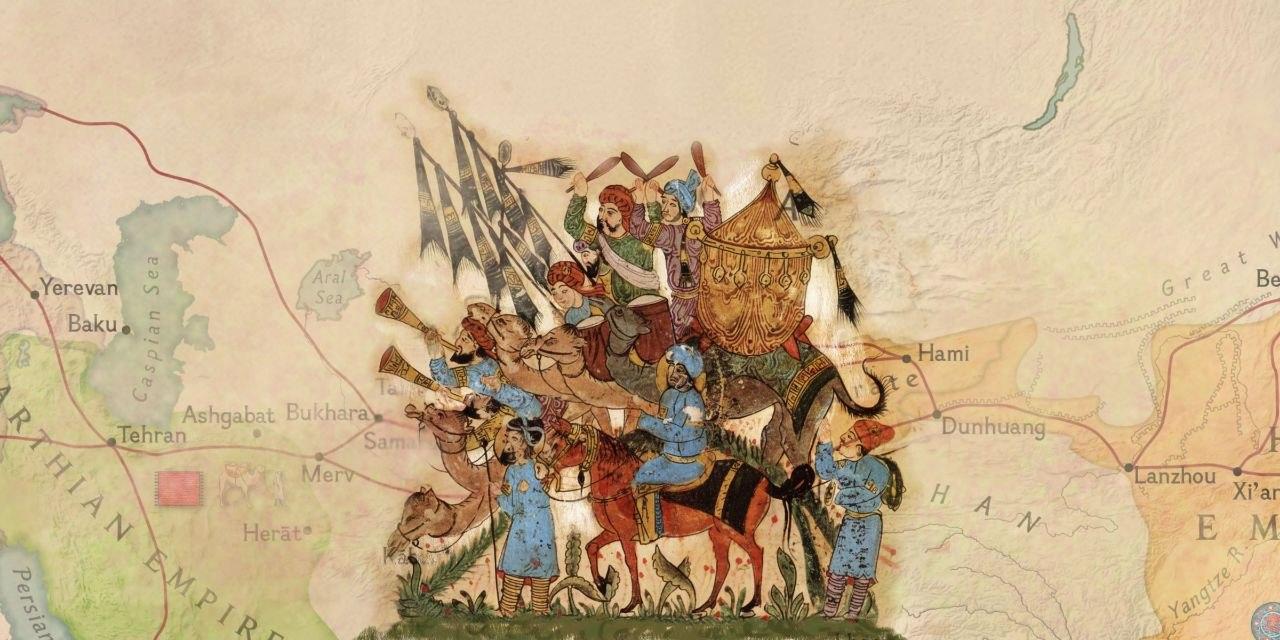
The recent hostilities in the Persian Gulf and the ensuing naval blockades of Iran have brought into sharp relief the growing importance of the Middle Corridor – or Trans-Caspian International Transport Route (TITR) – the rapidly expanding trade link between Western China and Europe. This vast network of road, rail and maritime transport links had already increased in importance as a result of Russia’s invasion of Ukraine and the ensuing sanctions, which have crippled large parts of Russia’s economy.
With hundreds of container ships and oil tankers bottled up in the Gulf and the prospect of serious economic consequences, particularly in the developing world and for China and India, the idea of an overland – mostly – trade route to Europe is increasingly seen as a solution that provides a viable alternative in uncertain times. And not for the first time, as we shall discover.
The TITR is around 3,000 km shorter than the so-called Northern Corridor through the Russian Federation, and transit times from China to Europe now average 10-15 days, compared to double that time for the Northern Corridor and anything up to 60 days for sea transport. According to World Bank estimates, the Middle Corridor could soon account for 20% of overland trade between China and the EU, with a tripling of current traffic levels by 2030, mainly due to economic growth in the Greater Caspian region.
When planning began on the Middle Corridor almost 15 years ago, few people appreciated how rapidly it would develop. But as uncertainties over trade policies have increased, a route that avoids both the Russian Federation and the increasingly dispute-prone waterways in the Gulf and the Red Sea makes sense. Goods produced in Chinese factories in Chongqing, Xi’an and Urumqi can now be transported westward across Kazakhstan by rail to its Caspian Sea ports at Aktau and Kuryk. There are now major rail termini at the Kazakhstan-China border and more than 4,250 kms of rail lines in the network, together with 500 kms of sea transport.
In Aktau on the Caspian, containers are loaded onto ships bound for Baku in Azerbaijan, where they are transferred onto the rolling stock of the Baku-Tbilisi-Kars (BTK) Railway for shipment into Turkey. The original plan was designed to handle 6.5 million tons of freight annually, but this figure is expected to top 17 million tons by 2034.
New port facilities to handle the increasing number of containers arriving at Aktau and Kuryk have been financed by Kazakhstan’s Nurly Zhol Programme. Aktau, for example, is being dredged to enhance maritime safety and expand capacity. Its port currently handles up to 15 million tons of cargo a year.
According to the TITR itself, around 57,000 containers travelled along the route in 2024, up from 20,500 in 2023. The route has continued to gather momentum in 2026: from January to March, 125 container trains were dispatched from China via the corridor, a 34.4% increase over the same period last year. Rail traffic volume increased by 5.7% in Azerbaijan and by 63% in Kazakhstan. More than 50 large trains travelled along the BTK every month in 2025, compared to an annual total of 190 trains in 2024.
Georgia is also building a massive new deep-seaport at Anaklia on the Black Sea at a cost of $600 million. It is expected to handle around 600,000 containers a year by 2029. Kazakhstan is also spending $30 million to pay for the redevelopment of Georgia’s Poti port so that it can handle 80,000 containers a year. Kazakhstan also has plans to build a new terminal in Baku. The World Bank recently said that $7billion was needed to enhance efficiency along the TITR.
Overall spending on the project has already been substantial, with Kazakhstan investing over $35 billion in infrastructure projects that include the Middle Corridor. Georgian Railways has spent over $1 billion on modernising its railway, and Turkey has also spent around $660 million. The World Bank and the Asian Investment Bank have a joint $650 million financing package to improve parts of the corridor, whilst the European Bank for Reconstruction and Development and the EU have pledged over Eu10.5 billion in loans and grants to improve transport connectivity in Central Asia.
Of course, there are potential problems in creating such a huge new transport infrastructure in Central Asia. The TITR also depends on political stability, and this cannot be guaranteed. All the nations along the route have had periods of instability in the last 15 years. But compared to the much larger geopolitical conflicts that have affected countries to both the north and the south, they are minor. Questions remain about Russia’s attitude towards the TITR, not least because if it becomes successful, it will have an impact throughout the Russian Federation, which will lose transit fees. There is also the possibility that the TITR will become bigger and involve more countries. Already, there are moves to open a southern route through Iran, a Trans-Afghan corridor, and a new China-Kyrgyzstan-Uzbekistan rail link.
To students of history, none of this should come as a surprise. China has had an impact on world trade for much of the past 2,000 years or more. Throughout this period, the precise trade routes from east to west have shifted many times. Two millennia ago, for example, when Chinese silk was an ultra-luxury commodity in Rome, trade goods were moved westwards partly by sea and partly by land. So much money was being spent on silk that Roman legislators eventually banned its import on the grounds that too much silver and gold were leaving the empire to pay for it. The Emperor Tiberius, for example, who ruled from 14 to 37CE, restricted (to little effect) the use of silk and enacted laws that banned Roman men from wearing it at all because it weakened masculinity. Not until the 6th century did Byzantine agents smuggle silkworms out of China and finally end European reliance on Chinese imports. That in turn led to a partial collapse of some of the old trade routes.
Even the idea of a Middle Corridor is not particularly new. The old northern trade corridor from the east that cut northwards from China through northern Mongolia and then westward into southern Siberia is ancient. At one time, Chinese brick tea and textiles were the main commodities travelling eastwards, where they were traded for furs, horses and forest products such as honey, pine nuts, etc.
After a period of chaos early in the first millennium CE, caused by the mass movements of groups such as the Huns and the Turks moving across Eurasia, trade settled down once again, and by the 7th-8th centuries Sogdhian merchants in Central Asia had monopolised much of the China trade, moving goods between the cities they had established in mountain valleys and along the waterways.
The Arab invasions of the 7-8th centuries fractured these routes for several centuries and the succeeding trade routes were much more limited, not least because of the collapse of European markets. The Arabs concentrated most of their Central Asia resources on Samarkand and Bukhara, but mainly looked towards Baghdad or Persia for trade.
Further disruption to markets came with the arrival of the Mongols in the early 13th century. But the Mongols also brought safety and efficiency to the trans-Eurasian trade routes, not least because of the need to protect the substantial traffic that flowed from the Mongol heartlands to their outlying satellites in Persia and southern Russia. This was particularly the case following the death of Chinggis Khan in 1227, after which the empire was apportioned among the lines of his four sons: Jochi, Chagatai, Ögedei, and Tolui. Jochi had predeceased his father, and his western ulus later passed to his son Batu.
The Mongol Yam system of strictly controlled, well-equipped and strongly protected posthouses formed the real backbone of the Silk Road, along which the Mongols could send troops, weapons, provisions, even fodder for their horses and camels. Later, as the Mongols consolidated their empire, luxury goods formed much of the cargo. Not surprisingly, the most challenging route to the west was to the most distant region, namely Batu’s Golden Horde, which controlled all the land west of Lake Balkash as far as Moscow, including the Volga River basin.
Under this Pax Mongolica, more trade goods began to flow directly out of China, especially after Chinggis Khan’s grandson, Kublai Khan, became Emperor. Besides the old northern corridor, the two main caravan routes in and out of China skirted the great Taklamakan Desert in present-day Xinjiang – a northerly path via Hami or a more southerly route that hugged the mountain massif to the north of Tibet. Those taking the Hami route still had the option of heading to Kashgar and reuniting with the southern route or striking off to the northwest, following the course of the Syr Darya River to the north of the Aral Sea and then on to the Volga Delta and Batu’s capital at Sarai.
This north-westerly route along the Syr Darya, which we can refer to as the Northen Silk Road, took the caravans through the cities of isfijab (now Sayram), Otrar, Turkistan, Sygnak, Sauran, Jend and Yangkent, and across the top of the Aral Sea, before the long desert crossing to the Volga Delta and then on to the heartland of the Golden Horde around the cities of Sarai and Kazan, or westwards to the Krim khanate (modern Crimea) on the Black Sea. In many ways, it was a precursor of the present-day Middle Corridor.
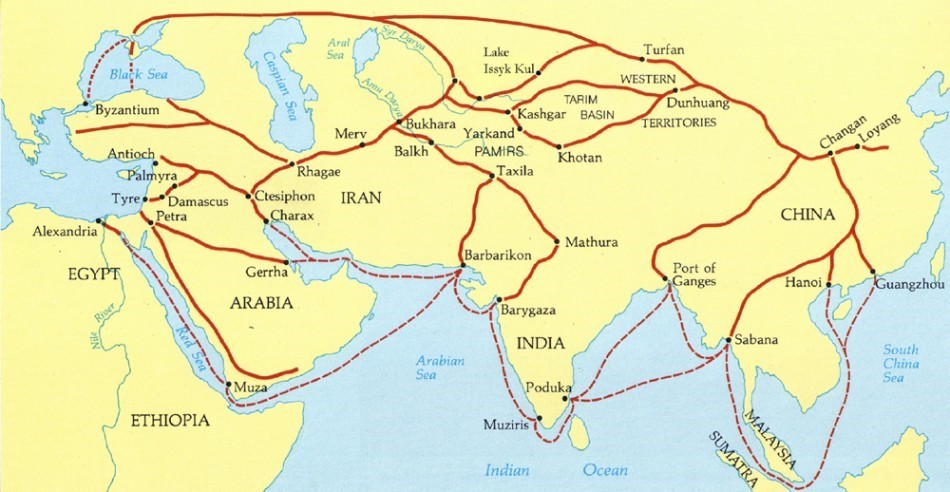
Main routes of the Silk Roads. Note the northern route that runs from Tarim and Issyk Kul, along the Syr Darya, past the Aral and Caspian Seas, towards Krim Tartary.
The early European Papal envoys William of Rubrouck and John de Pian Carpini both travelled eastwards along this well-established route in the 13th-century on their way to the Mongol capital at Karakorum. Remains of some of the cities along this route can be found in the Zhetysu region of Eastern Kazakhstan, although many were wrecked – including Aktam, Karamergen, and Agashayak – in the Mongol invasions.
The most important section followed the Syr Darya from near its source in the Pamirs of what is now Kyrgyzstan, through the Ferghana Valley, and then north-westwards through the Kyzyl Kum desert to the delta at the northern tip of the Aral Sea. Recent archaeological digs at some of the ruined cities scattered along the Syr Darya have led all the present-day states in the region to draw up recommendations to include them in the list of UNESCO World Heritage sites.
Kazakhstan, for example, has drawn up a list of nine archaeological sites, located in what is referred to as the Fergana-Syr Darya Corridor. This in turn links up with the 5,000-km Chang’an-Tian Shan Corridor that stretches westwards from Chang’an in central China to the Tian Shan mountains in present-day Kyrgyzstan and whose 33 cities flourished between the 6th century and the 16th century.
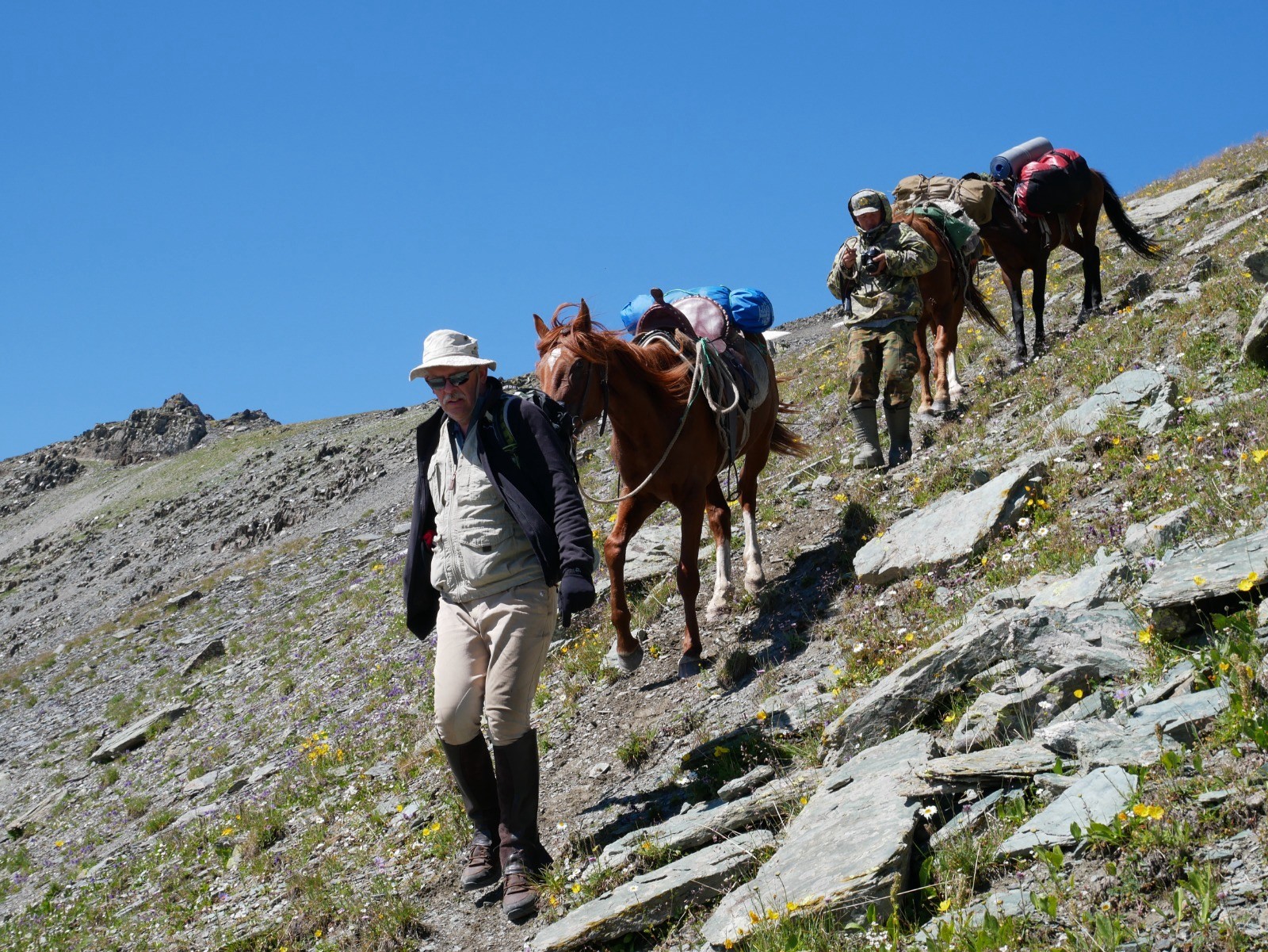
Expedition to the Djungar Alatau Mountains in Zhetysu, eastern Kazakhstan
The Ferghana-Syr Darya UNESCO submission for Kazakhstan describes each ancient city in detail, highlighting its historical significance, architectural features, periods of prosperity and decline, and the results of archaeological research. Otrar, for example, located close to the city of Turkistan, was a major administrative centre before its destruction by the Mongols, with a sophisticated irrigation system and trade connections to many regions. In 1200, Otrar’s population was 200,000, at a time when London had 40,000 inhabitants, Paris 110,000, and Venice 70,000.
Other cities on the Fergana-Syr Darya UNESCO list include Asanas, Kyshkala, Sygnak, Sauran, Zhankala, and Zhankent. Nor should we forget the city of Turkistan, with its famous Timurid mausoleum for Khoja Ahmed Yassavi – possibly the greatest of all the Timurid buildings. The city is built over the ruins of Yassy, which by the Middle Ages had become a commercial and religious hub, serving as a link between Central Asia, China, and the nomadic steppe. It later became the capital of the Kazakh khans, enhancing its regional role beyond trade.
Many of these cities were founded and flourished well before the Mongol conquest in the 12th-13th centuries, but before then, trade was mostly local. Some, like Otrar, which was destroyed by the Mongols, rose again once the Golden Horde had established itself in southern Russia. Nor was it just the Golden Horde that benefited from this trade. As one expert on the Golden Horde notes: “Until at least the sixteenth century Muscovy remained deeply involved in oriental trade, particularly with Persia, as did Yaroslavl and the annexed Volga khanates of Kazan and Astrakhan.”
However, after almost 200 years, which saw a huge expansion in trade and the increasing involvement of European merchants, this golden age of the Northern Silk Road was brought to an end with the defeat of the Golden Horde by Timur in 1391. Having conquered and devastated the region, Timur turned his back on Russia and diverted much of the Northern Silk Road trade from the Syr Darya cities towards Samarkand and Bukhara.
As this trade expanded and merchants found new routes to Europe via Persia, the newly wealthy members of Timur’s court were able to build beautiful palaces, mosques and madrassas in both cities and surround themselves with luxuries. Even today, despite depredations over the years, both Samarkand and Bukhara retain much of their beauty and still impress with their extraordinary textiles, architecture, and literary history.
With little left of the Golden Horde, the caravans that once sustained it now diverted towards more lucrative markets in Timur’s cities of Samarkand and Bokhara and then on towards the great cities of Merv and Herat, before reaching Persia and the Ottoman cities of Antioch and Tyre on the east coast of the Mediterranean in what is now Lebanon. The trade was dominated by Persians who were happy to sell their wares to Venetian and Genoan traders on the coast, who in turn resold their valuable cargoes across Europe – evident from the number of fine Turkish and Persian carpets that began to appear in European paintings.
Timur’s barbaric destruction of dozens of cities and their inhabitants was not a model for stable imperial government, even if, for a brief time, it allowed him to amass vast amounts of plunder to finance the beautification of Samarkand, Bukhara, Tashkent, and, most beautiful of all, Turkistan. Samarkand became one of the largest cities in the world under his rule, its riches obtained by the wholesale destruction of large parts of Central Asia, Persia, the Middle East, and northern India, and the enslavement or annihilation of their populations. After his death, his successors inevitably fell out with each other, and his empire too began to collapse.
By the mid-16th century – and particularly after the destruction by Ivan the Terrible of the khanates of Kazan and Astrakhan in the 1550s – the remaining trade along the Syr Darya fell into steep decline. As security collapsed, cities that had once relied on the caravan trade were abandoned or became shadows of their former selves. When the British merchant adventurer Anthony Jenkinson reached Bukhara in 1560, he was unable to continue his journey east due to numerous conflicts that had broken out along the route.
He was part of a small group of British merchants in the Muscovy Company who believed they could steal much of the Silk Road trade from the Genoese and Venetians operating in the Eastern Mediterranean and the Black Sea. Their idea was simple: divert the trade north again, either from Samarkand and Bukhara or northwards across the Caspian Sea from Persia towards Astrakhan and the Volga. By using the Russian rivers, goods could be taken to the White Sea in the far north and then transported by ship to England. Instead of Venetians and Genoans making super profits from trading in silk, jewels and spices, it would be English merchants controlling the trade.
As Michael Locke, a Muscovy Company agent stated at the time: “The traffic of Persia through Russia would be of exceedingly great importance to England for jewels, silks, drugs, galls [an insect product, used in tanning and dyeing], alum, and other merchandises there to be had at their fount; all of which might pass safely, without danger of the Turk, and without knowledge of Italy and Spain, and with no license from the King of Portugal. And all those commodities of Russia and Persia would pass abundantly by this North Sea into England and through England out again into Flanders, Germany, France, Spain and Italy, through the hands of Englishmen.”
The Muscovy Company received its royal charter in 1555, and two years later, Anthony Jenkinson set sail from London on what was the first of four expeditions aimed at unlocking the wealth of the Silk Road. He eventually reached Bukhara in 1560, thus becoming the first European to sail on the Caspian. Jenkinson would go on to visit Persia twice in an effort to make the business work. In fact, between 1557 and 1581 six English expeditions were sent down the Volga to Persia. When the Russian Tsars deprived the company of the right of free transit in the 1590s, the English opened trade relations in the Persian Gulf. They concluded an alliance with the Persian shah in 1620 and forced the Portuguese to give up their bases in the Gulf. In this way, they began to undercut the Genoans and Venetians in the Mediterranean and to establish the basis for a seaborne British empire.
New sea routes to the East meant goods were generally safer and no longer subject to the depredations of nomadic bandits on the Central Asian steppes. Although the Muscovy Company’s efforts to divert trade to the north were ultimately unsuccessful, even in the 18th century, English merchants were still trying to find a way of diverting the Persian trade northwards to Russia. In September 1743, for example, the English merchant Jonas Hanway left St Petersburg for Moscow, Tsaritsyn and Astrakhan, where he took a ship across the Caspian Sea to Persia.
Little came of Hanway’s efforts; much of his cargo was stolen, he became ill, and his ship was attacked by pirates. That, it seems, was the end of attempts by the British to divert the trade to the north. For the next 100 years or so, the cities of Central Asia continued their steady decline, left behind by a world increasingly dominated by the new modes of transport.
With the construction of the Transcaspian railway in the late 19th century – only possible due to Russia’s conquest of the khanates – travel to and within Central Asia became much easier. In fact, the military railway that the Russians opened in Spring 1888 as part of their project to control this vast region eventually became the main route into the heart of Central Asia. From the Caspian coast, it passed through Ashgabat and Merv before reaching Bukhara, Samarkand and Tashkent. As soon as the railway opened, it became a favourite with aspiring European tourists who could now reach the Registan in Samarkand almost without getting dust on their shoes.
At the same time, the fact that the new railway skirted the Syr Darya but took in both Samarkand and Bukhara only reinforced the view that these two cities were the most important survivors from the time of the Silk Road. Even before the beginning of the 20th century, the old Northern Silk Road along the Syr Darya had been almost completely forgotten.
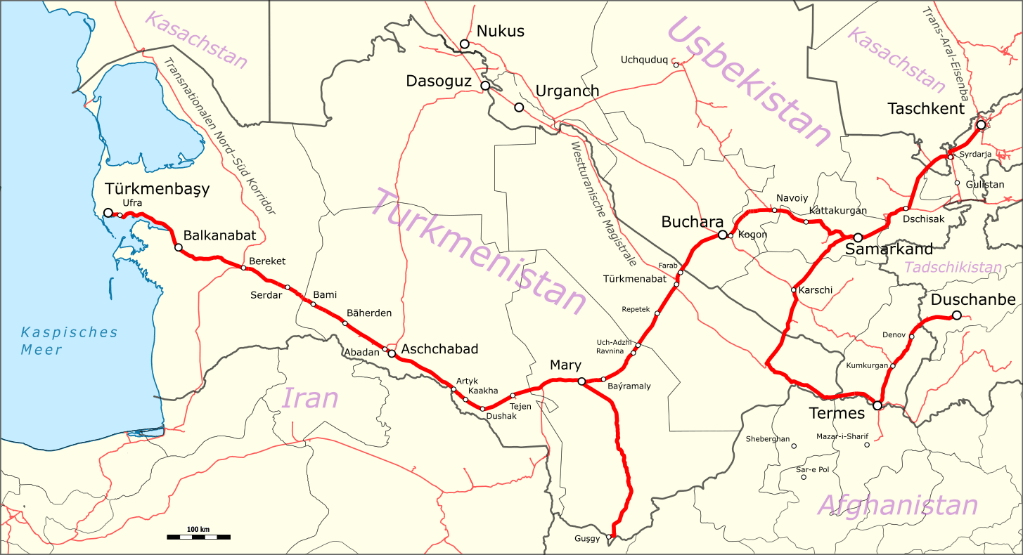
The Trans-Caspian railway opened in 1888
Today, the Middle Corridor is the phrase that is on everyone’s lips. The recent disruption to international shipping has reemphasised the importance of the old Eurasian land routes along the Syr Darya. Modes of transport may have changed, but safe, practical and efficient terrestrial systems may turn out to have an edge.