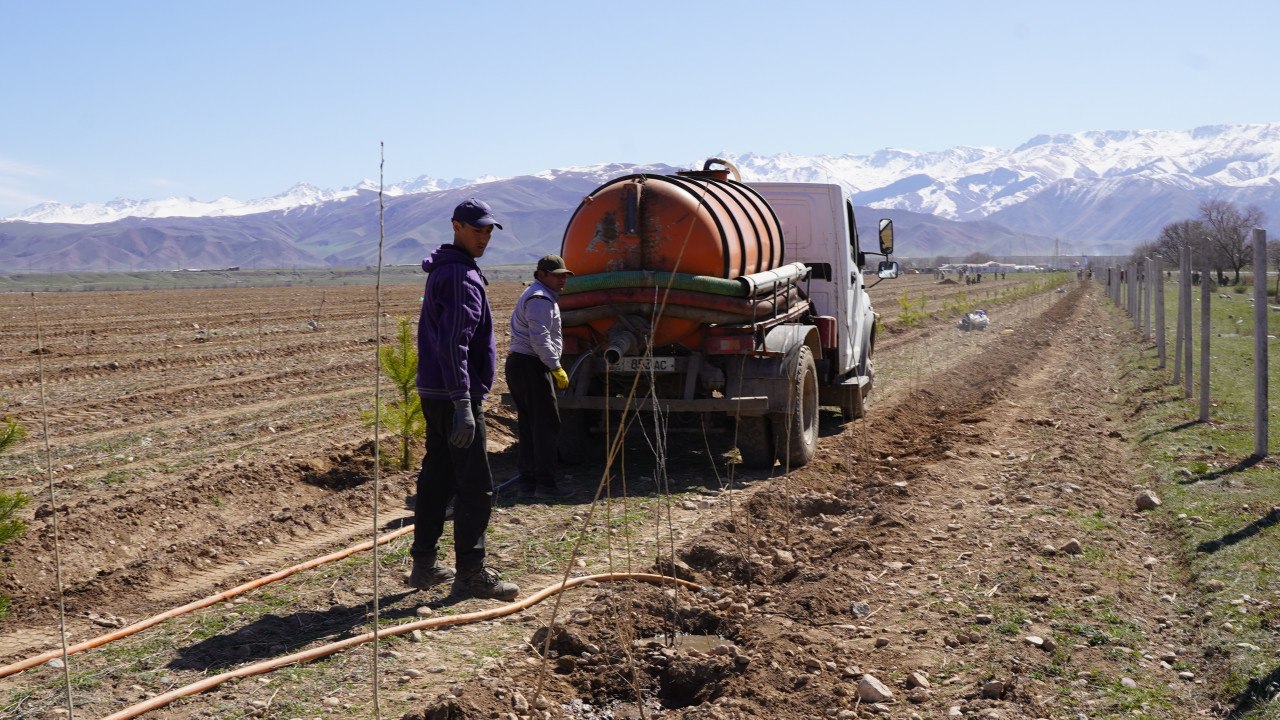
In spring 2026, more than 400,000 forest and fruit tree seedlings were planted over roughly 500 hectares of land across Kyrgyzstan under a project overseen by the United Nations’ Food and Agriculture Organization (FAO).
The project, Carbon Sequestration through Climate Investments in Forests and Pastures in the Kyrgyz Republic, began in 2023. Financed by the Green Climate Fund, it aims to reduce carbon dioxide emissions, while supporting climate change mitigation and adaptation.
According to FAO in Kyrgyzstan, the community-based planting activities included a wide variety of trees – Tian Shan spruce, juniper, walnut, almond, poplar, apple, apricot and plum. The species were selected because they are well adapted to Kyrgyzstan’s climatic conditions and have high resilience and carbon-sequestration potential.
The project gives special attention to strengthening the capacity of local communities. It provides seedlings, fencing materials and, where required, drip irrigation systems, while local communities contribute labor and participate in establishing planting sites. Planting on municipal land is organized by local self-government bodies, while work inside the State Forest Fund is carried out by local forestry units.
The four districts selected for the project – Ak-Talaa, Suzak, Toguz-Toro and Uzgen – were chosen because of their high vulnerability to the impacts of climate change in Kyrgyzstan’s Naryn, Jalal-Abad and Osh regions.
According to climate observations covering the past 27 years, the average annual temperature in these areas has increased by 1.5°C. Several districts have experienced declining precipitation levels, alongside an increasing frequency of climate-related disasters, including landslides and mudflows.
The project is part of a wider effort to help rural communities adapt to climate pressure in Kyrgyzstan. In 2025, TCA reported on the use of artificial glaciers to support farmers in water-scarce areas, where controlled winter ice accumulation can provide additional irrigation water during the growing season.
Nor is this Kyrgyzstan’s only collaboration with the FAO on climate and land management. In April 2025, the FAO and the European Bank for Reconstruction and Development launched a separate initiative, Greening Kyrgyzstan’s Economy: Know More, Act Better, Enhance Results, which uses geographic information system technology to improve farmland monitoring, support climate-smart agriculture and strengthen food security.
Climate concerns have also become increasingly visible around Lake Issyk-Kul, one of Kyrgyzstan’s most important natural landmarks. TCA has reported that melting glaciers, changing precipitation patterns and more frequent extreme weather pose long-term risks the Issyk-Kul basin, with possible consequences for water resources, agriculture, tourism and energy security.
Although the latest planting figures concern forests and orchards, the wider project also covers pasture management, a central issue in rural Kyrgyzstan, where overgrazing and land degradation have put pressure on mountain ecosystems. Planned measures include rehabilitating access roads and bridges to remote pastures, building livestock watering points, establishing shelterbelts, developing pasture grass seed nurseries, and introducing rotational grazing practices.
The project is expected to sequester more than 19.8 million tons of CO₂ equivalent over a 20-year period. This represents 7.6% of the country’s total greenhouse gas emissions and 22.6% of emissions from the agricultural sector. Under the Paris Agreement, Kyrgyzstan has committed to reducing greenhouse gas emissions by 15.97% by 2030, and the project is expected to contribute toward achieving that target.
Overall, more than 6,000 hectares of forest landscapes will be restored through both direct planting and assisted natural regeneration.
According to the Ministry of Natural Resources, Ecology and Technical Supervision, 8,239,915 tree saplings were planted across Kyrgyzstan in 2025 as part of the campaign.
In 2026, Kyrgyzstan plans to plant 9 million trees. As of March 2026, authorities said they had already having planted 3,820,663 saplings in the first three months of the year.