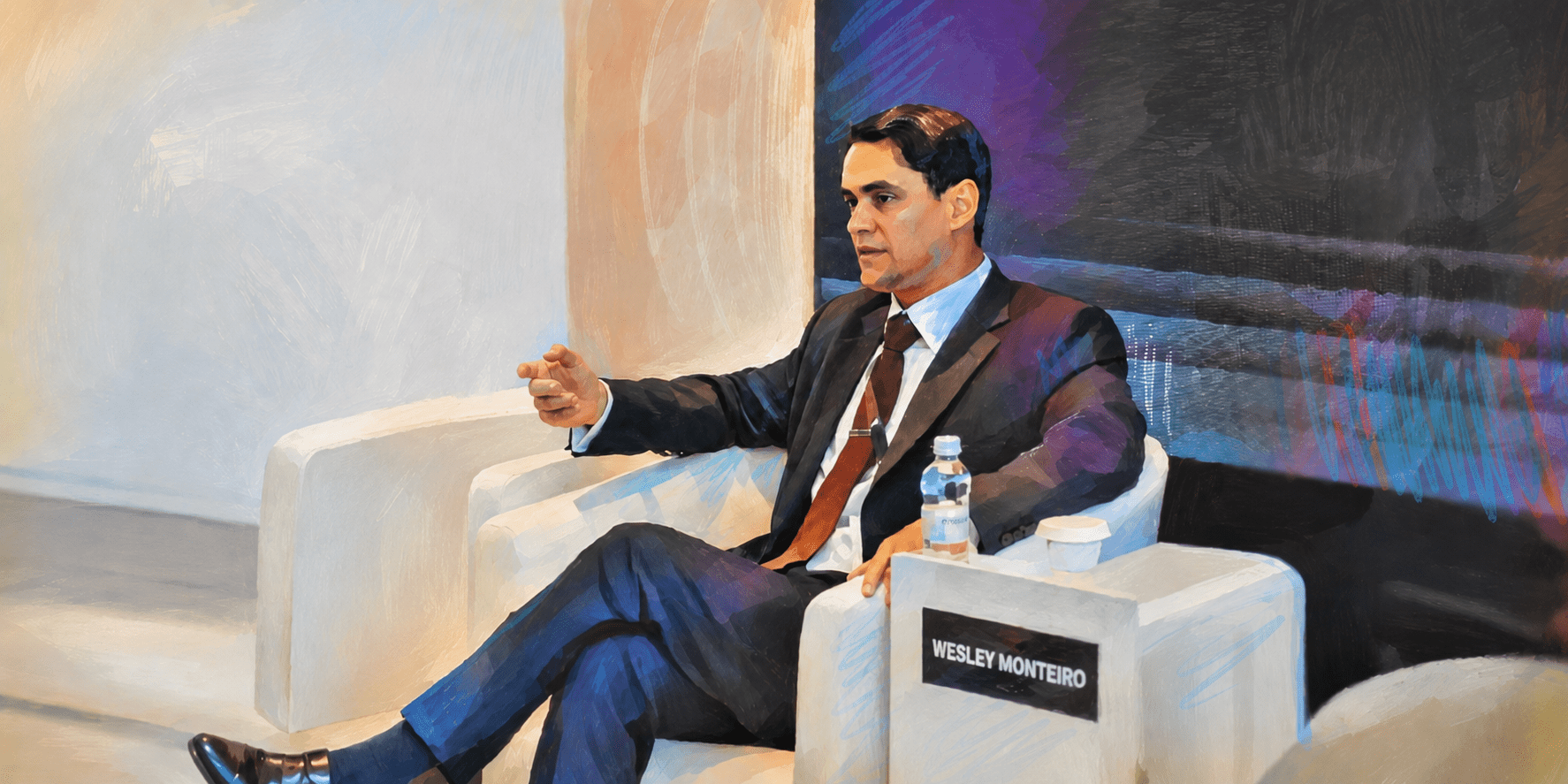
Wesley Monteiro, Global Market Engagement Lead at S&P Global Energy/Platts, said Kazakhstan has one of the strongest chances among mining jurisdictions to move from tier-two toward tier-one, speaking to The Times of Central Asia on June 12 on the sidelines of the Astana Mining & Metallurgy Congress in Astana.
“This is the country with a big chance to move from tier-two to tier-one,” Monteiro said.
He developed that argument around five factors: mineral breadth, scalable copper production, uranium, legacy mining waste, and Kazakhstan’s diplomatic architecture.
“Actually, this is the only country in the world that has this combination,” he said.
Monteiro used Canada and Australia as reference points for established first-tier mining countries. Kazakhstan is not yet in that category, he said, but the combination he described gives the country a credible path toward it.
Monteiro was speaking from the S&P Global Energy/Platts side of the company, which provides market information, price benchmarks, supply-demand analysis, and commodity-sector intelligence, rather than from S&P Global Ratings.
Kazakhstan, in his view, is being reassessed as part of a new global commodity framework shaped by energy security and flexibility, and materials security and flexibility. In that environment, Kazakhstan’s position could help reduce investor risk perception and support new or increased investment in the region.
“We can see in the short to medium term a reduction in the risk perception that can trigger new investments or can increase the investments in the region,” Monteiro said.
He then expanded on each of the five factors.
Mineral Breadth
The first pillar was mineral breadth. Monteiro pointed to copper, aluminum, zinc, uranium, and other minerals. He described this range as “mineral breadth” or “mineral range,” distinguishing Kazakhstan from mining jurisdictions built around a single resource. For Monteiro, that range was the starting point for the tier-one argument.
Scalable Copper Production
Within that mineral breadth, Monteiro singled out copper as the second pillar. Copper is central to the infrastructure behind electrification, power grids, data centers, and AI computing, and Monteiro said the demand is not distant or theoretical.
“Now everyone needs copper, not 15 years from now — yesterday, actually,” he said.
For Monteiro, Kazakhstan’s copper position is therefore not only about reserves. He distinguished between having the resource, having the capacity to produce it, and being able to develop it quickly.
“One thing is to have,” he said. “Another thing is the capacity to have the production. The third thing is how fast you can develop this.”
Uranium
Uranium was the third pillar in Monteiro’s account of Kazakhstan’s mining position. He framed it through the renewed global debate over nuclear power, saying the sector has returned to strategic relevance after years in which some governments moved away from it following the Fukushima accident in 2011.
Germany, he said, became the clearest example of that retreat, while France maintained a large nuclear base and, in his view, emerged in a stronger position.
“Nuclear is back in the game,” Monteiro said.
He said the renewed interest in nuclear power is being driven by energy security, energy flexibility, and the need for electricity generation with no direct carbon emissions. Kazakhstan’s position in uranium is therefore not merely that of an alternative supplier. The country is already the world’s leading uranium producer, and Monteiro said that role becomes more significant as nuclear power returns to the strategic agenda.
For consuming countries, Kazakhstan’s value lies not only in scale, but in its ability to function as a secure and politically workable supplier.
“If you have a country such as Kazakhstan, because of what this country represents — stability, relationships, secure supplier — you can have an option to have uranium from this country,” he said.
For Monteiro, uranium was not simply another mineral in Kazakhstan’s resource base. It was the pillar that connected the country’s mining sector directly to the nuclear-power revival and to the wider search for reliable, politically workable supply chains.
Mining Waste
The fourth pillar was Kazakhstan’s legacy mining waste. He described it as a potential secondary resource base, particularly because recovery from existing waste could be faster and cheaper than developing an entirely new mine.
Monteiro said Kazakhstan’s recycling rate is about 11%, leaving room for greater recovery where the economics and technology are viable. He contrasted that opportunity with the long lead times for new mining projects, which can take 10 to 15 years to develop. Existing mining waste, he said, may offer a nearer-term resource where recovery is technically feasible.
Geopolitical Balance
Diplomatic architecture was the fifth pillar. Monteiro said Kazakhstan is often described as neutral, but he argued that the word understates the country’s position.
“Neutral is too weak” of a description, he said. “It’s too weak in my perception to express the diplomatic architecture that this country built.”
What he described was not neutrality in the passive sense, but an active network of relationships across competing centers of power. Kazakhstan, he said, has built working ties with the East and West, Europe, Russia, China, the Middle East, and other regions. That gives the country a different profile from jurisdictions whose resources are constrained by alignment with one bloc or dependence on a single route.
For Monteiro, that diplomatic architecture feeds directly into Kazakhstan’s value as a partner and supplier. Consumers are not only looking for materials; they are looking for redundancy.
“If you are a consumer in Europe, what do you want now?” he said. “You want to have options. This country can also position itself as an option.”
He compared that kind of optionality to having two turbines on an aircraft. It does not remove risk, but it changes the risk profile by giving buyers and investors another source of supply and level of security.
Monteiro illustrated the point through pipelines. Engineering, he said, is often straightforward. The harder issue is whether countries trust one another enough to build and rely on cross-border infrastructure.
Kazakhstan, by contrast, has been able to manage major resource and transport relationships across borders. Monteiro pointed to Kazakhstan’s oil exports through Russia as an example of infrastructure that depends on long-term political and commercial relationships.
“The main resource of this country is exported through another country,” he said, referring to Kazakhstan’s oil exports through Russia. “Why can this country do that? It’s not a given. It’s not destiny. It’s a thing that was built by this country.”
He also linked Kazakhstan’s landlocked geography to infrastructure and diplomacy. The country does not have direct access to open sea routes, but Monteiro said its railways and cross-border connections give it a valuable position. In his view, that is part of why Kazakhstan can reduce investor risk perception. Its resources are backed not only by good geology, but by the relationships and infrastructure needed to move them.
Reinforcing the Tier-One Case
Beyond the five pillars, Monteiro also pointed to Kazakhstan’s downstream development, domestic technical capacity, and record of managing long-term resource relationships as signs of a more mature mining jurisdiction.
Kazakhstan is already more than a raw-material exporter in several parts of the sector, with existing smelting, refining, processing, and metallurgical capacity. For Monteiro, that downstream base and its continued expansion are evidence of a more mature mining industry.
“They are advancing further in the chain,” he said.
That expansion broadens the investment profile. Processing, smelting, refining, metallurgy, logistics, and related infrastructure carry different risk profiles, return expectations, and investment horizons. For Monteiro, Kazakhstan’s ability to work with foreign investors across those stages reinforces its profile as a more mature mining jurisdiction.
Monteiro also treated human capital as part of Kazakhstan’s execution capacity. Large resource projects, he said, depend on domestic technical depth: geologists, engineers, site managers, operators, and the institutional knowledge needed to keep projects running over long-time horizons.
He referred to a figure cited by Kanat Sharlapaev, chairman of Atameken, Kazakhstan’s National Chamber of Entrepreneurs, that the country produces about 3,000 geologists a year. He also noted that foreign companies operating in Kazakhstan often find that technical and managerial roles are filled locally rather than by expatriates.
For Monteiro, that gives Kazakhstan a different profile from jurisdictions where technical capacity must be imported or built more gradually.
He also linked Kazakhstan’s mining profile to its experience working with foreign investors in resource sectors. The country’s ability to move further down the value chain, he said, reflects the “maturity of the industry as a whole to deal with foreign investors.”
For Monteiro, that record is important because mining projects are not short-cycle investments. They can run for 20 to 30 years, and investors assess those risks differently from projects with four- or five-year horizons.
“A history of being able to manage long-term relationships would be really important,” he said.
Monteiro also placed Kazakhstan in a broader commodity context. Separate from his mining-tier comparison with Canada and Australia, he compared Kazakhstan with Brazil and Australia as a country whose profile extends beyond metals to energy and agricultural commodities.
From Deposits to a First-Tier Mining System
Monteiro was careful not to treat today’s assumptions underpinning demand for commodities as permanent. Commodity narratives can shift quickly, he said, recalling how investor attention has moved in recent years from the metaverse to energy transition, hydrogen, artificial intelligence, data centers, and data infrastructure. For now, however, the pressures behind the mining story remain in place: energy security, power demand, materials security, and the search for supply chains that are reliable and politically workable.
Kazakhstan’s case, in his telling, is not simply a story of attractive geology. It is the combination of a broad mineral base, copper that can be developed to meet immediate demand, uranium at a moment when nuclear power is returning to the strategic agenda, a secondary opportunity in mining waste, and diplomatic architecture that gives buyers and investors options.
That is what separates a mining system from a mining prospect. Deposits on a map are only the beginning. The question is whether a country can turn them into production, sustain that production, and move it to market over decades. Kazakhstan is not yet Canada or Australia, the established first-tier mining countries Monteiro cited. But in his assessment, it has assembled enough resource depth, industrial capability, and geopolitical reach to make first-tier status a realistic prospect.
This article forms part of The Times of Central Asia’s special coverage of Central Asia’s expanding role in U.S. critical minerals security.