Azerbaijan has moved from preliminary mining talks to signed project agreements in Uzbekistan.
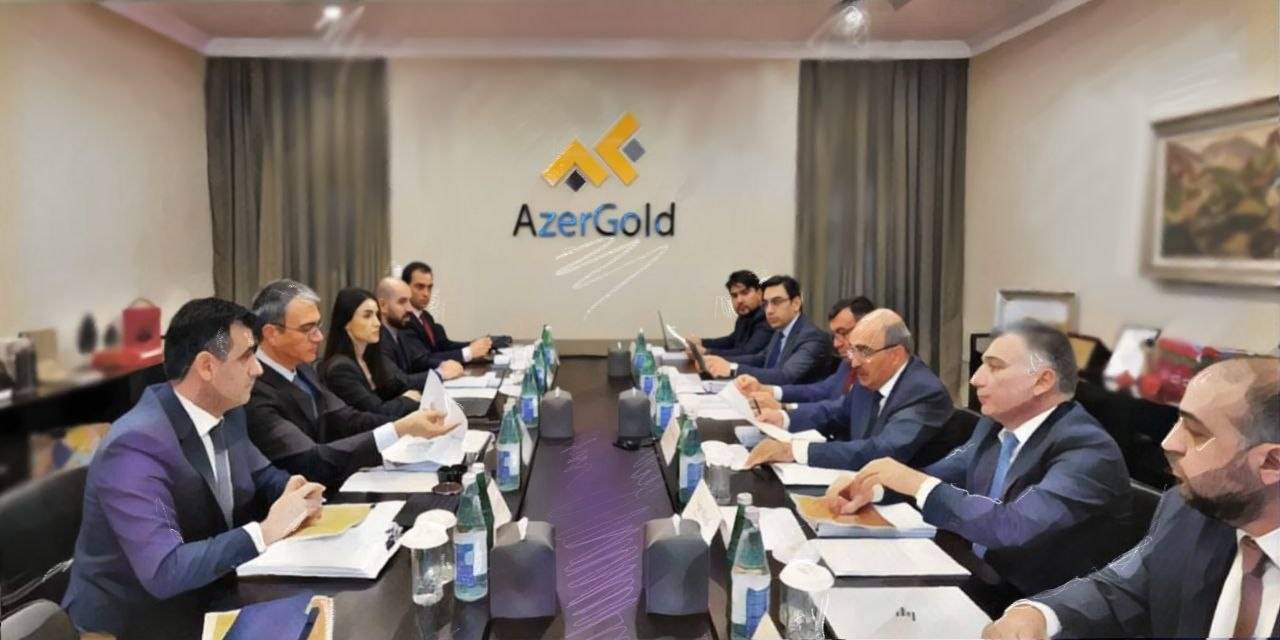
On June 16, state-owned AzerGold signed an agreement to jointly develop a gold deposit in Uzbekistan. A separate document covered a critical minerals project with NEQSOL Holding. Azerbaijani Prime Minister Ali Asadov and Uzbek Prime Minister Abdulla Aripov attended the ceremony in Tashkent.
AzerGold chairman Zakir Ibrahimov and Uzbekistan’s First Deputy Mining Minister Feruza Hamidova signed the gold agreement. Public releases provide few details on either project, naming no deposits and disclosing no reserve estimates, ownership split, investment value, production target, or timetable.
Three Years of Groundwork
AzerGold’s entry into Uzbekistan dates to February 24, 2023, when the company signed a memorandum and agreement with Uzbekistan’s Ministry of Mining Industry and Geology. The documents covered geological exploration and the development of gold deposits. In August 2024, the two sides discussed projects in Uzbekistan, Azerbaijan, and third countries, and agreed to deepen cooperation.
By May 2026, Uzbek officials were reviewing prospective areas and project documents. “We have begun active joint work with the Azerbaijani company AzerGold on geological exploration in the territory of the Republic of Uzbekistan,” Deputy Mining Minister Ural Yusupov said. He added that a decision on joint gold and silver exploration was expected by the end of the year.
Yusupov identified Kashkadarya and Surkhandarya as areas under study for precious metals, and Karakalpakstan and Jizzakh for critical minerals. The June signing followed six weeks later, but did not identify the selected deposit.
A Much Larger Gold Market
AzerGold was established in 2015 and began operations in 2016. The company develops gold, iron, and other metal deposits in Azerbaijan and has extracted ore at its Chovdar gold mine since 2017.
In 2025, AzerGold sold 73,200 ounces of gold and 93,200 ounces of silver. Revenue reached 439.3 million manats, about $258 million, up 43% from 2024.
Uzbekistan’s gold industry operates on a much larger scale. Navoi Mining and Metallurgical Company produced 3.15 million ounces of gold in 2025. The country has set production targets of 120 tonnes for 2026 and 175 tonnes by 2030.
The country plans to invest $2.2 billion across 90 mining projects this year. Across the broader mining and metallurgical sector, projects worth $22 billion are expected to create 38,000 jobs.
In February, AzerGold identified Uzbekistan and Kazakhstan as possible locations for international expansion. The company prefers brownfield projects with existing infrastructure and production bases.
NEQSOL’s Critical Minerals Track
The second document is broader, covering a joint critical minerals project involving NEQSOL Holding but naming neither the mineral nor the deposit. The group also operates in energy, telecommunications, construction, and high technology.
NEQSOL had already established a wider framework with Tashkent. In July 2025, the group and Uzbekistan’s Ministry of Investment, Industry and Trade agreed to develop projects in geology and mining, energy, telecommunications, chemicals, construction materials, and digital technology.
NEQSOL entered mining in 2025 through its acquisition of UMCC Titanium in Ukraine. UMCC operates the Vilnohirsk and Irshansk mining and processing complexes, which produce ilmenite, rutile, and zircon concentrates for aerospace, chemical, and industrial users. NEQSOL plans to modernize the assets and expand downstream processing.
Public disclosures name no local partner and give no investment figure or production date.
Uzbekistan Targets Deeper Processing
The agreements come as Uzbekistan rapidly expands its critical minerals program. A $4.2 billion plan for 2026-2030 covers 120 projects and could support industrial production of 28 critical minerals. The government wants output to reach $1 billion by 2028 and $2 billion by 2030.
For 2026 alone, 12 projects worth $166 million are planned, including high-purity selenium, tellurium, and rhenium. Uzbekistan is also planning full value chains for tungsten and molybdenum, from powders and alloys to rods, wires, and industrial parts.
“We invite the leading companies to Uzbekistan to implement projects on deep processing of strategic raw materials and creating high-value-added chains,” President Shavkat Mirziyoyev said in 2024.
The June agreements turn three years of groundwork into formal project commitments.