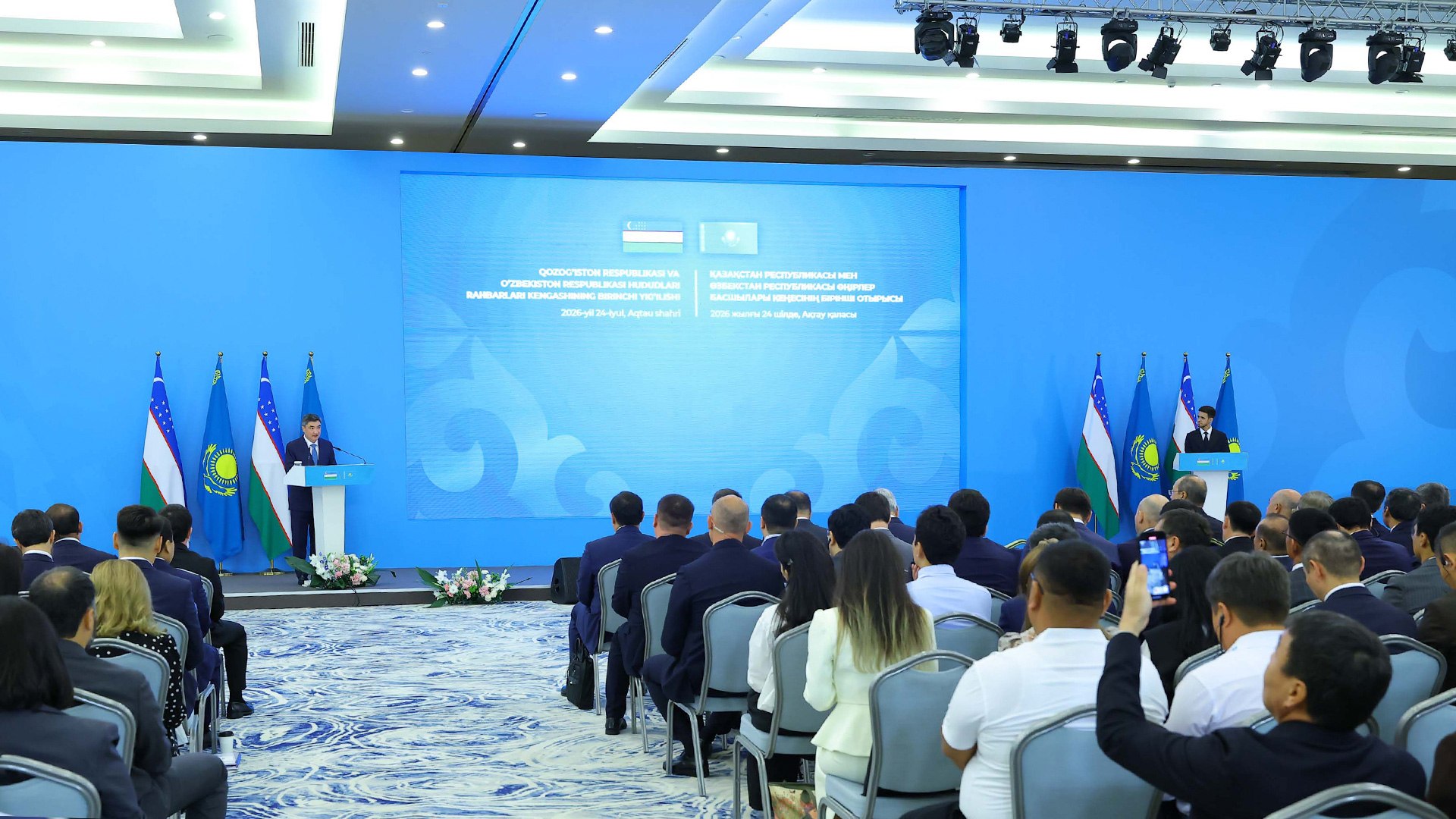
The first meeting of the Kazakhstan-Uzbekistan Council of Regional Leaders was held in the Caspian city of Aktau on July 24, involving Kazakh Prime Minister Olzhas Bektenov and Uzbek Prime Minister Abdulla Aripov, according to the Kazakh government.
The new platform for regional cooperation is aimed at facilitating trade and investment, as well as strengthening transport links and cross-border partnerships.
“We attach special importance to the comprehensive development of our strategic partnership with our brotherly Uzbekistan,” Bektenov said, describing the establishment of the Council of Regional Leaders as a “logical” step in the two countries’ relationship.
Bektenov noted that direct ties between regions would play an important role in expanding trade and investment, adding that he was confident the council “will make a significant contribution” toward achieving the goal set by the two presidents of increasing bilateral trade to $10 billion.
Aripov, his Uzbek counterpart, described Aktau as a symbolic venue for the inaugural meeting, calling it “the pearl of the Caspian Sea” and one of the region’s key transport and logistics hubs.
“Kazakhstan is not only a close neighbor for Uzbekistan, but also a reliable strategic partner and ally,” Aripov said.
“Interregional cooperation has become one of the priority areas of our partnership, and that is why our respected presidents decided to establish the Council of Regional Leaders.”
He said direct contacts between regional authorities would provide “a powerful impetus” for further strengthening Uzbek-Kazakh relations.
Bektenov also highlighted the importance of fully launching the Central Asia International Center for Industrial Cooperation, saying the project should be filled with competitive and mutually beneficial initiatives.
Transport and logistics featured prominently in the discussions. Kazakhstan and Uzbekistan two countries share a border of approximately 2,300 kilometers and officials stressed the need to further develop infrastructure connecting the two countries. Particular attention was given to the Trans-Caspian International Transport Route, which is linked to the North-South corridor and the Trans-Afghan route.
According to the Kazakh government, cargo handling through the ports of Aktau and Kuryk reached 8 million tons last year. During the first half of 2026, container traffic through Kazakhstan’s ports increased by 5%, surpassing 50,000 twenty-foot equivalent units (TEUs).
The two sides also discussed expanding tourism cooperation, citing growing interest among citizens of both countries in visiting historical and cultural destinations.
Regional leaders from both countries presented development plans during the plenary session. Participants included the governors of Kazakhstan’s Mangystau and Turkistan regions, the deputy mayor of Shymkent, and the governors of Uzbekistan’s Jizzakh, Syrdarya, and Tashkent regions. More than 300 business representatives from Kazakhstan and Uzbekistan also attended the event.
The meeting concluded with the signing of several memorandums between the regions of the two countries, along with commercial agreements worth more than 80 billion tenge, or approximately $170 million.
According to the Kazakh government, the new agreements are expected to strengthen cross-border cooperation, support joint investment projects, and contribute to the long-term economic development of Central Asia.