Kazakhstan’s long-dominant Amanat party has voted to merge into the newly formed pro-presidential Adilet party, transferring the machinery of the country’s ruling political force into a new vehicle more closely associated with President Kassym-Jomart Tokayev.
The move gives Adilet the campaign infrastructure and nationwide network of officials and activists that it lacked as a newly registered party. For Amanat, it offers a way to move beyond a political brand still closely associated with former President Nursultan Nazarbayev.
Amanat held a congress in Astana on June 12 that is likely to be remembered as the final meeting of a political organization whose history spans a quarter of a century. For most of that period, the party was known as Nur Otan, the ruling party built around Nazarbayev and chaired by him for much of its existence.
The rebrand followed the chaos of January 2022, officially referred to in Kazakhstan as the January Events, when protests triggered by fuel price rises grew into the most serious political crisis in the country’s post-Soviet history. The violence weakened Nazarbayev’s remaining influence and accelerated Tokayev’s effort to distance the political system from the Nazarbayev era. It also made Nur Otan’s association with the former president a political liability.
Tokayev took over Nur Otan from Nazarbayev in January 2022. Two months later, the party was renamed Amanat. Tokayev stepped down from the party leadership in April, after Kazakhstan amended its legislation to prohibit the president from being a member of any political party. Since then, Amanat has been led by Yerlan Koshanov, an experienced official and Tokayev ally.
At the congress, Koshanov acknowledged that the 2022 name change had failed to remove the party’s association with the previous political era.
“Let us be frank,” he said. “Certain associations and assessments related to the party’s past still remain in public consciousness.”
Amanat remains politically useful: it has the organization needed to contest elections. But its connection to Nazarbayev’s era sits uneasily with Tokayev’s attempts to present his presidency as a break with the old system.
Koshanov told delegates that the country needed “new points of unity” rather than new divisions, and said Amanat should combine its resources with Adilet as part of a single pro-presidential force. Delegates unanimously approved the decision to join Adilet.
New Kid On The Block
Adilet, meaning “justice,” is a very new party. As previously reported by The Times of Central Asia, it held its founding congress on May 7 and was officially registered by Kazakhstan’s Ministry of Justice on June 1. Its chairman is Aibek Dadebay, a former head of Tokayev’s presidential administration. The party presents itself as a pro-presidential force built around the language of responsibility and reform.
On June 14, Adilet held its second congress. Party leader Aibek Dadebay, addressing participants, proposed voting in favor of Amanat joining Adilet, describing it as a decision based on national responsibility and broader state interests rather than narrow party calculations. Delegates approved the merger, confirming that Adilet is less the creation of an entirely new political force than a transfer of Amanat’s organizational capacity into a newer pro-presidential platform.
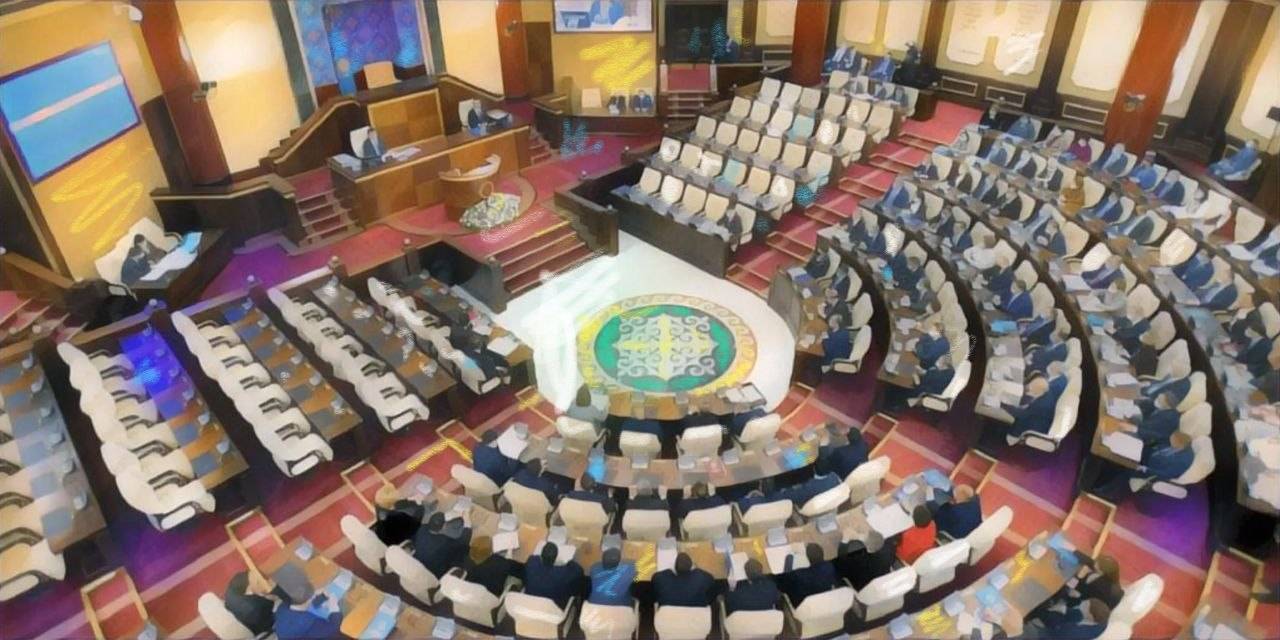
The timing appears deliberate. Kazakhstan’s new Constitution comes into force on July 1, triggering the dissolution of the current bicameral parliament. Elections are expected in August to a new unicameral legislature, the Kurultai, which will have 145 deputies.
The merger therefore comes just before Kazakhstan’s first parliamentary campaign under the new constitutional framework. It also follows Tokayev’s June 4 call for “healthy, progressive socio-political forces” to consolidate around national goals and values.
Analysts See a New Dominant Party
Several Kazakh political analysts have read the Amanat-Adilet merger in that context.
Political analyst Andrey Chebotarev, writing on Telegram, said Amanat would bring Adilet a powerful organizational base, including deputy factions in maslikhats at all levels, youth, women’s and business wings, regional branches, primary party organizations, a media operation, and institutions for policy analysis and party training.
For Chebotarev, the political result of the merger will be “the emergence on Kazakhstan’s political stage of a new dominant party,” one likely to take most seats in the first Kurultai. The prospects of other parties, he said, will depend largely on how well they prepare for the coming election campaign.
Chebotarev suggested that the process of uniting the two parties will most likely be officially completed in July through another Adilet congress, with updates to the party’s charter and the composition of its governing bodies.
Political analyst Daniyar Ashimbayev said the merger scenario appeared to have developed gradually, during internal discussions and public debate. He described it as part of a political style “that prefers flexible planning and monitoring of public opinion.”
Political analyst Marat Shibutov, who was involved in the creation of the new party, predicted that it would be able to win between 100 and 120 seats in the new legislative body, the unicameral Kurultai.
Other Parties Face a Short Campaign
Olzhas Baidildinov, another political commentator, noted that Kazakhstan currently has eight registered parties: Adilet, Amanat, Ak Zhol, Baytaq, the People’s Party of Kazakhstan, Auyl, Respublika, and the National Social Democratic Party. With Amanat now moving into Adilet, the balance among the remaining parties will become one of the main questions of the campaign.
“With 70% or 80% for the leading party headed by Aibek Dadebay, there may already not be enough seats for all the other parties. At least one party, and more likely two or three, will not enter the new parliament,” he said. No election date has been formally announced, though the vote is widely expected in August.
The Ak Zhol party has already moved to refresh its own leadership. At a party congress on June 13, longtime chairman Azat Peruashev stepped aside and Daniya Yespayeva, a former presidential candidate and deputy speaker of the Mazhilis, was elected party chair.
Kazakhstan has had women leading registered parties before. In 2003, the Rukhaniyat party was headed by Altynshash Jaganova. The party was dissolved in 2013, and since then women have usually occupied secondary roles in Kazakhstan’s party leadership.
Yespayeva’s elevation gives Ak Zhol a new figurehead before a short and potentially difficult campaign. The party has long presented itself as a pro-business liberal opposition, while remaining inside the legal parliamentary field.
Auyl may also be well placed to compete for representation. The party represents rural interests, and its electorate may prove more disciplined than urban voters during a summer campaign.
For now, the central change is clear. Amanat’s name is being left behind, but its organization is not. The country’s main pro-presidential party infrastructure is being repositioned under the Adilet banner, giving a party created only weeks ago the national machinery to contest Kazakhstan’s first election to the new Kurultai.