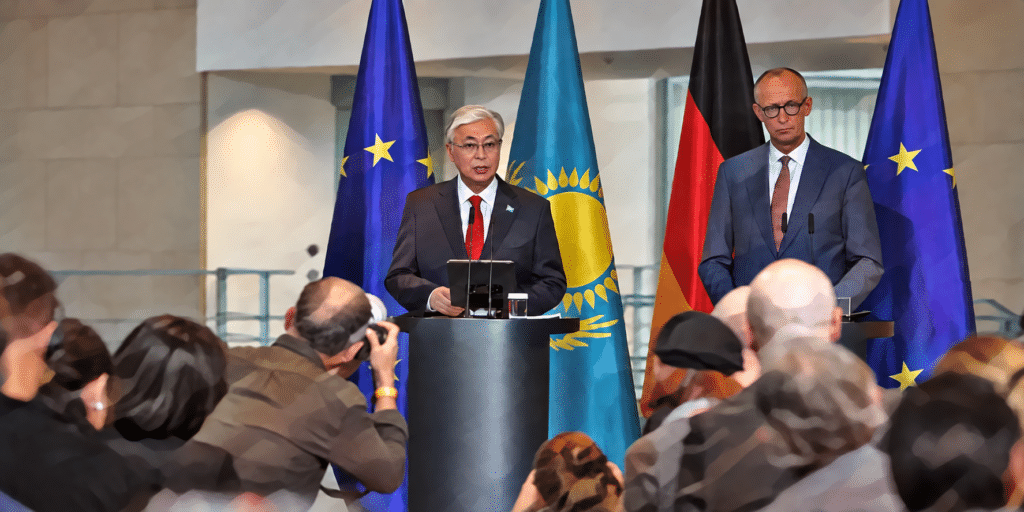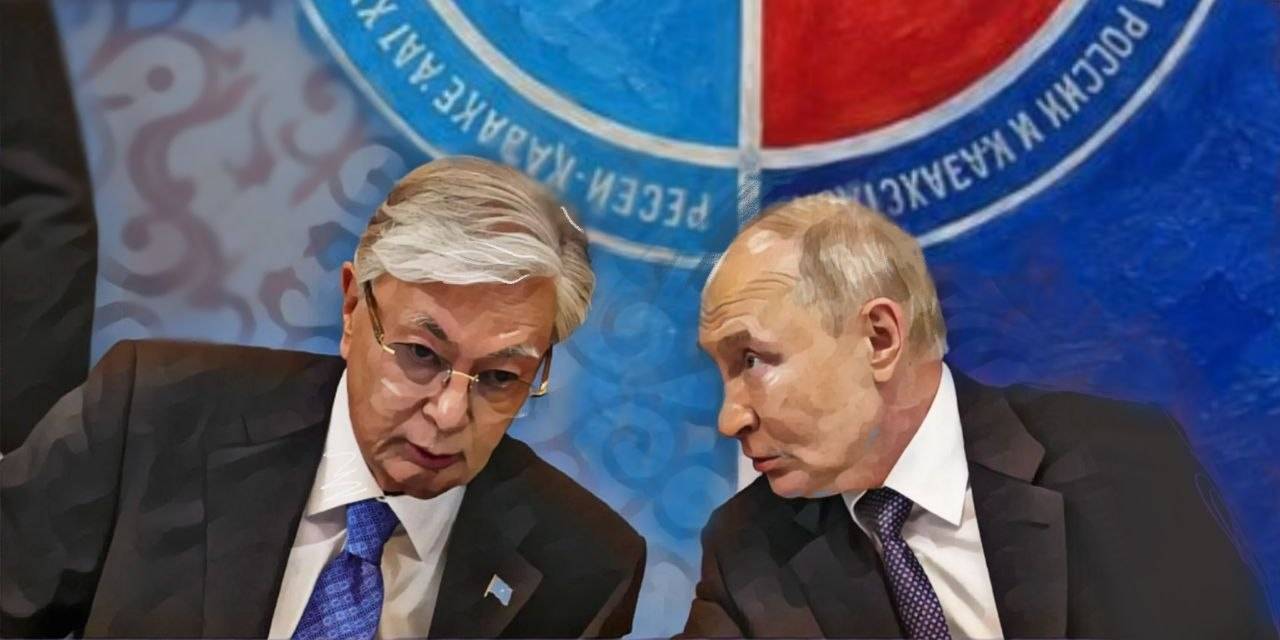
Kazakh President Kassym-Jomart Tokayev has delivered his most direct public appeal to Vladimir Putin for an end to Russia’s war in Ukraine. Speaking alongside the Russian president during the 22nd Kazakhstan-Russia Interregional Cooperation Forum in Omsk on July 25, Tokayev called for freezing the war and returning to what he described as the “Istanbul Formula 2.0.”
For many observers, the statement marked a significant departure from the cautious language traditionally used by leaders across the post-Soviet region. Although Azerbaijani President Ilham Aliyev has repeatedly criticized the war and reaffirmed support for Ukraine’s territorial integrity, Tokayev’s intervention was notable because he advanced a concrete proposal directly to Putin on Russian territory.
Tokayev’s remarks were consistent with Kazakhstan’s long-standing foreign policy, which has emphasized negotiated settlements and diplomatic conflict resolution. While Russia remains one of Kazakhstan’s largest trading partners and a crucial infrastructure partner, Astana has not recognized Moscow’s annexation of Ukrainian territory.
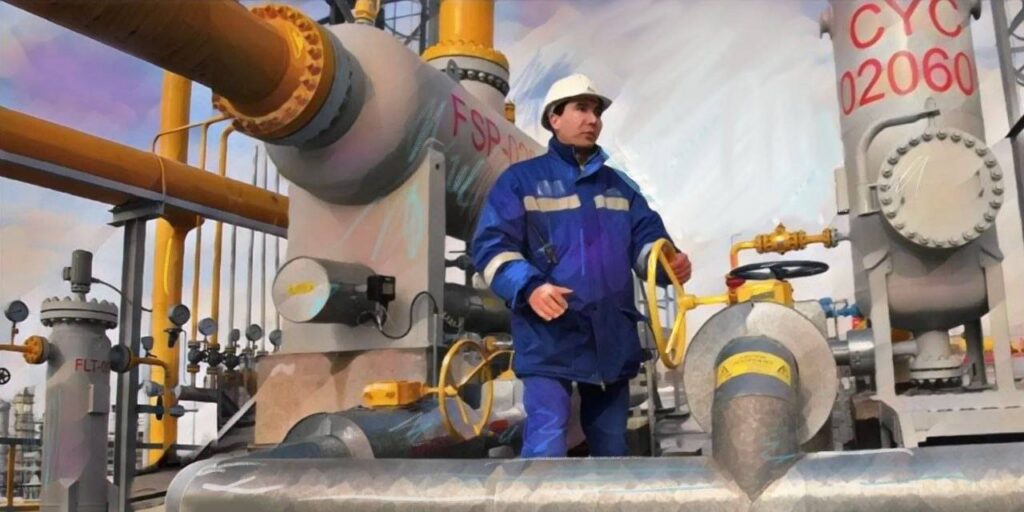
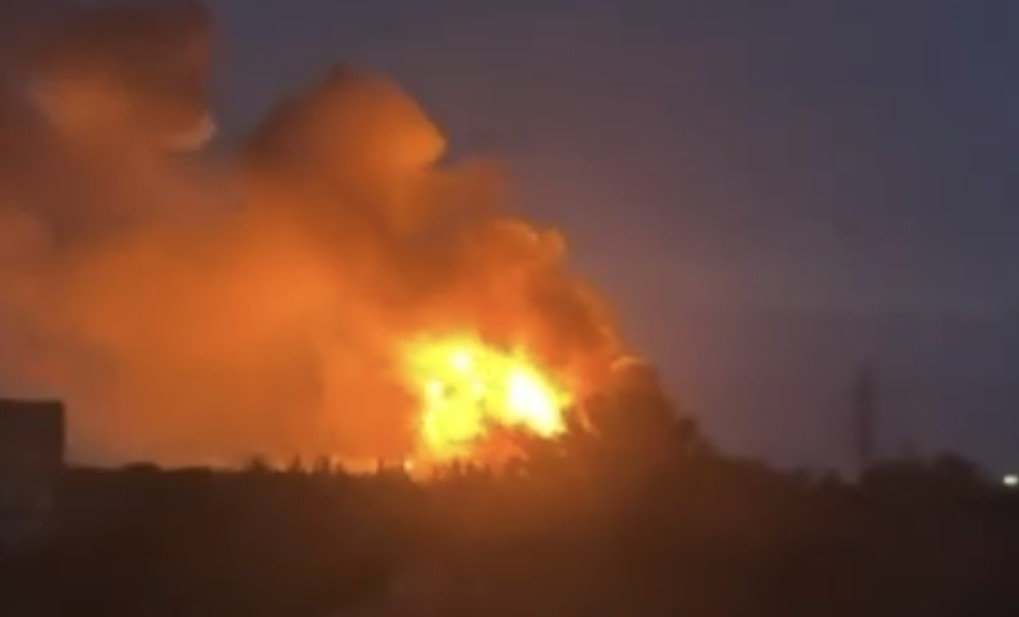
The war has also become a direct economic concern for Kazakhstan. More than 80% of the country’s crude exports move through the Caspian Pipeline Consortium (CPC), whose Black Sea export route has recently been affected by attacks on tankers and related security incidents. Those disruptions have highlighted Kazakhstan’s continued dependence on the CPC corridor and the risks posed by an expanding conflict zone.
Tokayev’s Proposal
According to the Kremlin transcript, Tokayev told Putin that he had been receiving “many signals” from Europe and the United States regarding the current state of the Russia-Ukraine conflict and had already discussed them with the Russian president by telephone.
Tokayev also stressed that he regarded the conflict as an interstate war rather than a civil war. He added that Kazakhstan had always treated the Ukrainian people, their culture and their language with respect.
He further said Putin had demonstrated “maximum diplomatic flexibility” during his meeting with U.S. President Donald Trump in Anchorage, Alaska.
“This is simply my humble opinion, since people keep asking me: perhaps the conflict should already be frozen, and we should return to the ‘Istanbul Formula 2.0,’ because significant results had been achieved there. Then, naturally, under guarantees from the major powers, including Russia, it would be possible to move toward long-awaited peace,” Tokayev said.
Tokayev also made clear that he did not intend to serve as an official mediator in any future negotiations.
Tokayev did not define the formula in detail. Russia and Ukraine held talks in Istanbul in 2022 and resumed direct negotiations there in 2025, but neither round produced a settlement. It remains unclear whether he envisaged a ceasefire along the current front line, how occupied territory would be treated, or what guarantees any major powers would provide.
Planned or Spontaneous?
Major strategic decisions in the post-Soviet space have traditionally been shaped behind closed doors. That is one reason why Tokayev’s remarks, delivered while sitting beside Putin, immediately attracted the attention of political analysts. Several experts argue that such a proposal was unlikely to have been made spontaneously.
Tokayev’s call to freeze the fighting and resume negotiations between Russia and Ukraine came as a “bombshell” for many experts, according to Andrey Vypolzov, a Russian analyst based in Kaliningrad and head of the Stan-Center analytical bureau, in an interview with Kursiv.
Vypolzov said Tokayev and Putin share a relationship built on trust.
“Tokayev, as a diplomat with enormous experience in statecraft and a committed peacemaker, mentioned earlier this year that he was taking part in ‘closed consultations at the request of leaders of certain countries,’” Vypolzov stated. “Therefore, in my view, political logic suggests that Astana should make the same proposal to Kyiv. We are waiting.”
Kazakh political analyst Daniyar Ashimbayev wrote that, “At first glance, it looked like a surprise and an improvisation. Some even wrote that the Kazakh president had lost his nerve amid the latest strikes on the CPC, the situation surrounding Russian refineries, and the prospect of a fuel crisis. Tokayev, as far as I remember, is not someone who loses his nerve in a crisis. Still less is he someone who would improvise publicly on such matters. An experienced diplomat wanted it to look spontaneous and, I would bet, had agreed it with his counterpart in advance.”
Ashimbayev recalled that in August and September 2025, Tokayev had emphasized the importance of peace to Ukrainian President Volodymyr Zelenskyy, even at the cost of flexibility on territorial issues. In both cases, according to Ashimbayev, Tokayev stressed that members of two fraternal peoples were dying in the war.
“He categorically dislikes the search for historical causes of the conflict because it creates endless pretexts for continuing the war and negatively affects the historical legitimacy of post-Soviet states,” Ashimbayev said.
Kazakhstan’s Economic Stakes
Kazakh political analyst Marat Shibutov said Tokayev’s rhetoric was fully consistent with Kazakhstan’s foreign policy outlook. Astana has traditionally supported diplomatic solutions to international crises and the preservation of channels for dialogue. The president, he said, was not attempting to offer a ready-made solution or assume additional obligations. His emphasis was on the need to retain political mechanisms as part of any settlement process, according to his analysis.
“Today, it is particularly important to preserve room in the international agenda for diplomacy and conflict resolution. Kazakhstan has consistently supported precisely this approach, based on the principles of responsibility, pragmatism, and an interest in regional and global stability. Therefore, the proposal to return to negotiations appears to be a logical continuation of the line our country has followed for many years. This is costing us too much,” Shibutov said.
Shibutov was referring to the difficulties Kazakhstan has faced in transporting oil through the CPC since the war began. The scale of the country’s dependence on the route became particularly clear on July 22, when Kazakhstan’s oil and gas condensate output fell by about 21% after the consortium stopped receiving Kazakh crude and suspended loadings at its Black Sea terminal. Tengiz production fell by more than half.
The conflict has also added to inflationary pressure across the post-Soviet region, as military action and Western sanctions have disrupted numerous logistics chains.
Kazakh political analyst Gaziz Abishev also drew attention to the personal dimension of the war and the need for negotiations.
“President Tokayev’s statement on Saturday about the need to freeze the war should not be regarded as audacity or rudeness. It should be seen as a sign of particular concern for Russia. Everyone understands how important a strong Russia is to Kazakhstan. One must remember the eternal truth: bitter truth is better than sweet lies. Kazakhs are masters of speaking indirectly and know how to avoid sharp corners. That makes the truth they speak not behind someone’s back, but directly to their face, all the more valuable,” Abishev wrote.
“It is already clear to everyone that the war is causing all its participants far more real harm than potential benefit. The war is grinding down the gene pool of two powerful peoples. It reduces investment in human capital. It worsens social development. It undermines faith in the future,” Abishev added.
Kyiv welcomed the appeal. Ukrainian Foreign Minister Andrii Sybiha called it a “realistic, timely, and wise message,” saying Ukraine had proposed stopping the war along the current front line and turning to diplomacy.
Moscow, meanwhile, rejected the central proposal. Kremlin spokesman Dmitry Peskov said freezing the conflict was impossible under Kyiv’s current position and that Russia had to “achieve our goals.” The responses underscore the limits of Tokayev’s intervention: Kyiv embraced his appeal, while Moscow rejected its immediate premise. Kazakhstan has nevertheless made it clear that the cost of the war is reaching well beyond the battlefield.