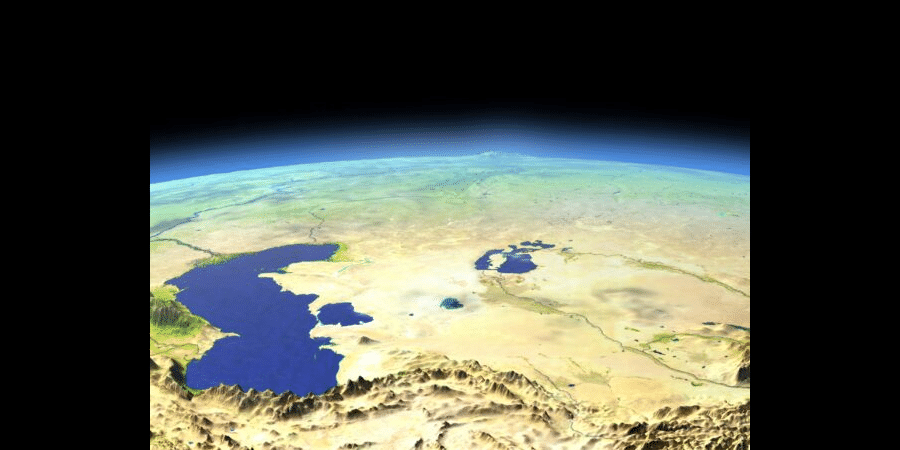
Japan is funding a $3 million project to improve monitoring of the shrinking Caspian Sea, focusing particularly on Kazakhstan’s shallow northern basin. The project, implemented by the United Nations Development Programme in partnership with Kazakhstan, was officially launched in Aktau on October 5. Experts from across the Caspian region are expected to take part in joint research and a regional scientific platform designed to improve the exchange of data and expertise.
For Kazakhstan, the most immediate problem lies in the northern Caspian. The water there is extremely shallow, meaning that even relatively small declines in sea level can push the shoreline back considerable distances. Habitats used by Caspian seals and sturgeon are already changing, while ports and shipping face growing difficulties.
Scientists link the decline to changes in the Caspian Sea’s water balance. The sea has no connection to the world’s oceans and depends on river inflow, precipitation, and evaporation. The Volga supplies most of its river water, while rising temperatures are increasing evaporation.
In July 2025, the Caspian was reported to have fallen to its lowest level in the instrumental record. The Times of Central Asia reported that the shallow northeastern section along Kazakhstan and Russia was retreating particularly rapidly.
The consequences could become far greater than the shoreline retreat already visible today. A study published in Communications Earth & Environment found that a five-meter decline from the study’s reference level could turn about 77,000 square kilometers of the Caspian’s current water surface into land, equivalent to around one-fifth of its present area. The northern basin would be among the areas most severely affected.
The new project is intended to provide a clearer picture of how the decline is unfolding. Specialists will assess Kazakhstan’s existing observation network along the northern Caspian and identify where additional monitoring sites and modern equipment are needed. Sea level and river-flow measurements will be combined with data on temperature, salinity, evaporation, weather conditions, seabed depth, and satellite observations to improve projections of future changes.
Kazakhstan is also tracking the volume of water reaching the Caspian. According to data from the Zhaiyk-Caspian basin inspectorate cited by the Ministry of Water Resources and Irrigation, 6.16 billion cubic meters had reached the sea since the start of 2026. Over the previous two and a half years, the total exceeded 35 billion cubic meters, including more than 17 billion during the exceptional floods of 2024.