• KGS/USD = 0.01144 0%
  • KZT/USD = 0.00196 -0%
  • TJS/USD = 0.10899 -0%
  • UZS/USD = 0.00008 -0%
  • TMT/USD = 0.28490 0%
  • KGS/USD = 0.01144 0%
  • KZT/USD = 0.00196 -0%
  • TJS/USD = 0.10899 -0%
  • UZS/USD = 0.00008 -0%
  • TMT/USD = 0.28490 0%
  • KGS/USD = 0.01144 0%
  • KZT/USD = 0.00196 -0%
  • TJS/USD = 0.10899 -0%
  • UZS/USD = 0.00008 -0%
  • TMT/USD = 0.28490 0%
  • KGS/USD = 0.01144 0%
  • KZT/USD = 0.00196 -0%
  • TJS/USD = 0.10899 -0%
  • UZS/USD = 0.00008 -0%
  • TMT/USD = 0.28490 0%
  • KGS/USD = 0.01144 0%
  • KZT/USD = 0.00196 -0%
  • TJS/USD = 0.10899 -0%
  • UZS/USD = 0.00008 -0%
  • TMT/USD = 0.28490 0%
  • KGS/USD = 0.01144 0%
  • KZT/USD = 0.00196 -0%
  • TJS/USD = 0.10899 -0%
  • UZS/USD = 0.00008 -0%
  • TMT/USD = 0.28490 0%
  • KGS/USD = 0.01144 0%
  • KZT/USD = 0.00196 -0%
  • TJS/USD = 0.10899 -0%
  • UZS/USD = 0.00008 -0%
  • TMT/USD = 0.28490 0%
  • KGS/USD = 0.01144 0%
  • KZT/USD = 0.00196 -0%
  • TJS/USD = 0.10899 -0%
  • UZS/USD = 0.00008 -0%
  • TMT/USD = 0.28490 0%
08 December 2025

Kazakhstan Seeks to Mitigate Impact of U.S. Tariffs

Kazakhstan is working to minimize the economic damage from newly imposed U.S. tariffs, the highest levied on any Central Asian country. The government is assessing the scope of potential losses and pursuing diplomatic efforts to reverse or reduce the trade measures.

A New Front in the Trade War

On April 2, U.S. President Donald Trump announced sweeping new tariffs on imports from over 180 countries. Kazakhstan was subjected to a 27% tariff rate. In contrast, most other post-Soviet countries, including Uzbekistan, Kyrgyzstan, Armenia, and Tajikistan, were assigned a 10% tariff, described by the U.S. administration as the “base rate” for countries that “trade fairly” with the United States. Russia and Belarus, whose trade with the U.S. is effectively suspended due to sanctions, were exempt from the increase. Only Moldova, which reportedly imposes a 61% duty on U.S. goods, received a higher rate than Kazakhstan.

According to Washington, Kazakhstan applies a 54% tariff on U.S. imports, prompting a reciprocal response, though the methodology behind the administration’s calculations has been questioned by many analysts. Moldova’s higher rate of 61% led to a 31% U.S. tariff.

Limited Exposure for Key Exports

U.S. President Trump announced a 90-day reprieve for affected countries on April 9, allowing time for negotiations to take place. While the move signals potential flexibility, the economic impact remains uncertain.

Kazakh Trade Ministry representative Serik Ashitov stated on April 29 that only 4.8% of Kazakhstan’s exports to the U.S. would be affected by the tariffs. Crucially, major exports, such as oil, uranium, silver, and ferroalloys stand to remain untouched. These commodities account for approximately 90% of Kazakh shipments to the U.S.

Despite fears of a broader economic fallout, Kazakhstan’s stock market showed resilience in the first quarter of 2025, according to financial news channels. However, the trade conflict has had a deflationary effect on key exports. Oil prices have dropped below projected baselines amid concerns about declining global demand driven by slowing industrial activity, especially in Asia.

“We’re observing falling oil prices and reduced global trade. The tariffs are cutting into industrial output in China and other key consumers of raw materials, which affects oil demand directly,” noted a representative of the Kazakhstan Stock Exchange. As of late April, Brent crude was trading at approximately $64 per barrel.

Negotiations and Constraints

In response, Kazakhstan has initiated diplomatic talks with the United States and plans to raise the issue at the World Trade Organization (WTO). “At present, there is no reason to believe these measures will significantly affect our exports. Nonetheless, we will continue working with American counterparts to mitigate the consequences of these unilateral measures,” Ashitov said during a press briefing.

However, analysts caution that Kazakhstan may face structural limits in attempting to resolve this dispute. As a member of the Eurasian Economic Union (EAEU), Kazakhstan does not set its tariff policy independently. “Our customs duties are EAEU duties,” economist Almas Chukin explained. “If we wanted to unilaterally lower tariffs for the U.S., as Israel did, it would require the approval of Minsk, Yerevan, Bishkek, and Moscow”.

Chukin also noted that trade volumes between Kazakhstan and the U.S. are relatively modest. Neighboring Uzbekistan, for instance, has double the trade volume with Washington.

While Kazakhstan may not feel immediate direct consequences, the country remains vulnerable to broader instability in global trade and falling export revenues.


Kazakhstan Sees Surge in Tourists from Arab Countries

Kazakhstan experienced a significant rise in tourism from the Arab world in 2024, with a 62% increase in visitors from five Arab countries, according to the Ministry of Tourism and Sports.

Data from the Border Service indicates that the number of tourists from Oman surged by 80%, exceeding 15,000 visitors. The United Arab Emirates followed closely, with 14,700 tourists, a 40% increase compared to 2023. Saudi Arabia saw a 47% rise, contributing over 9,000 visitors. Meanwhile, tourist arrivals from Qatar increased by 50%, and visitors from Bahrain nearly quadrupled compared to 2022.

In a bid to further attract travelers from the Gulf region, Kazakhstan participated in the Arabian Travel Market, held in Dubai from April 28 to May 1. The national stand highlighted major tourist destinations including Almaty, Astana, and the Baikonur Cosmodrome. The country promoted a diverse range of travel offerings, from cultural and culinary routes to scientific and educational tours.

Kazakhstan was also among the most sought-after destinations for Arab tourists during the Eid al-Fitr holidays, marking the end of Ramadan.

Overall, Kazakhstan continues to solidify its status as a rising international tourism destination. In 2024, the country welcomed 15.3 million visitors, a 66% increase from the previous year. Among them were 655,000 tourists from China, 146,000 from India, 130,000 from Turkey, 92,000 from Germany, and 40,000 from South Korea.

Uzbekistan Leads Repatriation of Deported Citizens from the U.S.

A group of 131 individuals from Uzbekistan, Kazakhstan, and Kyrgyzstan were repatriated from the United States this week on a special charter flight, Fox News reports. The flight, organized and funded by the government of Uzbekistan, followed a bilateral agreement with U.S. authorities and reflects expanding cooperation between the two countries on migration and security issues.

Departing the U.S. on April 30, the flight primarily carried Uzbek nationals who had been living in the United States without legal status. According to the agreement, Uzbek citizens were transported to Tashkent, while those from Kazakhstan and Kyrgyzstan are expected to continue on to their respective home countries.

U.S. officials welcomed Uzbekistan’s role in facilitating the repatriation. U.S. Secretary of Homeland Security Kristi Noem expressed appreciation for the initiative. “We commend Uzbekistan for sending a flight to return 131 illegal aliens back to their home country,” she said. “This shows the strong security ties between our countries.”

Uzbekistan’s Ministry of Foreign Affairs stated that the repatriation was conducted in accordance with international standards and aimed to protect the rights of Uzbek citizens in difficult legal and humanitarian situations abroad. Most of those returned had overstayed their visas or were found in violation of U.S. immigration laws.

The Embassy of Uzbekistan in Washington, D.C., and the Consulate General in New York played key roles in organizing the repatriation process. Both diplomatic missions maintained close coordination with U.S. immigration authorities and provided support to citizens throughout their return journey.

This was not Uzbekistan’s first such operation. Earlier this year, the country repatriated seven citizens from the United States to Tashkent after preventing their transfer to Costa Rica. That effort also followed high-level consultations between officials from both governments.

With a population exceeding 37 million, Uzbekistan continues to enhance its collaboration with the United States on migration management, repatriation procedures, and broader regional security cooperation.

Kazakhstan Has a Deal for Tajik Electricity, Now the Wait Begins

In the latest sign of Central Asian regional cooperation, Kazakhstan has signed a long-term deal to import electricity from Tajikistan. However, that electricity might not reach Kazakhstan anytime soon, as there are some important details that need to be worked out by Tajikistan before supplies can begin.

Kazakhstan’s energy problems

Kazakhstan has been experiencing severe energy deficits for several years now, particularly during winter months. Kazakh Senator Suyindik Aldashev said in late February this year that Kazakhstan would be short some 5.7 billion kilowatt hours (kWh) of electricity in 2025, which would be a 46% increase in the country’s electricity deficit compared to 2024.

Kazakhstan was forced to import electricity from Russia during the winter of 2024 to help alleviate energy shortages. These shortages contributed to Kazakhstan’s decision to hold a referendum to approve the construction of the country’s first nuclear power plant (NPP). To date, however, there has been no announcement of which company will build the NPP, so additional electricity from that source could be a decade or more away.

This has led Kazakhstan to explore importing energy resources from its Central Asian neighbors. The head of Turkmenistan’s Halk Maslahaty (People’s Council) Gurbanguly Berdimuhamedov just visited Kazakhstan and met with Kazakh President Kassym-Jomart Tokayev with Turkmen gas exports to its northern neighbor high on the agenda.

Kazakhstan has been in discussions with Tajikistan about electricity shipments for months, and the agreement was finalized toward the end of April.

Rogun

The source of the electricity Tajikistan intends to export to Kazakhstan is the Rogun Hydropower Plant (HPP) on the Vakhsh River, some 110 kilometers east of the Tajik capital Dushanbe.

The Rogun HPP has a history of controversy. It was conceived in the 1960s when Tajikistan was a Soviet Republic. Construction on the project started in 1976, but not much had been done by the time the USSR collapsed in late 1991, and work ground to halt shortly thereafter.

Russian company RUSAL signed an agreement in 2004 to invest more than $1 billion and finish building Rogun, but disputes over the project led the Tajik government to cancel the contract in 2007. One of the main differences between the two parties was RUSAL’s insistence the dam wall at Rogun be no higher than 285 meters, whereas the Tajik authorities wanted the original height of 335 meters. At 285 meters, the HPP’s output would have been 2400 megawatts (MW), while at 335 meters, the output would be 3600 MW.

Russia’s Inter RAO EES was in talks with Tajikistan about the Rogun project in 2008, but in the end, nothing came from those negotiations.

With no hope of foreign backing, Tajik President Emomali Rahmon started portraying Rogun as a project of national salvation, the key to energy independence. Rahmon’s government called on citizens to help finance construction of the HPP and when public support in the poorest country in Central Asia proved insufficient, citizens were pressured into buying shares in the project.

The government in neighboring Uzbekistan objected to Rogun’s construction, arguing that water supplies from Tajikistan’s rivers to Uzbekistan’s agricultural lands would be severely reduced as the water was diverted to fill the massive reservoir at Rogun. When Tajikistan continued work at Rogun, Uzbekistan halted railway shipments of construction materials from Iran which were headed to Tajikistan.

Uzbekistan eventually dropped its objections. In recent years several parties, including the World Bank, Asian Development Bank, Islamic Development Bank, and European Union, have pledged hundreds of millions of dollars in financial assistance to help complete the Rogun project. Even so, the estimated price tag for Rogun continues to rise and some of the latest estimates have the project costing some $6.4 billion to complete.

So far, only two of the six generator units for Rogun have been installed and are operational, and strict power rationing continues to be implemented during the winter months. President Rahmon said in a speech at the end of 2023 that the third 600-MW unit should start operating in 2025, but some forecasts now say it will be 2035 before all six units at Rogun are installed and operating.

The agreement with Kazakhstan specifies the price for Tajik electricity ($0.034 per 1 kWh) but does not mention how much electricity Kazakhstan is hoping to purchase, or exactly when supplies would start.

Rogun is also one of the sources for the Central Asia-South Asia (CASA) 1000 project to supply hydropower electricity from Kyrgyzstan and Tajikistan to Afghanistan and Pakistan. That project is far behind schedule, but the Taliban said recently that they expect to complete the Afghan section of the power transmission line, the only part still unfinished, by 2026.

The long game

Kazakhstan does need the electricity, and supplies from Tajikistan would be especially welcome as they would target Kazakhstan’s southeast, one of the country’s most populous areas and location of the largest city, Almaty.

The electricity would be shipped through Central Asia’s unified energy grid, another Soviet-era project connecting the then-Central Asian republics to distribute energy by using coal and gas-fired power plants in downstream republics, now countries, during winter, and hydropower from upstream countries during summer. The grid had been abandoned by 2009, but with warming ties among the five Central Asian states in recent years, it has been repaired and put back into operation.

One other attractive feature of the Tajik electricity deal for the Kazakh side is that Kazakhstan will be able to claim carbon credits for the Tajik hydropower it purchases.

The Kazakh-Tajik contract is for 20 years with the possibility of a 10-year extension. That electricity might not reach Kazakhstan soon, but with Kazakhstan’s growing need for additional power, it will no doubt be welcome whenever it finally arrives.

U.S. Deports Over 100 Central Asian Migrants on Uzbek Charter Flight

More than 100 people from Uzbekistan, Kazakhstan, and Kyrgyzstan who were illegally in the United States have been deported on a charter flight organized by the Uzbek government, the U.S. Embassy in Tashkent said on Thursday.

The operation, which happened on Wednesday, was “the first in which a U.S. partner proactively provided a dedicated flight to repatriate its citizens” and underscores collaboration on issues such as counterterrorism and law enforcement, according to the embassy.

“By organizing and funding the removal of its citizens present illegally in the United States and allowing the removal of nationals from other countries on Uzbek flights, Uzbekistan demonstrated its role as a trusted and proactive partner in the realm of international security,” it said.

The embassy statement did not provide details on the people who were deported.

U.S. President Donald Trump had campaigned on the promise of the mass deportation of migrants that he said were in the country without permission, and Immigration and Customs Enforcement has carried out deportations in line with that pledge since he took office for a second term in January. The speed and severity of the crackdown have alarmed advocates who have argued in court that the U.S. administration is denying due process to some migrants.

U.S. relations with some of its traditional allies, including Canada and European countries, have frayed since Trump took office.

But Uzbekistan and several other Central Asian countries appear to have maintained a relatively harmonious dialogue with the Trump administration while also collaborating with regional powers Russia and China.

On April 9, U.S. Secretary of State Marco Rubio and Uzbek Foreign Minister Bakhtiyor Saidov met in Washington to discuss investment, critical minerals and security matters. Rubio “thanked Uzbekistan for their efforts to facilitate the return of their deportees from the United States,” the U.S. State Department said.

U.S. plans for mass deportations have been a source of concern for Central Asian communities in the United States.

This month, Kazakhstan urged any of its citizens who are subject to a U.S. deportation order but remain in the United States to voluntarily return home by using a U.S. Department of Homeland Security mobile app. The Kazakh Embassy in Washington urged those nationals to do so in order “to prevent possible negative consequences” such as fines, a ban on re-entry to the United States and other penalties.

In January, Kyrgyzstan warned its citizens to follow U.S. immigration law and always carry relevant documents with them.

May Day in Central Asia: From Soviet Parades to a Celebration of Unity

In Soviet times, May 1 and 2 were public holidays. May 1 was International Workers’ Day, marked by large-scale parades celebrating the proletariat, while May 2 served as a day to recuperate before returning to work. Today, three of the five Central Asian republics have preserved the tradition of celebrating May Day, effectively marking the arrival of spring twice, once through Central Asian customs – Nauryz – and again through European ones.

Workers of the world, unite!

Coined by Karl Marx and Friedrich Engels in The Communist Manifesto, this famous communist slogan once appeared on the coats of arms of the Soviet Union and its republics. International Workers’ Day became the living embodiment of this phrase. Celebrated on 1 May, May Day began as a European festival of spring but gained global significance through the labor movement. The Second International, formed at the 1889 International Workers Congress in Paris, called for an annual demonstration advocating an eight-hour workday. The date honors the U.S. general strike that started on 1 May 1886 and led to the tragic Haymarket massacre on 4 May. The date became a powerful symbol of working-class solidarity and a yearly tradition across large swathes of the globe.

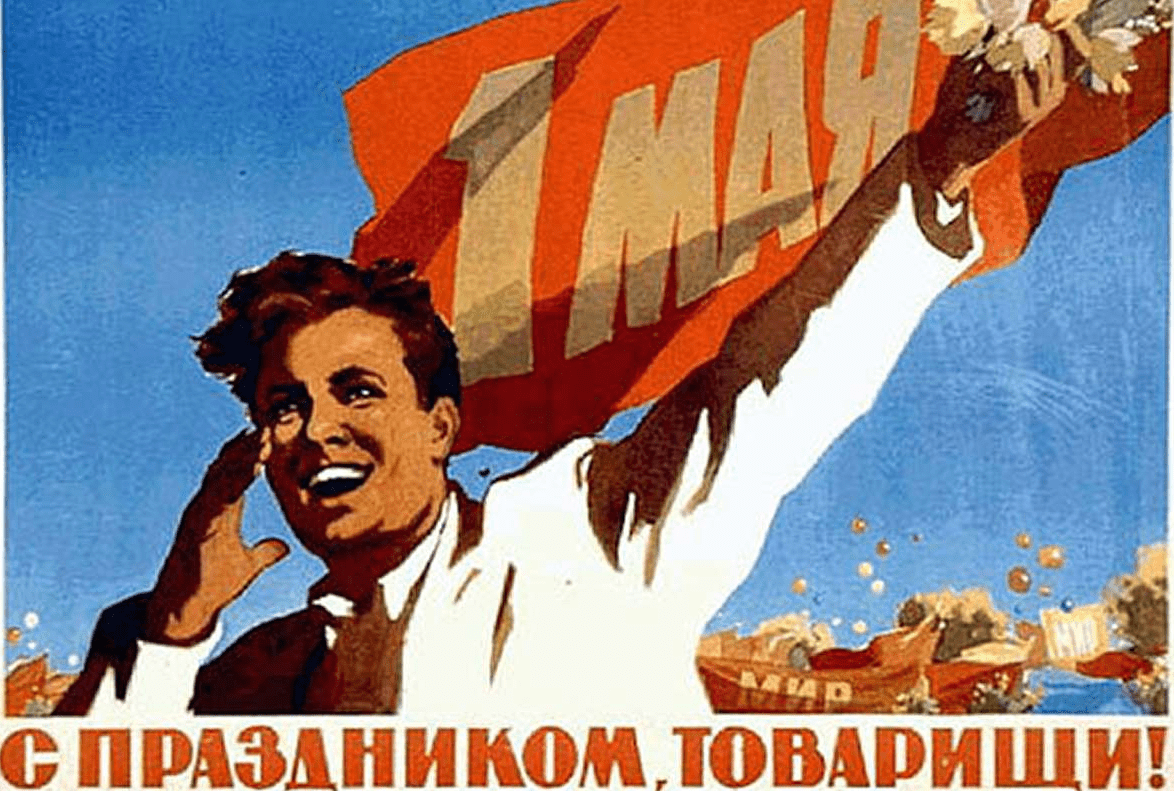
Soviet-era poster for International Workers’ Day

Before the Bolsheviks came to power, political agitators in the Russian Empire used May 1 to call for change with slogans such as “Down with the Tsar” and “Give us freedom.” After the October Revolution, May 1 and 2 became official state holidays, with May Day becoming synonymous with International Workers’ Day and mandatory parades. Unlike the more formal and solemn celebrations honoring the October Revolution, however, May Day events were often met with genuine enthusiasm.

After the collapse

The fall of the USSR brought about a widespread reevaluation of Soviet holidays. The celebration of the October Revolution on November 7 was widely discarded, but many post-Soviet republics retained May 1 as a public holiday, albeit with new interpretations and meanings.

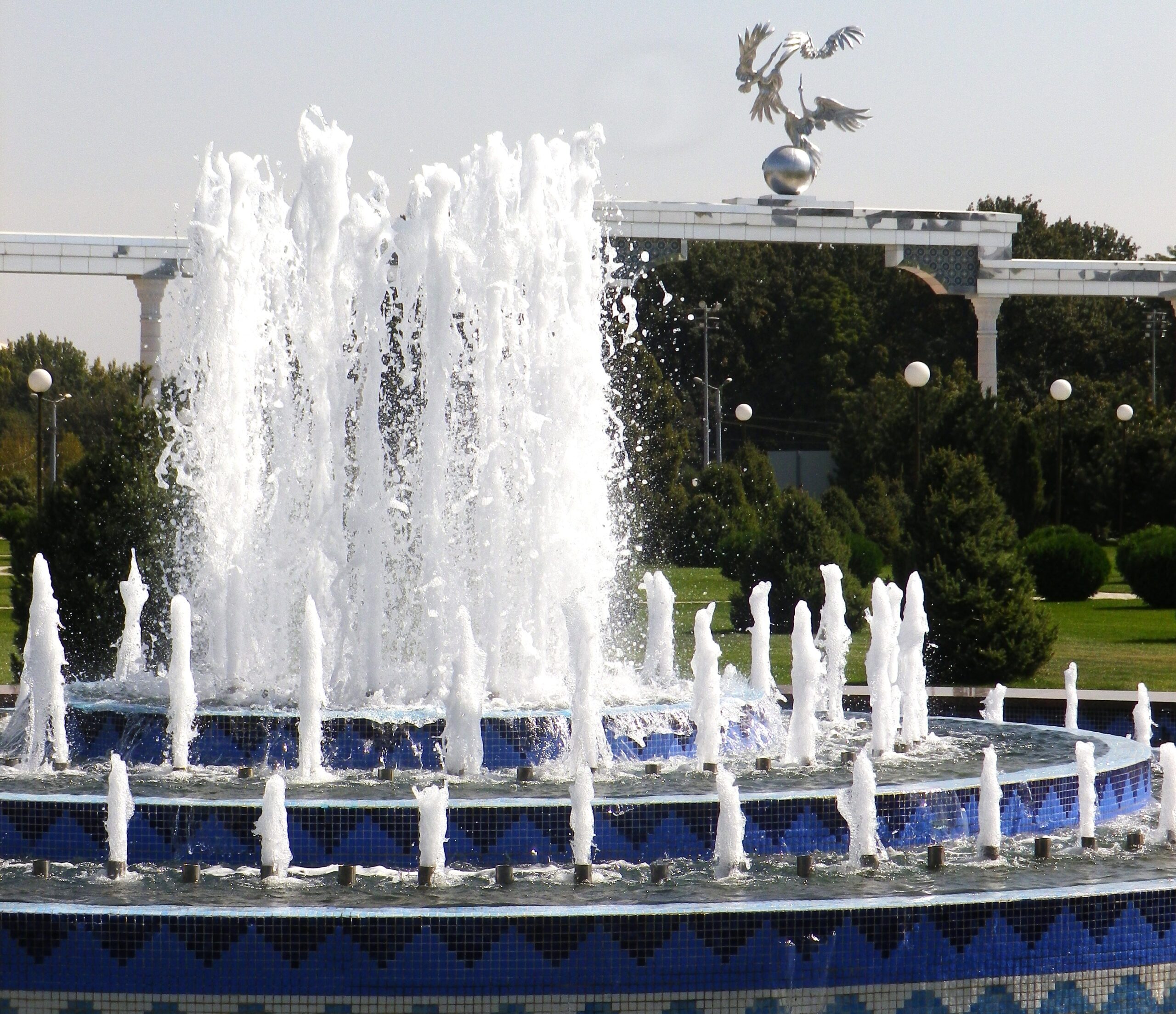
In Central Asia, Turkmenistan and Uzbekistan do not officially celebrate May 1. Turkmenistan has developed a distinct holiday calendar, while in Uzbekistan, May 1 is observed symbolically as the Day of Fountains.

Day of Fountains, Tashkent; image: TCA, Stephen M. Bland

Though celebrations are more modest and it is no longer officially a day off, Tajikistan has retained the holiday’s Soviet-era name, International Workers’ Day. Some traditions, such as honoring outstanding workers, persist.

Kyrgyzstan calls the holiday Labor Day, in line with its American equivalent. It is marked by festive events and activities organized by trade unions.

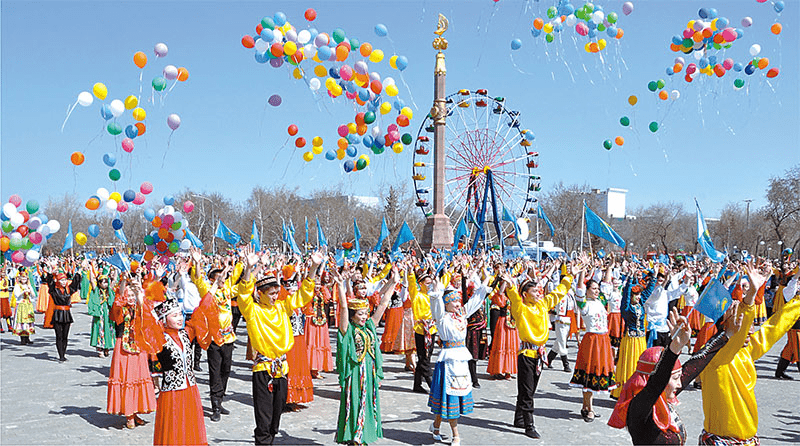
Kazakhstan has taken a different approach, reimagining May Day as the Day of Unity of the People of Kazakhstan. The name reflects the country’s emphasis on stability and interethnic harmony, a model promoted by the Assembly of the People of Kazakhstan, an institution established on March 1, 1995, at the initiative of the country’s first president, Nursultan Nazarbayev. Since 2016, March 1 has also been celebrated as Thanksgiving Day, another holiday focused on national unity. Over a hundred different nationalities and ethnic groups reside within Kazakhstan.

On the Day of Unity, cities across Kazakhstan host concerts featuring ethnic groups and pop stars, fairs, exhibitions, and traditional folk festivities. The holiday is a vibrant expression of the country’s multicultural identity, underscoring the idea that “We are different, but we are equal,” a phrase frequently invoked by the current president, Kassym-Jomart Tokayev.

Day of Unity of the People of Kazakhstan celebration; image: el.kz

The modern iteration of May Day originated as a commemoration of American workers’ struggles in the late 19th century, but in East Slavic traditions, among Russians, Ukrainians, and Belarusians, May 1 also marked the seasonal transition from winter to spring. Bonfires were lit, and straw effigies representing winter were burned. These celebrations often involved gatherings with family and friends, symbolizing rebirth and renewal.

In essence, May Day is the East Slavic counterpart to Nowruz, the Central Asian New Year, which is celebrated at the end of March. While the ideological undertones of May Day have faded, it remains one of the most beloved and eagerly anticipated holidays in the post-Soviet world.