How a Family-Run Mini-Factory in Almaty Ships Chocolate to Belgium and Switzerland

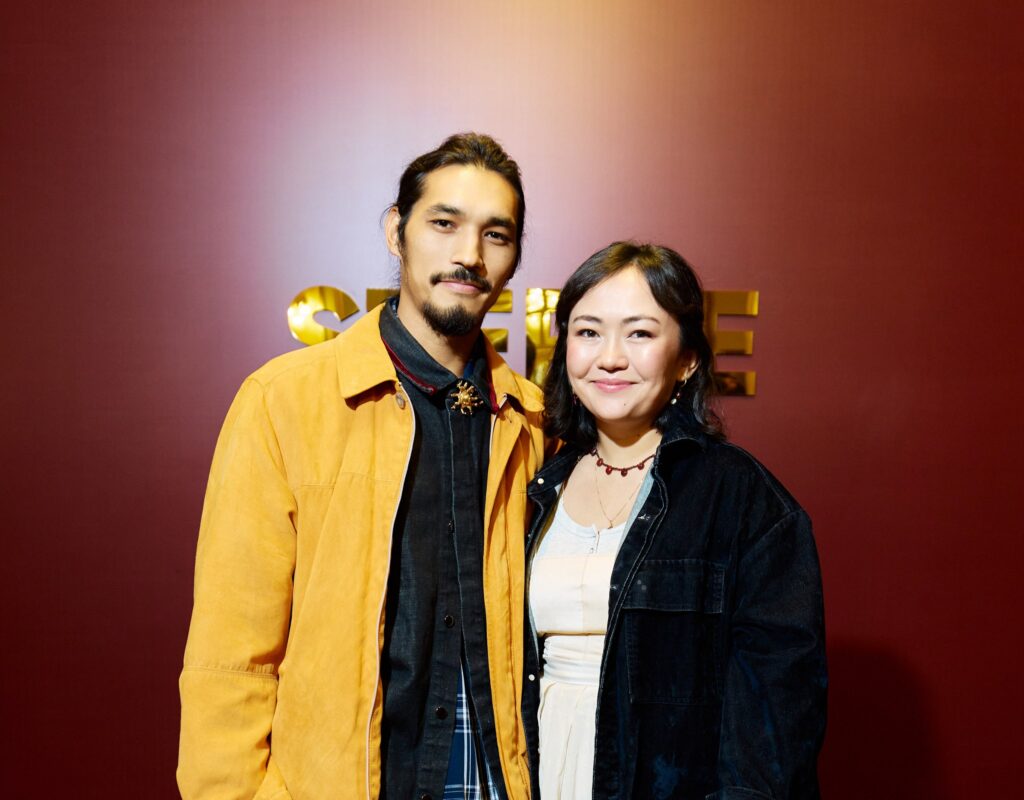
Nurlan and Zhaniya Orynbayev are Kazakhstani chocolatiers known for creating distinctive desserts inspired by national traditions. Their creations include sweet yurts, chocolate mountain landscapes, a chocolate version of the Kazakhstan Hotel filled with zhent (a traditional dessert made from roasted millet, butter, and honey), chocolate with kurt, and other culinary experiments.
Nurlan is also a musician and a member of the Kazakhstani hip-hop group Dayinball. In an interview with The Times of Central Asia, the couple spoke about how the chocolate version of one of Almaty’s main landmarks was created, what sweets Kazakh consumers prefer, how to choose high-quality kurt, and how the global cocoa bean shortage has affected their business.
TCA: Nurlan, you are sometimes called the “Kazakh Willy Wonka.” It seems you were among the first chocolatiers in Kazakhstan. How do you feel about that?
Nurlan: In fact, my wife Zhaniya was the one who started our chocolate business. She was the first to learn confectionery techniques and how to work with chocolate, and then she taught me. I simply began posting videos of the process on social media, and they became popular.
Now the brand is often associated with me, but the real mastermind behind the project is Zhaniya. She develops all the ideas and recipes. Our coffee shops, our confectionery line, the brand image, and at least 60% of our products are thanks to her.
TCA: So is Zhaniya the driving force behind your chocolate mini-factory?
Nurlan: You could say that. She has a deep understanding not only of confectionery but of gastronomy in general. She can taste a dish and almost break it down into its components, what has been added and which ingredients work well together.
I did not have that kind of intuition. I had never worked with food or desserts before. But gradually I became more involved and began to understand the process better.
TCA: Zhaniya, you are said to have come up with the chocolate shaped like the Kazakhstan Hotel. Tell us about it.
Zhaniya: Yes, that was my idea. It is a chocolate structure weighing about 130 grams, made in the shape of the famous hotel. We produce it in both milk and dark chocolate.
We experimented with fillings for a long time, but eventually settled on zhent, a traditional Kazakh dessert made from roasted and ground millet with butter and sugar. Customers really like it.
TCA: You used to make this dessert only for Nauryz, but now you produce it year-round?
Zhaniya: Yes, and it happened almost by accident. Once, a restaurant critic connected with the World’s Best Restaurants ranking visited us. We treated her to various chocolates, but she liked the chocolate with zhent the most.
She wanted to buy more, but we had run out. We did not want to disappoint her, so we urgently decided to make a new batch and began searching for good talkan, one of the ingredients in zhent. We found it and quickly prepared everything.
The process was quite chaotic. Our daughter was very young at the time, and I was even running errands with a stroller. But it all worked out, our guest was pleased. After that, we decided to produce this chocolate throughout the year, not only for holidays.
TCA: Did you also design the chocolate mold yourselves?
Zhaniya: A friend of mine, my office neighbor, created the mold. At the time, I was working in jewellery, and he was involved in 3D modelling. I suggested trying to make a building-shaped mold, since he was already producing architectural models.
I asked him to simplify the design as much as possible so that it would be easy to pour chocolate into it. The first two attempts failed, but the third one was perfect.
TCA: Recently in Almaty there was controversy over a dessert inspired by a Jaume Plensa sculpture, which was removed from a menu due to copyright concerns. How is this regulated in the confectionery business?
Nurlan: To be honest, we did not seek any formal approval. It is similar to whether sellers of souvenir magnets would need copyright permission from the creator of the Eiffel Tower or other landmarks.
The Kazakhstan Hotel is a symbol of Almaty. On the contrary, we wanted to support the city’s identity by recreating it in chocolate. The idea came to Zhaniya after she spoke with an architect who makes building models. She proposed creating a series of chocolate versions of Almaty’s architectural landmarks, and we decided to try it immediately.
TCA: What other landmarks have you turned into chocolate?
Nurlan: We made a model of the Koktobe TV Tower. It tasted great, but the spire often broke during transport, so we discontinued that design. We also planned to make the Almaty Circus, but we have not done so yet.
TCA: How long can your chocolate be stored, given that it contains no preservatives?
Nurlan: About two weeks. After that, it begins to crumble because the filling contains butter and moisture gradually evaporates. It is still edible later but best consumed within the first two weeks.
TCA: At one point, the whole world was talking about Dubai chocolate. It seems marketing accounts for about 70% of success in the confectionery business.
Nurlan: I completely agree.
TCA: So why has the whole world not gone crazy for your chocolates yet?
Zhaniya: In fact, they are becoming popular, just not on a massive scale yet. Our chocolates travel the world more often than we do.
They are regularly ordered in Belgium and Switzerland. Sometimes that feels a little awkward, since those countries are considered the birthplace of chocolate and consumers there are very knowledgeable. People also take our chocolates to the U.S., and there have been cases where they were brought to Thailand.
TCA: How many Kazakhstan Hotel chocolates do you produce per year?
Nurlan: Production is still quite spontaneous. We do not yet have precise annual statistics. I have tried to calculate the figures, but we lack comprehensive analytics. We realize this needs attention and are planning to address it soon.
TCA: A foreign baker who worked in Almaty once complained about the quality of butter. Do you face difficulties sourcing ingredients?
Zhaniya: A true professional must be able to work with local ingredients and still create a high-quality product. Any food technologist will confirm this.
In the past, suitable butter for desserts was harder to find, it was either too fatty or had an overly strong flavor. Now the situation has improved significantly.
@gensneg
TCA: There is currently a global cocoa bean shortage due to poor harvests in Côte d’Ivoire. Has this affected your business?
Zhaniya: Yes. Poor harvests have affected both coffee and cocoa, as they grow in similar climate zones.
Production costs have risen by 30-40%. Compared with prices two years ago, the cost of raw materials has nearly tripled. We also had to raise our prices, although we tried to keep them stable for as long as possible.
TCA: Do people in Kazakhstan have a sweet tooth?
Zhaniya: Yes. Tea is central to our culture, and tea is rarely served without dessert. In China and Japan, tea traditions are different, but here it is customary to serve sweets on the dastarkhan.
When Mars entered the Central Asian market, it introduced mini versions of products such as Snickers, Twix, Bounty, and Milka so they could easily be shared at the table. I learned this when I applied for a job there.
Our sales figures also show that people in Kazakhstan love sweets, especially chocolate with zhent and kurt. It seems the taste for these flavors is deeply ingrained.
TCA: You are said to have your own method for testing whether kurt is authentic.
Zhaniya: Yes. I am a big fan of kurt. Sometimes starch or flour is added to it. To check, you can apply iodine. If the color turns purple, it indicates impurities. If the color remains unchanged, the product is natural.
We first made chocolate with kurt on commission for a company. They ordered a small batch but later canceled. We had already produced about 50 pieces, which was a lot for us at the time.
We sold them in our coffee shop. I remember the first customer well, a young man from Russia. He liked the product and took the chocolates back to St. Petersburg. After that, he kept returning for that specific item.
At first, many people in Kazakhstan did not understand the flavor. Now it is very popular.
TCA: Does your chocolate have a particular philosophy?
Zhaniya: We simply love experimenting. For example, we make milk chocolate with salted caramel.
Initially, we worked only with dark chocolate. A classic combination is dark chocolate with Parmesan and salt. One day, however, Nurlan suggested trying milk chocolate and it worked perfectly.
The result is a rich sweet-and-salty combination. I think this reflects something distinctly Kazakhstani, we are a country of contrasts.
TCA: Do you have any classic filling combinations?
Zhaniya: Of course. Pistachio with raspberry is very popular. But we also enjoy experimenting. For example, we created a filling with freeze-dried banana and caramel inspired by the banoffee dessert.
TCA: You do not only make chocolate, you also produce a full range of desserts for coffee shops.
Zhaniya: Yes. We offer many baked goods, including cookies and lemon tart.
We started baking lemon tart when I was pregnant with my first child and constantly craving sour flavors. We looked for it in cafés, but it was usually sold out by evening. So we decided to make it ourselves.
TCA: Many people are now focused on healthy eating. Does this affect the dessert business?
Zhaniya: Not significantly. Our desserts are sweet but made without additives or palm oil.
Nutritionists often say that if you crave something sweet, it is better to eat a small portion of high-quality dessert than to restrict yourself for a long time and then overindulge. That is why many health-conscious customers choose our products.
TCA: Tell us about your production process. Do you make all the chocolate yourselves?
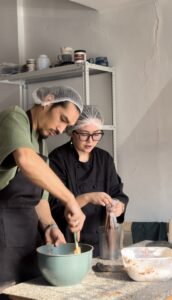
Nurlan: We have assistants, but the workshop is small. At the moment we have one employee. Previously, I handled production on my own, and later we began working together.
After our daughter was born, I focused more on chocolate while Zhaniya concentrated on baking. Over time, I also started developing new recipes. For example, we once adapted a Dubai-style chocolate to suit our customers’ tastes.
TCA: How difficult is it to be a chocolatier in Kazakhstan?
Nurlan: It is not easy. There is no dedicated school for chocolatiers, so we had to learn a great deal on our own.
When we started, this was a completely new field. Now the market has expanded, and many more people are working with chocolate.
Zhaniya: After Nurlan began actively blogging and showing the production process, many people started copying us, especially our chocolate with kurt and zhent.
Some customers would buy our products, study the technique, and try to replicate it. But we are not afraid of competition. We continue to grow and put our hearts into our work.
TCA: I first heard about you not through chocolate, but at the Oyu music festival, where you performed with Dayinball.
Nurlan: Thank you. That was our debut on a large stage.
A year earlier, we had attended the festival as guests. I remember standing in front of the stage and saying, “One day I will perform here.” A year later, it happened.
TCA: The Oyu Festival attracted around 15,000 people singing in Kazakh. Is Kazakh-language music currently on the rise?
Nurlan: I think the peak was slightly earlier, around 2018–2019. At that time, many strong artists and unique songs emerged simultaneously. It felt like a real breakthrough.
Now the industry is more established. There is a lot of content, but it has become harder to surprise audiences.
TCA: But there are new successes too, for example, Yenlik’s performance on the COLORS platform.
Nurlan: That is a major achievement. Kazakh music continues to grow and gain international visibility. It just feels different from within the industry.
TCA: Is your music primarily rap?
Nurlan: Yes, mostly rap and hip-hop. But we do not want to limit ourselves to one genre. We also experiment with pop, rock elements, and even reggae.
The name Dayinball is a play on words meaning “be ready.” We try to live by that principle.
TCA: Is performing on stage frightening?
Nurlan: On the contrary, I love the stage. Much depends on the audience. Sometimes people are simply passing by and do not know your music, which makes it more challenging.
But I try to perform even if there is only one listener.
Zhaniya: Once he even performed just for our daughter.
Nurlan: Yes, she was dancing and having fun. That is great motivation.
TCA: Finally, which is easier: being a chocolatier or a musician?
Nurlan: Sometimes I experience impostor syndrome. I am the face of the band, although perhaps not the most talented member. I am also the public face of our chocolate business, even though the main work, ideas, recipes, strategy, belongs to Zhaniya.
I am simply someone who enjoys doing what he loves: music, family, and everything we have created together.