• KGS/USD = 0.01144 0%
  • KZT/USD = 0.00212 0%
  • TJS/USD = 0.10456 0.19%
  • UZS/USD = 0.00008 0%
  • TMT/USD = 0.28490 0%
  • KGS/USD = 0.01144 0%
  • KZT/USD = 0.00212 0%
  • TJS/USD = 0.10456 0.19%
  • UZS/USD = 0.00008 0%
  • TMT/USD = 0.28490 0%
  • KGS/USD = 0.01144 0%
  • KZT/USD = 0.00212 0%
  • TJS/USD = 0.10456 0.19%
  • UZS/USD = 0.00008 0%
  • TMT/USD = 0.28490 0%
  • KGS/USD = 0.01144 0%
  • KZT/USD = 0.00212 0%
  • TJS/USD = 0.10456 0.19%
  • UZS/USD = 0.00008 0%
  • TMT/USD = 0.28490 0%
  • KGS/USD = 0.01144 0%
  • KZT/USD = 0.00212 0%
  • TJS/USD = 0.10456 0.19%
  • UZS/USD = 0.00008 0%
  • TMT/USD = 0.28490 0%
  • KGS/USD = 0.01144 0%
  • KZT/USD = 0.00212 0%
  • TJS/USD = 0.10456 0.19%
  • UZS/USD = 0.00008 0%
  • TMT/USD = 0.28490 0%
  • KGS/USD = 0.01144 0%
  • KZT/USD = 0.00212 0%
  • TJS/USD = 0.10456 0.19%
  • UZS/USD = 0.00008 0%
  • TMT/USD = 0.28490 0%
  • KGS/USD = 0.01144 0%
  • KZT/USD = 0.00212 0%
  • TJS/USD = 0.10456 0.19%
  • UZS/USD = 0.00008 0%
  • TMT/USD = 0.28490 0%

U.S. Ambassador to Kazakhstan Highlights Cultural Diplomacy, AI, and Strategic Partnerships

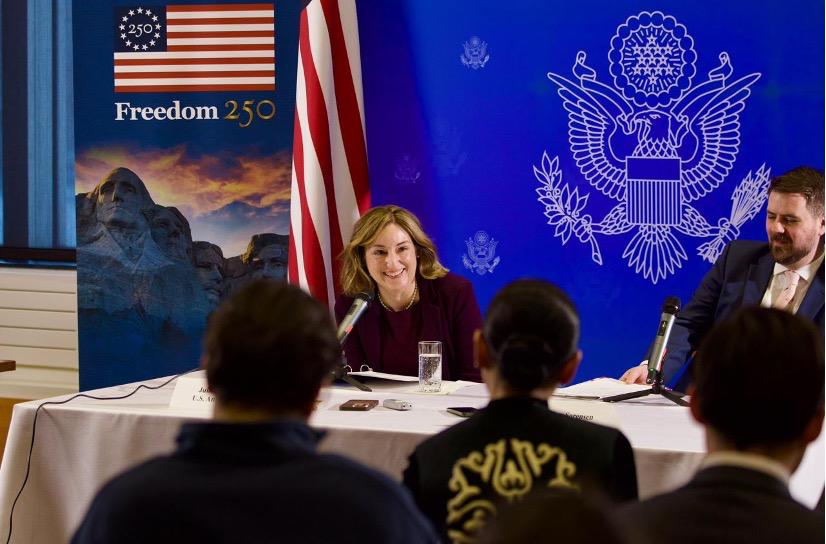
At a wide-ranging press conference at the U.S. Embassy in Astana, the recently appointed U.S. Ambassador to Kazakhstan, Julie M. Stufft, underscored the deepening ties between the United States and Kazakhstan, highlighting cooperation in cultural diplomacy, artificial intelligence, and critical minerals.

“I arrived in Astana a month ago, and while the weather has been a little cold, the welcome has been very warm. It has been exciting to meet the embassy team, our colleagues in government and civil society, and the people of Kazakhstan. I am very excited to be here and already feel at home. U.S.-Kazakhstan relations are the strongest they have been in the history of our two countries,” Ambassador Stufft said. She pointed to the convergence of political, commercial, and cultural factors that make the partnership distinctive, noting that bilateral ties have evolved beyond their initial commercial foundation. Thirty-five years ago, U.S. companies began investing in Kazakhstan, she said; today, cooperation spans security, cultural exchange, and economic collaboration.

A key priority for the ambassador is expanding people-to-people exchanges. “Since Kazakhstan’s independence, 22,000 Kazakh students and professionals have participated in U.S. exchange programs,” she said, adding that 3,000 Kazakh students studied in the United States last year. “We need more Americans here, and we need more Kazakhs in the United States. These ties go far beyond political diplomacy.”

Ambassador Stufft also identified artificial intelligence as a major growth sector. “Already, $3.7 billion in deals with U.S. AI companies have been concluded in Kazakhstan,” she said. “This is the year of AI development in Kazakhstan. The youth here are exceptionally creative and talented. AI represents a significant area for growth.”

Critical minerals featured prominently in the discussion. The ambassador described Kazakhstan as a major holder of rare-earth resources and stressed the importance of establishing reliable, transparent supply chains. “Kazakhstan is cooperating with at least 53 other countries to ensure a world market that is fair and accessible,” she said, referring to a recent ministerial meeting in Washington at which Kazakhstan’sForeign Minister Yermek Kosherbayev delivered a keynote address.
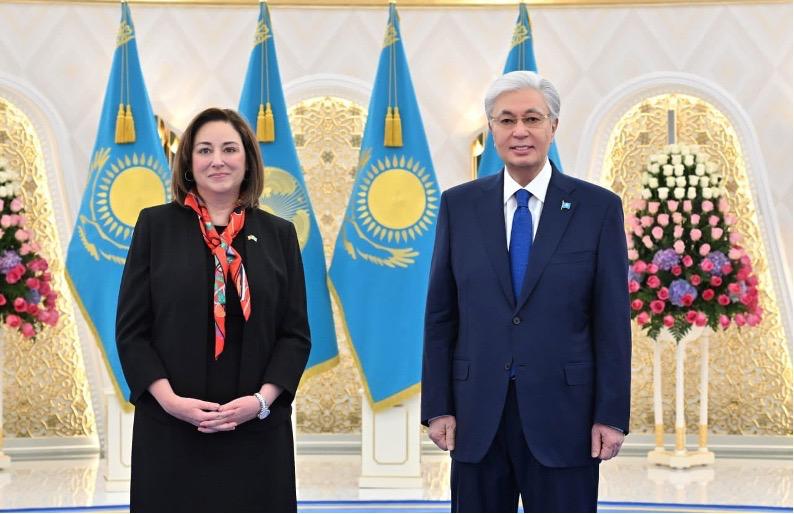
U.S. Ambassador Julie Stufft presents her credentials to President Kassym-Jomart Tokayev of Kazakhstan; image: Akorda

Addressing commercial ties, Ambassador Stufft discussed efforts to facilitate investment and mining projects, including a joint venture between U.S.-based Cove Capital and the national mining company Tau-Ken Samruk in the Karaganda region. She emphasized that such agreements are commercially driven and not politically imposed. “This is a commercial deal, and it opens the door to a new chapter in our cooperation,” she said.

The press conference also touched on broader geopolitical issues. Asked about Kazakhstan’s strategic partnerships with Russia and China, Ambassador Stufft said the United States respects Kazakhstan’s multi-vector foreign policy while seeking to remain a partner of choice. On U.S. visa policy, she clarified that temporary pauses on certain immigrant visa categories were procedural and do not affect the majority of Kazakh applicants. “Hundreds of thousands of visas are issued every week,” she said, pointing to the continued growth of educational exchanges.

Ambassador Stufft praised Kazakhstan’s role in multilateral diplomacy and its engagement with international sanctions regimes. She emphasized that the United States has never asked Kazakhstan to sever ties with other partners and described sanctions as international measures rather than unilateral U.S. actions. According to the ambassador, Kazakhstan has cooperated closely with the international community to comply with sanctions while working to mitigate negative consequences for its population.

Concluding on a personal note, Ambassador Stufft said: “I am very excited to be here and to live in Kazakhstan. My family is thrilled to explore the beauty of your country and meet its warm and inspiring people.”

As Kazakhstan navigates a rapidly evolving regional and global environment, the ambassador’s message was clear: the U.S.-Kazakhstan partnership extends beyond government-to-government relations, encompassing cultural, technological, educational, and strategic dimensions with significant potential for further growth. As Astana continues to navigate its multi-vector course, the United States is signaling that it intends to be not just a partner, but a durable presence in Kazakhstan’s economic and technological transformation.
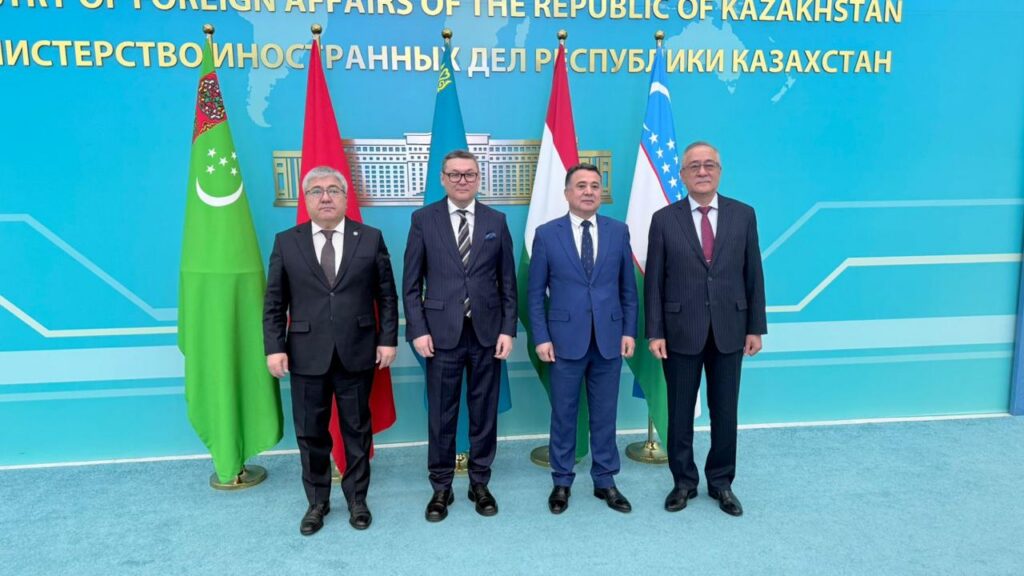
Coordination Instead of Declarations: Astana Hosts Meeting of Regional Contact Group on Afghanistan

On Monday, Astana hosted an extraordinary meeting of the Regional Contact Group of Special Representatives of Central Asian Countries on Afghanistan, with delegations from Kazakhstan, Kyrgyzstan, Tajikistan, and Uzbekistan in attendance.

The agenda focused on trade and economic cooperation with Afghanistan, including joint projects, investment protection, transit tariff policy, and the development of transport corridors through Afghan territory.

The establishment of the group represents the practical implementation of agreements reached at the Sixth Consultative Meeting of the Heads of State of Central Asia, held in Astana in August 2024, and reflected in the Roadmap for Regional Cooperation for 2025-2027. The first meeting of the Contact Group took place on August 26 last year in Tashkent.

As noted by Erkin Tukumov, Special Representative of the President of Kazakhstan for Afghanistan, Astana is interested in a constructive exchange of views and in identifying practical solutions to pressing issues of cooperation with Afghanistan.

In recent years, Kazakhstan has consistently kept Afghanistan among its foreign policy priorities, avoiding rhetorical declarations in favor of a measured and systematic approach.

President Kassym-Jomart Tokayev has paid particular attention to Afghanistan since the change of power in Kabul in 2021. In the first weeks after the Taliban assumed control, Astana began articulating its position on international platforms.

One of the key statements was Tokayev’s address at the Shanghai Cooperation Organisation summit in Dushanbe on September 17, 2021. He advanced a thesis that has since been reiterated in various formats: Afghanistan should be viewed not only as a source of risk but also as a potential driver of regional development, provided that stability and economic recovery are achieved.

This position was further elaborated days later at the United Nations General Assembly. At that time, Kazakhstan was among the first to emphasize the need for inclusiveness in Afghanistan’s future political system, not as an abstract requirement, but as a practical condition for stability.

Another significant step was the creation last year of the post of Special Representative of the President for Afghanistan, to which Tukumov was appointed. This role goes beyond that of an interdepartmental coordinator: as a direct representative of the head of state, it elevates the Afghan portfolio to the level of strategic priority. The establishment of such a position signals a transition from a situational response to a more systematic policy.

The Astana meeting confirmed the intention of regional countries to deepen cooperation through a regular platform capable of coordinating actions and presenting them externally in a consolidated manner.

Some external observers suggest that Central Asian countries are only now beginning to develop a common position on Afghanistan. However, that position has largely taken shape in recent years. The current task is not to formulate it, but to coordinate it more precisely.

The meeting in Astana demonstrated that, for Central Asian countries, the primary concern is not the nature of the regime in Kabul, but Afghanistan’s capacity to function as a predictable economic partner and responsible participant in international relations.

For the region, it is essential that its southern neighbor operate in accordance with generally accepted economic standards, ensure reliable transit management, and integrate into regional cooperation frameworks. The objective is to anchor Afghanistan within the regional context, not as an object of concern or threat, but as a full-fledged participant in discussions on water resources, security, logistics, and environmental issues.

Efforts in recent years to establish broader international formats on Afghanistan have repeatedly encountered contradictions, given the diversity of external interests and the heavy political burden involved.

The Central Asian format differs fundamentally: it is an intra-regional dialogue. There is no external arbitration, no competing geopolitical agendas, and the focus remains on practical matters.

For Central Asia, Afghanistan is not an abstract issue of global politics, but a direct neighbor. This pragmatism is gradually assuming an institutional form, effectively shaping a regional Afghanistan track initiated and coordinated by the countries of Central Asia themselves.

Afghanistan has not yet responded to the Contact Group meeting. However, the event has attracted attention in the Afghan media. Some media outlets note that the country’s inclusion in regional processes is in the interests of not only Afghanistan itself, but also its neighbors. In particular, the idea was raised that the countries of Central Asia are capable of playing the role of “positive mediators” in building a pragmatic line of interaction with Kabul.

Germany Builds a Z5+1 in Central Asia

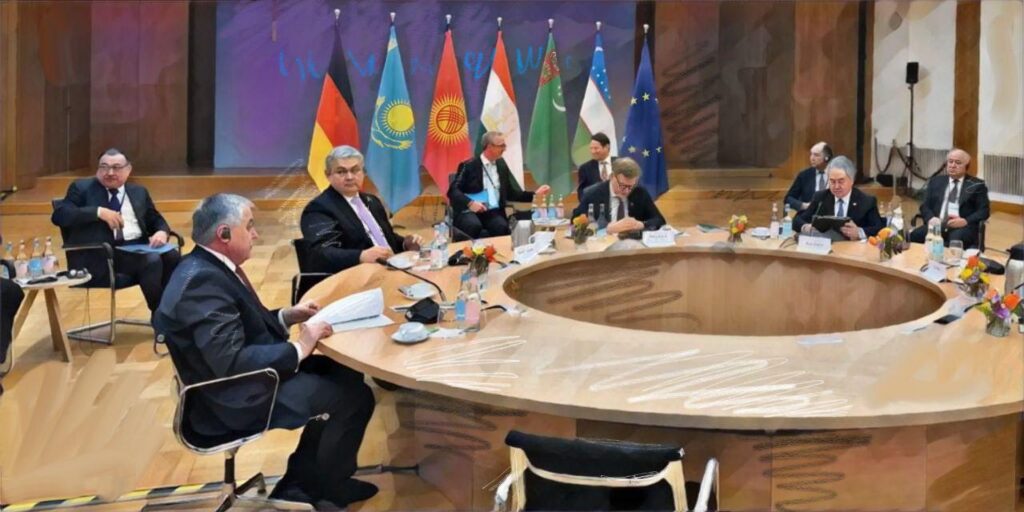
Germany’s meeting on February 11 with the five Central Asian foreign ministers in Berlin formalized the Z5+1 (“Z” for “Zentralasien”) format as a standing work channel. It joins other “plus-one” formats now crowding Central Asia that function as instruments of influence. The United States is using C5+1 to push a more deliverables-oriented agenda, including critical raw materials, and China has institutionalized leader-level summitry with accompanying treaties, grants, and transport-centered integration. The EU has elevated its relationship to a strategic partnership and is putting Global Gateway branding behind connectivity and investment.

Germany’s Z5+1 is best understood as Europe’s effort to add a practical, tool-driven channel that can move faster than EU consensus in some domains while still feeding EU programming rather than competing with it. The concluding Berlin Declaration reads like a program sheet with named instruments, sector priorities, and established a direct link to the EU’s broader “Team Europe” posture through the participation of EU Special Representative Eduards Stiprais. Germany’s Z5+1 fits this competitive field as a European execution lane that can move projects forward with German instruments while staying aligned with EU programs.

Berlin Defines the Tools

The Z5+1 meeting in Berlin drew on a sequence that Germany has been building since its 2023 “Strategic Regional Partnership” and subsequent summits in Berlin (2023) and Astana (2024), with an explicit emphasis on Central Asian regional cooperation as a counterpart to bilateral ties. The Berlin meeting, therefore, did not attempt to invent a new regional architecture but rather added a stable ministerial format for pushing forward project lists, regulatory expectations, and finance conditions between higher-level meetings.

In Berlin, Germany committed €2.7 million to a cooperation platform for the Trans-Caspian Transport Corridor: a small sum by infrastructure standards, but targeted at unglamorous coordination like data-sharing, planning discipline, and institutional continuity, i.e., standards and transborder management regimes where corridor initiatives often stall. This profile complements the EU-backed Trans-Caspian Coordination Platform track, which is explicitly tied to a wider €10 billion commitment announced at the January 2024 Global Gateway investors forum for EU–Central Asia transport connectivity. and which has addressed the corridor less as a construction problem than as a finance-and-sequencing problem.

Berlin also explicitly supported the commercial participation of German rail and logistics firms in transport and consulting projects, aligning with the intent to keep firm-level engagement attached to ministerial diplomacy. The declaration references export credits and investment guarantees, and links them to business-environment expectations. On the same day, the German Eastern Business Association convened a “Wirtschaftsgespräch” (economics talk) in the Foreign Office with the Central Asian delegations. There, the region was framed as strategically significant for Germany’s diversification agenda, and it was signaled that an autumn leaders’ summit is already in view. Germany’s public accounting of its regional engagement in Central Asia stresses its already-deep base of activity in Kazakhstan and Uzbekistan in particular, including dozens of projects and multi-billion-euro volumes.

The energy transition was mentioned, as the Berlin Declaration points to renewables, hydrogen, and climate programming that Germany is already funding and can expand through existing channels. These include the “Green Central Asia” initiative backed by a €250 million commitment and additional regional development cooperation portfolios. Reporting by The Times of Central Asia on green-energy export ideas from Kazakhstan, and on the domestic controversy around the Hyrasia One hydrogen project, illustrates why Berlin’s approach is structured as a portfolio of smaller pilots, grid work, and efficiency projects, rather than as one mega-plan that can fail on permitting, water stress, or local opposition.

Z5+1 in the Competitive “Plus-One” Ecosystem

Berlin also treated sanctions compliance as a practical agenda item by including language on the prevention of circumvention and on coordination on sanctions-related risks. EU deliberations and reporting on possible anti-circumvention measures already include scrutiny of re-export channels. This creates direct exposure for Central Asian economies that have benefited from gray-zone trade since 2022. As a gatekeeper for specific industrial goods and finance tools, Germany is positioned to translate this into concrete expectations of sanctions compliance.

One lever is programming under the “security” rubric that often functions as infrastructure and services in border regions. Berlin has dedicated more than €13 million in financial support for OSCE regional projects since 2022, with a €3 million contribution in 2025 to the OSCE fund responding to Afghanistan-related issues, including water and conflict management. It also reiterates cross-border stabilization programming that has direct local effects in border regions, where hard infrastructure, services, and administrative capacity are often inseparable from “security” labels.

The U.S. channel provides a useful comparison. A more deliverables-oriented U.S. C5+1 track has elevated critical raw materials, and the associated dialogue mechanisms have been presented as a concrete area for practical cooperation, including the launch of the C5+1 Critical Minerals Dialogue. Germany’s Z5+1 is not seeking to replicate the U.S. working-group architecture.

Likewise, Germany will not outspend China, which has used leader-level summitry to consolidate a long-horizon political umbrella for infrastructure and trade integration, including treaty-level upgrading of ties and grant commitments alongside transport projects. China used its first China–Central Asia summit in 2023 to define a new platform and embed security and capacity-building language alongside economics.

Operational Implications

Germany’s Z5+1 is a standing work channel that links German export credits and investment guarantees to corridor governance, critical minerals, and energy-transition project pipelines. It treats sanctions-circumvention risk as a structuring constraint, bringing compliance management into project selection, financing terms, and due diligence rather than leaving it as ambient exposure. For the Central Asian five, this creates an additional diversification venue with more explicit discipline costs than many other “plus-one” tracks.

As “C5+1” formats proliferate, Central Asian bargaining leverage increases, and demands on regional coordination and sanctions-risk management increase as well. Germany competes in that environment without creating a separate EU track, signaling Team Europe alignment through the EU Special Representative’s participation and by linking the channel to EU program pipelines shaped by Global Gateway financing and regulatory expectations. By design, Z5+1 makes corridor sequencing, financing terms, and sanctions-risk practices the locus of operational negotiation. Its practical effects will accumulate in corridor governance capacity, project bankability, and partner diversification under pressure from larger neighbors.

After Firing Close Ally Tashiyev, Japarov Says Goal for Kyrgyzstan is Unity

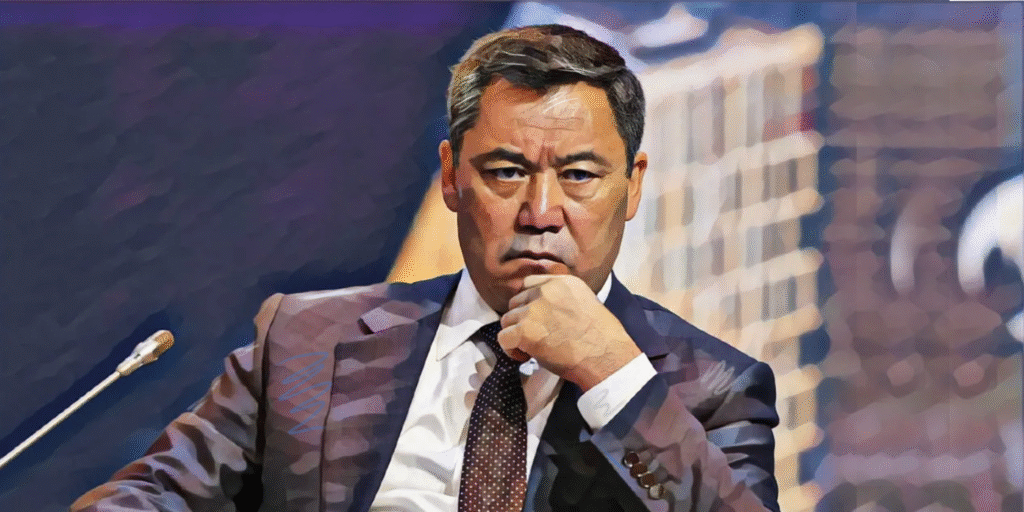
Kyrgyzstan’s President Sadyr Japarov, who fired his powerful security chief Kamchybek Tashiyev last week, says he plans to wipe out the “disease” of division between northern and southern groups in the country.

In an interview published on Monday by the state Kabar news agency, Japarov spoke about his broader vision for Kyrgyzstan in some of his most detailed comments since the dismissal of Tashiyev, the head of the State Committee for National Security who campaigned effectively against organized crime and was a close confidant of the president. 

Some criticism of Japarov suggests he made the move to amass more power as part of an authoritarian project for Kyrgyzstan. But the president said he wants to repair traditional rifts that he blamed for political unrest in the country over the years. His government has accused some political figures of trying to exploit Tashiyev’s stature and undermine Japarov’s government, though the former security chief said he accepted the president’s decision to remove him. 

Japarov is from northern Kyrgyzstan, while Tashiyev is from the south. For a time, their tight alliance appeared to be a way of smoothing over divisions between factions in the two regions. Japarov was sworn in as president in early 2021 after a tumultuous period that included his imprisonment, protests and victory in a landslide election. 

Tashiyev has been a supporter of Japarov all along, including during moves against the media that opponents described as democratic backsliding in a country once known for relative freedom of expression.

“Since independence, politicians have been dividing the country into north and south,” Japarov said. “I saw this with my own eyes when I first entered politics in 2005. They divided the government so that half of it would be north, half south, or something like that in some ministry. And I was very sad.”

Japarov said the divisions had been “disappearing” since he took office, thanks to a policy of rotating district chiefs, prosecutors, governors, judges and the heads of other institutions around the country. People from the south hold leadership jobs in the north, and vice versa, he said. 

“I will eventually eradicate the disease of North-South divide. It will take time,” Japarov said in the Kabar interview.

After Absence, Tajikistan’s Rahmon Highlights a Daily Schedule

He’s back.

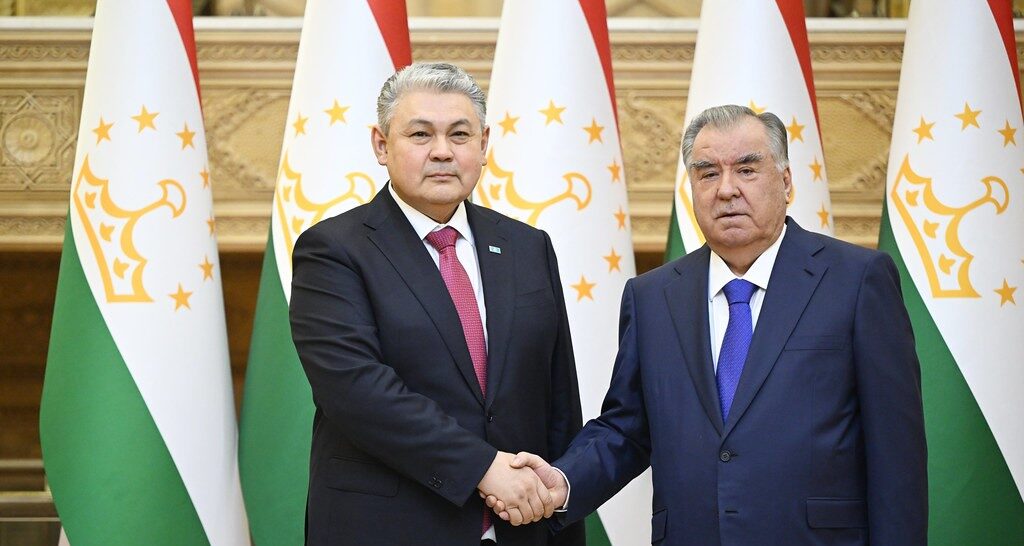
President Emomali Rahmon of Tajikistan met Kazakhstan’s foreign minister on Monday, two days after welcoming the head of the Asian Infrastructure Investment Bank to Dushanbe.

It might seem like routine business for the leader of a country. But the meetings, during which Rahmon was photographed and shown in video, followed more than two weeks during which Tajikistan’s president hadn’t been seen in public. The absence prompted some media and other online questions about his whereabouts and health, possibly prompting the presidency to issue a statement last week that said Rahmon had upcoming meetings.

The 73-year-old president, who has held the post since 1994, posed for a photographed handshake with Kazakh Foreign Minister Yermek Kosherbayev that was posted on the website of Tajikistan’s presidential office. Rahmon’s account on X also showed a video of a meeting between him and Zou Jiayi of the Asian Infrastructure Investment Bank on Saturday.

In addition, on Sunday, the presidential office posted a video of Rahmon congratulating Chinese President Xi Jinping on the beginning of the Chinese New Year. Speaking in a deep voice, Rahmon sat in front of an image of tree blossoms that are associated with the Spring Festival, which runs into early March.

Rahmon´s son, Rustam Emomali, is chairman of the National Assembly and would take over as interim president if his father is unable to serve.

Kazakhstan Intends to Triple Its Hydropower Capacity by 2030

Kazakhstan plans to significantly expand its hydropower capacity over the next five years. By the end of 2030, the country intends to commission new hydropower plants with a combined capacity of approximately 660 MW, nearly tripling the sector’s current installed capacity, according to the Ministry of Energy.

At present, 43 hydropower facilities operate in Kazakhstan with a total installed capacity of 313 MW. The implementation of agreements already concluded is expected to raise this figure to nearly 1 GW, substantially increasing the contribution of hydropower to the national energy mix.

In 2025, an additional project was added to the portfolio: the 26 MW Korinskaya HPP-2 was commissioned in the Jetisu Region. By the end of the year, total electricity generation from renewable energy sources reached 8.621 billion kWh, of which 1.196 billion kWh was produced by small and medium-sized hydropower plants.

Kazakhstan continues to rely on an auction mechanism to attract investment and enhance transparency in the renewable energy sector. In 2025, 500 MW of capacity designated specifically for hydropower projects was offered through competitive auctions. According to the Ministry of Energy, this approach helps reduce project costs and foster a stable investment environment.

The highest concentration of renewable energy facilities, including hydropower plants, is located in the southern and southeastern regions, Zhambyl, Almaty, and Jetisu regions. These areas benefit from significant river potential and established infrastructure capable of supporting further generation growth.

The ministry states that implementation of the planned projects will diversify Kazakhstan’s energy mix, supply remote areas with stable green electricity, reduce pressure on the main transmission grids, and enhance overall system reliability.

As previously reported by The Times of Central Asia, renewable energy accounted for 7% of Kazakhstan’s national energy mix by the end of 2025.