For Kazakhstan, deeply embedded in global supply chains and international investment flows, soft power is evolving from an image-building asset into a strategic instrument of resilience. In an era of globalization, when even geographically distant conflicts can directly threaten national infrastructure and economic security, Astana’s ability to leverage institutional initiatives and investment interdependence as a form of diplomatic protection has become a decisive advantage.
Over the long term, stability tends to characterize states whose infrastructure and economic interests are deeply interconnected with those of major global centers of power.
A middle power and rational diplomacy
Kazakhstan’s status as a middle power is not a matter of ambition, but a deliberate choice in favor of rational diplomacy, where flexibility and institutional engagement serve as key resources.
Multilateral dialogue with the U.S., Russia, China, the EU, Turkey, and countries of the Middle East is being developed not as situational maneuvering but as a core strategy for minimizing external risks and preserving sovereignty.
It is precisely the combination of proactive soft power, political neutrality, and economic openness that allows Kazakhstan to transform geopolitical turbulence into a strategic advantage, positioning the country as an indispensable hub of international stability.
Ultimately, the rational diplomacy of a middle power transforms the country’s geographical position from a potential zone of conflict into a platform for dialogue, where pragmatism and institutional mediation become the principal guarantees of national sovereignty.
The Ukrainian case: infrastructure protection as an element of soft power
Developments surrounding Russia’s war in Ukraine illustrate how Kazakhstan’s soft power can function as a form of economic protection. The attacks on infrastructure in the Novorossiysk area, through which the Caspian Pipeline Consortium exports oil, highlighted a distinctive mechanism for safeguarding national interests through investment interdependence.
Strikes near the Black Sea hub posed a direct threat not only to logistics but also to the assets of major American investors in Kazakh energy projects, including Tengiz.
According to reports cited in public discussions, the U.S. urged Ukraine to take into account the interests of American investors in Kazakhstan. If confirmed, such a step would represent an important precedent: even amid an intense military conflict, global actors remain attentive to protecting the economic interests tied to Kazakhstan’s energy infrastructure.
For Astana, this episode illustrates how decades of building strategic relations with Western partners have created a significant layer of economic security. In this context, soft power manifests itself as a form of “investment protection,” discouraging actions that could damage oil production or transport infrastructure linked to global stakeholders.
Institutionalizing neutrality: why Kazakhstan needs a Board of Peace
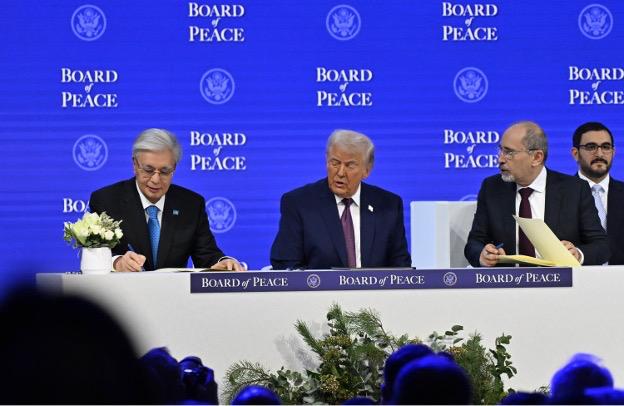
The creation of the Board of Peace by U.S. President Donald Trump and Kazakhstan’s active participation signals Kazakhstan’s transition from ad hoc mediation toward a more structured institutional architecture of soft power. The signing of the Board of Peace Charter by President Kassym-Jomart Tokayev formally embeds peacebuilding activities within the state’s foreign policy framework.
Kazakhstan’s developing participation in this initiative is also linked to its experience hosting the Congress of Leaders of World and Traditional Religions, which has been held in Astana since the early 2000s. The forum has gained international recognition as a platform for religious diplomacy that complements traditional political dialogue and often provides deeper insights into conflicts rooted in historical, cultural, and spiritual dynamics.
In the future, the forum could potentially evolve into a more institutionalized structure resembling a “spiritual security council.” Such a body could operate continuously rather than meeting once every three years, with a permanent secretariat, regional offices, missions in conflict zones, working groups, and mechanisms for sustained religious diplomacy.
In the context of the war in Gaza, and more broadly the history of the Israeli-Palestinian conflict, where religious dimensions are inseparable from political realities, Kazakhstan’s experience in convening such forums may prove particularly relevant. Religious dialogue can address aspects of conflicts that are often difficult to tackle through formal diplomatic channels, including questions of identity, historical memory, cultural narratives, and spiritual barriers to reconciliation.
Afghanistan: economy, education, and humanitarian sustainability
Afghanistan provides another example of Kazakhstan’s strategy, in which soft power operates through integration rather than isolation.
In 2025, this approach entered a phase of deeper economic engagement. Agreements worth approximately $303 million were signed in areas including trade, logistics, and infrastructure, reinforcing Afghanistan’s potential role in Eurasian connectivity and as a transit link to South Asian markets.
Astana’s pragmatic policy is complemented by a significant humanitarian and educational component. The decision to expand quotas for Afghan students at Kazakh universities represents a long-term investment in human capital, fostering a generation of specialists oriented toward constructive international engagement. Regular humanitarian aid, including large deliveries of food and medical supplies, also contributes to stabilizing the social situation in Afghanistan, while reinforcing Kazakhstan’s reputation as a responsible regional actor.
In this way, Kazakhstan is building a distinctive framework of influence in Afghanistan, where economic cooperation, educational diplomacy, and humanitarian support combine into a broader effort to integrate the country into the regional security and economic architecture.
A strategy for sustainability
In conditions of geopolitical turbulence, Kazakhstan’s soft power is evolving from a secondary diplomatic tool into a central pillar of its long-term sustainability strategy. It serves as a mechanism for protecting infrastructure and maintaining investment attractiveness, while enabling the country to balance relations among major global powers and avoid being drawn into geopolitical confrontation.
The institutionalization of peacebuilding initiatives through the Board of Peace gives this strategy a longer-term framework. In an era of rising mistrust in international politics, Kazakhstan’s capacity to act as a platform for dialogue and a provider of pragmatic solutions may become a significant strategic advantage for a middle power.