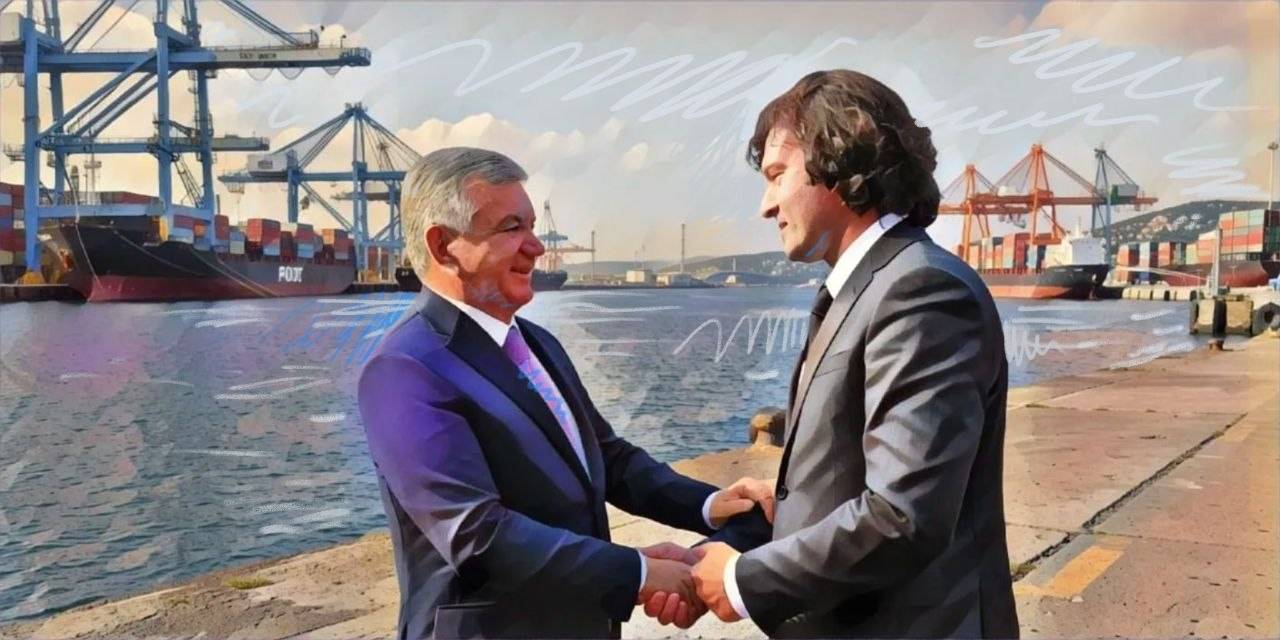
Uzbekistan and Georgia have elevated their relations to a strategic partnership as Tashkent seeks wider access to Black Sea ports and new routes linking Central Asia with European markets.
As The Times of Central Asia previously reported, Mirziyoyev traveled to Georgia on a July 2-3 state visit aimed at expanding cooperation in trade, transport, investment, and regional connectivity. The visit concluded with the signing of a Strategic Partnership Declaration and a series of agreements designed to deepen political and economic ties.
Uzbekistan and Georgia established diplomatic relations on August 19, 1994. Their cooperation was formalized a year later with the signing of the Treaty on Friendship and Cooperation. While political dialogue has continued over the years, bilateral engagement has accelerated since 2022 through regular presidential meetings, visits by prime ministers, sessions of the intergovernmental commission, and consultations between the two countries’ foreign ministries.
Last year, on March 5, Georgian Prime Minister Irakli Kobakhidze visited Tashkent, where the two sides discussed expanding cooperation. The latest visit built on those discussions.
According to the Uzbek presidential press service, the two leaders agreed to strengthen cooperation in politics, trade, investment, transport, tourism, and humanitarian exchanges. Bilateral trade reached $270 million in 2025, and has already exceeded $100 million since the beginning of this year. Both governments adopted the goal of increasing annual trade to $1 billion through a dedicated roadmap, reducing trade imbalances, and expanding exports through reciprocal industrial exhibitions.
Transport and logistics featured prominently in the talks. The leaders agreed to expand the use of Georgia’s Poti and Batumi ports for Uzbek cargo and supported plans to establish a logistics hub that would include an industrial zone and a permanent showroom for Uzbek products. Mirziyoyev also proposed linking the future China-Kyrgyzstan-Uzbekistan railway with the Baku-Tbilisi-Kars railway, a move that could create a new transport corridor connecting Central Asia with European markets.
The two countries also agreed to establish a joint investment fund and launch new industrial projects in agriculture, electrical engineering, pharmaceuticals, renewable energy, food processing, construction materials, digital technologies, digital banking, and tourism. Uzbekistan will also open an embassy in Georgia, while educational and tourism forums are scheduled to take place later this year.
Political analyst Mukhtor Nazirov believes the visit represents more than a routine diplomatic exchange. Speaking to local media, he argued that Georgia is increasingly becoming Uzbekistan’s gateway to Europe as Tashkent seeks to diversify its foreign trade routes.
“Today, a country’s economic opportunities are largely determined by its transport corridors and access to foreign markets,” Nazirov said. “The signing of the Strategic Partnership Declaration is therefore an important event in Uzbekistan’s foreign policy.”
Nazirov noted that the Trans-Caspian International Transport Route, commonly known as the Middle Corridor, has become increasingly important for Uzbekistan. According to him, the route carried 12% of Uzbekistan’s foreign trade cargo in 2021, but that share has now risen to 28%. Official figures show that 1.2 million tons of cargo were transported along the corridor in 2025, while container train transit times to Georgian ports have fallen from 18-23 days to 12-15 days.
Nazirov pointed to Uzbekistan’s investment in an $18.3 million logistics terminal at the Port of Poti as evidence of the country’s long-term commitment to developing international transport infrastructure. He also cautioned that challenges remain, including limited capacity at Black Sea ports, declining water levels in the Caspian Sea, and infrastructure bottlenecks.
“Despite these challenges, strategic partnership with Georgia goes far beyond diplomatic relations,” he said. “It expands Uzbekistan’s access to European markets, diversifies export routes, and strengthens the country’s position within the Eurasian transport system.”
The visit also drew attention after Georgian Prime Minister Irakli Kobakhidze gave an interview to Uzbek journalist Jahongir Olimov at Tbilisi Airport following Mirziyoyev’s departure.
Calling the new agreement “very important,” Kobakhidze thanked the Uzbek president for his personal contribution to strengthening bilateral ties.
“We highly value this friendship,” he said. “Our cooperation is based on the historical friendship between our two peoples, and this agreement will give new momentum to cooperation and friendship between our two states.”
Political analyst Shukhrat Rasul said the visit reflected Georgia’s pragmatic foreign policy and Tbilisi’s effort to balance regional ties with long-term European aspirations. He described Georgia as a natural partner for Uzbekistan because of its position on land routes between Asia and Europe.