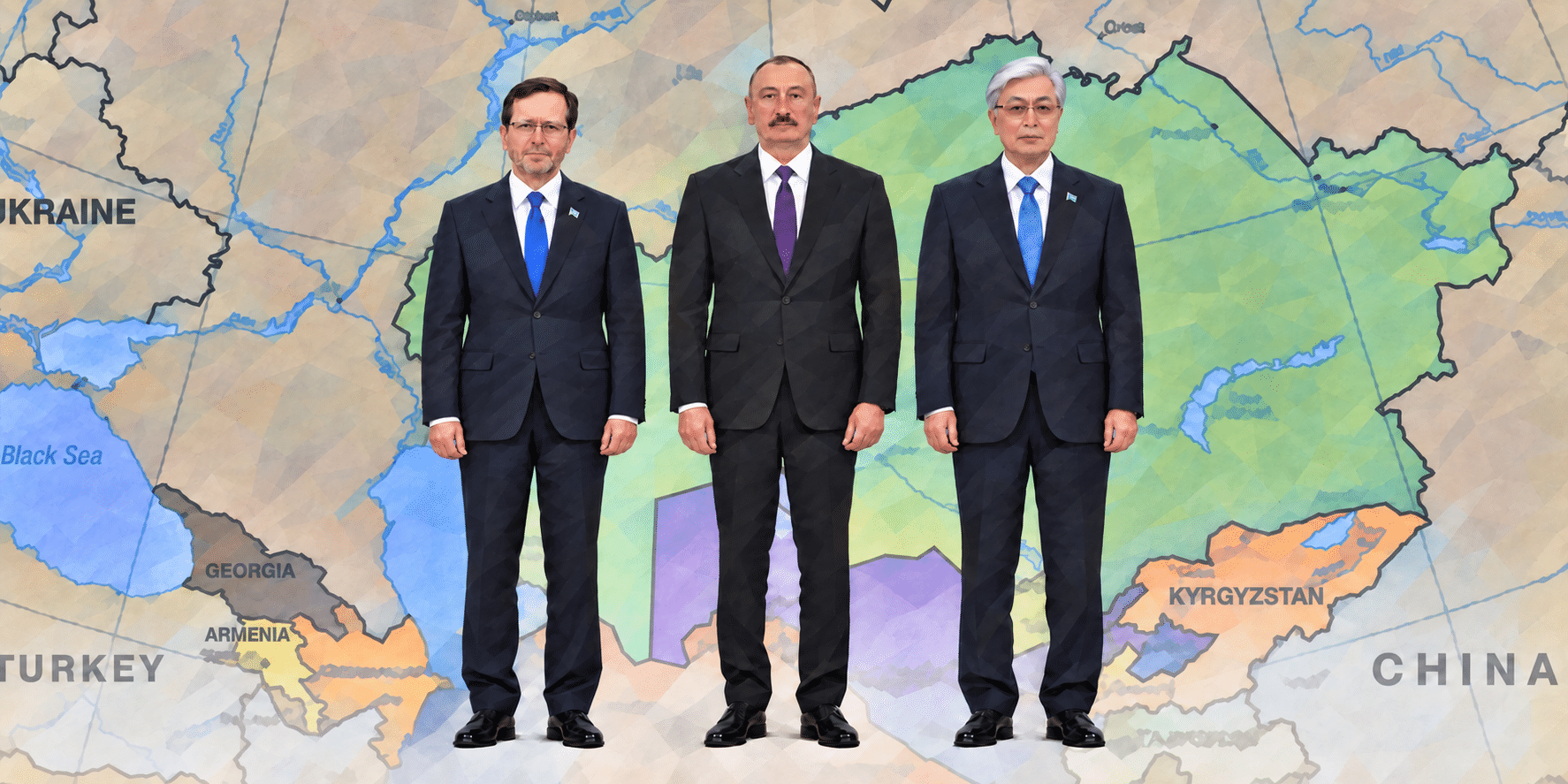
Eighty years after Winston Churchill described an Iron Curtain dividing Europe from Stettin to Trieste, another geopolitical rivalry is emerging across the Middle East, with the swing states of Central Asia and the South Caucasus poised to play a pivotal role.
From Gwadar to the Golden Horn, the new Mecca Pact brings together Pakistan, Saudi Arabia, and Turkey. From Pune in India to Piraeus in Greece, the proposed India–Middle East–Europe Economic Corridor, or IMEC, represents a different vision of regional integration, linking India, the United Arab Emirates, Saudi Arabia, Jordan, Israel, and Europe.
At the heart of the struggle is the Turkey–Israel rivalry for regional leadership in the wake of the Iran war.
But the contest will be shaped not only by the Middle East’s principal players, but also by countries on its periphery, particularly in the South Caucasus and Central Asia.
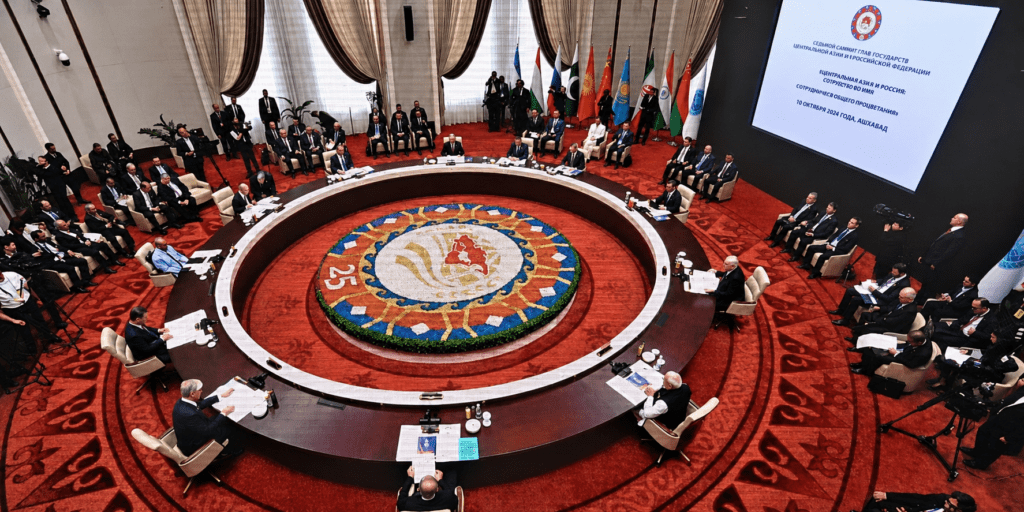
When Turkish Foreign Minister Hakan Fidan walked out of a regional summit in Baku as Israeli President Isaac Herzog began speaking on October 15, he was accompanied by representatives of Iran, Pakistan, Kuwait, Saudi Arabia, the Palestinian Authority, and others opposed to Israel’s actions in Gaza.
But none of the five Central Asian leaders followed him.
Kazakhstan’s President Kassym-Jomart Tokayev went further. On the sidelines of the summit, he held a bilateral meeting with Herzog, speaking about the “dynamic development” of Kazakhstan-Israel relations.
The episode illustrated that the more Turkey plays the Israel card, the more difficult it becomes to maintain cohesion across the Turkic world.
The Competition for Swing States
At a Hudson Institute discussion in Washington on October 26, analysts examined competing regional alignments as the Middle East prepares for an era of reduced American engagement.
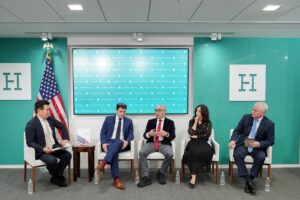
From left, Ken Moriyasu, Chaim Martin, Soner Çağaptay, Aslı Aydıntaşbaş and Michael Doran at a Hudson Institute event on Oct. 26. Image: Hudson Institute
Aslı Aydıntaşbaş, director of the Turkey Project at the Brookings Institution, said the Mecca Pact is “an early experiment” in managing a post-American region.
“In the long run, whether it’s a Democratic or Republican administration, the notion of reducing U.S. footprint in the region is a very dominant theme, and you only have to look at the American public to see that,” she noted.
Soner Çağaptay, director of the Turkish Research Program at the Washington Institute for Near East Policy, suggested the pact could best be understood through the countries it excludes, both beginning with the letter “I.”
Israel and Iran are seen as “part of the regional problems, not the solutions,” he said, adding that the Mecca Pact envisions a broad coalition of countries establishing a new security architecture without either country at its center.
India is the third “I,” said Chaim Martin, Israel’s minister of economic affairs to the United States.
“That too is an ‘I’ that is specifically not in that pact,” he said. Israel views India as a key strategic partner, with both democracies navigating complex regional environments.
Erdogan’s Azerbaijan Problem
Despite the ambitions of the Mecca Pact, Turkish President Recep Tayyip Erdogan has received a reminder of the limits of bloc politics from one of his closest allies: Azerbaijan.
Ankara and Baku describe themselves as “one nation, two states.” Turkey’s military support played a significant role in Azerbaijan’s victories over Armenia, while Azerbaijan remains indispensable to Turkey’s ambitions to become an energy and transportation hub connecting Central Asia and Europe.
At the discussion, Michael Doran, Hudson’s director of the Center for Peace and Security in the Middle East, cited Zbigniew Brzezinski’s description of Azerbaijan as “the cork in the bottle” containing the riches of the Caspian Sea basin and Central Asia.
Without access through Azerbaijan, Turkey’s ability to connect with Central Asia through the Middle Corridor, bypassing Russia and Iran, would be severely constrained.
Yet Baku also maintains close security and economic relations with Israel, whose relationship with Turkey has deteriorated sharply.
In recent weeks, tensions between Ankara and Baku have surfaced over Azerbaijan’s restrictions on headscarves in state schools. Erdogan’s adviser Oktay Saral publicly criticized the policy as “unacceptable,” provoking an angry response from Azerbaijan.
With the Organization of Turkic States (OTS) summit scheduled for October 30, the dispute raised questions about whether Azerbaijani President Ilham Aliyev would attend.
On October 25, Saral confirmed that he had left his position at Erdogan’s direction, clearing the way for reconciliation.
Although Azerbaijan has traditionally been viewed as the junior partner in its relationship with Turkey, Aydıntaşbaş observed that Baku “is now actually calling the shots.”
Kazakhstan: Israel’s Opening into the Turkic World
A similar dynamic is emerging in Kazakhstan, where Israel has made significant diplomatic inroads.
In November 2025, Kazakhstan became the first Central Asian country to join the Abraham Accords, the U.S.-sponsored framework originally established to promote normalization between Israel and Arab states.
The relationship has deepened rapidly. In January, Israeli Foreign Minister Gideon Sa’ar visited Azerbaijan and Kazakhstan with a large business delegation, seeking cooperation in fields including agriculture, water management, cybersecurity, and advanced technology. In April, President Herzog visited Astana, where he and Tokayev discussed expanding cooperation.
Then came the October 15 meeting between Tokayev and Herzog in Baku, even as Fidan led a diplomatic walkout during the Israeli president’s address.
Kazakhstan’s relationship with Israel has an intriguing Washington dimension.
Astana has long sought the repeal of the Jackson–Vanik amendment, a Cold War-era U.S. trade provision originally intended to pressure the Soviet Union to permit Jewish emigration.
More than three decades after independence, Kazakhstan remains subject to the provision, although it receives normal trade treatment through a waiver mechanism. Ending its application remains an important diplomatic objective for Astana.
By joining the Abraham Accords and strengthening ties with Israel, Kazakhstan may be able to build additional support in Washington for its efforts to secure permanent normal trade relations, a step that requires congressional action.
For Israel, Kazakhstan offers a diplomatic foothold inside the Turkic world, complicating any assumption that Turkic solidarity automatically translates into support for Ankara’s positions.
The C6 Alternative to Turkic Unity
Erdogan’s decision to remove his adviser likely reflected concern that a prolonged rupture with Baku could encourage Azerbaijan to place greater emphasis on another regional grouping gaining momentum: the C5 plus Azerbaijan.
In November 2025, Azerbaijan became a full participant in the consultative meetings of the five Central Asian states, creating what is increasingly described as the C6.
The arrangement brings together Kazakhstan, Uzbekistan, Kyrgyzstan, Tajikistan, Turkmenistan, and Azerbaijan in a regional framework without Turkey.
The developments demonstrate the limits of Turkish influence over Azerbaijan, Aydıntaşbaş said. While Aliyev will likely visit Ankara for the OTS summit, “this doesn’t mean there won’t be a residual effect,” she said.
A renewed conflict in Iran or the pace of normalization with Armenia could reopen the wounds, she added.
A New Balance of Power
The Mecca Pact and IMEC may represent two competing visions for the Middle East.
Yet the countries linking the Middle East to the Eurasian interior are demonstrating that the future regional order will not simply be determined by whichever bloc assembles the greatest number of powerful members.
Eighty years after Churchill’s Iron Curtain speech, the swing states of Central Asia and the South Caucasus are determined to avoid being placed on one side of another dividing line.
The emerging Middle Eastern rivalry is making them more important, not less independent.
Ken Moriyasu moderated the Hudson Institute panel discussion on October 26, 2026, on which this article is based.