• KGS/USD = 0.01144 0%
  • KZT/USD = 0.00196 -0%
  • TJS/USD = 0.10899 -0%
  • UZS/USD = 0.00008 -0%
  • TMT/USD = 0.28490 0%
  • KGS/USD = 0.01144 0%
  • KZT/USD = 0.00196 -0%
  • TJS/USD = 0.10899 -0%
  • UZS/USD = 0.00008 -0%
  • TMT/USD = 0.28490 0%
  • KGS/USD = 0.01144 0%
  • KZT/USD = 0.00196 -0%
  • TJS/USD = 0.10899 -0%
  • UZS/USD = 0.00008 -0%
  • TMT/USD = 0.28490 0%
  • KGS/USD = 0.01144 0%
  • KZT/USD = 0.00196 -0%
  • TJS/USD = 0.10899 -0%
  • UZS/USD = 0.00008 -0%
  • TMT/USD = 0.28490 0%
  • KGS/USD = 0.01144 0%
  • KZT/USD = 0.00196 -0%
  • TJS/USD = 0.10899 -0%
  • UZS/USD = 0.00008 -0%
  • TMT/USD = 0.28490 0%
  • KGS/USD = 0.01144 0%
  • KZT/USD = 0.00196 -0%
  • TJS/USD = 0.10899 -0%
  • UZS/USD = 0.00008 -0%
  • TMT/USD = 0.28490 0%
  • KGS/USD = 0.01144 0%
  • KZT/USD = 0.00196 -0%
  • TJS/USD = 0.10899 -0%
  • UZS/USD = 0.00008 -0%
  • TMT/USD = 0.28490 0%
  • KGS/USD = 0.01144 0%
  • KZT/USD = 0.00196 -0%
  • TJS/USD = 0.10899 -0%
  • UZS/USD = 0.00008 -0%
  • TMT/USD = 0.28490 0%
08 December 2025

Attitudes Toward Children with Special Needs in Kazakhstan Are Beginning to Shift

An appalling call by an Almaty-based blogger to “kill autistic people” has reignited public debate over attitudes toward children with special needs in Kazakhstan, revealing deep-rooted prejudices that persist in society despite ongoing reforms.

Shocking Comments and a Criminal Case

“There are too many autistic people, they need to be treated, and if they cannot be cured, they should be killed or autism hospitals should be opened. Children with autism have no feelings!” wrote Almaty blogger Raihan Zhumamuratova in a now-deleted post on social media. Her remarks sparked outrage online and drew swift condemnation from authorities.

Zhumamuratova’s post followed a disturbing incident on August 23, when a mother posted on Instagram that her two-year-old son was attacked in a courtyard by a teenager who picked him up, threw him in the air, and then fled while covering his ears. The act was captured on video. Initial reports suggested the 13-year-old boy may have a mental health condition, possibly an autism spectrum disorder, though no official diagnosis has been confirmed.

The Auezov District Police Department opened a criminal case, and the teenager’s parents were held accountable for failing to properly fulfill their parental duties.

Zhumamuratova’s comments were widely condemned. The Autism Kazakhstan association filed a formal complaint, prompting Almaty police to launch an investigation. Minister of Labor and Social Protection Svetlana Zhakupova stated, “I think law enforcement agencies will take the right decisions regarding this blogger. The harshest ones.”

“You know, we are building an inclusive society together. We do not tolerate discrimination against people with disabilities,” Zhakupova added. “Children with autism are currently under the special supervision of several government agencies, the Ministry of Education, our Ministry of Labor, and the Ministry of Health. We fully support these children.”

A Pattern of Neglect and Violence

While Zhumamuratova’s statements have drawn near-universal condemnation, this is not the first time a child has been seriously harmed by a teenager with a psychiatric condition.

In February 2025, a teenager attacked a five-year-old with a knife inside an elevator in a residential building in Astana. The assault was also recorded and widely circulated online. The attacker, who is registered at a psychoneurological clinic, was later placed in a psychiatric hospital. His legal guardian was held accountable, according to Children’s Rights Commissioner Dinara Zakieva.

Parents of children with special needs frequently report being left to cope alone. Rehabilitation services are limited, oversight is weak, and resources are stretched thin.

A Long Road to Inclusion

Kazakhstan faces systemic challenges in building an inclusive society. For decades, people with psychiatric or developmental diagnoses were kept out of public view. Traditional nomadic culture stigmatized them, and under the Soviet regime, psychiatric diagnoses often carried punitive implications that brought shame upon families.

Many citizens today remain uninformed about developmental disorders like autism. As a result, people with such conditions are often met with fear or hostility. Compounding the issue, disability benefits remain low, making private care and quality rehabilitation inaccessible for most families.

As of March 1, 2025, Kazakhstan had 12,807 children and adolescents under observation for autism spectrum disorders, more than triple the number recorded in 2020. This surge reflects both improved diagnostics and growing public awareness.

Currently, 74 rehabilitation centers provide medical assistance to children nationwide. A development and early intervention center is under construction, while 207 mental health offices operate at the district level. The Republican Scientific and Practical Center for Mental Health in Almaty serves as the leading institution. Pilot programs for early intervention are being tested in Almaty and the Kyzylorda region.

However, according to parents, these efforts fall short. Many are forced to turn to expensive private specialists due to long waits and a lack of qualified personnel in state facilities. Stigma remains entrenched, especially in rural areas, but also in urban centers like Almaty, as demonstrated by Zhumamuratova’s inflammatory comments.

Political Response and Public Hope

Mazhilis deputy Irina Smirnova responded to the incident by calling for a systemic overhaul of Kazakhstan’s approach to supporting children with autism.

“When we hear reports about the opening of rehabilitation centers, these are all fragmented moments that do not solve the overall picture,” said Smirnova. “We need to review our approaches, take the best international experience, study it, and implement it.”

While the path ahead is steep, the widespread backlash against Zhumamuratova’s comments and the strong response from civil society suggest a growing awareness and a willingness among Kazakhstani citizens to stand up for children with special needs.

UNDP and Eldik Bank Partner to Advance Green Finance in Kyrgyzstan

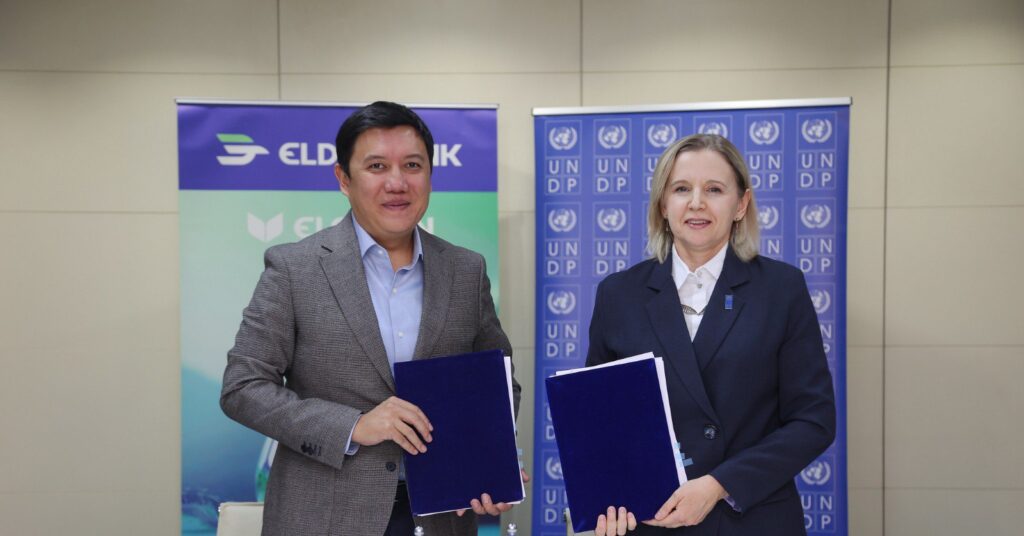
Kyrgyzstan is taking a significant step toward building a greener and more resilient economy. On September 9, state-owned Eldik Bank and the United Nations Development Programme (UNDP) signed a memorandum of understanding to deepen cooperation in sustainable finance.

The agreement aims to mobilize climate-related investments, develop sustainable financial products, and integrate Environmental, Social, and Governance (ESG) principles into Kyrgyzstan’s banking sector. It also outlines plans for joint research and knowledge exchange in climate finance, including the creation of tools to assess climate risks in lending operations.

This initiative supports Kyrgyzstan’s updated Nationally Determined Contributions (NDC 3.0) under the Paris Agreement, which commit the country to reducing greenhouse gas emissions, expanding renewable energy, and enhancing climate resilience. It also aligns with the National Development Program through 2030, which prioritizes expanding the regulatory framework for green finance.

“UNDP supports the development of sustainable finance solutions that reduce the carbon footprint of the economy, enable the green transformation of businesses, and create new opportunities for investment,” said Alexandra Solovieva, UNDP Resident Representative in Kyrgyzstan.

For Eldik Bank, the partnership represents more than a financial commitment; it is a strategic step toward becoming a catalyst for climate-conscious economic development. “Together with UNDP, we aim to introduce products that promote green growth and sustainable business development for our clients,” said Ulanbek Nogaev, Chair of the bank’s Management Board.

Green finance is gaining traction across Central Asia, a region still heavily reliant on extractive industries but increasingly vulnerable to climate risks such as water scarcity, extreme weather, and glacial melt. Kyrgyzstan’s efforts to empower domestic financial institutions signal that achieving climate goals will require more than policy declarations; it will demand concrete investments and innovation.

The Eldik Bank-UNDP partnership also underscores the importance of regional cooperation. Similar initiatives are under discussion in neighboring countries, as Central Asia seeks to attract international capital for renewable energy, sustainable agriculture, and green infrastructure projects.

If effectively implemented, Kyrgyzstan’s model could serve as a regional benchmark, demonstrating how national banks can help transform global climate commitments into tangible, growth-oriented outcomes.

Opinion: The Contact Group on Afghanistan – Central Asia Formulates a Regional Position

On August 26, special representatives on Afghanistan from Kazakhstan, Kyrgyzstan, Tajikistan, and Uzbekistan met for the first time in Tashkent. The meeting resulted in the creation of a permanent regional platform: the Contact Group on Afghanistan.

This gathering was not only a continuation of commitments outlined in the joint statement from the most recent Consultative Summit of Central Asian heads of state, but also a step toward preparing for the next high-level format, scheduled for November in Tashkent.

Formally, Turkmenistan was absent. Available information suggests the reasons were purely technical. Ashgabat was ready to join and expressed support for the results through its foreign ministry channels.

The key outcome is that Central Asian states have, for the first time, shown their readiness to speak with one voice on an issue long shaped by competing external interests. This is not the start of forming a common position; that had already developed de facto in recent years. All Central Asian countries have supported trade and transit with Afghanistan, continued supplying electricity and food, and maintained working contacts with the Taliban, while avoiding extremes. The Tashkent meeting institutionalized this approach: parallel tracks have now shifted, cautiously, toward coordination. Informal unity has been formalized into a tool.

Unlike external players, who often cloak interests in grand rhetoric, Central Asia acts openly and pragmatically. The logic is simple: whatever is done for Afghanistan is, in fact, done for oneself. That is the distinctive feature of the regional approach – no ideological cover, no attempts to reshape Afghanistan.

Examples are straightforward. Electricity continues to flow even when payments are delayed – not as charity, but as an investment in security. A blackout in Afghanistan could trigger refugee flows and threats heading north. Exports of flour and fuel sustain Afghan markets but also expand outlets for Central Asian producers. Participation in trans-Afghan corridors is not a gift to Kabul but an opportunity for Central Asia to anchor itself in southern logistics routes.

Ultimately, every step “for Afghanistan” is primarily for the region itself. If Kabul ignores basic rules, cooperation will simply stop. In politics, there are no eternal friends, only eternal interests.

The new format does not yet imply collective pressure on the Taliban. Rather, it creates conditions for each country to conduct more substantive bilateral dialogue, but grounded in a shared position. Until now, Central Asia has mainly spoken to the Taliban about trade, transit, and infrastructure. The Contact Group now makes it possible to add another dimension: clarifying boundaries of what is acceptable on issues like extremism, border escalation, or water pressure. For now, “red lines” are unlikely, since the Taliban have not crossed them. The situation remains manageable, leaving room for constructive dialogue.

Equally important, the Contact Group is not a threat or ultimatum. Coordination is meant to expand opportunities for dialogue, not limit them. In the long run, this could evolve into a sustainable C5+A format. Afghanistan would then be integrated into regional frameworks not as a problem to be managed, but as a partner engaged in discussions on water, security, logistics, and the environment.

The issue for Central Asia is not who governs Kabul, but whether Afghanistan can function as a competent economic and political actor. What matters is adherence to accepted economic standards and integration into regional formats. For this reason, the C5+1 could become the backbone of future cooperation, regardless of regime.

The recent SCO summit in Tianjin illustrates this pragmatic approach. Its final declaration stated that Afghanistan should become an independent, neutral, and peaceful state, free of terrorism, war, and drugs, and that “the formation of an inclusive government with broad participation of representatives of all ethno-political groups of Afghan society is the only way to achieve lasting peace and stability in this country.” Central Asia, through the Contact Group, is advancing the same principle: cooperation is possible, but some issues are non-negotiable.

This regional subjectivity is also evident within multilateral organizations, particularly the SCO. The 2024 Astana Declaration enshrined Central Asia as the “core of the organization.” President Tokayev’s proposals – specialized SCO centers to tackle security threats, new infrastructure and humanitarian initiatives, and engagement with UN resources – demonstrate that the region is moving beyond declarations to building institutional mechanisms that could also involve Afghanistan.

Attempts to create broad international formats on Afghanistan have consistently stalled under the weight of competing interests. The Tashkent format is different: it is an intra-regional conversation, without outside players. Of course, disagreements remain within Central Asia itself. But the fact that states have created a permanent platform on an issue vital to them is already progress. It strengthens their international standing and tests their ability to overcome differences for a shared purpose.

Cautious optimism is warranted, though it is too early to judge effectiveness. Yet the need for such a platform has long been obvious. It allows the region to set its own agenda instead of waiting for outside decisions.

The new format is not altruism, but calculation: by helping Afghanistan, Central Asia strengthens its own stability. If the Contact Group enhances their ability to negotiate and act together, it will prove an important investment in the region’s future.


The views expressed in this article are those of the author and do not necessarily reflect the official policy or position of the publication, its affiliates, or any other organizations mentioned.

Syrian Forces Intensify Arrests of Uzbek and Foreign Militants in Idlib

Syrian forces under the administration of Ahmed al-Sharaa have escalated their long-running security campaign against foreign fighters in northwestern Syria, targeting individuals affiliated with the Islamic State (ISIS) and other jihadist factions. According to Syrian sources cited by the El Manshar news outlet, the crackdown has gained momentum in recent months, with a focus on detaining commanders and field operatives of various nationalities, particularly in the Idlib region.

Among those detained are several Uzbek nationals. In June 2025, security forces in Idlib arrested Ayoub “Abu Dujana” al-Uzbeki, a military trainer, and transferred him to an undisclosed location. In late August, another Uzbek figure, known as Islam al-Uzbeki, was detained during a raid in the Qasour neighborhood of Idlib. On September 3, Syria’s Internal Security Directorate announced the dismantling of an ISIS cell in the Harem area of western Idlib, with all members taken into custody, including fighters from Iraq and Uzbekistan.

This is not the first time Uzbek militants have been the focus of security operations. Reports from late 2022 documented more than 20 raids on ISIS-affiliated cells across Idlib province, resulting in the arrests of several Uzbek fighters. Since 2020, forces loyal to Sharaa have also targeted the al-Qaeda-linked “Tawhid and Jihad” battalion, detaining senior figures such as its founder, Abu Saleh al-Uzbeki. Those arrests sparked violent clashes with rival jihadist groups.

Analysts suggest the campaign aims to consolidate Sharaa’s authority by bolstering security services, pre-empting the rise of autonomous armed factions, and eliminating groups that resist integration into his command structure. It also appears intended to signal compliance with previous understandings with the United States concerning the handling of foreign fighters in Syria.

Despite these efforts, El Manshar notes that extremist groups continue to maintain a limited but persistent presence in eastern Idlib and along the Turkish border. The campaign, therefore, represents a protracted struggle for dominance rather than a definitive resolution of the foreign fighter issue.

Contemporary Art Center Tselinny Opens in Almaty

Summer in Almaty was rich with music festivals, concerts, and public projects, and this cultural momentum appears set to continue into fall. The grand opening of the Tselinny Center for Contemporary Culture last Friday marked the start of September with a major cultural milestone for the city.

A Historic Space Reimagined

At a recent press conference, organizers spotlighted the significance of this new cultural landmark within the evolving discourse of Central Asian contemporary art.

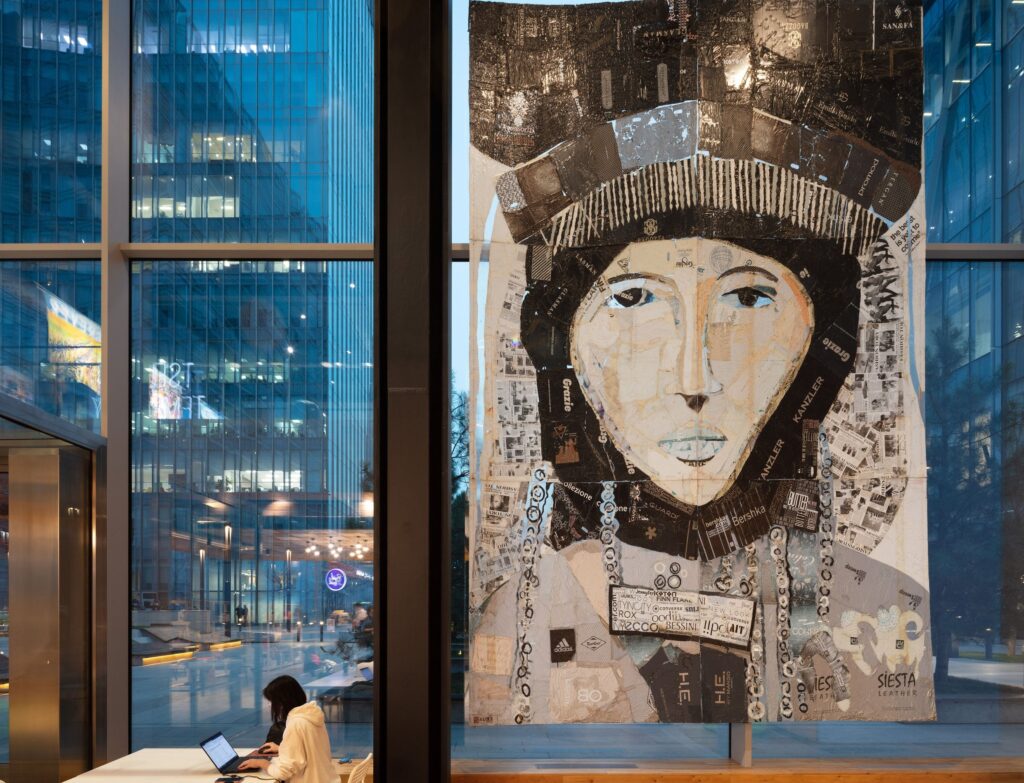
Director Jamilya Nurkalieva led a short tour ahead of the official opening, sharing insights into the restoration and rethinking of the historic Tselinny cinema. Reinterpreting Almaty’s first panoramic cinema, an iconic piece of Soviet-era modernist architecture, was, in her words, about creating “an architectural pearl.” She described the new space as embodying “inclusivity and acceptance, the ultimate state of tranquility, almost like a hug.”

Image: TCA

Image: Atelier Cauchemar

The transformation was a deeply local effort. Nurkalieva emphasized the importance of working with Kazakhstani architects, builders, and craftsmen to ensure authenticity throughout the reconstruction process. Among the most unexpected discoveries during renovation were original works by renowned Soviet graphic artist Yevgeniy Sidorkin, long believed lost. His preserved sgraffito now welcomes visitors at the entrance. “Conceptually, we didn’t want the space to become a monument to Sidorkin alone, this is a place for new artists,” said Nurkalieva. “In some areas, craftsmen recreated panels from his sketches. We chose neutral tones so the sgraffito wouldn’t dominate the space.”

Image: tselinny.org

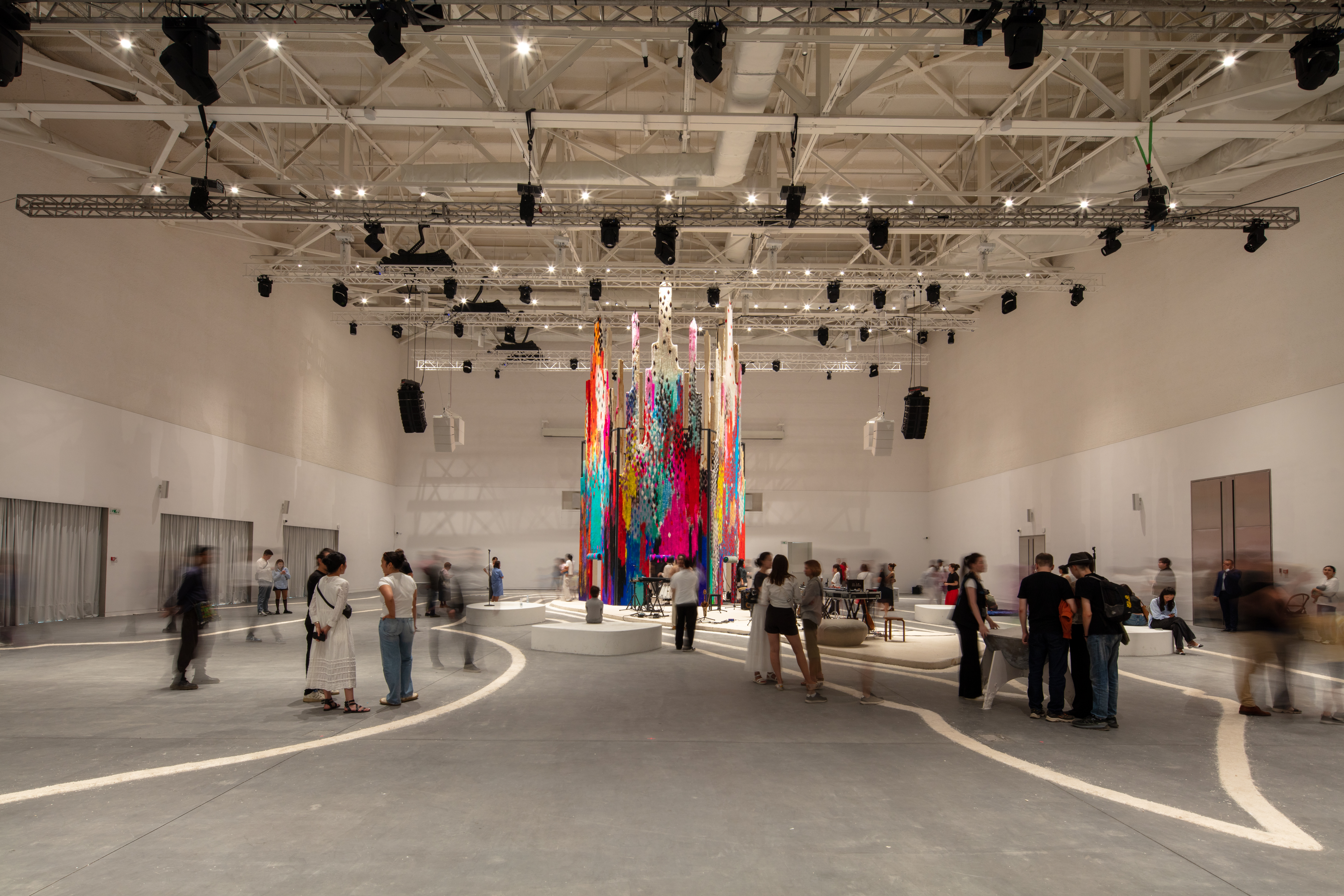
In just its first three days, Tselinny welcomed more than 12,000 visitors. The public experienced debut exhibitions, the interdisciplinary performance BARSAKELMES, and the launch of an educational program. The former Soviet cinema, now reimagined by British architect Asif Khan, has been reborn as a cultural hub for Almaty and the wider region. Tselinny will gradually extend its hours and programming over the coming months, with full operations set to begin in January 2026.

Image: TCA

Asif Khan’s architectural vision reflects a concept of spatial unity rooted in the Kazakh cosmological balance of Tengri (sky) and Umai (earth), representing power and growth. Drawing inspiration from the steppe landscape, Khan has preserved the spirit of the original building while opening a new horizon for each visitor.

Launching a New Dialogue

Three exhibition projects opened in parallel with the center itself. These include installations by Gulnur Mukazhanova and Daria Temirkhan as part of BARSAKELMES; the architectural showcase From Sky to Earth: “Tselinny” by Asif Khan (curated by Markus Lahtinenmäki); and the archival project Documentation: Imagining Central Asia on the Map of Contemporary Art (curated by Asel Rashidova). These inaugural exhibitions are intended to initiate long-term dialogue between artists, institutions, and the broader public. A full program is available on Tselinny’s official website.

The Return of Tselinny

Once the largest cinema in Soviet Central Asia, Tselinny has now been transformed into a multifunctional art center. The revamped complex includes exhibition spaces, workshops, a library, a bookstore, offices, and open public areas. The renovation balances the building’s historical legacy with the requirements of a contemporary cultural institution.

Image: TCA

During the first month of operations, public access to the space will be limited as the team gradually introduces new features and services while ensuring high safety and service standards.

Kazakhstan to Launch Internationally Accredited Rare Earth Laboratory

Kazakhstan is set to host an internationally accredited laboratory for rare earth metals, a move expected to bolster the country’s role in global supply chains for critical raw materials.

Minister of Industry and Construction Yersayin Nagaspayev announced that agreements have been reached with two leading global laboratory brands, RCI Inspection and PARAGON, to open a geo-analytical facility in Astana under their certification. The site will include core storage and archival repositories. Preparatory work on design and feasibility studies is already underway.

The initiative follows President Kassym-Jomart Tokayev’s September 8 address to Parliament, in which he emphasized the strategic importance of rare earth elements (REEs) for Kazakhstan’s long-term economic development. The laboratory will be established under the National Geological Service and is scheduled to open by mid-2026.

Tokayev also directed the government to launch at least three high-tech production facilities using rare earth metals within the next three years, citing their growing importance in global trade and technology.

“Given global trends, rare earth metals and other critical materials are acquiring particular significance. Kazakhstan has all the capabilities to firmly integrate into global production and trade chains,” Tokayev said.

Rare earth metals, a group of 17 elements including scandium, yttrium, and the lanthanides, are essential for manufacturing electronics, batteries, renewable energy equipment, and defense technologies. Despite holding substantial reserves, Kazakhstan has traditionally exported REEs in raw form, a practice that has sparked concern among lawmakers.

Nagaspayev outlined four strategic priorities for domestic processing:

  • Battery materials production
  • Recycling, including permanent magnets
  • Heat-resistant alloys for turbine engines
  • Semiconductor materials manufacturing

Kazakhstan is building partnerships with the EU, U.S., Japan, South Korea, and China to advance these sectors. Planned projects include:

  • A 15-ton-per-year gallium plant
  • Production of high-purity manganese sulfate and graphite for battery use
  • Nickel-based superalloys for advanced manufacturing

Pilot recycling of permanent magnets is scheduled to begin next year at the Zhezkazganredmet and Ulbinsky Metallurgical Plant, in cooperation with European partners.

As The Times of Central Asia recently reported, new geological surveys have revealed that Kazakhstan’s rare earth reserves exceed previous estimates, further strengthening its position as a potential global supplier.