• KGS/USD = 0.01144 0%
  • KZT/USD = 0.00194 0%
  • TJS/USD = 0.10872 0.18%
  • UZS/USD = 0.00008 0%
  • TMT/USD = 0.28571 0%
  • KGS/USD = 0.01144 0%
  • KZT/USD = 0.00194 0%
  • TJS/USD = 0.10872 0.18%
  • UZS/USD = 0.00008 0%
  • TMT/USD = 0.28571 0%
  • KGS/USD = 0.01144 0%
  • KZT/USD = 0.00194 0%
  • TJS/USD = 0.10872 0.18%
  • UZS/USD = 0.00008 0%
  • TMT/USD = 0.28571 0%
  • KGS/USD = 0.01144 0%
  • KZT/USD = 0.00194 0%
  • TJS/USD = 0.10872 0.18%
  • UZS/USD = 0.00008 0%
  • TMT/USD = 0.28571 0%
  • KGS/USD = 0.01144 0%
  • KZT/USD = 0.00194 0%
  • TJS/USD = 0.10872 0.18%
  • UZS/USD = 0.00008 0%
  • TMT/USD = 0.28571 0%
  • KGS/USD = 0.01144 0%
  • KZT/USD = 0.00194 0%
  • TJS/USD = 0.10872 0.18%
  • UZS/USD = 0.00008 0%
  • TMT/USD = 0.28571 0%
  • KGS/USD = 0.01144 0%
  • KZT/USD = 0.00194 0%
  • TJS/USD = 0.10872 0.18%
  • UZS/USD = 0.00008 0%
  • TMT/USD = 0.28571 0%
  • KGS/USD = 0.01144 0%
  • KZT/USD = 0.00194 0%
  • TJS/USD = 0.10872 0.18%
  • UZS/USD = 0.00008 0%
  • TMT/USD = 0.28571 0%
22 December 2025

Kazakhstan, Kyrgyzstan, and Uzbekistan Agree on Joint Water and Energy Measures

Kazakhstan, Kyrgyzstan, and Uzbekistan have reached a landmark agreement on coordinated water and energy management, signaling a deepening commitment to cross-border cooperation amid growing seasonal and climate-related challenges.

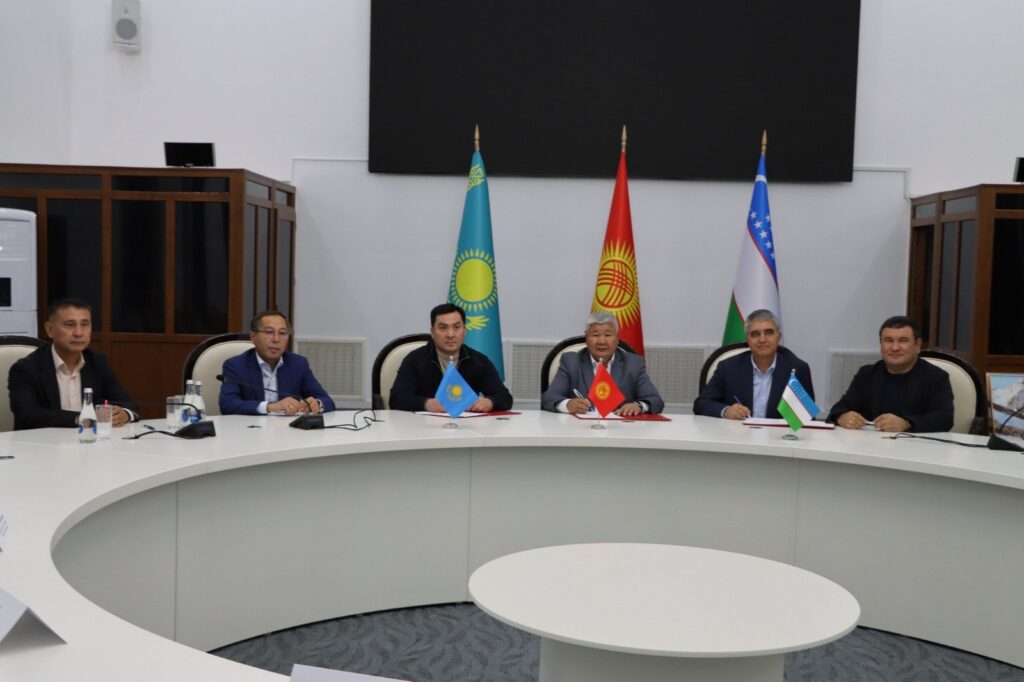
The agreement was formalized on September 7 in Cholpon-Ata, Kyrgyzstan, during a meeting of energy ministers and water management authorities from the three countries. The protocols define mutual obligations for water releases and electricity exchanges, with the goal of balancing the region’s energy needs and preserving critical water resources.

Under the terms of the agreement, Kyrgyzstan will release water from the Toktogul Hydroelectric Power Plant (HPP) reservoir to downstream Kazakhstan and Uzbekistan. In return, Kyrgyzstan will receive electricity from both countries through spring 2026.

According to the Kyrgyz Ministry of Energy, the arrangement is designed to optimize the use of water stored in Toktogul and to secure reliable electricity supplies for Kyrgyzstan during the 2025-2026 autumn-winter period.

Regional Power Transit Agreements

The protocols also include provisions for cross-border electricity transit: from Russia to Kyrgyzstan via Kazakhstan’s grid, and from Turkmenistan to Kyrgyzstan through Uzbekistan’s transmission network.

The Toktogul HPP, situated on the Naryn River, a major tributary of the Syr Darya, is Kyrgyzstan’s largest power facility, generating roughly 40% of the country’s electricity. It serves a dual function: providing domestic energy and regulating water flows that are essential for irrigation in downstream Kazakhstan and Uzbekistan.

In winter, Kyrgyzstan often increases power output from Toktogul to meet heating demand, but this can significantly lower reservoir levels, jeopardizing irrigation supplies the following spring. The new agreement is intended to reduce this risk by enabling Kazakhstan and Uzbekistan to supply electricity during peak winter months, allowing Kyrgyzstan to conserve water.

Kazakhstan’s Ministry of Energy emphasized that the trilateral deal is crucial to maintaining water levels in Toktogul and ensuring sufficient irrigation for southern Kazakhstan during the next growing season.

Broader Regional Energy Cooperation

Separately, Kazakhstan and Uzbekistan signed an agreement for the supply of approximately 900 million kilowatt-hours of electricity between March and December 2026. The electricity is expected to cover anticipated shortages in Kazakhstan’s southern power grid and further underscores the growing interdependence of Central Asia’s energy and water systems.

Uzbekistan to Supply Electricity to Kazakhstan and Afghanistan in 2026

Uzbekistan will supply 900 million kilowatt-hours of electricity to Kazakhstan between March and December 2026, according to a statement by the Kazakh Ministry of Energy. The agreement was formalized on September 7 in Cholpon-Ata, Kyrgyzstan, during a trilateral meeting of energy and water authorities from Kazakhstan, Kyrgyzstan, and Uzbekistan.

The meeting produced several protocols aimed at stabilizing the region’s water and energy balance. A key component includes coordinated water releases from Kyrgyzstan’s Toktogul Reservoir in exchange for electricity supplied by Kazakhstan and Uzbekistan to Kyrgyzstan. The parties also finalized transit arrangements for Russian electricity flowing to Kyrgyzstan via Kazakhstan’s grid.

These measures are designed to ensure adequate irrigation for southern Kazakhstan during the next growing season and to maintain critical water levels in the reservoir.

Kazakhstan’s Energy Minister Yerlan Akkenzhenov emphasized that the protocols include “specific figures, timelines, and prices,” underscoring that strict compliance with the agreed schedule is essential to maintaining stability in both electricity supply and water resource management.

The electricity deal with Uzbekistan is expected to help offset power shortages in Kazakhstan’s southern grid during planned maintenance work at domestic power stations.

Uzbekistan Supports Afghanistan’s Energy Sector

In parallel, Uzbekistan has reaffirmed its commitment to supporting Afghanistan’s efforts to modernize its electricity infrastructure. The Uzbek Ministry of Energy reported that a high-level investment conference was recently held in Kabul, drawing officials from Afghanistan, Uzbekistan, Turkmenistan, and Tajikistan, along with representatives from international organizations and diplomatic missions.

As part of the conference, a financial agreement was signed for the construction of new power transmission lines and substations with capacities ranging from 220 to 500 kilovolts. The project is slated for completion in the first quarter of 2027.

Uzbekistan also pledged to assist Afghanistan in modernizing its power distribution networks, implementing smart metering technologies, and providing technical expertise to improve energy delivery and reliability.

From Mansions to Classrooms: Kazakhstan Turns Corruption Assets into Public Good

Kazakhstan is actively reclaiming assets obtained through corrupt practices and redirecting them toward social development. Confiscated properties, including luxury mansions, high-end vehicles, and even ancient jewelry, are being allocated for public benefit, particularly in education, healthcare, and infrastructure. These efforts form part of a broader anti-corruption campaign under President Kassym-Jomart Tokayev, which aims to transform stolen wealth into schools, hospitals, and public services while restoring public trust in government.

Luxury Assets Reallocated for Public Use

Over the past several years, billions of dollars in assets have been returned to the state budget. On September 5, officials announced that a luxurious mansion formerly owned by convicted ex-Prime Minister and ex-head of the National Security Committee Karim Massimov had been transferred to the Ministry of Education. Located in Astana, the property will be converted into a center for children with special needs. Initially slated for auction, the villa was withdrawn from sale and reassigned for social use. Massimov, who was sentenced in 2023 to 18 years in prison for high treason, attempted coup, and abuse of office, had amassed large amounts of property and luxury goods now being liquidated or redirected to state use.

Image: National Security Committee of the Republic of Kazakhstan; a luxury mansion once owned by ex-Prime Minister Karim Massimov, complete with a disco bar, private theater, pool, and 30 rooms

This approach is not limited to Massimov’s holdings. In 2025, assets belonging to Perizat Kairat, the founder of a high-profile charity fund, were confiscated after she and her mother were convicted of embezzling donations meant for flood victims. The case shocked the country, as Kairat had been celebrated for her volunteer work before investigations revealed widespread fraud. She received a 10-year prison sentence while her mother was given seven years. Their seized property included a private house and apartments in Astana, along with luxury vehicles such as a Mercedes-Benz S450, Lexus LX 600, and Mercedes EQS 500. Authorities announced that these assets would be auctioned, with proceeds used to compensate victims defrauded by the foundation.

Image: Instagram; Perizat Kairat in Abu Dhabi

A Legal Framework for Asset Recovery

A legal framework for asset recovery underpins these actions. In July 2023, Tokayev signed the Law “On the Return of Illegally Acquired Assets to the State,” targeting entities involved in large-scale corruption and oligopolistic practices. The law established an Asset Recovery Committee and a state management company to oversee confiscated property. It also created mechanisms to repatriate funds hidden abroad. Since its adoption, Kazakhstan’s Anti-Corruption Agency has recovered approximately 1.12 trillion KZT, ($2.1 billion) in assets and funds. These reclaimed resources are being reinvested in critical sectors.

Examples of reallocated property illustrate the scale of the initiative. In Almaty, the Kaisar Tower business center, once privately owned, was transferred to the Kazakh National Women’s Pedagogical University. Another building in the city was handed over to the T. Zhurgenov Kazakh National Academy of Arts. In Astana, three mansions confiscated from corrupt officials are now being used by the municipal correction office serving children with disabilities. The state also reclaimed the Shevchenkivskoye deposit in Kostanay region – previously controlled by a convicted former vice minister – which contains nickel and cobalt reserves valued at over 5.6 trillion tenge. Internationally, meanwhile, Kazakhstan has reclaimed assets from Austria, France, Liechtenstein, the UAE, Turkey, Russia, and other countries.

Not all recovered assets are properties or cash. In May 2025, authorities transferred a seized collection of jewelry and artifacts dating from the 7th century BC to the 3rd century AD to the National Museum. The items, crafted in the Scythian “animal style,” had been seized from a corrupt official. By preserving these artifacts, the state emphasized that cultural heritage as well as financial wealth belong to the public.
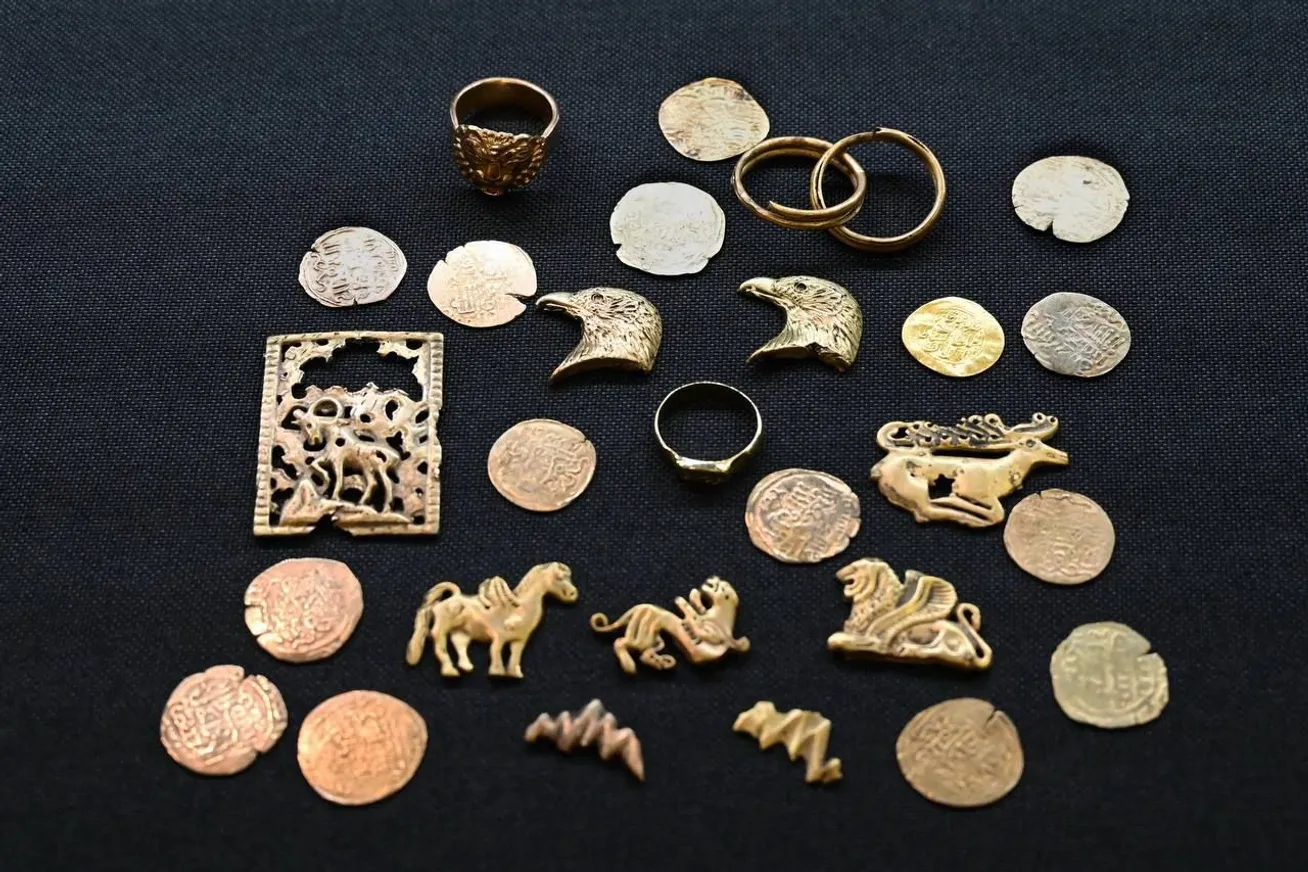
Image: Prosecutor General’s Office of the Republic of Kazakhstan

Addressing the Education Crisis and Building Social Infrastructure

One of the most pressing areas where recovered assets are being deployed is education. Kazakhstan is currently facing a chronic shortage of school places due to a growing population and years of underinvestment. In June 2025, the Anti-Corruption Agency (Antikor) reported that 153.3 billion KZT, (approximately $329 million), had been allocated from recovered funds to the Education Infrastructure Support Fund. These resources are financing the construction of 89 schools designed to accommodate 100,000 students. Sixty-one schools have already been completed; the remaining 28 are scheduled to open in 2025.

Beyond education, 406 development projects supported by returned assets are currently underway across Kazakhstan. These include healthcare initiatives, water supply systems, and sports facilities. Nearly all regions have projects funded by recovered money. In the Akmola region, for example, confiscated assets are being used to build new water pipelines for towns facing shortages. Similar initiatives are taking place in Turkestan, Aktobe, and other provinces. In the health sector, resources are supporting the construction of hospitals, outpatient clinics, and specialized care centers.

Repurposing the Assets of the Former Elite

The campaign has also reached into the business empires of former political elites. Prominent figures tied to the Nazarbayev era, including Kairat Satybaldy and Kairat Boranbayev, have returned vast assets to the state through settlements and court rulings. Satybaldy’s holdings, valued at hundreds of millions of dollars, were confiscated after his 2022 arrest, while Boranbayev handed over oil fields, commercial centers, and cash payments in exchange for lighter sentences. These high-profile cases demonstrate the government’s determination to dismantle oligarchic wealth and reinvest it into public needs.

The sale of seized luxury assets continues. Jewelry, watches, cars, and even private aircraft have been auctioned, with proceeds going directly into the Special State Fund. In 2025, auctions raised millions of dollars, and the state expects these revenues to grow as more cases are concluded. In addition to funding schools and hospitals, recovered wealth has been directed toward sports infrastructure and cultural projects, reflecting a broader effort to demonstrate visible, tangible benefits to the population.

Kazakhstan’s strategy to recover and repurpose stolen wealth reflects a dual objective: to strengthen the rule of law by ensuring that corrupt officials cannot enjoy ill-gotten gains, and to visibly channel these resources into projects that improve everyday life, from classrooms to clean water. By converting mansions into schools and using confiscated billions to build infrastructure, the government is underscoring its message that corruption has consequences and restitution has rewards.

The national effort is ongoing and evolving, with officials continuing to pursue asset recovery cases abroad while monitoring the effective use of funds at home. While skepticism remains among parts of the public given Kazakhstan’s long history of elite corruption, the scale of the returned assets and the speed at which they are being converted into public projects mark a significant shift. If sustained, the program could serve as a regional example of how to turn the legacy of corruption into tangible social benefits.

Kazakhstan and Turkmenistan Finalize $555 Million Investment and Trade Agreement

Kazakhstan’s Senate on September 4 ratified a bilateral agreement with Turkmenistan aimed at bolstering mutual investment and economic cooperation, Kazinform reported. The agreement, which sets out conditions for the promotion and protection of investments, is expected to create a more transparent and predictable environment for investors from both countries.

Senator Amangeldy Nugmanov emphasized that the agreement provides comprehensive legal safeguards for investment across all sectors, from state-led initiatives to private enterprise. For the first time at the interstate level, Kazakhstan and Turkmenistan have formalized clear guarantees to protect investor interests. The agreement includes provisions for dispute resolution, including access to international arbitration, and ensures fair and equal treatment for foreign investments.

Energy Sector as Strategic Priority

Energy cooperation figures prominently in the agreement. Kazakhstan has expressed readiness to invest in the development of Turkmenistan’s gas condensate fields and to support the expansion of pipeline infrastructure. Nugmanov highlighted a separate agreement signed between Kazakhstan’s QazaqGaz and Turkmenistan’s state concern Turkmengaz, describing it as a “golden bridge” that will enhance both nations’ economic prospects and contribute to regional energy security.

Trade and Transport Ties Expand

Senator Sergey Ershov noted that bilateral trade reached $555.7 million in 2024. Kazakh investors injected $16.1 million into Turkmenistan’s economy, while Kazakhstan received $400,000 in direct investment from Turkmenistan. Beyond energy, cooperation now includes rail, road, and maritime transport. Turkmenistan has also shown interest in modernizing armored vehicles and supplying spare parts to Kazakhstan.

During a summit held in April, the presidents of both countries agreed to target $1 billion in annual trade turnover in the near future. They also underscored the strategic importance of expanding cooperation in energy and transport. Key projects under discussion include Kazakhstan’s potential participation in Turkmenistan’s Galkynysh gas field and the development of the Turgundi-Herat-Kandahar-Spin Boldak railway. The rail line, which would pass through Afghanistan, is seen as a means of diversifying trade routes and unlocking new regional markets.

Cotton Deadlock: Why Tajikistan’s Farmers Are Working at a Loss

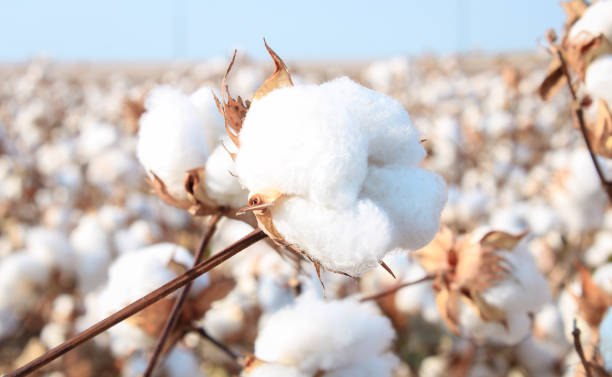
Tajikistan’s cotton farmers are facing a growing crisis: while global cotton prices remain high, local producers are forced to sell at rates below production cost, threatening the viability of an entire sector that once served as a strategic pillar of the national economy.

Farmers say they are currently paid just 6-6.5 TJS ($0.66-0.72) per kilogram for raw cotton, while the cost of production stands at 7-8 TJS ($0.77-0.88). Many now warn that without government intervention, the cotton industry is unsustainable.

Selling Below Cost

“If we don’t sell for at least 10 TJS ($1.10) per kilogram, we will go bankrupt. The production cost is simply too high,” said a farmer from Khamadoni district.

He estimates that it takes between 10,000 and 12,000 TJS ($1,100-1,320) to cultivate one hectare of cotton. Yet this season, even the most optimistic buyers offer well below that value.

In Khamadoni, the crisis is compounded by non-operational cotton ginning factories. Farmers were instructed in the spring to plant cotton, but come harvest time, they discovered there was no local processing infrastructure in place. Many are now searching for buyers in other districts, where prices remain equally unprofitable.

Despite official claims of “freedom of crop choice,” farmers say that in practice they face unspoken pressure from local authorities. Refusing to grow cotton can complicate land lease renewals or access to loans.

Intermediaries Reap the Profits

On the international market, cotton prices hover around $1.50-1.60 per kilogram. But Tajik producers remain disconnected from global buyers. Instead, they rely on a procurement system that disproportionately benefits intermediaries.

“Without subsidies and higher purchase prices, cotton farming will collapse. The current procurement system works in favor of intermediaries, not the farmers,” said economist Farrukh Saidov.

Labor costs add to the burden. Pickers are paid just 1.5 TJS ($0.16) per kilogram while many can earn up to 200 TJS ($22) a day in construction. This pay disparity is driving workers away from agriculture.

Uzbekistan Supports, Tajikistan Promises

In neighboring Uzbekistan, cotton production has become more viable thanks to government subsidies of 2.1 TJS ($0.23) per kilogram. Tajikistan offers no such support, leaving local farmers to operate at a loss.

On paper, however, the government has ambitious plans. The national strategy for the development of the cotton and textile industry through 2040 includes proposals for preferential loans, grants, tax breaks, and greater participation of farmers in setting factory prices.

Plans also call for establishing a national cotton and textile association, retraining agricultural specialists, and bringing in foreign experts. But on the ground, farmers say these promises remain unfulfilled. Video appeals shared widely on social media reflect growing desperation among rural communities.

“We are forced to sell cotton below cost. Without state support, this is a path to ruin,” one farmer said.

Experts agree that systemic reforms are urgently needed. These would include introducing subsidies, creating direct access to export markets, and eliminating unofficial crop mandates.

For now, cotton, once a key strategic industry, is fast becoming a symbol of Tajikistan’s broader agricultural dysfunction.

Recipes for Broken Hearts: Bukhara Hosts Its First Contemporary Art Biennale

The heat of Bukhara’s old city does little to deter the crowds. Tourists squeeze through narrow lanes, pausing in the shade of centuries-old madrasas or beneath towering minarets. This September, the heart of the UNESCO Creative City of Crafts and Folk Art is hosting something new: the inaugural Bukhara Biennale of contemporary art.

Running from September 5 to November 20, the biennale is already being hailed as one of Central Asia’s largest and most diverse art initiatives. Its title, Recipes for Broken Hearts, reflects both its ambition and tone, blending art, history, and community in a city long known for its spiritual and cultural heritage.


A Global Effort Rooted in Bukhara

The Bukhara Biennale is commissioned by Gayane Umerova, Chairperson of the Uzbekistan Art and Culture Development Foundation, which has played a pivotal role in preserving and promoting the country’s cultural legacy. Artistic director Diana Campbell sees the biennale as a continuation of Bukhara’s historic role as a center of learning and exchange.

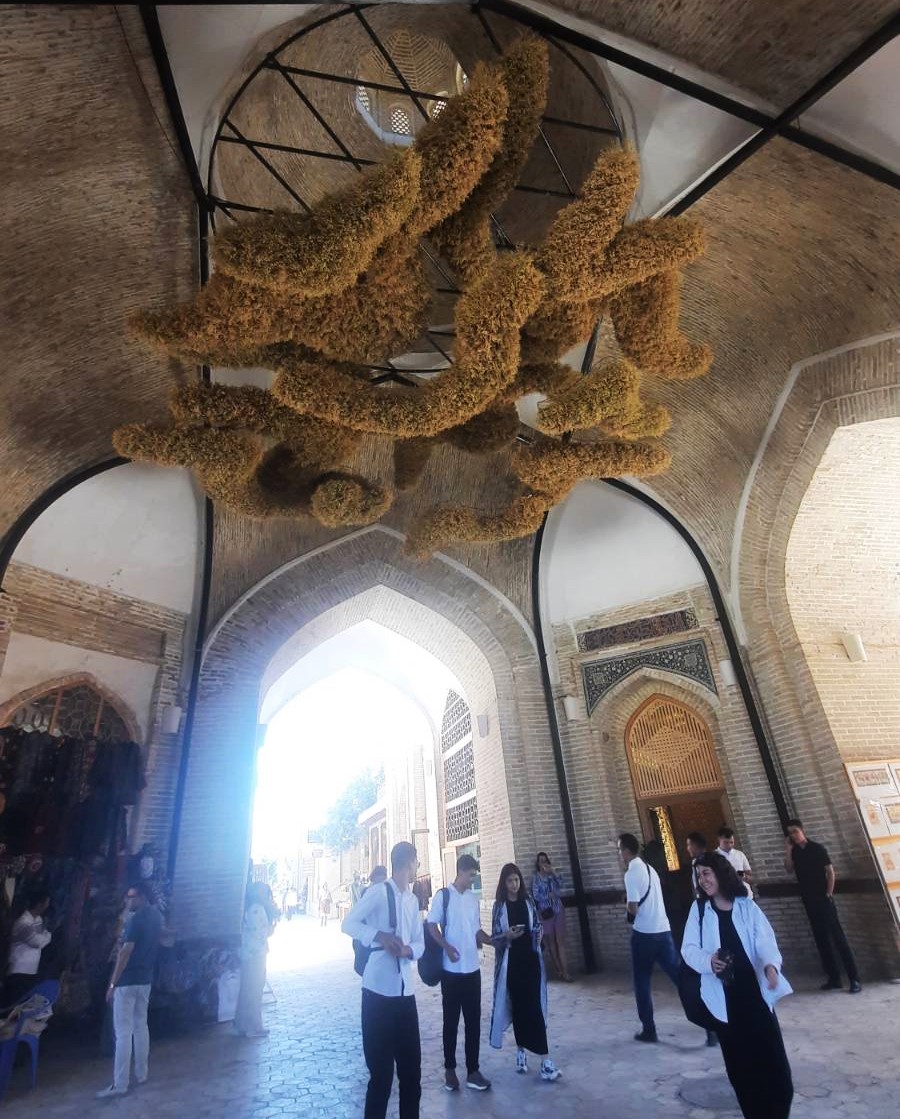
Isiriq (wild rue) is a traditional herbal medicine also widely used in purification rituals among Uzbeks. It is often burned or hung in homes to ward off misfortune and evil. In the installation, bunches of isiriq hanging from the roof appear to reflect this age-old custom; image: TCA, Sadokat Jalolova

“The heart’s creative power comes into view when we look to tenth-century Bukhara, a time and place that offer many ways of mending heartbreaks,” said Campbell. She referenced Bukhara’s legacy as the home of polymath Ibn Sina and a crossroads on the Silk Roads. “For more than a millennium, Bukhara has been a place where people gathered to seek knowledge, healing, and hope. We believe the city holds many extraordinary recipes in its heart.”

The biennale unfolds in the newly developed Bukhara Cultural District, where restored monuments are paired with modern design, featuring contributions from architects Wael Al Awar and landscape designer Günther Vogt.

From Jeddah to Bukhara: Palm Waste Becomes Structure

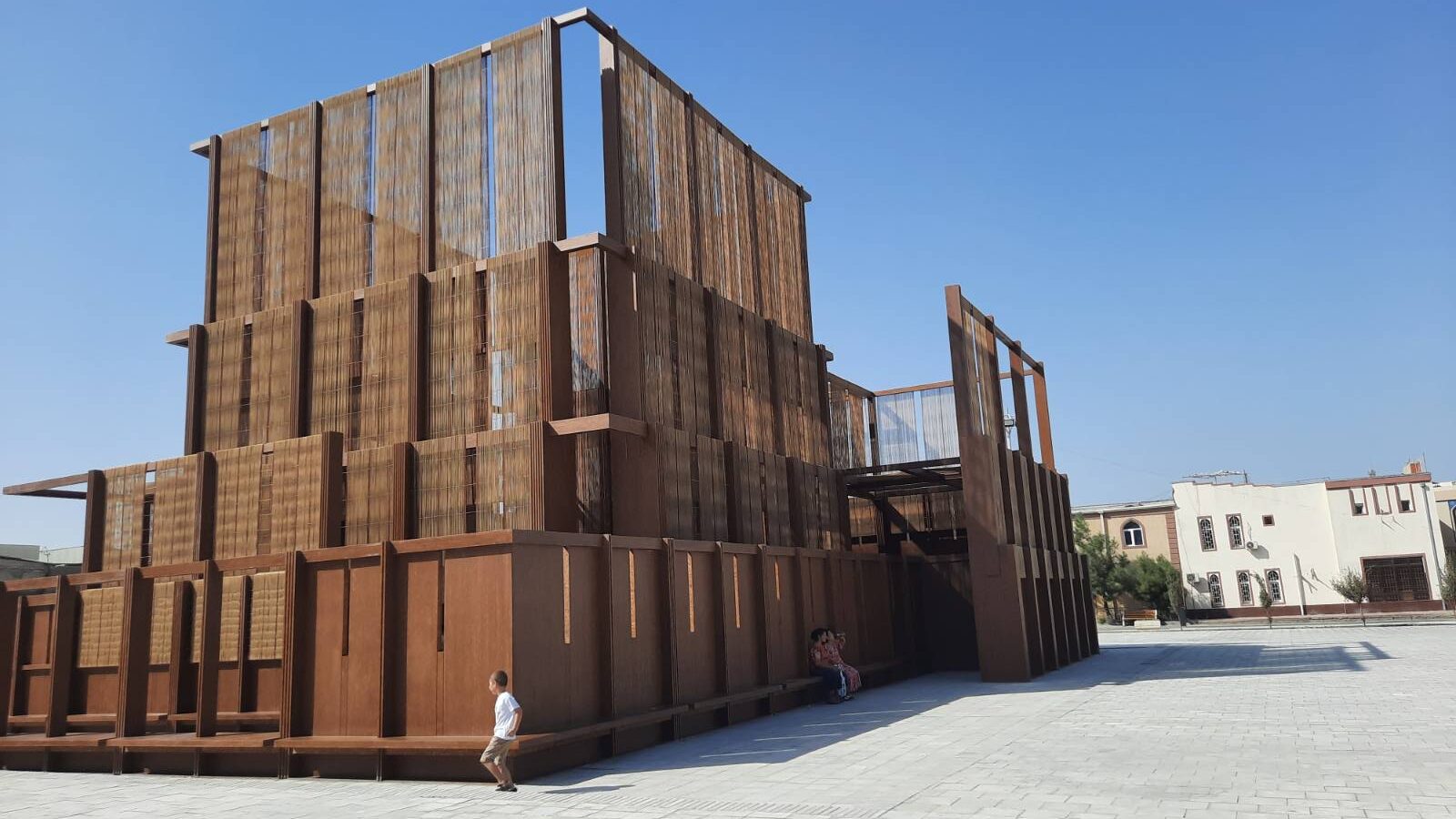
A highlight of the biennale is the AlMusalla Prize-winning installation, a reimagined musalla, or prayer space, constructed entirely from palm tree waste. Originally built in Jeddah, the structure has been transported to Bukhara as a symbol of sustainability and reuse.

AlMusalla Prize winning installation; image: TCA, Sadokat Jalolova

Christopher Blust, engineer at AKT II, explained the origins of the project: “We were inspired by the idea of courtyards as places of gathering. Even the Prophet Muhammad’s house in Medina began with a courtyard for prayer and community.”

Equally important, he said, was the material itself. “Palm fronds are discarded and often burned. We asked: Why not return to how these were used centuries ago? We shredded them, pressed them into boards, and created structural timber. This is the world’s first project to use palm waste in this way.”

Architect Nicolas Fayad of East Architecture Studio noted that their design was informed by Jeddah’s traditional materials, timber, mud, and stone, reinterpreted through modern technology. “Everything visible in this structure, the framework, screens, and mats, comes from a single source: the palm,” Fayad said.

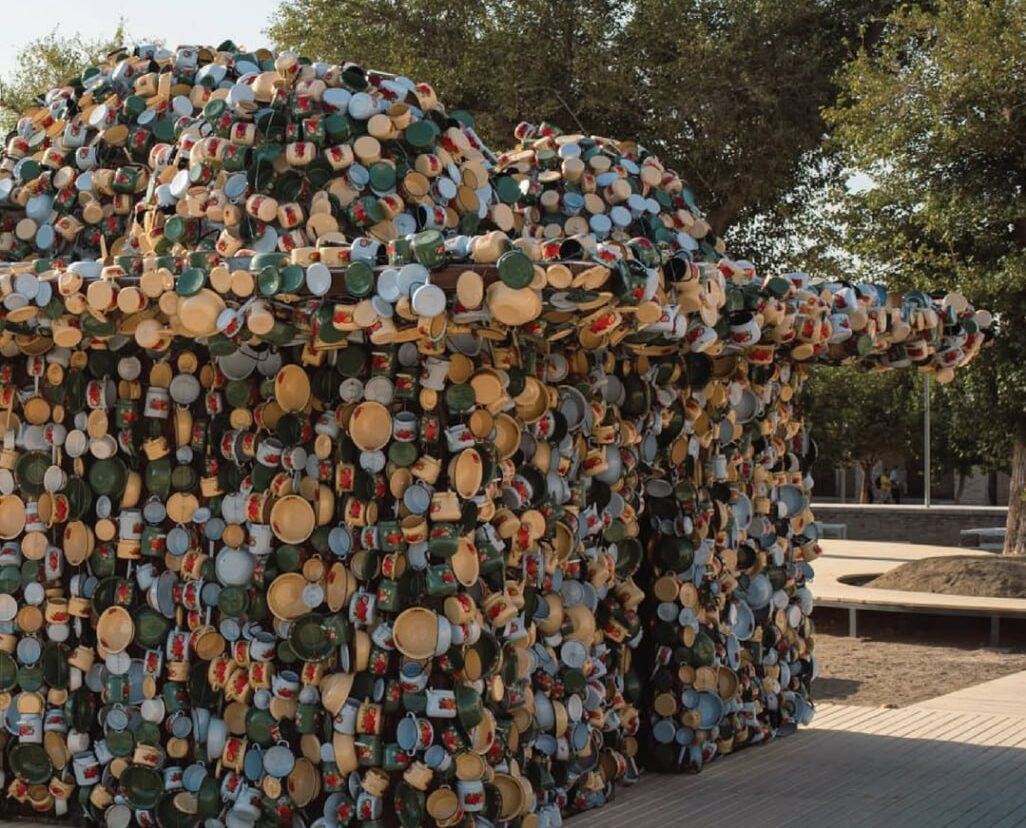
Crafted from everyday household objects, this installation portrays women occupied with countless kitchen tasks; image: ACDF Uzbekistan

Healing Cracks with Gold

Other works draw inspiration from Bukhara’s monuments. Master craftsman Bakhshullo Jumayev and his wife Muqaddasxon Jumayeva partnered with Belgian designer Hanna Militsich to repair cracks in the façade of the Khoja Kalon madrasa using golden threads, a technique inspired by the Japanese art of kintsugi.

“In Japan, they don’t discard broken vessels; they mend them with gold,” said Jumayev. “Inspired by that, we decided to patch the cracks in our heritage buildings with golden threads.”

Jumayev chose Khoja Kalon not just for its beauty but for personal reasons. He was born nearby, in the home of the renowned Bukharan gold embroiderer Rajab Oqsoqol. “We grew up walking barefoot around Khoja Kalon. This project fills me with joy,” he said.

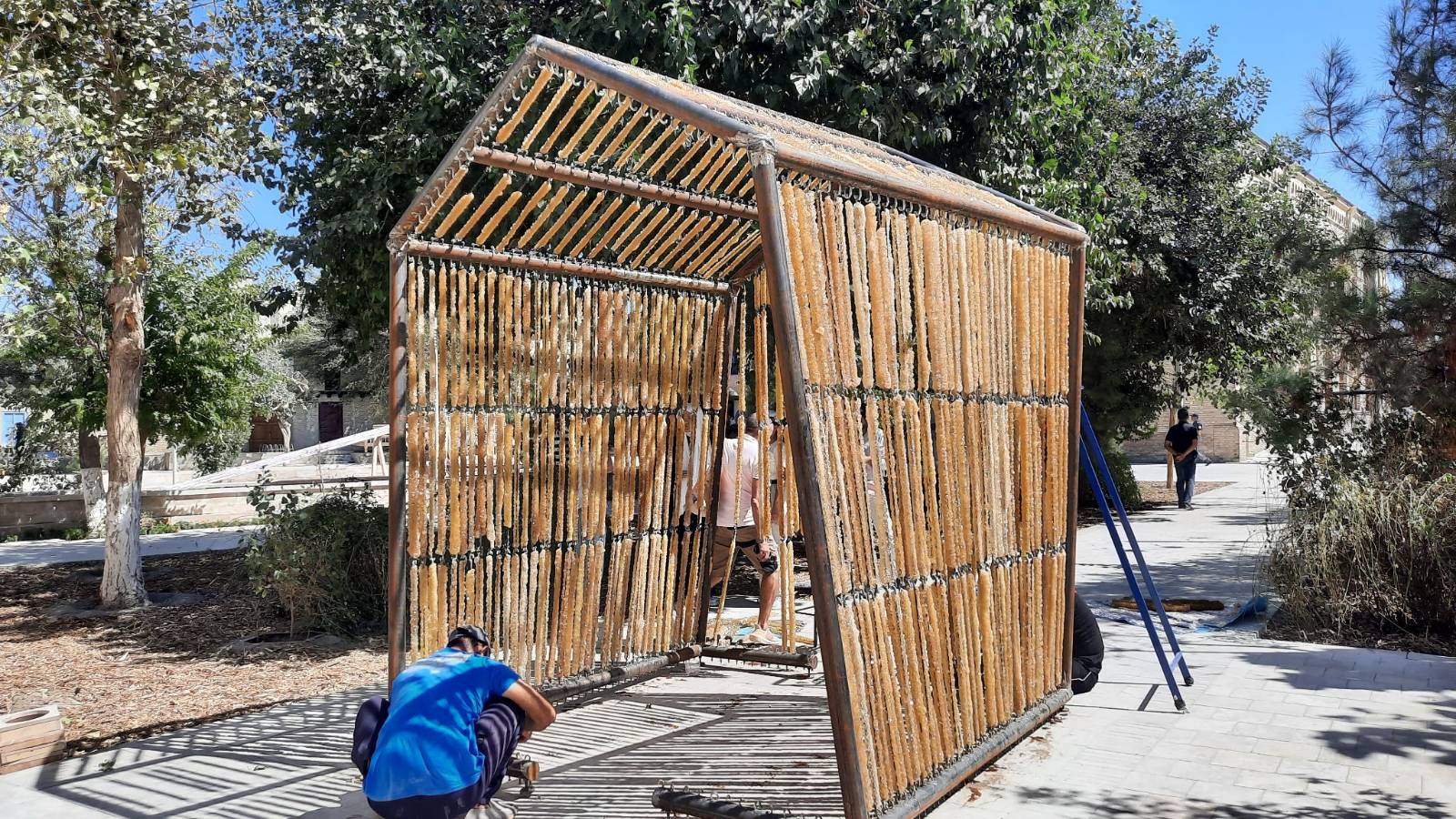
A small house made of novvot, or rock candy, appears to symbolize a life and family home filled with sweet memories; image: TCA, Sadokat Jalolova

The repairs took seven months to complete, and Jumayev emphasized that the work was both practical and symbolic. “The biennale aims to soothe aching hearts. We wanted to mend the cracks like applying a healing balm,” he said.

At 69, the sixth-generation artisan has trained more than 500 students, many now working globally. Participating in the biennale, he said, is “a dream come true.”

Voices of Women in Central Asia

Beyond installations, the biennale creates a platform for dialogue. On September 6, a panel titled Central Asian Women was held at the historic Gavkushon madrasa, focusing on the intersections of heritage, identity, and contemporary art.

An installation made of national Atlas fabric is designed to remind visitors of a bird, sending a message that women should be free to live without limits; image: TCA, Sadokat Jalolova

Organized with the support of ACWA Power, the session featured women artists from across the region. “Women play a strategic role in shaping business and cultural landscapes,” said Janona Ahmedova, Communications Director at ACWA Power Uzbekistan. “Through art and dialogue, we aim to amplify women’s voices as part of a sustainable future.”