• KGS/USD = 0.01143 -0%
  • KZT/USD = 0.00193 -0%
  • TJS/USD = 0.10881 0%
  • UZS/USD = 0.00008 0%
  • TMT/USD = 0.28575 0%
  • KGS/USD = 0.01143 -0%
  • KZT/USD = 0.00193 -0%
  • TJS/USD = 0.10881 0%
  • UZS/USD = 0.00008 0%
  • TMT/USD = 0.28575 0%
  • KGS/USD = 0.01143 -0%
  • KZT/USD = 0.00193 -0%
  • TJS/USD = 0.10881 0%
  • UZS/USD = 0.00008 0%
  • TMT/USD = 0.28575 0%
  • KGS/USD = 0.01143 -0%
  • KZT/USD = 0.00193 -0%
  • TJS/USD = 0.10881 0%
  • UZS/USD = 0.00008 0%
  • TMT/USD = 0.28575 0%
  • KGS/USD = 0.01143 -0%
  • KZT/USD = 0.00193 -0%
  • TJS/USD = 0.10881 0%
  • UZS/USD = 0.00008 0%
  • TMT/USD = 0.28575 0%
  • KGS/USD = 0.01143 -0%
  • KZT/USD = 0.00193 -0%
  • TJS/USD = 0.10881 0%
  • UZS/USD = 0.00008 0%
  • TMT/USD = 0.28575 0%
  • KGS/USD = 0.01143 -0%
  • KZT/USD = 0.00193 -0%
  • TJS/USD = 0.10881 0%
  • UZS/USD = 0.00008 0%
  • TMT/USD = 0.28575 0%
  • KGS/USD = 0.01143 -0%
  • KZT/USD = 0.00193 -0%
  • TJS/USD = 0.10881 0%
  • UZS/USD = 0.00008 0%
  • TMT/USD = 0.28575 0%
20 December 2025

U.S. State Department: No Improvement in Turkmenistan’s Human Rights Record

The U.S. State Department’s annual report on Turkmenistan for 2024 concludes that “no significant changes in the human rights situation in the country have been observed.” 

Death in Custody and Pressure on Journalists

The report cites the death of Allamurat Khudayramov, from Mary region, who reportedly died from torture while in custody.

Journalists also remain under pressure. On August 13, former Radio Azatlyk correspondent Khudayberdi Allashov died in Koneurgench. Independent journalist Soltan Achilova reported harassment by authorities in video messages on July 11 and December 10. In November, she was barred from traveling to Geneva for the second time to receive an international award for her human rights work.

The government continues to enforce strict media censorship and control of the internet, blocking websites, social media platforms, and VPN services. Security services reportedly summoned citizens who used VPNs for questioning, though more people are finding ways to bypass restrictions.

Labor Rights Violations

The report details widespread abuses in the workplace. Employers, including state agencies, compelled employees to work 10-hour days or six-day weeks without overtime pay. Many civil servants were required to work Saturdays.

Penalties for labor law violations remain light compared with other crimes, and enforcement mechanisms are weak. Only 327 labor inspectors were responsible for monitoring compliance nationwide. The Ministry of Labor reported 2,269 violations as of September 1, 2024.

Workers in the cotton industry faced health risks from chemical exposure but could not refuse unsafe tasks without risking dismissal. The report also documents the use of child labor, with children from low-income families engaged in heavy work in markets and agriculture.

Restrictions on Freedom and Repression Abroad

The organization Show Them Alive! recorded 162 cases of prisoner disappearances. While no new cases were identified in 2024, existing cases remain unresolved. Courts reportedly prevent detainees from challenging their arrest, and families are often unaware of prisoners’ whereabouts. Torture continues to be reported.

The State Department also notes Turkmenistan’s involvement in transnational repression. On November 11, Human Rights Watch warned that Turkmen citizens critical of the government face arrest and torture if they return from abroad.

Exit bans remain in force: some citizens are prevented from leaving the country even after renewing passports. In August, Turkmen News editor Ruslan Myatiev was denied entry to Turkey, where he was labeled a “threat to national security.”

Turkmen activists abroad have also faced detention. Several opposition figures were arrested in Turkey at Ashgabat’s request, with some deported, including Merdan Mukhamedov, who now faces up to 25 years in prison.

Uzbekistan’s Pharma Pivot: Strategic Gains or Growing Dependence on China

Since 2016, Uzbekistan has steadily deepened its partnership with China across multiple sectors. Energy, infrastructure, agriculture, and the digital economy have long been the pillars of this cooperation. Yet recent discussions showed that the pharmaceutical sector will be another critical area for cooperation in the long term.

Much like renewable energy and critical minerals, the pharmaceutical sector is now viewed in Tashkent as a strategic domain where Chinese expertise and investment could accelerate development and add value to the domestic economy.

The Compelling Logic of Partnership

China’s strength lies in its ability to produce high-quality, affordable medicines and distribute them globally at scale. For Uzbekistan – whose growing population and rising demand for advanced healthcare have placed pressure on its system – this makes China a natural partner.

At present, the Uzbek pharmaceutical market remains heavily import-dependent: by the end of 2024, imported drugs accounted for 87% of retail sales in monetary terms and 63% in physical volume. This reliance not only exposes vulnerabilities but also highlights the untapped potential for local production.

Recognizing this, Tashkent has moved to create favorable conditions for investment. The country has established specialized pharmaceutical Special Economic Zones (SEZ) such as Parkent-Pharm and Andijan-Pharm.

These SEZs offer investors an attractive package of incentives, from exemptions on customs duties and VAT for raw materials and equipment, to a 20% preference in government procurement for local products. Such regulatory incentives, combined with a growing domestic market, have already begun to draw interest from Chinese pharmaceutical firms.

Strategic Priorities

Recently, Uzbekistan has signed a series of memorandums of understanding with Chinese firms such as Zhendong Health Industry, Guojo Medical Technology, and Langtian Pharma Group, signaling a stronger bilateral focus on the pharmaceutical sector.

These agreements align closely with Uzbekistan’s strategic goal of building a robust domestic pharmaceutical industry with an emphasis on access to capital and technology, localization, and human capital development.

One of Uzbekistan’s key priorities is securing access to capital and expertise. Without investment and collaboration with experienced companies, the state cannot establish modern laboratories and production facilities. In this regard, the Uzbek company, Ozwell, has signed an MoU with Zhendong Health Industry Group to jointly implement a modern pharmaceutical laboratory.

The partnership involves a total investment of $9.5 million, with $4.5 million allocated toward creating a world-class laboratory facility and $5 million designated for establishing and scaling up a production complex. This agreement reflects Tashkent’s desire to tap into Chinese technical knowledge and experience, while simultaneously building domestic capacity and developing local talent in the long term.

Another critical priority is the localization of drug production. By reducing dependency on imports, Uzbekistan is aiming to strengthen supply chain resilience, meet domestic demand, and create new opportunities for regional exports. In this regard, the MoU established with Langtian Pharma Group and Guojo Medical Technology is designed to investigate opportunities for domestic production while promoting technological collaboration and knowledge transfer within the pharmaceutical industry.

The final priority is the development of human capital. In this regard, Uzbekistan is engaging not only with Chinese firms but also with Chinese educational institutions to strengthen its workforce. For example, the MoU between Wenzhou Medical University, the Eye Valley Innovation Cluster, and Uzbekistan’s Agency for the Development of the Pharmaceutical Industry reflects cooperation in education, research, technology transfer, and clinical practices. This partnership aims to promote skills development among Uzbek students and medical professionals.

Possible Risks

While cooperation with Chinese firms and educational institutions offers clear benefits in human capital development, access to capital, and localization, there are also risks if a balanced approach is not maintained. Reliance on Chinese investment and expertise can help develop local production and create value addition, but it can also foster dependency on Chinese technology and know-how.

Technology transfer is a key incentive of these partnerships, yet there is a risk that critical knowledge may not be fully transferred, leaving Uzbek firms reliant on foreign partners. This dependency could limit domestic value addition and hinder the development of indigenous innovation and local industry over the long term.

Moreover, growing cooperation may encourage regulatory harmonization with Chinese practices. While this can facilitate faster market access and the introduction of advanced pharmaceutical products, over-aligning with Chinese standards carries its own risks.

Uzbekistan could face barriers to trade with other regions if its regulations diverge from EU or U.S. pharmaceutical requirements, potentially limiting export opportunities if local rules are tailored too narrowly to Chinese norms.

Calibrated Optimism

Despite being in the early phase of cooperation, Uzbekistan’s engagement with Chinese pharmaceutical firms and institutions sets the stage for a transformative road in healthcare and industrial development. The real opportunity lies not just in importing capital or expertise but in turning these partnerships into a platform for homegrown innovation, stronger supply chains, and regional competitiveness.

Success will depend on Uzbekistan’s ability to absorb knowledge, adapt technology to local needs, and craft policies that foster autonomy rather than dependence. If managed wisely, these early steps could redefine the country’s pharmaceutical sector and create a blueprint for sustainable growth in other strategic industries.

How Climbers Die: The Tragedy of Natalya Nagovitsyna and the Perils of the Peaks

Professional climbers have all but given up hope for Russian mountaineer Natalya Nagovitsyna, who remains stranded on Pobeda Peak (Victory Peak) in the Tien Shan mountains of Kyrgyzstan. No successful evacuation has been recorded from this treacherous summit since 1955. Still, Nagovitsyna’s son continues to hold out hope, citing drone footage taken last week that appeared to show her waving from her tent and still in good spirits. However, on August 27, a military drone captured thermal imaging of conditions on Pobeda Peak, showing no signs of life in Nagovitsyna’s tent, as confirmed in imagery published on the official website of Kyrgyzstan’s State Committee for National Security (GKNB).

Officially Declared Lost

Russian Investigative Committee Chairman Alexander Bastrykin has ordered his office to coordinate with the Ministry of Emergency Situations and submit an operational report regarding Nagovitsyna’s case.

However, rescue services have already called off search operations and dismantled the base camp at Pobeda Peak. Alexander Yakovenko, head of the classical mountaineering commission of the Russian Mountaineering Federation, stated:

“In reality, there’s no one left to rescue; we can only speak of a body recovery. The climbing season at Victory Peak has ended, and the base camp has been removed.”

Yakovenko emphasized that Pobeda Peak is one of the most difficult and dangerous mountains for rescue operations. Since the 1960s, many bodies have been left behind, unreachable due to extreme weather and inaccessible terrain.

A Mountain That Does Not Forgive

Veteran Russian climber Alexander Shcherbashin recently told reporters that a rescue mission for Nagovitsyna would be logistically impossible.

“In my view, survival is unlikely. The ridge is long, and evacuating someone from there typically requires between 8 and 18 people, under varying conditions,” he said.

Another experienced mountaineer, Alexander Kirikov, described Pobeda Peak as “a mountain that does not forgive mistakes.”

“There are fatal accidents there nearly every year, going back to the late 1950s. I estimate the mountain has claimed over 150 lives,” he noted.

Death in the Mountains

Mountaineering remains one of the world’s most dangerous sports. On average, 24 out of every 10,000 climbers die annually. Hundreds perish each year in mountain accidents.

The highest-risk peaks are the so-called eight-thousanders. Everest (Jomolungma), while the most fatal in absolute numbers, owes its toll to the sheer volume of climbers. The deadliest is Annapurna I in the Himalayas, where the fatality rate approaches 50%. Other notorious peaks include K2 (Chogori, “Savage Mountain”) and Nanga Parbat, dubbed “the man-eater.”

The former Soviet Union has no eight-thousanders, but Pobeda Peak is widely recognized as its most dangerous seven-thousander. It was here that Natalya Nagovitsyna’s story unfolded.

Tragedy has struck her family before. In 2021, just 16 kilometers away on nearby Khan Tengri, Nagovitsyna’s husband died in her arms after suffering a stroke during their ascent.

As her case unfolded this summer, another Russian climber, Alexey Ermakov, died on Khan Tengri.

“We passed him on the route; he was climbing up as we were descending,” said Alexey Trubachev, a mountain guide and founder of MCS AlexClimb. “Three Iranian climbers are also still missing”.

A Pattern of Loss

Earlier, in February 2024, solo climber Evgeny Glazunov died during an expedition on Mount Aksu in Kyrgyzstan. After turning back due to bad weather, he lost contact and was later found dead, believed to have been caught in a rockfall during his descent.

In a devastating incident on August 5, 2004, an avalanche on Khan Tengri killed 11 climbers from Russia, Ukraine, and the Czech Republic.

On July 29, 2015, three Russian climbers, Pavel Markovskikh, Ilya Poselyanichev, and Sergei Shpiz, died during a night descent from a 4,810-meter peak in Kyrgyzstan’s Karavshin Gorge. Their bodies were recovered on July 31. Investigators concluded that technical errors during the descent contributed to the tragedy.

A Final Reminder

These repeated tragedies underscore a painful truth known all too well in the mountaineering world: the mountains do not forgive. At best, mistakes cost health. More often, they cost lives. The unresolved fate of Natalya Nagovitsyna is a solemn reminder of this harsh reality.

Ilyas Khrapunov Found in Contempt by U.S. Federal Court

The U.S. District Court for the Southern District of New York has ruled in favor of the city of Almaty and BTA Bank, finding Ilyas Khrapunov guilty of contempt of court.

New Verdict in Ongoing Legal Battle

Federal Judge John G. Koeltl ruled that Khrapunov had violated a prior court order requiring him to report regularly on his assets. He had previously been ordered to pay $221,285.31 in sanctions. “After an independent review, the Court adopts the Magistrate Judge’s findings, which are well-founded and support a finding of civil contempt,” the judge’s statement reads. “Although Khrapunov has demonstrated an inability to pay the $221,285.31 judgment against him at this time, Khrapunov has failed to comply with the clear and unambiguous court order to submit quarterly declarations regarding his financial status.”

The latest ruling reaffirms Khrapunov’s obligation to fully disclose assets and make efforts to satisfy court judgments. It also includes provisions for further financial penalties in the event of non-compliance. Additionally, Khrapunov has been ordered to reimburse Almaty and BTA Bank for legal costs arising from his misconduct.

A Central Figure in Corruption Scandals

Ilyas Khrapunov is the son of former Almaty mayor Viktor Khrapunov and the son-in-law of fugitive banker Mukhtar Ablyazov, figures long entangled in corruption investigations. The Kazakh authorities have accused members of both families of large-scale embezzlement and money laundering.

Viktor Khrapunov fled Kazakhstan in 2008 and has resided in Switzerland ever since. He was sentenced in absentia in 2018 to 17 years in prison for corruption-related offenses, a judgment he disputes. Ilyas Khrapunov also left Kazakhstan shortly beforehand.

Almaty and BTA Bank continue to pursue legal action in U.S. and European courts, alleging that Ablyazov and his associates siphoned billions of dollars through offshore entities. Investigators assert that Khrapunov Jr. played a direct role in the schemes.

Pattern of Legal Violations

In December 2022, the Southern District Court in New York ruled against Ablyazov and his associates in the amount of $218 million. In June 2024, the U.S. District Court for the Southern District of New York awarded over $32 million in damages to BTA Bank and the City of Almaty, following a jury verdict against Khrapunov and Ablyazov’s associates, Felix Sater, Bayrock Group Inc., Global Habitat Solutions, and MeM Energy Partners LLC. The jury found the defendants liable for misappropriation of property, unjust enrichment, and money had and received, affirming fraud and money laundering schemes impacting Kazakh institutions.

The plaintiffs estimated the total damage caused by Viktor Khrapunov and his wife, Leila, at over $300 million, including stalled development of city land and the “alienation of properties.”

In a related case, in September 2018, a UK court fined Ilyas Khrapunov $500 million for violating an asset freeze order in connection with Ablyazov’s fraudulent activities.

Opinion: Gas, Geopolitics, and Realism: U.S.–Turkmenistan Talks Signal Shift

U.S. Secretary of State Marco Rubio and his Turkmen counterpart Rashid Meredov wrapped up bilateral consultations last week in Washington, DC. The encounter suggested a new awareness on Washington’s part of Turkmenistan’s pivotal geostrategic location in the heart of Central Asia and its status as a major hub of natural resources.

Since becoming head of state in March 2022, Turkmenistan’s President Serdar Berdimuhamedov has shifted his country’s foreign policy from one of strategic isolation to what might be called practical realism, whereby priority is given to fair trade and investments that are in line with national interests and long-term development.

Like the other Central Asian heads of state, Berdimuhamedov also champions a pragmatic, interest-based foreign policy. Consequently, they find the current, pragmatic U.S. administration with its concern to work out deals (presumably mutually beneficial ones) more congenial than its predecessor, with its penchant for geostrategic maneuvering and ideology.

Secretary Rubio recently observed: “A mature foreign policy requires a balancing of interests – that’s a fact.” This way of thinking goes over well in smaller independent states such as Turkmenistan and other Central Asian countries, whose key national priorities include establishing their statehood on a firm basis and safeguarding their sovereignty amid the turbulent great power politics being played out in their vicinity.

Oil and Gas

Over the years, Berdimuhamedov has insisted that foreign entities seeking access to the country’s vast natural gas reserves must play by Ashgabat’s rules. Home to the world’s fourth-largest gas reserves, Turkmenistan invites foreign participation in its energy sector, provided that agreements are structured as win-win arrangements and don’t give suitors the geostrategic upper hand.

In this context, it would make sense for Washington to get the word out about two upcoming conferences in Ashgabat: The Turkmenistan Investment Forum, September 18– 19, 2025, which will serve to attract long-term investment into the country’s economy, and the 30th Oil & Gas of Turkmenistan – 2025 International Conference & EXPO (OGT 2025) on 22–24 October.

Turkmenistan had a strong 2024 in terms of energy, producing 77.6 billion cubic meters of natural gas and 8.3 million tons of oil. The OGT 2025  will showcase the country’s resource potential and new investment opportunities, focusing on upstream projects such as the Galkynysh gas field and the Caspian blocks, as well as on initiatives in the areas of renewable energy, methane mitigation, and infrastructure modernization.

Moreover, Ashgabat wants to expand its Trans-Caspian and north-south economic corridors and complete the Turkmenistan-Afghanistan-Pakistan-India (TAPI) gas pipeline, among other initiatives in transport and logistics. U.S. companies may want to explore these new opportunities.

Travel Limitations to the U.S.

Ashgabat is working with the U.S. Department of State to lift recently imposed restrictions on Turkmen citizens wishing to travel to the U.S. Both sides are aiming to ensure that applicants are properly screened before a visa is granted and that recipients comply with its terms.

To further deepen ties, Washington should view Turkmenistan’s neutrality towards others on the global stage in security and foreign-policy matters not as an obstacle, but as an advantage that facilitates dialogue. While maintaining its advocacy for democratic principles, the State Department should pivot its focus towards championing specific commercial opportunities, particularly in the gas, agriculture, and transport sectors, including shared corridors.

Like other regional states, Turkmenistan is well on its way to becoming a pivotal north-south, east-west transit hub in Central Asia. In connection with this, Washington should take note of last week’s summit involving the former president of Turkmenistan, Gurbanguly Berdimuhamedov, Chairman of the Halk Maslakhaty, the People’s Council, an independent body that exercises supreme authority on constitutional matters, Azerbaijan’s President Aliyev, and Uzbekistan’s President Mirziyoyev at Turkmenistan’s Awaza seaside resort. The leaders met to further Eurasian integration – specifically to approve the roadmap for the Turkmenbashi-Baku corridor linking the Caspian Sea, Uzbekistan, and the South Caucasus to Europe. All this spells geopolitical convergence – a process that has gained significant forward momentum.

The message from Ashgabat during the United States-Turkmenistan bilateral consultations was clear. Turkmenistan welcomes Washington’s role in its development, but insists on a strictly professional, business-focused relationship, using diplomacy to facilitate such cooperation.


The views expressed in this article are those of the author and do not necessarily reflect the official policy or position of the publication, its affiliates, or any other organizations mentioned.

Bold Pavilions, Big Statements: Central Asia at Osaka Expo 2025

On a sweltering August day, The Times of Central Asia arrived at the Osaka Expo 2025. The theme, “Designing Future Society for Our Lives,” set the stage for a carnival of new ideas and technology. Pavilions buzzed with invention, each one a world of its own. Central Asia turned heads – with all five countries represented – with vibrant stalls, bustling booths, and grand castle-like showpieces that drew crowds from every corner.

Kazakhstan Pavilion; image: TCA, Stephen M. Bland

Kazakhstan’s pavilion presents the theme “Born Bold” in the “Connecting Lives” zone, alongside South Korea, Germany, Luxembourg, Nepal, Azerbaijan, Iran, Monaco, and Türkiye. At its heart rises the shanyrak, the sacred crown of the yurt, once a symbol of roots and now a beacon of unity, mirroring the Expo’s spirit of innovation and shared horizons.

The story begins with the essence of the Kazakh people. Generations, history, culture, and traditions unfold from the Kazakh Khanate and the vast steppe to Abai’s poetry and the nation’s sporting heroes. It is a narrative of memory and strength, where the past is not closed, but carried forward as a living value.

From history, the focus shifts to unity. Every guest becomes part of the experience as their face is woven into a digital mosaic, a vivid symbol of belonging. Interactive technologies present Kazakhstan as a country where diversity does not divide but connects.

From past to present, the spotlight then falls on a Kazakhstan that is inventive and future-ready. Visitors explore the country’s energy transition, green initiatives, digitalization, and work in artificial intelligence, alongside its rise as an investment hub.

Prolonging life – ALEM at the EXPO; image: TCA, Stephen M. Bland

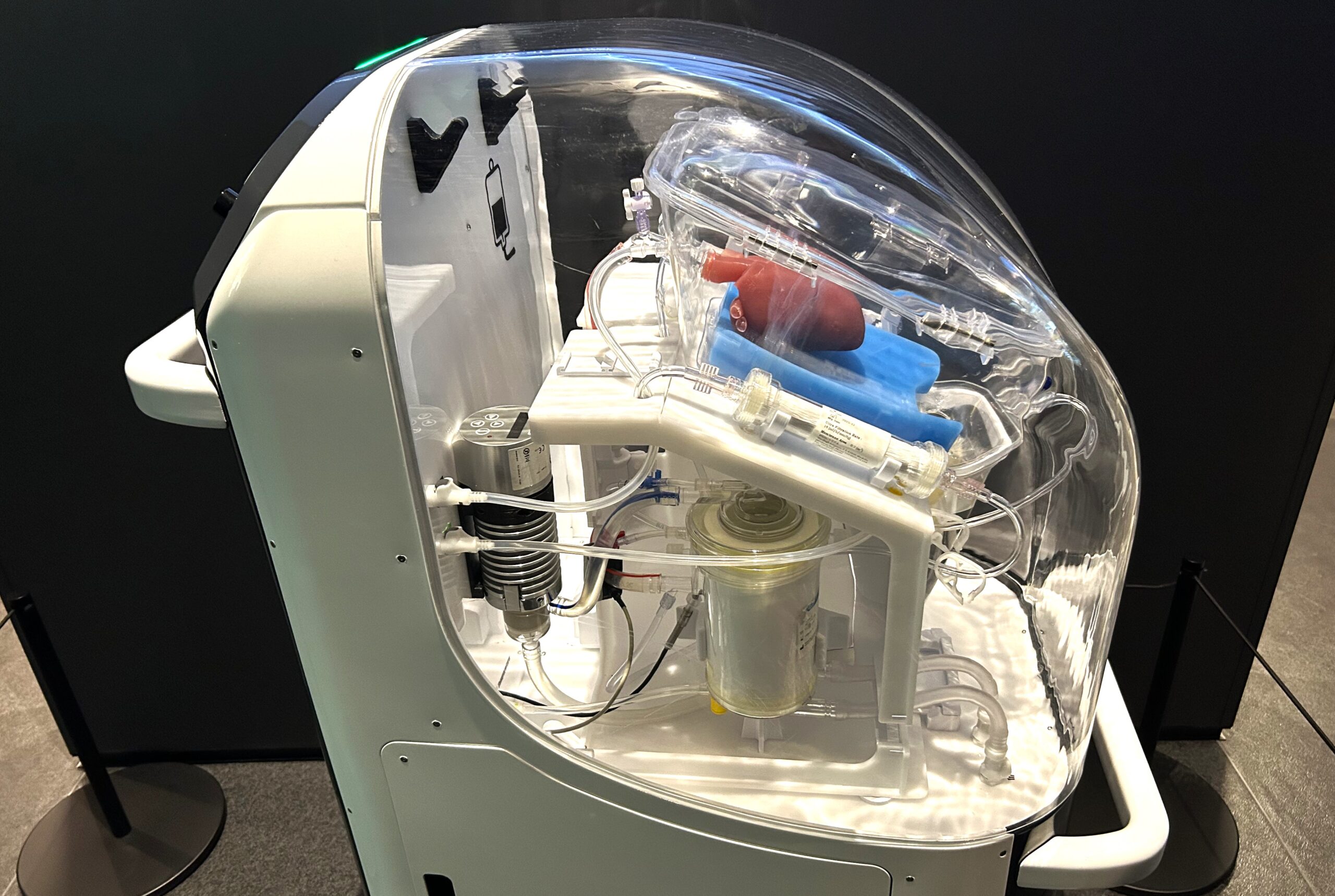
The final chapter places pride and place on the groundbreaking ALEM (Astana Life Ex-situ Machine) developed by Kazakh scientists. Created by the Heart Center Foundation, it is already redefining the possibilities of transplantation.

The window for organ transplants is short, from just a few hours for a heart or lungs to more than a day for a kidney. ALEM changes the game. By replicating the body’s internal conditions, it can keep a donor heart alive for 24 hours, opening new possibilities. Only a few models currently exist, including the one on display in the pavilion.

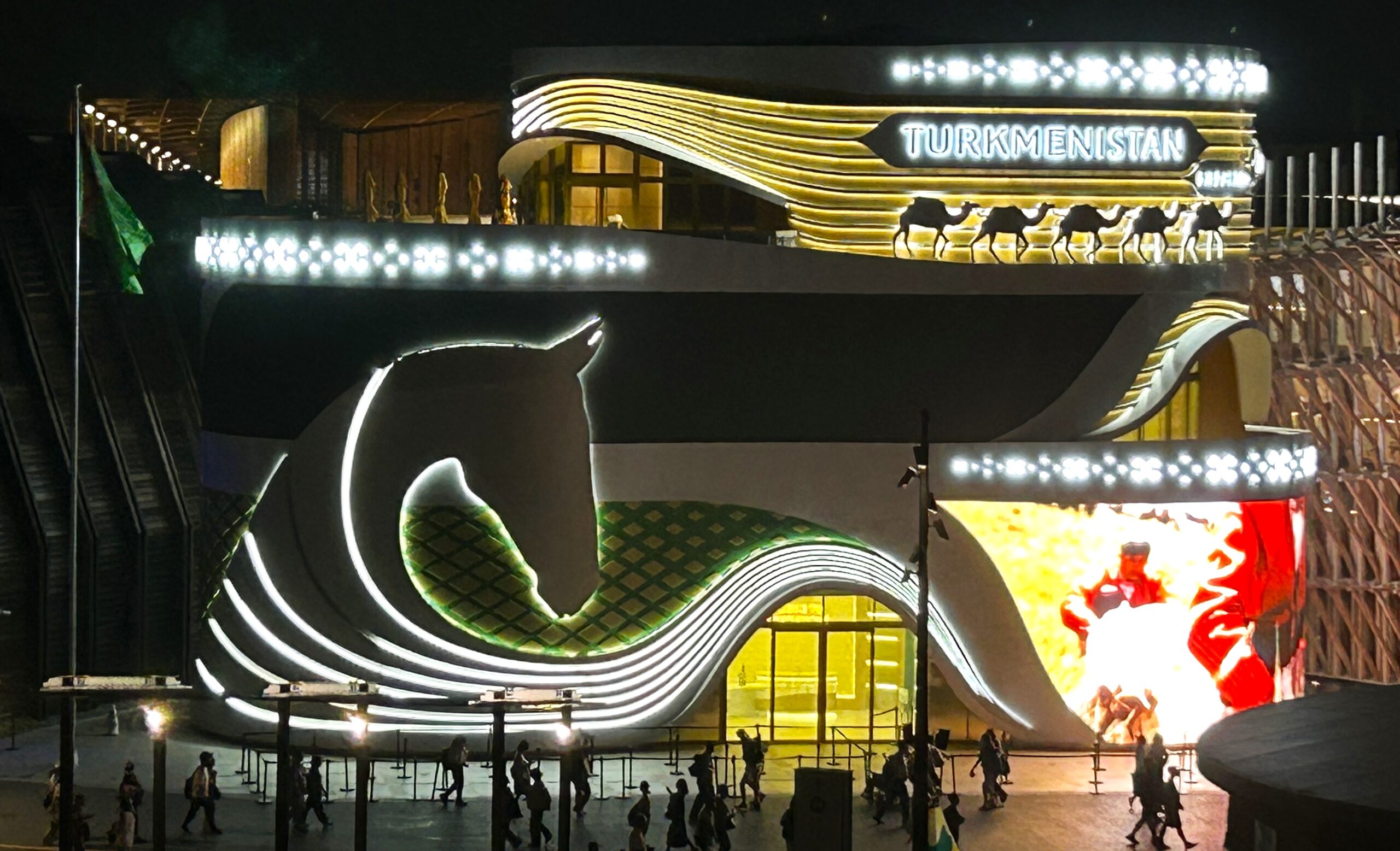
The Turkmenistan Pavilion; image: TCA, Stephen M. Bland

The Turkmenistan Pavilion dazzles with three lavish floors beneath an iconic, rounded-triangular ceiling that symbolizes circulation, sustainability, and the flow of life. On the ground level, an epic immersive video left the Japanese audience gasping as it honored Turkmenistan’s great men, legendary horses, and loyal dogs, while women appeared only in fleeting roles.

The second-floor shifts to the present, celebrating modern achievements, from the smart city of Arkadag to advances in industry, finance, and science. The space unfolds as an eclectic mix of books, jewelry, rugs, and even everyday objects like bottles of oil. At its center, a glowing holographic orb lends a Star Wars-like quality to the story of medicinal plants.

The third level celebrates Turkmen cultural treasures, with handmade carpets and delicate national embroidery on display. Guests can savor organic Turkmen cuisine in a national restaurant, or unwind on an open terrace shaded by traditional gazebos. The theme, “Inspiring a Better Tomorrow,” runs through every detail. By July, the pavilion had already welcomed more than a million visitors, securing its place as one of the Expo’s star attractions.

On the bottom floor, the gift shop tempts visitors with pricey fridge magnets, funky sunglasses, and finely woven rugs. There’s even a chance to slip into traditional garbs, as two Japanese chaps did, grinning as they donned the outfits, and clearly enjoying the transformation.

Ippei Okuma and Gen Nero channel their inner Turkmen at the Turkmenistan Pavilion; image: TCA, Stephen M. Bland

It’s an ironic twist. For years, Turkmenistan has been one of the most closed countries in the world, often ranked just behind North Korea in its isolation. Most foreigners can only enter through an accredited Turkmen travel agency, their every move trailed by a government-approved guide. The alternative, a five-day transit visa, is rarely granted. On top of that, Turkmenistan continues to enforce some of the world’s toughest entry requirements, including mandatory PCR tests for all arrivals at Ashgabat International Airport, long after most countries dropped pandemic restrictions.

Hints of change are in the air, however. Rumors suggest the regime is considering easing rules and making the country more accessible to visitors. For a state so tightly sealed, even the possibility of a softer stance feels momentous.

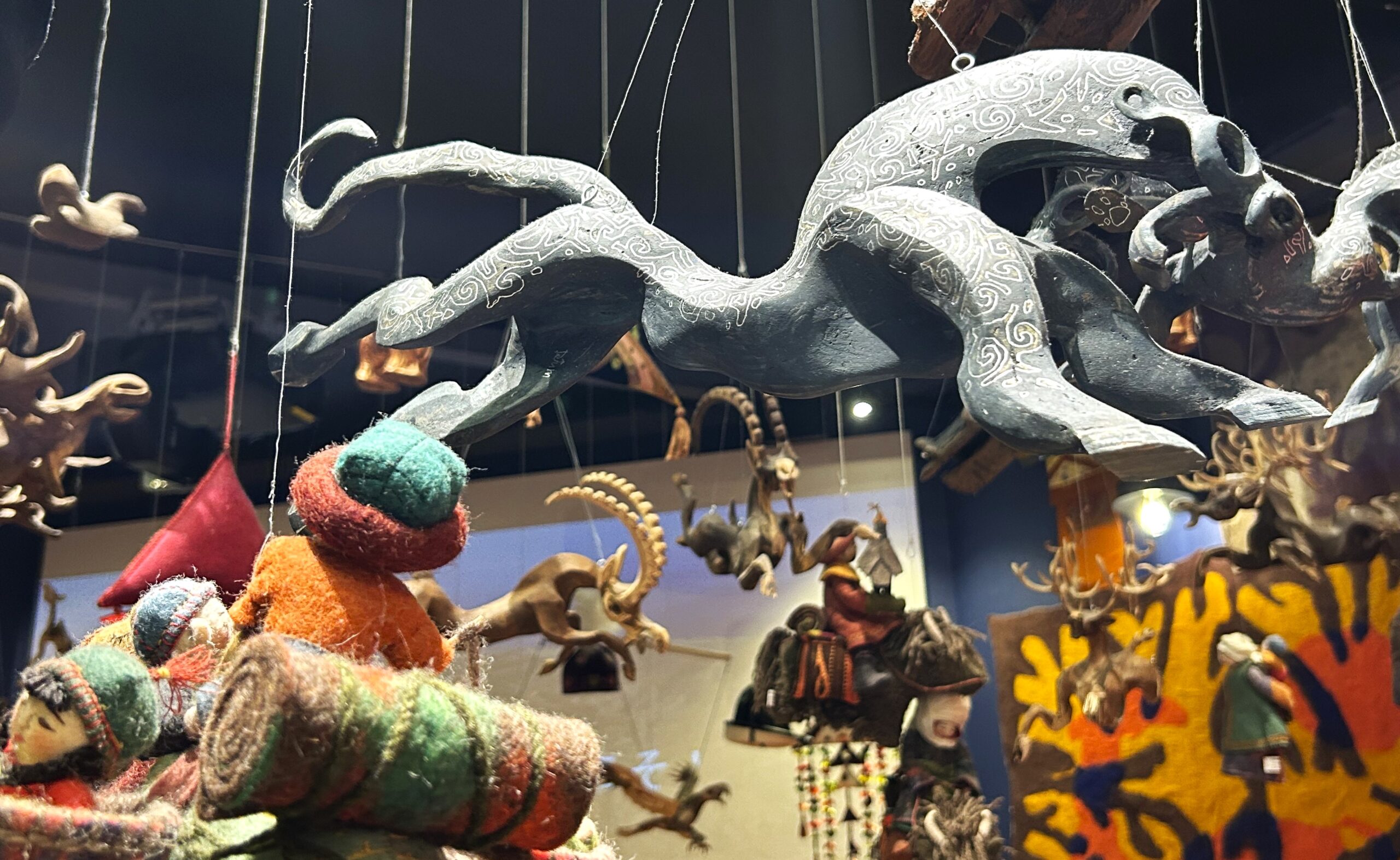
Kyrgyzstan Pavilion; image: TCA, Stephen M. Bland

Tajikistan Pavilion; image: TCA, Stephen M. Bland

Join us again soon for the second stop in our Expo 2025 series, as we explore the award-winning Uzbek Pavilion. A fusion of heritage and ingenuity, it offers a striking vision of Uzbekistan’s concept of a green tomorrow.