The Times of Central Asia previously published an interview with Komoliddin Ikromov, head of the Agribusiness Association, addressing recent land disputes, legal processes, and ongoing reforms in Uzbekistan’s agricultural sector. In a separate conversation, Umida Niyazova, founder of the Uzbek Forum for Human Rights, has offered an additional perspective, focusing on the conditions faced by cotton and wheat farmers.
Her remarks come in the context of a recent joint report by the Uzbek Forum and Human Rights Watch examining structural issues in the agricultural system. While the report has drawn international attention, Niyazova emphasized that its primary focus differs from earlier discussions centered on cotton pickers.
Focus on farmers rather than pickers
Niyazova said public debate in recent years has largely focused on forced labor among cotton pickers, particularly prior to reforms introduced after 2019. However, she noted that the new report shifts attention to another group.
“Our recent report on the cotton sector in Uzbekistan does not focus on cotton pickers, but rather on cotton and wheat producers, farmers,” she told The Times of Central Asia. “This is a different segment of workers whose problems have, for decades, remained overshadowed by the issue of forced labor of cotton pickers… The central finding of our report is that the working conditions of farmers producing cotton and wheat in Uzbekistan place them at risk of forced labor.”
Basis for assessing risk
Niyazova explained that this conclusion is based on eleven indicators developed by the International Labour Organization, “which define warning signs that individuals may be at risk.”
However, the report does not conclude that specific cases constitute forced labor.
“We did not have sufficient information to determine that any particular farmer is working under forced labor conditions,” she told TCA. “However, we were able to conclude that cotton and wheat farmers in general are at risk due to the conditions in which they work.”
These indicators include factors such as vulnerability, intimidation, threats, withholding of wages, and abusive working conditions.
At the same time, she acknowledged that Uzbekistan has made progress in addressing earlier concerns related to cotton picking.
Changes in cotton picking practices
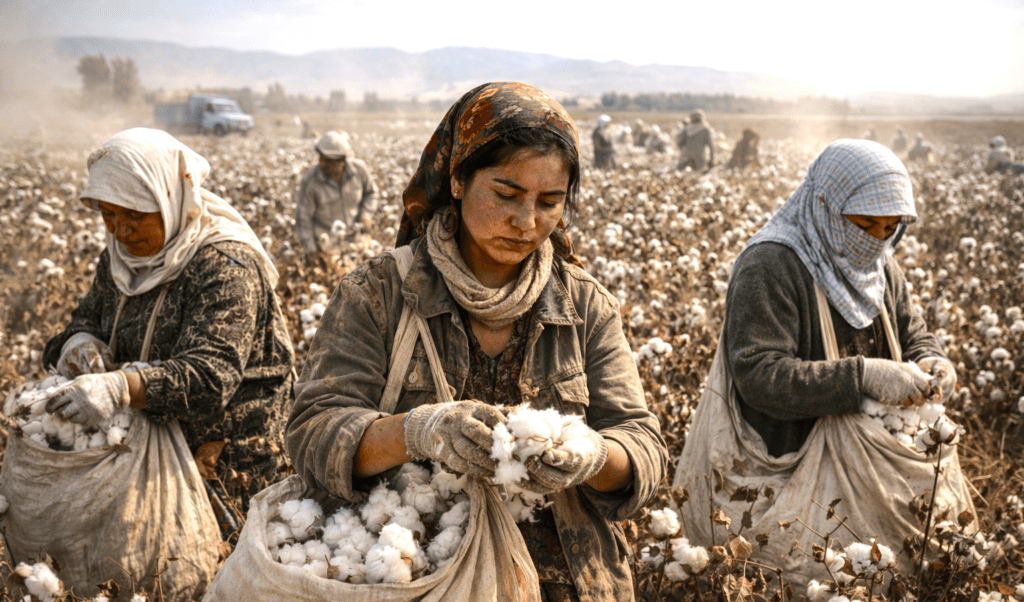
Niyazova said the situation for cotton pickers has changed significantly in recent years.
“These are seasonal workers, primarily rural residents, who are recruited by farmers or mahallas (neighborhoods) to harvest cotton over a two-month period,” she said. “Since the 2020 harvest, payment rates for manual cotton picking have increased. This has been an important, though not the only, factor in attracting voluntary laborers.”
According to the Ministry of Agriculture, a recommended price of 2,000 UZS ($0.16) per kilogram of hand-picked cotton was set for 2025. During the harvest, prices may also be determined through agreements between cluster operators, farms, and pickers.
Niyazova said additional reforms have contributed to changes in the sector, including the introduction of private clusters, increased mechanization, and government oversight.
“Mechanization has increased year by year, reducing the need for manual labor,” she said, adding that by 2025, more than 50% of the harvest was carried out by machines.
On March 13, a presidential decree on providing the agricultural sector with modern machinery was adopted, prioritizing increased mechanization, particularly in cotton harvesting. The authorities aim to raise the share of machine-harvested cotton to 70% by 2026.
Niyazova also pointed to awareness campaigns and enforcement measures.
“The government conducted information campaigns emphasizing the prohibition of forced labor, and the labor inspectorate held local officials accountable for coercion,” she said.
“Taken together, these measures contributed to the end of large-scale, systematic forced labor of cotton pickers.”
Engagement with authorities
During a visit to Uzbekistan in March, Niyazova said she discussed the report’s findings with representatives of several ministries.
“Overall, I assess these meetings very positively,” she told TCA, despite some disagreements, particularly over how the current system should be described.
“Some government representatives maintain that there is no longer a state order for cotton production,” she said, while adding that the report finds elements of a centralized system still exist in practice, sometimes referred to as a “forecast.”
“Disagreement does not preclude continued dialogue,” Niyazova said, emphasizing that there is common ground among stakeholders.
“Our goal is for Uzbek cotton to be fully free of its legacy of coercion,” she said.