• KGS/USD = 0.01144 0%
  • KZT/USD = 0.00216 0%
  • TJS/USD = 0.10659 0%
  • UZS/USD = 0.00008 0%
  • TMT/USD = 0.28530 0%
  • KGS/USD = 0.01144 0%
  • KZT/USD = 0.00216 0%
  • TJS/USD = 0.10659 0%
  • UZS/USD = 0.00008 0%
  • TMT/USD = 0.28530 0%
  • KGS/USD = 0.01144 0%
  • KZT/USD = 0.00216 0%
  • TJS/USD = 0.10659 0%
  • UZS/USD = 0.00008 0%
  • TMT/USD = 0.28530 0%
  • KGS/USD = 0.01144 0%
  • KZT/USD = 0.00216 0%
  • TJS/USD = 0.10659 0%
  • UZS/USD = 0.00008 0%
  • TMT/USD = 0.28530 0%
  • KGS/USD = 0.01144 0%
  • KZT/USD = 0.00216 0%
  • TJS/USD = 0.10659 0%
  • UZS/USD = 0.00008 0%
  • TMT/USD = 0.28530 0%
  • KGS/USD = 0.01144 0%
  • KZT/USD = 0.00216 0%
  • TJS/USD = 0.10659 0%
  • UZS/USD = 0.00008 0%
  • TMT/USD = 0.28530 0%
  • KGS/USD = 0.01144 0%
  • KZT/USD = 0.00216 0%
  • TJS/USD = 0.10659 0%
  • UZS/USD = 0.00008 0%
  • TMT/USD = 0.28530 0%
  • KGS/USD = 0.01144 0%
  • KZT/USD = 0.00216 0%
  • TJS/USD = 0.10659 0%
  • UZS/USD = 0.00008 0%
  • TMT/USD = 0.28530 0%

Kyrgyzstan Expands Efforts to Promote Safe and Organized Labor Migration

A new office of the Center for Employment of Citizens Abroad and the Pre-Departure Training and Migrant Reintegration Center has opened in Osh, Kyrgyzstan’s second city, as part of efforts to promote safer and more structured labor migration.

The opening ceremony took place on April 29.

The project was implemented by the International Organization for Migration under the “Labour Migration – Central Asia” program, with support from the Swiss Agency for Development and Cooperation.

The new center in Osh is designed to provide comprehensive support to citizens at all stages of labor migration from pre-departure preparation to reintegration upon return.

Services include information on legal and safe employment channels abroad, pre-departure training, consultations on migrant rights and contract conditions, as well as guidance on the risks of labor exploitation and human trafficking.

In addition, the center assists job seekers in finding vacancies and organizes online interviews with prospective employers.

According to Esenbek Ergeshov, head of the labor migration department at the Center for Employment of Citizens Abroad, around 5,500 Kyrgyz citizens were placed in jobs overseas through the center in 2025, while private agencies facilitated employment abroad for an additional 19,500 people.

Kyrgyzstan is also working to diversify its labor migration destinations. While Russia remains the primary destination, interest is growing in countries such as Turkey, South Korea, Japan, and several European countries.

Uzbekistan and Afghanistan Plan Joint Hospital Project in Mazar-i-Sharif

Uzbekistan and Afghanistan have agreed to build a hospital in the Afghan city of Mazar-i-Sharif under a public-private partnership, Uzbekistan’s Ministry of Health said.

The agreement was reached during a visit by an Uzbek delegation led by Health Minister Asilbek Khudayarov to Afghanistan, where talks were held with Afghan Health Minister Mawlawi Noor Jalal, Balkh regional governor Mohammad Yusuf Wafa, and other officials.

According to the ministry, the Afghan side highlighted the need to expand cooperation in healthcare, noting that many districts in the country still lack hospitals. Officials also pointed to a rise in cancer cases in recent years and requested Uzbekistan’s support in building a medical facility in Mazar-i-Sharif, training specialists, and simplifying procedures for Afghan patients seeking treatment in Uzbekistan.

Wafa expressed appreciation for Uzbekistan’s continued support, particularly during difficult periods such as natural disasters, and emphasized the importance of strengthening humanitarian ties between the two countries.

During the visit, the Uzbek delegation also toured healthcare facilities in Balkh province, including a district clinic in Dehdadi and the Abu Ali Ibn Sina Central Hospital in Mazar-i-Sharif, where they met with medical staff and reviewed current conditions.

As a result of the talks, the parties agreed to establish a joint working group to develop proposals for supporting Afghanistan’s public healthcare system. Plans were also outlined to organize reciprocal visits by Afghan medical delegations to Uzbekistan.

The sides discussed launching training programs that would allow up to 100 Afghan specialists each year to improve their qualifications at Uzbekistan’s specialized medical centers. In addition, the possibility of allocating annual scholarships for up to 50 Afghan students to study at Uzbek medical universities was considered.

The Uzbek side also agreed to explore simplifying the issuance of medical visas for Afghan patients and easing procedures for the supply and registration of pharmaceuticals produced in Uzbekistan, which Afghan officials said are in strong demand in the local market.

A key outcome of the visit was the agreement to construct a hospital in Mazar-i-Sharif in cooperation with Arman Group. Under the arrangement, the Afghan side will invest in the project, adapt an existing building for medical use, and procure modern equipment, while Uzbekistan will provide qualified medical personnel.

The Times of Central Asia previously reported that in March, Uzbekistan and Afghanistan established a joint Business Council aimed at strengthening trade and economic ties, bringing together representatives from both countries’ business communities and institutions. The new healthcare agreement reflects a broader trend toward expanding cooperation between the two neighbors.

European Athletes Dominate World Triathlon Championships in Samarkand

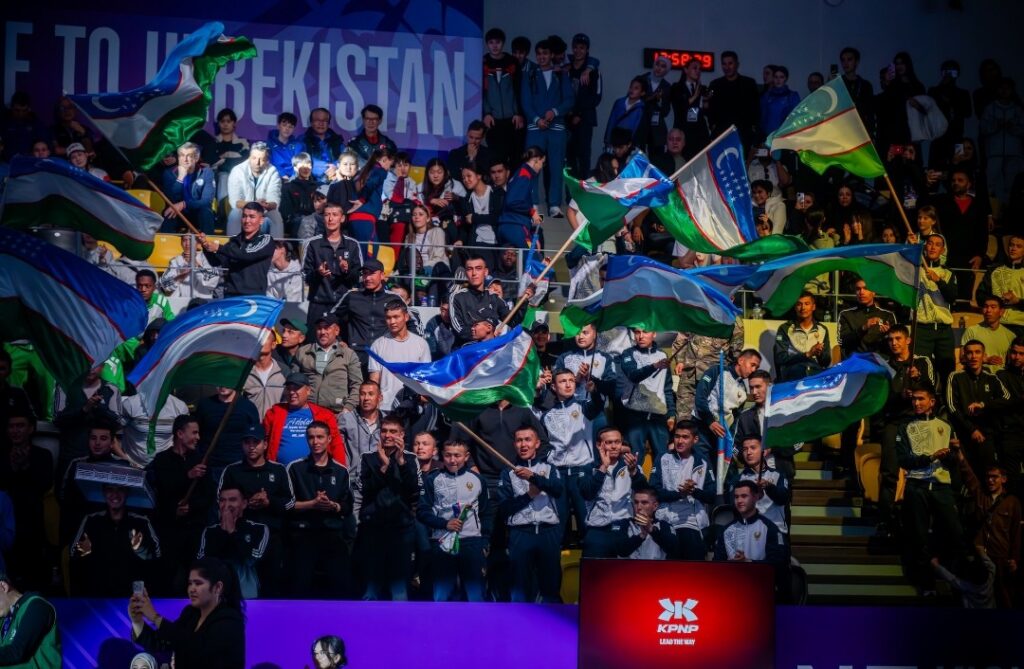
The city of Samarkand hosted the World Triathlon Championship Series (WTCS) from 25-26 April, further cementing Uzbekistan’s reputation within the Olympic Movement.

The event saw more than 150 athletes from over 40 countries compete on Samarkand’s Olympic-distance course, weaving through UNESCO World Heritage sites and historic Silk Road landmarks, including the breathtaking Eternal City complex. 

In the elite races, the world’s top triathletes battled for crucial ranking points. Vasco Vilaça from Portugal took gold in the men’s category with a time of 1:43:33, while the UK’s Beth Potter secured the top spot on the podium for the women’s race after a dramatic final run segment through the historic city centre.

“This weekend marked another landmark sporting occasion for Uzbekistan,” said Otabek Umarov, Vice President of the Olympic Council of Asia (OCA) and Deputy Chairman of the National Olympic Committee of Uzbekistan. “By bringing the World Triathlon Championship Series to Samarkand, we have once again shown that Uzbekistan can successfully deliver some of the world’s biggest sporting events, blending our warm hospitality with world-class sport.”

This event follows a series of major international sporting events recently hosted in Uzbekistan, including the record-breaking World Taekwondo Junior Championships in April, the Fencing World Cup and the Judo Grand Slam, alongside the largest-ever OCA General Assembly.

These successes underline a national strategy driven by President Shavkat Mirziyoyev, who has made the promotion of healthy and active lifestyles a cornerstone of the country’s development. With 60% of Uzbekistan’s population under the age of 30, Mirziyoyev’s initiatives focus on leveraging world-class sporting events to inspire the next generation to engage in physical activity and pursue excellence on the global stage.

Kazakhstan’s Abraham Accords Dividend

Astana’s entry into the Abraham Accords is not the opening of a relationship with Israel so much as the re-platforming of one. Kazakhstan recognized Israel in the early 1990s and has maintained a functional, if understated, partnership since then. What has changed is the format. An existing bilateral channel is being placed inside diplomatic architecture with better access to political attention, private capital, and commercially useful networks.

Kazakhstan announced its intention to join the Accords on November 6, 2025, ahead of President Kassym-Jomart Tokayev’s meeting with Donald Trump in Washington. The Times of Central Asia described Kazakhstan as the first Central Asian state and the only non-Middle Eastern or North African country to enter the framework. An official accession ceremony is still pending.

For Kazakhstan, the value lies not in symbolism but in the Accords’ convening power. The Accords make Kazakhstan more legible to Israeli technology firms, Gulf investors, American policymakers, and the growing ecosystem of institutions and policy platforms built around regional economic integration. For Astana, this is the practical utility of membership. It does not need the Accords to talk to Israel. It can use them to widen the circle around specific projects.

The formulation is also consistent with Kazakhstan’s foreign-policy habits. Astana has not presented the decision as a strategic turn against any other partner. Its Foreign Ministry said accession was made “solely in the interests of Kazakhstan,” and was consistent with a “balanced, constructive, and peaceful foreign policy.” The same statement reaffirmed support for a two-state settlement of the Middle East conflict.

That wording appears carefully calibrated. It allows Astana to engage with a Trump-associated diplomatic framework while presenting the decision as an extension of Kazakhstan’s established multi-vector foreign policy, not a departure from it. The better interpretation is additive multi-vectorism in the form of another channel, another table, and another set of possible transactions. A Times of Central Asia analysis made this point directly, arguing that Kazakhstan’s aims include converting symbolic capital into policy traction, developing Gulf co-financing, and preserving equilibrium with Moscow and Beijing.

The commercial agenda is already visible. Israeli Foreign Minister Gideon Sa’ar’s January 2026 visit to Astana, the first by an Israeli foreign minister in 16 years, produced a package of institutional and economic steps. A Kazakhstan-Israel business forum ran alongside the official meetings, and the sides identified a project map covering high-tech agriculture, water management, digital technologies, artificial intelligence, infrastructure, logistics, energy efficiency, renewables, healthcare, and pharmaceuticals.

These sectors are not ornamental but match Kazakhstan’s own reform priorities of productivity, digital administration, non-resource growth, infrastructure modernization, and technology transfer. Israel’s appeal lies less in its market size than in its applied capability. Gulf participation, where available, adds scale and financing. The Accords can help package those elements into projects that are easier for companies, development institutions, and governments to recognize.

Energy and infrastructure may become the most consequential tests. The Times of Central Asia has argued that the Accords could give Israeli firms a clearer political and legal framework for work in Kazakhstan’s energy and infrastructure sectors, while Gulf Cooperation Council states, especially the UAE, could provide project finance. If that model works, the Accords become not a communiqué but a deal structure.

The April 27, 2026 visit of Israeli President Isaac Herzog to Astana reinforced the same trajectory. Tokayev described Kazakhstan’s decision to join the Accords as a contribution to normalization between Middle Eastern countries and Israel, but his emphasis quickly moved to economic cooperation, the potential of which he called “extremely vast.” Herzog arrived with a delegation focused especially on technology. In expanded talks, Tokayev proposed holding an official accession ceremony in Astana, signaling that Kazakhstan sees itself not as a quiet entrant into the Accords but as a visible supporter and potential mediator in their expanding geography.

Platforms such as the N7 Initiative help explain why the Accords now have relevance beyond their original Arab-Israeli context. N7 has described Azerbaijan and Kazakhstan as a “new frontier” for the Accords, arguing that membership can provide access to a network organized around investment, prosperity, and broader cooperation with Israel and the United States. That framing suits Kazakhstan precisely because it is project-based rather than alliance-based.

For Astana, the promise of the Accords lies in their practical utility. They offer Kazakhstan another channel through which to connect Israeli technology, Gulf investment, and its own modernization agenda. The real dividend will come not from the ceremony, but from the partnerships, financing, and projects that follow.

Lavrov in Astana as Kazakhstan Prepares for Putin State Visit

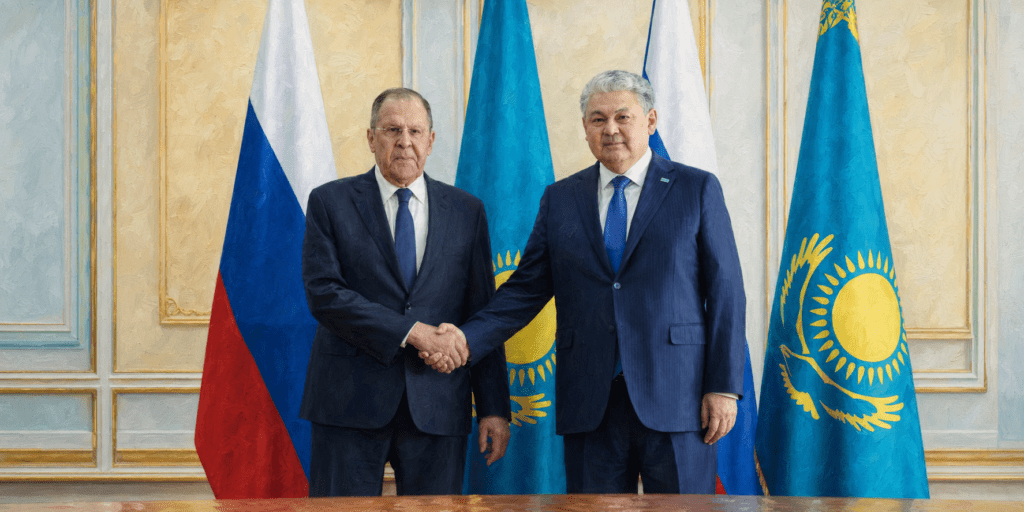
Russian Foreign Minister Sergey Lavrov has visited Astana for talks with Kazakhstan’s leadership, as the two countries prepare for a planned state visit by Russian President Vladimir Putin in late May.

Lavrov arrived in Kazakhstan on April 29. The main working part of the visit took place on April 30, with meetings with President Kassym-Jomart Tokayev and Foreign Minister Yermek Kosherbayev. Russia’s Foreign Ministry said the agenda covered political, trade, economic, cultural, and humanitarian ties, as well as cooperation in the Eurasian Economic Union, the Collective Security Treaty Organization, the Commonwealth of Independent States, and the Shanghai Cooperation Organization.

At expanded talks in Astana, Kosherbayev said Russia remains one of Kazakhstan’s key trade partners. Bilateral trade exceeded $27 billion last year, and the two governments are working toward a target of $30 billion. Kosherbayev said the talks covered energy, transport, logistics, industry, digitalization, cultural ties, and international issues.

The foreign ministers signed a cooperation plan between the two ministries for 2027-2028 during the visit. Kosherbayev said the plan reflected close coordination between Astana and Moscow on bilateral and international issues.

The visit also comes ahead of Putin’s expected trip to Kazakhstan. The Kremlin said in February that Putin had confirmed his participation in the Supreme Eurasian Economic Council meeting in Astana in late May and accepted Tokayev’s invitation to make a state visit linked to the event.

For Kazakhstan, relations with Russia remain a central part of its multi-vector diplomacy, alongside growing ties with China, the European Union, Turkey, the Gulf states, and the United States. The two countries share a long border, have deep trade links, and work together through several regional organizations. Russia also remains central to Kazakhstan’s energy export network. The Caspian Pipeline Consortium terminal near Novorossiysk handles roughly 80% of Kazakhstan’s crude exports.

That gives Astana a strong reason to keep stable ties with Moscow, but it also explains why Kazakhstan is pushing to diversify transport routes. The government has promoted the Trans-Caspian International Transport Route, also known as the Middle Corridor, as a way to move freight between China, Central Asia, the Caspian Sea, the South Caucasus, and Europe with less reliance on Russian territory.

The war in Ukraine has made that approach harder to sustain. Kazakhstan has kept ties with Moscow, but Tokayev has also stressed the importance of the UN Charter, sovereignty, and territorial integrity. In a phone call with Ukrainian President Volodymyr Zelenskyy on August 10, 2025, Tokayev said Kazakhstan supported the UN Charter, the inviolability of sovereign borders, and the territorial integrity of sovereign states.

Economic pressure has also grown. Western governments have increased scrutiny of trade routes that could be used to bypass sanctions on Russia. Kazakhstan has tried to protect its own trade from that pressure while avoiding a direct break with Moscow.

Energy adds another dimension. Any disruption to the CPC route can quickly become a national economic issue for Kazakhstan. In April, Kazakhstan’s energy ministry said CPC exports through the Black Sea remained stable after Russia reported a drone attack near Novorossiysk. The episode showed once again how Kazakhstan’s oil exports can be exposed to security events on Russian territory.

Lavrov’s visit, therefore, goes beyond routine diplomacy. It took place as Astana prepares for Putin’s state visit, manages sanctions risk, and tries to keep open several foreign policy tracks at once. Moscow wants to show it remains a central partner for Kazakhstan. Astana wants to keep that relationship stable without closing off its other options.

Lavrov’s visit showed how much of Kazakhstan’s Russia policy is still shaped by geography and infrastructure. Astana is building wider ties with other powers, but its oil exports, rail routes, border trade, and security contacts still run through or alongside Russia. That does not point to a rupture. It points to a relationship Kazakhstan cannot afford to mishandle.

Pannier and Hillard’s Spotlight on Central Asia: New Episode Coming Sunday

As Managing Editor of The Times of Central Asia, I’m delighted that, in partnership with the Oxus Society for Central Asian Affairs, from October 19, we are the home of the Spotlight on Central Asia podcast. Chaired by seasoned broadcasters Bruce Pannier of RFE/RL’s long-running Majlis podcast and Michael Hillard of The Red Line, each fortnightly instalment will take you on a deep dive into the latest news, developments, security issues, and social trends across an increasingly pivotal region.

This week, the team will be covering the environmental situation in the Caspian Sea and the recent Regional Ecological Summit in Astana.

Special guest, Vadim Ni, co-founder of the Save the Caspian Sea movement.