• KGS/USD = 0.01144 0%
  • KZT/USD = 0.00193 -0%
  • TJS/USD = 0.10876 0.55%
  • UZS/USD = 0.00008 0%
  • TMT/USD = 0.28490 0%
  • KGS/USD = 0.01144 0%
  • KZT/USD = 0.00193 -0%
  • TJS/USD = 0.10876 0.55%
  • UZS/USD = 0.00008 0%
  • TMT/USD = 0.28490 0%
  • KGS/USD = 0.01144 0%
  • KZT/USD = 0.00193 -0%
  • TJS/USD = 0.10876 0.55%
  • UZS/USD = 0.00008 0%
  • TMT/USD = 0.28490 0%
  • KGS/USD = 0.01144 0%
  • KZT/USD = 0.00193 -0%
  • TJS/USD = 0.10876 0.55%
  • UZS/USD = 0.00008 0%
  • TMT/USD = 0.28490 0%
  • KGS/USD = 0.01144 0%
  • KZT/USD = 0.00193 -0%
  • TJS/USD = 0.10876 0.55%
  • UZS/USD = 0.00008 0%
  • TMT/USD = 0.28490 0%
  • KGS/USD = 0.01144 0%
  • KZT/USD = 0.00193 -0%
  • TJS/USD = 0.10876 0.55%
  • UZS/USD = 0.00008 0%
  • TMT/USD = 0.28490 0%
  • KGS/USD = 0.01144 0%
  • KZT/USD = 0.00193 -0%
  • TJS/USD = 0.10876 0.55%
  • UZS/USD = 0.00008 0%
  • TMT/USD = 0.28490 0%
  • KGS/USD = 0.01144 0%
  • KZT/USD = 0.00193 -0%
  • TJS/USD = 0.10876 0.55%
  • UZS/USD = 0.00008 0%
  • TMT/USD = 0.28490 0%
11 December 2025

After High Hopes, Central Asia Views Iran Trade Routes with More Caution

Like some Central Asian neighbors, Uzbekistan is urgently reviewing possible changes to some trade routes because of conflict in the Middle East, even though that could entail sharply higher transport costs. The contingency planning follows a surge in trade talks between officials from Iran and countries in Central Asia earlier this year, prior to the intense strikes that Israel and Iran launched at each other this month.

A ceasefire between Israel and Iran appeared to be holding on Wednesday, but questions remain about Iran’s ability to build a nuclear bomb even after the U.S. attacked Iranian nuclear sites. U.S. President Donald Trump said the sites were “obliterated,” but, according to some Western media organizations, a preliminary U.S. intelligence report concluded that the U.S. attacks may have only set back Iran’s nuclear program by months. A June 25 statement by the Central Intelligence Agency says that “Iran’s nuclear program has been severely damaged by the recent, targeted strikes.”

Against this murky backdrop, and the partial uncertainty over Central Asia’s extensive web of trade links, Uzbekistan is reviewing transport and logistics arrangements to keep its economy and connections with international partners running as smoothly as possible. Uzbek President Shavkat Mirziyoyev discussed options with key advisers at a meeting on Monday.

“The military actions that have taken place in the Middle East in recent days have further aggravated the already unstable situation. This cannot but affect Uzbekistan’s foreign economic relations and access to world markets,” Uzbekistan’s presidential office said.

“In particular, the need to diversify export routes and redirect cargo to other, safer ports was noted. According to preliminary estimates, this could lead to an increase in transportation costs by up to 30%. In this regard, instructions were given to coordinate alternative routes with partner countries and support export-oriented enterprises,” the presidency said.

It said the trade and transport ministers, as well as other key officials, have been instructed to help business groups with export-import operations and finding new sales markets. Maintaining price stability in the domestic market and sustainable production rates are also key concerns.

Last month, Uzbek and Iranian officials met in Tehran and agreed to expand trade between their countries to an annual $2 billion, four times the current amount. Iranian ports offer Central Asian exporters access to the Indian Ocean and international markets beyond.

“The five Central Asian republics — Kazakhstan, Uzbekistan, Turkmenistan, Tajikistan and Kyrgyzstan — are increasingly seeking alternatives to the traditional transit routes that have tied them to Moscow or made them dependent on Chinese infrastructure,” said a commentary posted by the Begin-Sadat Center for Strategic Studies, an Israel-based group that studies Mideast security and foreign policy.

“Iran offers an appealing option: a gateway to the Persian Gulf and Indian Ocean, access to European markets via Turkey, and industrial and technological partnerships that diversify the region’s economic relationships,” said the analysis, which was published on June 4, shortly before the recent round of fighting between Israel and Iran.

Officials in Kazakhstan have warned of disruption to southern logistics routes, specifically a railway that runs from Kazakhstan through Turkmenistan and into Iran. But Economy Minister Serik Zhumangarin has said contingencies are available and that it’s too early to say how the situation will evolve.

Turkmenistan shares a border with Iran and its gas export plans could face challenges from protracted uncertainty in the region.

Iran–Israel War Highlights Central Asia as Zone of Strategic Stability

The explosive conflict between Iran and Israel, including coordinated U.S. strikes on Iranian nuclear infrastructure, has drawn global attention to the Persian Gulf and Levant. The escalatory spectacle, however, has blinded most observers to a quieter structural shift. This is the rising indispensability of Central Asia, including its linkages with the South Caucasus.

Unaligned in rhetoric and untouched by spillover, Central Asia’s very stability quietly threw into relief its increasing centrality to Eurasian energy and logistics calculations. As maritime chokepoints came into question and ideological rhetoric became more inflamed, Central Asia offers a reminder that the most valuable nodes in a network are the ones that continue operating silently and without disruption.

Neither Israel nor Iran has real operational depth in Central Asia, and this has made a difference. Unlike Lebanon, Iraq, or Yemen — where proxy networks or ideological leverage allowed Tehran to externalize confrontation — no such mechanisms exist east of the Caspian Sea. Iran’s efforts in Tajikistan, grounded in shared linguistic heritage and periodic religious diplomacy, today remain cultural and informational rather than sectarian and clientelist.

The influence of Iran’s Islamic Revolutionary Guard Corps (IRGC) in Central Asia is minimal; Israeli presence, while diplomatically steady in places like Kazakhstan and Uzbekistan, is neither controversial nor militarized. There are no significant arms flows or dual-use infrastructure for either side to use. As a result, Central Asia has remained untouched by the conflict.

Although the Iran–Israel conflict is relatively geographically localized, it has shed light on global systems far beyond the immediate zone of combat. Although not so far from the missile trajectories and nuclear facilities, Central Asia and the South Caucasus are remarkably insulated from their effects. Rather than becoming another theater of contestation, they have demonstrated their value as stabilizing elements at a time of heightened geostrategic volatility.

It is no longer optional to take into account the Central Asian space, which geoeconomically includes Azerbaijan, now a permanent fixture at the region’s summits. As the war now produces a phase of reactive adaptation in international geoeconomics and diplomacy, the region has become a control parameter of the international system rather than a fluctuating variable dependent upon it.

The Iran–Israel conflict has drawn new attention to the vulnerability of maritime energy corridors, especially the Strait of Hormuz, through which a fifth of the world’s oil passes. While contingency planning has focused on naval logistics and airpower deterrents in the Gulf, the Eurasian interior has remained materially unaffected, reflecting its structural indispensability. Central Asia and the South Caucasus, particularly Kazakhstan and Azerbaijan, offer existing and potential overland alternatives that bypass maritime chokepoints entirely.

Kazakhstan’s oil continues to flow via the Caspian Pipeline Consortium (CPC) pipeline to the Black Sea, while Azerbaijan’s infrastructure, anchored by the Baku–Tbilisi–Ceyhan (BTC) corridor, links Caspian energy to Mediterranean terminals. These routes are not replacements for Persian Gulf volumes, but, as redundancies, they acquire significance as stabilizing arteries as well as increased relevance in moments of system stress. The war has thus sharpened a fact already known in energy strategy circles: overland continuity through Central Asia and the Caspian and South Caucasus corridor is not about volume but about resilience.

The same logic extends beyond hydrocarbons. The Middle Corridor (Trans-Caspian International Trade Route, TITR) has quietly increased its throughput volumes since Russia’s war in Ukraine disrupted northern routes. Even during the Iran–Israel conflict, freight has continued to move uninterrupted along these overland routes. Such continuity reflects years of quiet investment in rail modernization, customs harmonization, and port interconnectivity, which is still ongoing.

Central Asia’s insulation is not only material but also ideological. Unlike parts of the Middle East where the Iran–Israel conflict has triggered rhetorical mobilizations or proxy signaling, Central Asia has remained outside the ideological line of fire. The region’s majority Sunni population, shaped by Hanafi traditions and post-Soviet secularism, offers little traction for Tehran’s Shia revolutionary narrative. Even Tajikistan, despite a close ethno-linguistic relationship with Iran that is rooted in shared Persianate heritage and mutually intelligible languages, did not issue any public solidarity statement during the conflict; nor did Iranian religious diplomacy generate visible mobilization in the population.

Groups that have historically opposed regional governments (e.g., Hizb ut-Tahrir in Uzbekistan or the internationalized remnants of the Islamic Movement of Uzbekistan that spread throughout the region) are Salafi-oriented or nationalist in impulse, and likewise often antagonistic toward Iranian positions. Iran’s economic and religious diplomacy in both Tajikistan and Turkmenistan (the only Central Asia state with which it shares a border) has remained limited in scope and carefully managed by the governments in place.

This ideological distance is further attenuated by diplomatic caution. Central Asian states have developed pragmatic relations with both Israel and Iran, but have declined to take sides rhetorically. Kazakhstan has long engaged Israel in agricultural and technological cooperation, but it has maintained official silence during the war, as did Uzbekistan. Thus, no Central Asian state has become a platform for rhetorical escalation or even a venue for protest. This is so because Central Asian diplomacy has generally aligned itself with strategic neutrality in order to minimize visible entanglements, while hedging through multilateral and plurilateral institutions.

That restraint has not gone unnoticed internationally. The United States, while publicly less engaged in the region, has quietly increased diplomatic signaling and is seeking to become re-involved. The European Union, long concerned with energy diversification, has begun to treat Central Asia less as a buffer and more as a logistical and ideological hinge between East and West. China, already structurally embedded through the Belt and Road Initiative and the Shanghai Cooperation Organisation, views the region’s neutrality as essential to preserving overland connectivity.

Central Asia’s insulation from escalatory entanglement is no longer a product just of internal intent. That is because the external environment has now shifted so as to incorporate this systemic role of the region. The Central Asian countries have not changed their outward behavior, but the international system has adapted to them. The region is no longer marginal or drifting; rather, it is an active participant in conditioning its neighborhood. The facts of its logistical corridors, regulatory stabilities, and ideological neutrality are entering the strategic calculus of powers even outside its neighborhood. What was originally an initiative from within has been transformed into a structural demand from without.

In complex-systems terms, the international system has “recategorized” Central Asia. In practical strategic terms, this means that Central Asia now occupies a position of increased centrality, not because it has asserted power, but because its self-defined operational mode has become integral to the overall system’s optimal functioning. Likewise, its neutrality — as a corridor of last resort and buffer against ideological contagion — operates as ideational infrastructure providing global-architectural redundancy. The region has not declared a new role, but the system has conferred one. That transformation is structural, not declarative; and it is already in effect.

Bishkek Launches “Living Wall” Project to Tackle Heat and Pollution

Bishkek has launched a pilot project to green the facades of buildings as part of a broader effort to adapt to climate change and mitigate growing heat and air pollution in Kyrgyzstan’s capital.

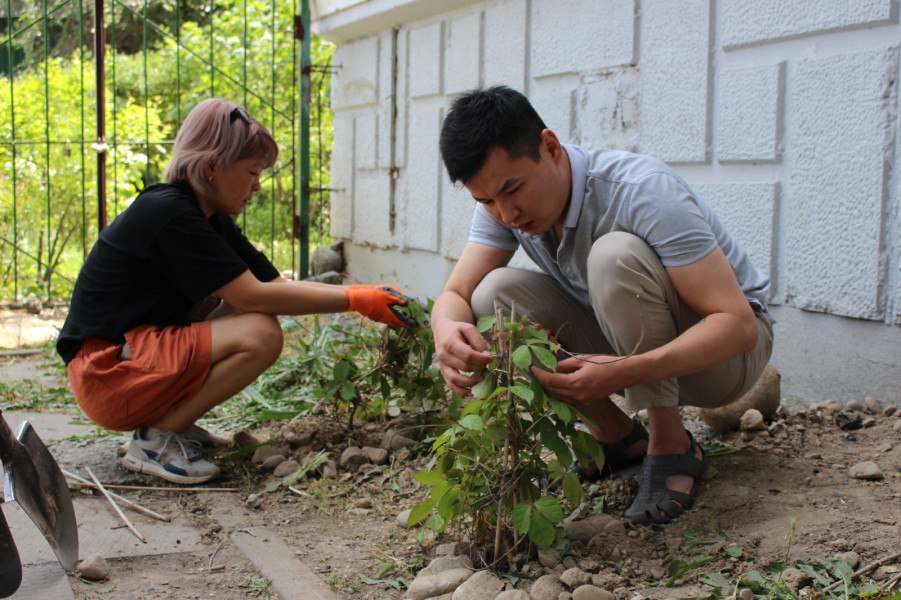
In June, vertical greenery was installed on the facades of three schools and one apartment building under the “1000 Green Walls” program. The initiative is jointly implemented by the environmental organization MoveGreen and the Bishkek municipality, with support from the United Nations Environment Programme (UNEP) and the development agency Bread for the World.

More Than Just Aesthetic

Green facades, also known as living walls, offer both visual and environmental benefits. They reduce building surface temperatures, absorb carbon dioxide, release oxygen, and filter dust and pollutants from the air. These vertical gardens also improve sound insulation, protect buildings from temperature extremes, and support urban biodiversity, providing habitat for birds, insects, and butterflies.

Two species were selected for the pilot phase: maiden grapes and ivy.

Maiden grapes are fast-growing, frost- and drought-resistant vines that create dense green coverage. In addition to insulating buildings, they absorb dust and exhaust emissions, improving local air quality. Their vibrant red foliage in autumn also enhances the city’s visual appeal.

Ivy, an evergreen perennial, retains its foliage year-round and provides consistent thermal and acoustic insulation. It is effective in trapping airborne pollutants and helps create a more temperate and pleasant microclimate around buildings.

A Scalable Urban Solution

The Bishkek municipality views this as a sustainable and scalable urban solution. “These green facades contribute to a more comfortable, ecological, and aesthetically pleasing urban environment,” officials said.

The city plans to expand the 1000 Green Walls program to include more schools, kindergartens, and residential buildings in the coming months.

Structural Barriers Continue to Hamper Industrial Growth in Tajikistan

Despite recent gains in industrial output, Tajikistan’s full industrial potential remains largely unrealized. Analysts point to a combination of systemic issues that continue to constrain the sector’s sustainable development.

Growth Driven by Extractive Industries

According to the Statistical Agency under the President of Tajikistan, industrial production totaled 18.9 billion somoni in January, April 2025, marking a 25.2% increase compared to the same period in 2024. However, this growth was overwhelmingly fueled by the extractive sector, which surged by 90%. In contrast, manufacturing expanded by just 3.5%.

While 121 new enterprises were launched during the first four months of the year, disruptions in existing operations and the narrow structure of industrial growth highlight deeper systemic problems.

Idle Enterprises and Obsolete Equipment

Minister of Industry and New Technologies Sherali Kabir reported that 92 industrial enterprises remained non-operational as of August 2024. Over half have been idle since 2008-2018, with the rest inactive since 2019-2022.

The reasons range from financial difficulties and pandemic-related business closures to outdated equipment and low competitiveness. Rising input costs and limited market access further compound the problem. Some sectors, such as textiles and garments, could potentially resume operations, but only with significant modernization.

Although some light and food industry enterprises have diversified, others, such as the porcelain factory in Tursunzade, have failed to adapt to changing market conditions.

Raw Material Shortages

Insufficient raw material supply remains a major bottleneck for several subsectors. The vegetable oil industry, for instance, requires approximately 833,000 tons of oilseeds to produce 100,000 tons of oil. However, domestic output is under 100,000 tons, limiting production to just 25,000 tons, four times below the national requirement.

The canning industry faces similar constraints due to an inconsistent supply of fruits and vegetables.

Energy Shortages

Power outages continue to disrupt industrial output, especially in winter. Cotton processing plants produced 980 tons less fiber in the first half of 2025 compared to the same period in 2024 due to energy shortages.

At the Azot plant in Levakant, production losses translated to a 7.3 million somoni revenue shortfall. Agricultural infrastructure has also been affected: the Land Reclamation Agency reported 130 pump station failures in 2023 alone, caused by voltage surges and sudden power cuts.

Declining Cement and Coal Exports

Despite advances in cement production, Tajikistan’s export volumes have declined sharply. From January to April 2025, the country exported just 154,000 tons of cement, down from 655,000 tons during the same period in 2024. This marks a 30.4 percent decline compared to the same period in 2023.

The decline stems largely from reduced demand in key markets. Uzbekistan’s new cement plants have fulfilled domestic needs and displaced Tajik exports to Afghanistan.

Coal exports have also suffered due to increased transit fees. Afghanistan raised its transit tariff from $7 to as much as $50 per ton, leading to a 15,000-ton decline in exports to Afghanistan and a 65,000-ton drop to Pakistan.

High Production Costs Undermine Competitiveness

High production costs across all sectors continue to undermine Tajikistan’s industrial competitiveness. For example, the cost of cultivating one hectare of cotton exceeds 10,000 somoni, twice as high as in neighboring Uzbekistan. This is driven by elevated fuel, service, and fertilizer prices.

Livestock farming faces similar hurdles. High feed and veterinary costs make domestic meat and dairy products less competitive, reducing profitability and limiting foreign investment interest.

Uzbekistan Signs $78 Million Deal with Saudi and French Firms to Manage Hazardous Waste

Uzbekistan has signed a landmark $78 million agreement with Saudi Arabia’s Vision International Investment Company (VIIC) and France’s Suez International to improve hazardous industrial waste management and bolster environmental protection. The Ministry of Ecology announced the signing earlier this month.

The agreement was formalized by Deputy Minister of Ecology Jusipbek Kazbekov, VIIC Director of Development Kapil Lalwani, and Paul Bourdillon, Regional Director for Europe and Central Asia at Suez. The project will be implemented in three phases.

A Three-Phase Strategy

The first phase will involve the construction of new waste stabilization facilities, landfills, and transfer stations to safely store and process hazardous industrial waste.

The second phase will focus on developing engineering designs and piloting technologies to produce Refuse-Derived Fuel (RDF), a method that converts waste into usable energy. This phase will also test incineration and thermal treatment systems.

In the third and final phase, the project will establish a full-scale RDF and waste-to-energy facility.

Suez International, with over 160 years of experience, is a global leader in water and waste management, offering innovative solutions across Europe, Asia, the Americas, Africa, and the Middle East. Saudi-based VIIC, founded in 2002, manages nearly $96 billion in assets and is active in energy, infrastructure, and public-private partnership projects.

The Ministry of Ecology views the agreement as a significant advancement for Uzbekistan’s environmental policy, aiming to reduce industrial pollution and support sustainable development.

Broader Environmental Initiatives

Uzbekistan’s Ministry of Ecology is also collaborating with the Food and Agriculture Organization of the United Nations (FAO) and the European Union to manage hazardous agricultural chemicals. A joint project launched in Tashkent last year aims to reduce pesticide use and improve waste handling in agriculture.

Minister of Ecology Aziz Abdukhakimov emphasized the importance of these initiatives for public health and environmental safety. He also highlighted the need to update the national registry of contaminated areas, particularly former agricultural airfields, many of which have not been surveyed since the 1990s.

World Bank: Over 65,000 Premature Deaths a Year in Central Asia Linked To Air Pollution

Air pollution remains one of the most pressing environmental and public health challenges in Central Asia, with significant consequences for human life and regional economies. A new World Bank assessment highlights the scale of the crisis, linking poor air quality to more than 65,000 premature deaths in 2021 across the region.

The report identifies pollution from fossil fuel combustion, especially for heating and transportation, as a major contributor to declining air quality in both urban and rural areas. Transboundary sand and dust storms are compounding the problem, affecting multiple countries simultaneously.

In many Central Asian cities, concentrations of fine particulate matter (PM2.5) exceed safe limits by a wide margin. During the winter, levels can spike to six to twelve times higher than the World Health Organization’s recommended thresholds. The economic burden is also staggering: the annual health costs associated with air pollution are estimated at $15-21 billion, representing 3-5% of the region’s GDP in 2022.

Human-Caused Emissions Dominate

According to experts, 50-80% of PM2.5 exposure is due to human activity, primarily the burning of solid fuels for heating in households and small businesses. While natural dust is a contributing factor in some areas, anthropogenic sources remain the dominant driver.

The World Bank argues that this crisis can be mitigated with the right policy interventions. Effective strategies include reducing emissions from household heating, traffic, and industrial operations, as well as expanding urban green spaces.

To better coordinate efforts, the Bank advocates for an “airshed approach”, a governance model that promotes joint responsibility between national and local authorities to improve air quality. Additional recommendations include strengthening air quality laws and monitoring systems, updating standards, raising public awareness, and enhancing cross-border cooperation among Central Asian states.

Impact on Children

A separate report by UNICEF underscores the disproportionate toll air pollution takes on children. In 2021, approximately 6,441 children and teenagers across Europe and Central Asia died from air pollution-related causes, 85% of them under the age of one. UNICEF stressed that these deaths were entirely preventable.

Experts maintain that improving air quality could yield wide-ranging benefits, including increased productivity, reduced healthcare costs, and enhanced quality of life. They urge governments to integrate air quality management into climate and development plans to unlock additional financial and technical assistance.