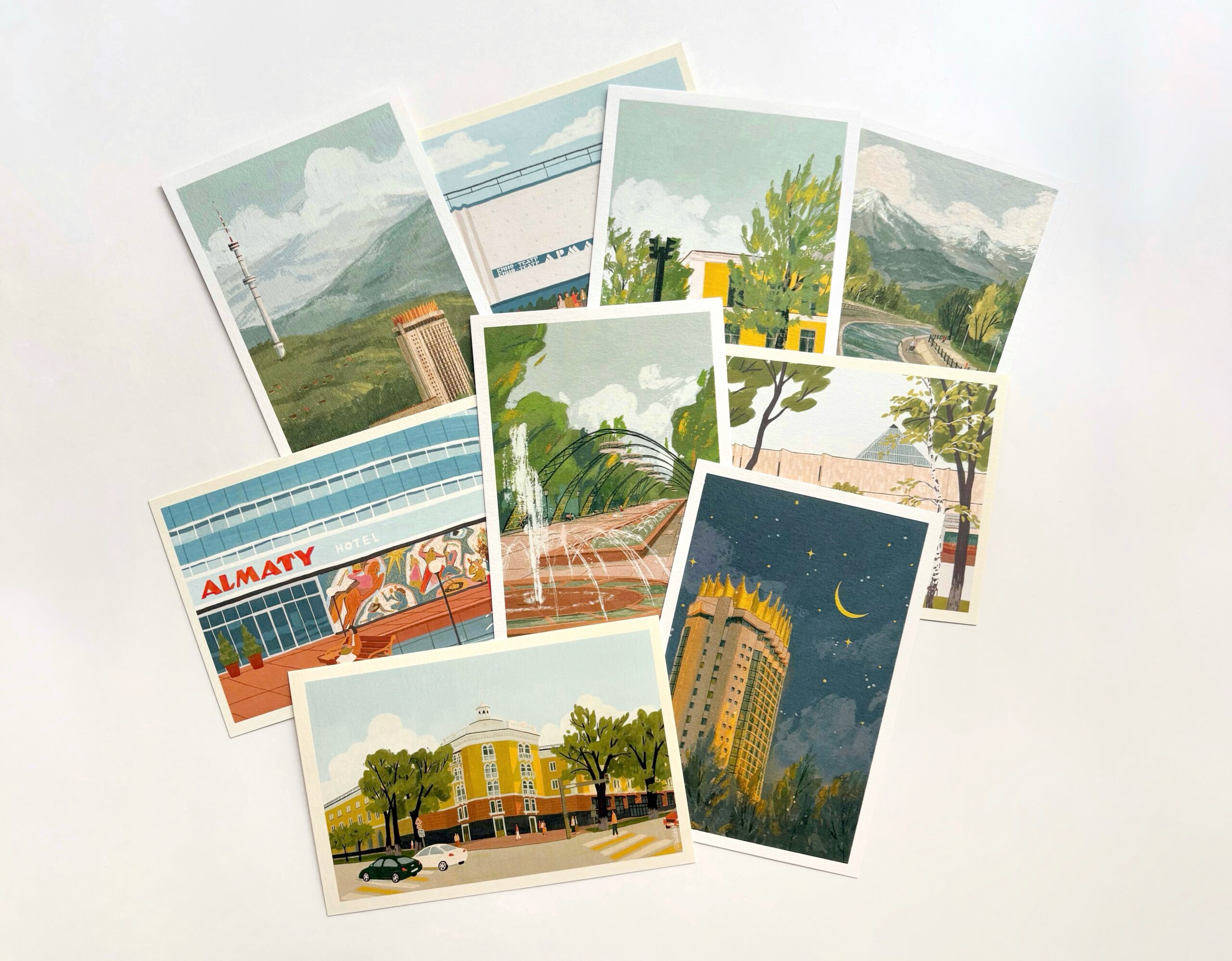
With colorful illustrations of landmarks, natural monuments, and city-life moments, Aidana Niyazalieva’s postcards of Almaty stand out. TCA spoke with the artist to learn more about her inspiration, creative process, and challenges behind her postcards and the Almaty arts scene.
TCA: What inspired you to start making postcards of Almaty?
I’ve been drawing since I can remember; everything surrounding me – my room, the streets, and the buildings – inspires me. This led me to study architecture. However, after working as an architect, I realized that my passion for drawing was stronger. I decided to try it, eventually devoting myself to illustration and turning this hobby into a profession. I started with the city I grew up in, Almaty, and created a few postcards of the views I walked past the most. This became a way to combine everything I love – art, architecture, and my love for the city.
TCA: How do you decide which landmarks, views, or themes to feature in your postcards?
I choose places and themes close to me that evoke an emotional connection in people. Usually, the ideas come from my walks around the city. During my walks, I take many photos for possible drawings. Sometimes, a few buildings of the same type could grow into a series of illustrations, as in the “Houses“ postcard set that was united by the old houses of the Soviet period located in a Golden Square area. Also, I might get requests from people about places they would like to see, as happened with the Kazakhstan Hotel or Esentai River illustrations.
TCA: What is your favorite spot in Almaty to capture in your art, and why?
My favorite place in Almaty is the old city center. Its unique architecture, with characteristic features from different periods from neoclassical to modernist buildings, and its streets with cafes and terraces have always attracted my attention. Those buildings keep their history, whether these are old houses with sophisticated details or monumental facades of theaters and institutes. When I’m there, I always look closely at small elements like the carved balconies, window frames, mosaics, and patterns on the facades – I try to capture them in every illustration.
TCA: Are there specific stories or personal memories behind some of your postcard designs?
As a local, I have a personal connection to almost every location I illustrate. Capturing a place authentically requires more than just visual reference – it also needs an emotional connection. That’s why I barely draw locations I’ve never visited. Behind almost every illustration is a moment tied to the place. For example, the Kasteyev Museum holds a special place in my heart. My grandma used to take me there often when I was little, and it’s where I first took art lessons. So, I decided to create this illustration to capture the architecture of the museum and the memories connected to the place.
TCA: Can you walk us through the creative process behind designing a postcard?
Firstly, after the location is chosen, I create a rough sketch to determine the composition that will best convey the atmosphere of the place. After that, I move on to the detailed drawing, experimenting with colors to find the palette reflecting the general mood. Then, I add finishing touches, like strokes, textures, and people. While placing them, I always love to imagine a little story of who they are and how they communicate with the place and each other. When everything is finished, I step aside and leave the finished illustration until the next day or so, and then I come back to see if anything needs to be retouched.
TCA: What tools and materials do you typically use for your art?
For the past few years, I switched from traditional materials to digital. When I started to take commissioned orders, it was also more convenient for me as it speeds up the process and makes it easier to edit the illustration for the client if needed. I use brushes and techniques similar to analog for digital drawings to keep the feeling of being made traditionally. When sketching just for myself, I usually use materials that are easy to carry with me, like brush pens or colored pencils.
TCA: How do you ensure your postcards capture the essence of Almaty?
There was a moment when I asked myself the same question: “How do you convey the core of Almaty in the illustrations?” To answer it, I decided to make a list of everything that, for me, defines the essence of the city. I later created a sticker sheet from that list called “Almaty is…, ” showcasing my associations with the city. The sheet includes nine stickers with the captions: “cozy balconies,” “summer terraces,” “fountains,” “walks,” “houses with history,” “colorful details,” Medeo,” “mountains,” and “cultural places.” I believe these are the signature elements that reflect Almaty’s unique character. So, when I create an illustration, I try to incorporate at least one of these elements to capture the atmosphere, whether it’s a cityscape or nature.
TCA: Do you collaborate with local businesses or other artists in Almaty?
Yes, I’ve collaborated a few times with local companies. The goal of such projects is usually not to earn money but to create new connections and promote each other’s work. Such projects also help to exchange your audiences. For example, there was a collaboration with a local photo studio for their birthday. We have created postcards and stickers that people could buy at their studio or directly from me. This way, more people reached out to both of us and even brought me more commissions.
TCA: What challenges have you faced as an independent artist in this niche?
During this period working for myself, I’ve had to struggle with a few things. The first thing is finding an audience. In the initial stages, attracting attention to my work was difficult. I had to learn how to properly present my projects on social media and local markets to get noticed. The second thing was the financial side, where I had to consider the cost of expenses on materials such as printing and packaging and, based on this, plan the budget so that the cost pays off and simultaneously keeps the price affordable. Another struggle is finding the balance between creativity and administration. Working for yourself, in addition to drawing, you have to do everything, from taking photos of your products and running social media to responding to messages and shipping orders. That takes a reasonable amount of time and energy, but all these challenges have taught me to stay flexible and organized.
TCA: How do you stay motivated and inspired to create new designs?
To keep myself motivated, I participate in local markets from time to time. Preparing for the market stimulates you to create something new, and it helps you revise and organize your workflow in a limited time, although it can be a little challenging. But mostly, I feel inspired by people who support my work. When I receive feedback from people telling me they have my art and send postcards around the world, it always warms my heart and motivates me to create more.
I also love trying new things: exploring new styles, participating in art challenges, workshops, or visiting shows by other artists. This helps me to stay inspired and not get stuck in a routine. Of course, there are moments of artistic block when it feels like you can’t create anything new. In these moments, I just allow myself to rest, switch to something else, or work on something small and insignificant – usually, it helps.
TCA: How does the culture and landscape of Almaty influence your work?
Over the past few years, the city’s landscape has changed a lot. There are lots of new buildings, cafes, and local businesses that constantly modify the urban identity. It inspires me to create works that combine heritage and modernity and adapt to changes in the city’s culture. For instance, in the past few years, people have spent more time on summer terraces due to the rise of cafes and coffee shop culture. One of the other changes is that people have become more aware of their surroundings, showing more interest in buildings’ history and details. All these changes stimulated me to highlight more of these moments in my illustrations.
TCA: If you could design a postcard to encapsulate Almaty’s spirit in one image, what would it look like?
If I had to think of a postcard to represent the city, I’d choose something that combines architectural landmarks and scenes of nature. I think that description applies to one of the existing postcards where we can see its famous buildings, like the Kazakhstan Hotel and the Kok Tobe TV tower that have become the city’s symbols, and there are our mountains with their green slopes in the background. That is, by the way, the postcard people tend to choose the most when they want to send it to someone to show the essence of Almaty.
If I were to create a postcard for a resident, the landscape would be different and include a place that might not exist today, but was prevalent in the old days. One such place was the Ldinka (Льдинка) Café, located in the heart of the Golden Square area. That postcard would be a mixture of the old and new. Along the way, there’s the Panfilov Street Promenade with crowds passing by, the Abay Opera House in the background, and mountain peaks in the distance. That kind of postcard, in my opinion, would evoke a nostalgic feeling in the older generation, but still be recognizable for the younger one, whilst simultaneously reflecting the city’s soul.