Kazakhstan Gains Weight in China’s Energy System

The newly extended U.S. waiver for Russian oil transit through Kazakhstan and the reported giant onshore hydrocarbon discovery in western Kazakhstan point in different directions, yet they belong in the same analytical frame. One concerns an existing flow that already reaches China through working infrastructure, while the other concerns a possible future source that has not yet reached the stage of commercially proven reserves. Together, they mark a change in Kazakhstan’s position. The country is increasingly important to China both as a corridor and as a possible larger upstream partner.
The U.S. waiver now runs until March 19, 2027. Kazakhstan is not a giant direct oil supplier to China in the way that Russia or Saudi Arabia is; China’s import structure is broader. But Kazakh-origin oil shipments, Russian transit oil, and adjacent energy links now constitute a single, more complex relationship. According to official Chinese sources, oil imported from Kazakhstan enters mainly through the China-Kazakhstan crude pipeline.
More Than Kazakhstan’s Own Barrels
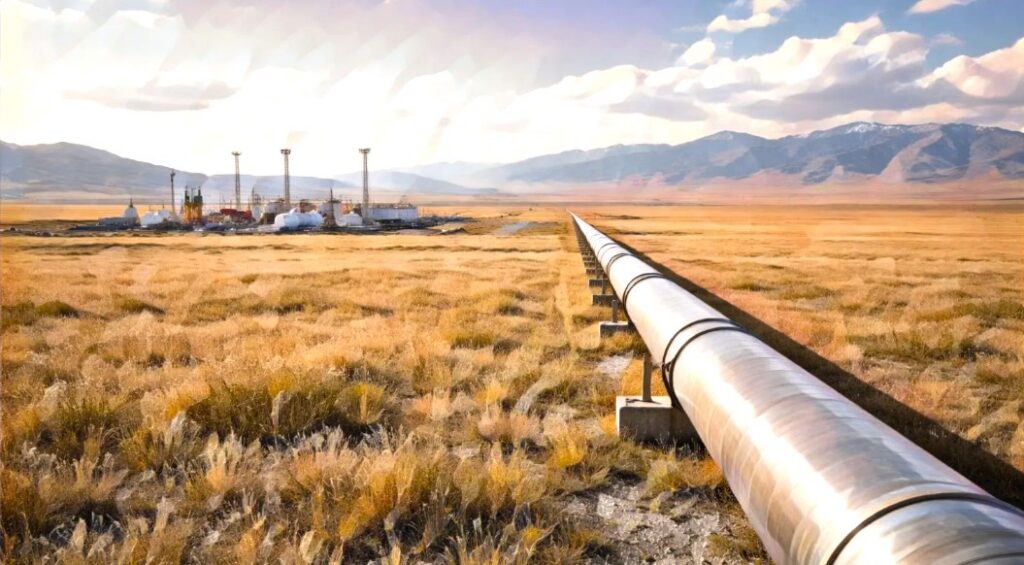
Kazakhstan-China Pipeline LLP reported that in 2024, the Atasu-Alashankou route carried 1.2 million tons of oil and 9.989 million tons of transit oil, against a design capacity of 20 million tons a year. Official Chinese figures sharpen the point. By the end of 2024, total cumulative throughput on the pipeline had reached 280 million tons, including 19.139 million tons in 2024, while cumulative crude imported from Kazakhstan was lower. Kazakhstan’s significance to China is therefore larger than Kazakhstan’s own volumes would suggest, because the route carries more than Kazakhstan’s own oil.
A glance at Europe keeps that proportion straight. Eurostat reports that Kazakhstan supplied 12.7% of the European Union’s petroleum oil imports in 2025. The European External Action Service said that Kazakhstan accounted for 10.9% of EU oil imports in the first quarter of 2024. This made it the bloc’s third-largest supplier in that period, and a more important direct oil supplier to Europe than to China.
The significance of Kazakhstan’s geographic proximity to China becomes clearer when one looks beyond crude oil. Kazakhstan is not only a direct oil supplier, but also a transit corridor for multiple China-bound energy flows. The Kazakhstan-China oil pipeline is one of China’s major import routes. At the same time, while Kazakhstan’s own gas exports to China remain limited due to rising domestic demand, gas from Turkmenistan and Russia both pass through its territory. Oil and gas do not form a single operational system, but together they show that China’s energy connection with Kazakhstan extends beyond one commodity and beyond Kazakhstan’s own barrels.
The Source Side May Be Growing
In this context, the reported discovery on the Zhylyoi carbonate platform makes a difference because it widens the source side of the relationship without changing present flows. According to public statements by KazMunayGas officials, the Karaton, Kazhygali, and Zhylyoi formation has resource potential of 4.7 billion metric tons of hydrocarbons, and the broader Zhylyoi carbonate reservoir may hold as much as 20 billion metric tons of oil equivalent. The field is onshore in the Atyrau Region near the Caspian coast. A well at Karaton has already been drilled to 5,750 meters. The formation is being compared with Kashagan not only because of the headline scale, but also because it is a very large structure in one of Kazakhstan’s core producing regions.
Caution nevertheless remains essential, as these are geological-potential figures rather than proven recoverable reserves. Hydrogen sulfide has already been encountered, and deposits may extend much deeper, perhaps to nine kilometers. Negotiations over subsoil-use contracts are underway, and exploration is expected to expand to the Kazhygali block. This is what is drawing attention from Chinese and other energy observers, although any Chinese participation remains far from decided.
The bilateral energy relationship does not stop at oil and transit. Kazakhstan produced about 25,839 metric tons of uranium in 2025, about 40% of world output, and has been the world’s leading uranium producer since 2009. More importantly, the Ulba-FA fuel-assembly plant in Oskemen reached its design capacity in 2024 at 200 tons of low-enriched uranium in fuel assemblies per year, and the company says all fuel assemblies produced there are supplied to nuclear power plants in China. Kazakhstan’s value-added nuclear-fuel link to the Chinese market is therefore significant.
Taken together, these lines do not make Kazakhstan into China’s overwhelming energy supplier, but they show that China needs Kazakhstan in several specific ways. First, it is a corridor for Russian oil as well as a direct supplier of some crude and other energy-related products. Second, it is a major uranium producer with a China-linked fuel-assembly operation. And third, it is also a country where a large onshore oil prospect may increase future upstream significance if the geology proves commercially sound.
The Regional Energy Network
That broader pattern returns the discussion to the argument about Berdimuhamedov’s recent Beijing visit and the reshaping of Central Asia’s gas system. The larger point is that the region’s energy relations are becoming more cross-linked through infrastructure, transport routes, and related forms of cooperation. In the recent Turkmen case, gas provided the clearest example, as China’s westward energy connection increasingly depends not on a single bilateral exchange but on a chain of producing states, transit territories, and linked projects. Oil transit through Kazakhstan and the new onshore discovery suggest that the same tendency is becoming visible in another energy sector as well, even if in looser form.
Kazakhstan alone does not fill a dominant share of Chinese oil demand, but China needs Kazakhstan because Kazakhstan occupies a growing place in a more networked Central Asian energy space. That place appears modest when measured against China’s biggest crude suppliers, but it becomes much more significant when bilateral corridor utility, regional geographic position, and multi-sector energy context are taken into account. The U.S. waiver extension confirms Kazakhstan’s present value in the network, and the Zhylyoi discovery increases its possible future weight.