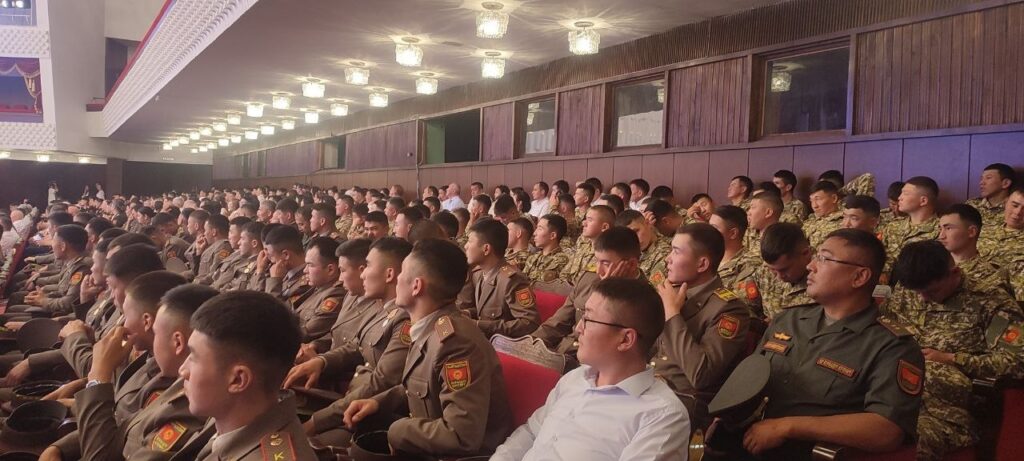
Speaking at a traditional ceremony ahead of Defender of the Fatherland Day, celebrated in Kazakhstan on May 7, President Kassym-Jomart Tokayev said the country must reform its armed forces within the next two years.
“Our country must be prepared to prevent various challenges and respond to any threats. Therefore, we need to strengthen our defense potential and continue, above all, the technological modernization of the Armed Forces. This is a requirement of today’s unstable and turbulent times. In this regard, it is first necessary to carry out deep reforms in our Armed Forces and militarized structures. This is a strategically important task that must be resolved in a short period within two years,” Tokayev said during a ceremony awarding state honors and military ranks ahead of Defender of the Fatherland Day and Victory Day, celebrated on May 9.
Russian analysts responded to the statement before many Kazakh commentators, largely arguing that Kazakhstan faces no major external threats and therefore has little need for sweeping military reform.
One of them, Stanislav Pritchin, head of the Central Asia sector at the Primakov Institute of World Economy and International Relations in Moscow, said Kazakhstan had no serious territorial disputes or significant tensions with neighboring countries.
“There are some political disagreements, but overall, the country exists in a fairly calm environment. There are simply no conflict points that would require Kazakhstan to fundamentally revise its military doctrine or significantly strengthen its army,” he told the publication, Expert.
Pritchin also suggested that Russian concern stemmed from uncertainty over how Tokayev’s accelerated military reform agenda fits with Kazakhstan’s commitments to Moscow-led organizations such as the Collective Security Treaty Organization (CSTO) and the Eurasian Economic Union (EAEU).
In Kazakhstan, however, the reform agenda fits a familiar pattern: by the time Tokayev publicly announces a deadline, work in that direction is often already well underway. In December 2025, Prime Minister Olzhas Bektenov outlined major military reforms while responding to parliamentary questions about discipline in the armed forces.
Following presidential instructions, the government submitted three draft laws to parliament intended to form the foundation of the reform process. The legislation addresses crime prevention and revises administrative regulations within the military system. One of the main goals is to clearly divide responsibilities among commanders, military police, and other authorized bodies while introducing technology-based disciplinary oversight mechanisms.
At the same time, the Health Ministry has developed a 2026-2028 roadmap for suicide prevention in Kazakhstan, with separate provisions focused on military personnel.
As part of the broader reform effort, the authorities have also approved the interagency “Digital Prevention” program for 2025-2028. The initiative includes integrating video surveillance systems, artificial intelligence, and a unified database to monitor discipline and public order within the military. In parallel, the “Law and Order in the Army” program aims to strengthen military discipline and prevent offenses among service members.
Tokayev also addressed military reform in an interview with the newspaper Turkistan earlier this year. The interviewer noted that repeated deaths among soldiers during military service were damaging the army’s standing and weakening public trust in the armed forces.
“I view the deaths and injuries of conscript soldiers extremely negatively; this is unacceptable in peacetime,” Tokayev said. “I spoke about this at a recent meeting with the heads of all security agencies. I criticized the leadership of the defense ministry for insufficient attention to educational and disciplinary work. The army must support, educate, and cultivate worthy citizens of our country. Commanders must serve as examples for service members. There can be no place in the army for hazing, hooliganism, tribalism, or regional favoritism. I will personally oversee this. I have ordered urgent measures to correct the situation.”
Commenting on the interview, Senator Bibigul Zheksenbay, a member of the Senate Committee on International Relations, Defense and Security, said the president’s course ensures the “comprehensive development of the army, combining strict discipline, social protection for personnel, technological modernization, digitalization, and effective communication with society.” According to Zheksenbay, these measures would strengthen public trust in the armed forces and raise the prestige of military service.
These reform efforts have also been sharpened by a series of tragic incidents this year. In January alone, three servicemen died under different circumstances, triggering public outrage. The Defense Ministry expressed its condolences to the families of the conscripts who died while serving.
“The Armed Forces command fully understands the seriousness of what has occurred and the degree of responsibility for ensuring the safety of military service. On the instructions of the Minister of Defense, Lieutenant General of Aviation Dauren Kosanov, a set of emergency measures has been adopted to prevent such tragedies in the future,” the ministry stated.
Against this backdrop, Tokayev’s two-year deadline appears less like the start of a new reform drive than an attempt to force the completion of changes already moving through Kazakhstan’s military system.