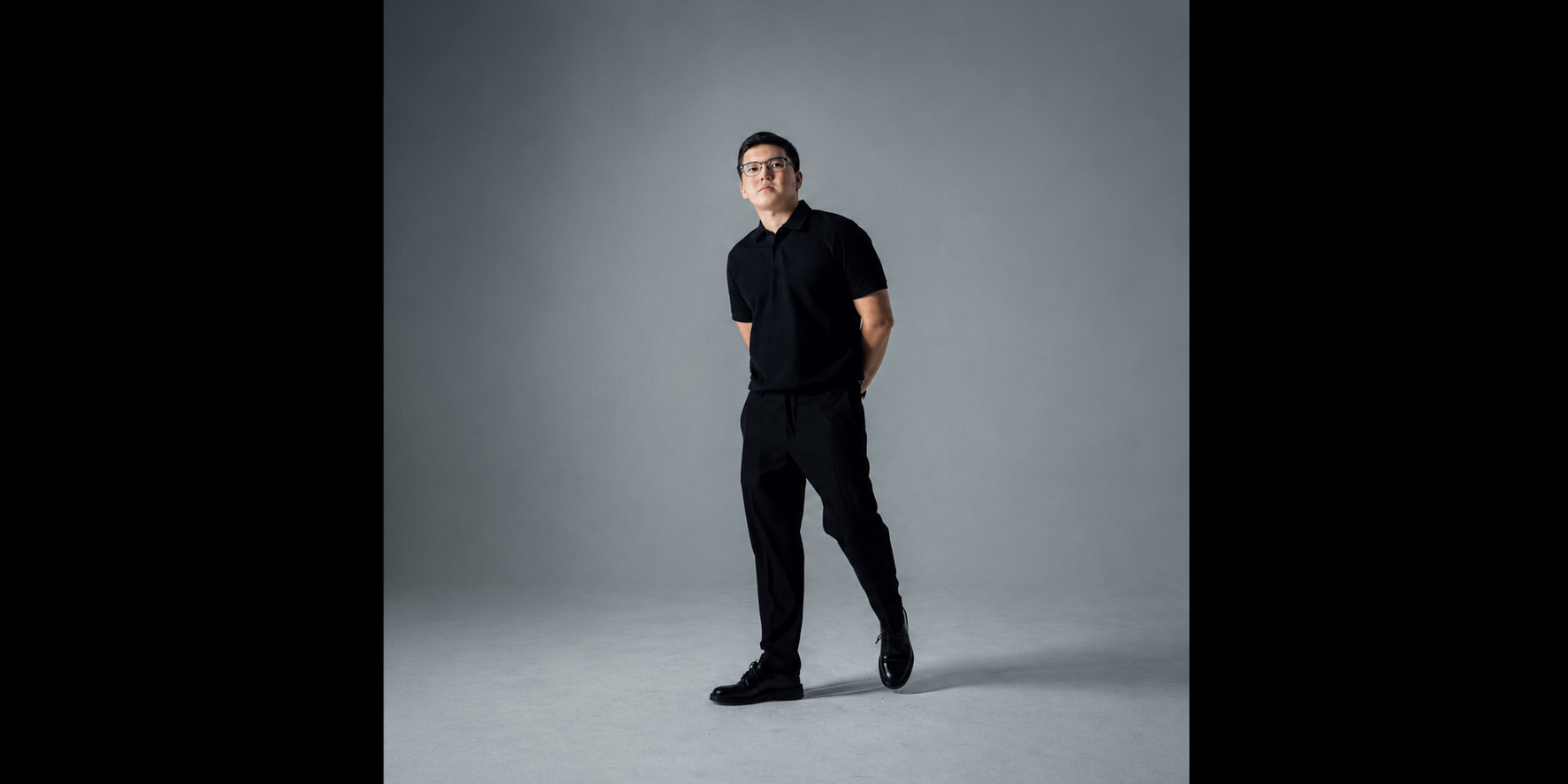
At 25, Kanybek Kalmatov is taking on a subject many older directors might have avoided: Chinghiz Aitmatov, Kyrgyzstan’s most internationally recognized writer and a figure deeply embedded in the country’s cultural identity.
Kalmatov, a cinematographer and graduate of VGIK, the prestigious Moscow film school, is making his directorial debut with Aitmatov, billed as Kyrgyzstan’s first full-length feature film about the writer’s life and career. The project has already drawn attention beyond Kyrgyzstan, not least because Russian actor Sergey Bezrukov has joined the cast.
For Kalmatov, the film is also personal. He first encountered Aitmatov as a schoolboy through The Little Soldier, and later found that even at film school in Moscow, Kyrgyzstan was often viewed through the writer’s name. Now, after months of research and nearly a year spent developing the screenplay, he says he is ready to take on a life that one film can only partly contain.
The Times of Central Asia spoke with Kalmatov about why he chose a biopic rather than an adaptation, how he approached Aitmatov’s life at such a young age, and why he hopes the film will send younger viewers back to the writer’s books.
TCA: You have chosen an ambitious project for your directorial debut. How did the film come about?
Kanybek Kalmatov: Since childhood, there have been two stories I always dreamed of filming. The first is about my parents, because they have an incredible love story. The second is about Aitmatov. It wasn’t only his works that fascinated me. It was the scale of his personality, how determined he was and how many different things he managed to do at the same time.
I fell in love with Aitmatov when I was about 12, after reading The Little Soldier. It’s about a boy whose father died in the war. Since then, Aitmatov’s works have always stayed with me. Even at VGIK, where I studied, people often saw me through that lens: “You’re from Kyrgyzstan? The homeland of Aitmatov?” For us, he’s not just a writer; he’s part of our cultural code. So I felt that, sooner or later, this film was bound to enter my life.
TCA: Were you afraid the project might not work?
Kanybek Kalmatov: No. Probably because I believe strongly in intention. Any big undertaking starts with that. If your motivation is right and you understand why you’re doing it, things begin to fall into place. From the start, my intention was pure. I never saw this film as a way to gain fame or prove something to anyone. I wanted to tell the story honestly of someone who means so much to our culture.
TCA: Don’t you think one has to “grow into” Aitmatov first?
Kanybek Kalmatov: There are topics you need to mature into. But if you wait for the perfect moment, you may never make anything at all. Maybe if I waited another 15 years, I would approach this story differently. Or maybe I’d never dare. Personally, I respect people who aren’t afraid to try, who take on difficult subjects sincerely and with full commitment. In that sense, I’m simply walking my own path.
TCA: Why did you choose a biopic rather than adapting one of his works?
Kanybek Kalmatov: In a way, a biopic is clearer territory. You have the facts of a person’s life, the events that happened. Yes, they can be interpreted differently, but the foundation is there. If you adapt one of Aitmatov’s works, you inevitably compete with a text people have loved for decades. That’s an even greater responsibility, because everyone already has their own image of it.
TCA: Let’s talk about Cassandra – Bekzat Pirmatov’s film inspired by Aitmatov’s The Mark of Cassandra. You worked on it, and it was visually striking, but Aitmatov himself was barely there. Aren’t you worried people will judge your film just as harshly?
Kanybek Kalmatov: Bekzat’s film was never meant to be a direct adaptation of the novel. If viewers expected that, it’s more about their expectations. I don’t share the criticism that it was “good cinema, but not Aitmatov.” The fact that a younger generation of directors is entering into dialogue with Aitmatov is important in itself.
TCA: Did anyone try to talk you out of it?
Kanybek Kalmatov: Of course. But I’ve never liked that approach. Challenges have always interested me more. When people say, “It’s impossible,” it makes me want to try and see why. I definitely wasn’t going to abandon it because someone thought I wasn’t old enough for the subject.
TCA: What do you mean when you say this project felt destined?
Kanybek Kalmatov: If you’ve seen Slumdog Millionaire by Danny Boyle, there’s that line: “It is written.” That idea feels close to me. Looking back at how this project came together, many things seem far from accidental. Filming is already complete, we’ve started editing, and it feels like everything is unfolding the way it was meant to.
TCA: Some ambitious Central Asian films have been criticized for weaker screenwriting. How much time did you spend on the script?
Kanybek Kalmatov: Several people worked on the script. The core team was Tilek Cherikov, myself, and Ruslan Akun. I met Tilek almost by chance and quickly realized we think in the same direction. At that point, I didn’t even look at his filmography. I just felt he was someone I wanted to work with.
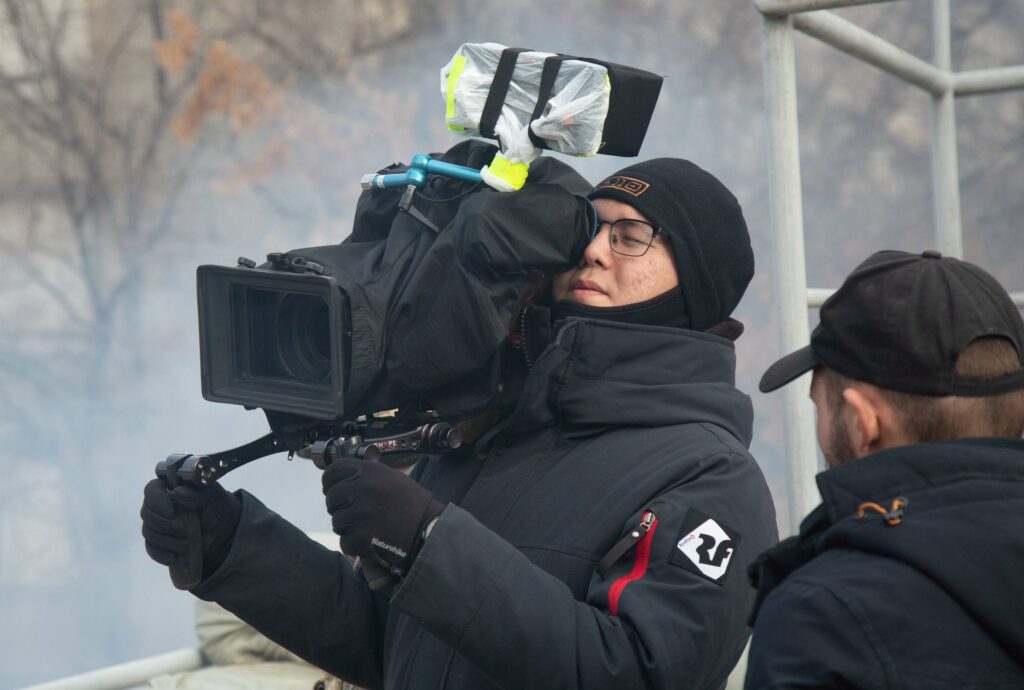
“Cinema is always a compromise between what you imagine and what you can actually achieve.” Image from Kanybek Kalmatov’s personal archive
TCA: How deeply did you research Aitmatov’s life?
Kanybek Kalmatov: Research alone took us seven to eight months. I constantly consulted different people, Aitmatov’s family, of course, but also Ruslan Akun, screenwriters like Gulzhan Toktogul, older generations, even my parents. I’m making a film about someone whose age and life experience I haven’t yet reached. To understand how a man in his forties or fifties thinks, I can’t rely only on myself.
TCA: Did you come to understand him as a person?
Kanybek Kalmatov: We tried. But he was incredibly multifaceted. He could sit alone writing books, spend time with his family on Issyk-Kul, then speak before influential people in Europe or take part in major public affairs. That ability to exist in several worlds at once always amazed me.
TCA: Do you think you achieved what you set out to do?
Kanybek Kalmatov: Cinema is always a compromise between what you imagine and what you can actually achieve. We did everything we could. Sometimes there wasn’t enough budget, sometimes people let us down, sometimes things happened that you simply can’t predict. But we got through it all.
TCA: The story seems to follow Aitmatov during one journey. Why do you think road movies are so popular in Central Asia?
Kanybek Kalmatov: I’ve thought about it a lot. But at some point, I realized this story wouldn’t work without the road. I’m not making fantasy or an invented world. I’m filming a human life. And every life is a journey from point A to point B.
TCA: Aitmatov’s creative legacy is enormous, and his life was incredibly rich. Did that help build the plot?
Kanybek Kalmatov: Honestly, when I first started sketching out the structure, it became clear very quickly that one film simply couldn’t contain everything. Even just the key events of his biography could easily fill an entire series.
TCA: You invited the well-known Russian actor Sergey Bezrukov to take part in the film. Who does he play, and why did you choose him?
Kanybek Kalmatov: Who he plays, let’s keep that a surprise for now. Why him? It’s like asking why directors dream of working with Leonardo DiCaprio. Because he’s a great actor. That’s the principle here too – Sergey is an exceptional professional. What impressed me most was how he prepares. It feels like he’s stepping onto a set for the very first time, fully focused, attentive to every word, every detail. He didn’t approach the project like an invited star who had come in just to do his scene. He treated it as if it were his own project. That was deeply felt.
TCA: Who do you see as the audience for this film?
Kanybek Kalmatov: I don’t have a fixed portrait of the viewer, it could be anyone from six to one-hundred-and-six. What matters isn’t age, but an inner willingness to grow, to think, to dream. Aitmatov is, above all, about books. And books begin with words. I want this film to spark curiosity about words, about reading, and about the man himself.
TCA: Do young people today still know Aitmatov?
Kanybek Kalmatov: At least in Kyrgyzstan, yes. Not everyone, and not equally well. But I don’t think Aitmatov’s audience has disappeared. In fact, one of the reasons I’m making this film is to reach those who have never read him.
The film should work even if you know nothing about Aitmatov’s biography or his books. That was my goal. I want a 15-year-old Gen Z viewer to walk into the cinema with a blank slate, watch it, and come out thinking: “That was an interesting person. That was a great story.” And maybe after that, pick up one of his books.
TCA: If your debut is this ambitious, what are your ambitions overall? Hollywood?
Kanybek Kalmatov: Why not? It’s not some forbidden territory for me. We brought in a famous Russian actor for our debut and even that once felt far away. Who knows where we’ll be in 15 or 20 years? Maybe tomorrow we’ll be filming with DiCaprio. Dreams are often much closer than they seem.
Aitmatov is scheduled to premiere in Kyrgyzstan on October 22, with a Kazakhstan release planned later that month. The production team is also targeting screenings in Russia, Uzbekistan, Azerbaijan, and Turkey in November, as part of a wider international rollout.