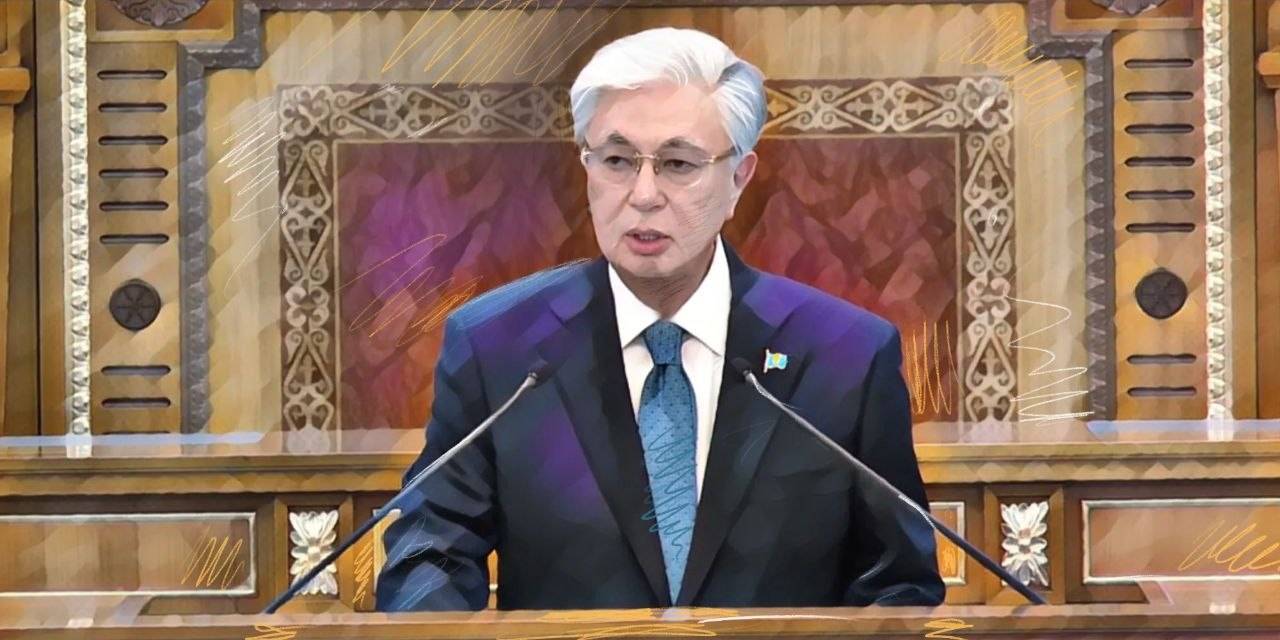
Kazakhstan plans to spend 6.5 trillion tenge (about $14.3 billion) from its National Fund on infrastructure projects by 2029 and eliminate its electricity shortage in the same period, President Kassym-Jomart Tokayev announced in his annual State of the Nation Address on October 28.
The president also outlined plans to accelerate nuclear power plant construction, expand transport routes between China and Europe, and establish a separate court for investors in the new city of Alatau.
$14 Billion for Infrastructure
Tokayev proposed declaring 2027 a year of large-scale construction and launching a nationwide program covering roads, airports, railway stations, and public facilities.
The government is expected to allocate approximately 6.5 trillion tenge from the National Fund by the end of 2029, including 1.5 trillion tenge ($3.3 billion) for social projects in the remaining months of 2026 and the first two months of 2027.
The program envisages building around 70 healthcare facilities and approximately 50 education, sports, and cultural facilities. Plans also include extending gas supplies and clean drinking water to underserved communities.
Tokayev said public funding should help attract private investment rather than finance the entire program.
The spending plans raise questions about the use of Kazakhstan’s accumulated oil revenues. The National Fund was established in part to protect the economy from fluctuations in commodity prices, but its resources are regularly used to meet budgetary needs. Tokayev said Kazakhstan must balance preserving financial reserves for future generations with investing in modern infrastructure. He argued that public spending should deliver economic and social returns.
Kazakhstan Aims to Eliminate Electricity Deficit
Tokayev acknowledged that Kazakhstan’s electricity production is insufficient to meet the needs of its growing economy, particularly as the country seeks to expand industry and build data centers.
According to the national grid operator KEGOC, Kazakhstan generated 123.1 billion kilowatt-hours of electricity in 2025, while consuming 124.6 billion. The shortfall of approximately 1.5 billion kilowatt-hours was covered by net imports.
The president set a target of achieving a sustained surplus of electricity production over domestic consumption by 2029.
Tokayev criticized the longstanding practice of purchasing expensive electricity from neighboring countries during winter peaks in demand and subsequently returning electricity in summer at substantially lower prices.
“That’s quite a simple little ‘business,’ and it’s been going on for decades,” Tokayev remarked.
He also pointed to delays in bringing new generating capacity online in Turkestan, Kyzylorda, Almaty, and Ekibastuz, as well as a shortage of qualified energy specialists.
To meet the 2029 target, Kazakhstan will need to build new power stations and modernize existing facilities. Tokayev called for further development of coal-fired generation alongside renewable energy, particularly solar power.
Nuclear Power Plans
Tokayev said construction of the Balkhash nuclear power plant could begin in 2027. He also proposed accelerating preparations for an agreement on the Moyynkum nuclear power plant.
Russia’s state nuclear corporation Rosatom is leading the Balkhash project, while China National Nuclear Corporation has been selected as the main contractor for the second plant.
However, the first reactor at Balkhash is not expected to begin operating until 2034, meaning Kazakhstan will have to address its immediate electricity shortage through other projects.
Tokayev also proposed establishing a national strategic uranium reserve to ensure long-term supplies for the country’s planned nuclear power plants.
“We need to start thinking now about how we will supply them with uranium, say, 50 years from now and beyond,” he said.
Kazakhstan is the world’s largest producer of natural uranium, but its nuclear ambitions will also require foreign technology and trained specialists. Tokayev said Russian and Chinese companies had made proposals to establish manufacturing facilities and train Kazakh nuclear personnel.
New Transport Routes Between China and Europe
Tokayev also outlined plans to expand Kazakhstan’s role in transporting freight between China and Europe, including through the Trans-Caspian transport corridor, also known as the Middle Corridor, which diversifies freight links between Central Asia and Europe.
The 272-kilometer Bakhty–Ayagoz railway in eastern Kazakhstan is scheduled to open in 2027. Construction began in December 2023, and the project includes a new border crossing with China at Bakhty–Tacheng. The line is expected to increase annual rail freight capacity between the two countries from approximately 28 million to 48 million metric tons.
Another major project is the Aral–Caspian Highway, an approximately 800-kilometer road connecting Beineu in western Kazakhstan with Saksaulsk, near the Aral Sea. Construction began in August.
Tokayev stated that the highway would shorten the overland freight route between China and Europe by approximately 1,000 kilometers and reduce delivery times by three days. These remain official projections, with the eventual savings dependent on the routes used by freight operators.
“The vulnerability of maritime routes has increased the strategic importance of overland transport corridors. Kazakhstan must seize this historic opportunity to become a leading logistics hub in Eurasia in practice,” Tokayev said.
He also called for the development of domestic logistics companies and new cargo handling facilities near major transport hubs, enabling Kazakhstan to earn more from the goods passing through its territory.
A New Court for Investors in Alatau
Tokayev also proposed establishing a separate judicial system in Alatau, a developing city near Almaty that already operates under a special legal regime intended to attract investment.
Commercial disputes would be heard by an investment court modeled on English common law, while a separate civil court would deal with other matters arising under the city’s special legal arrangements.
Kazakhstan already has an English common-law court at the Astana International Financial Centre (AIFC), which operates independently of the national judicial system. Alatau’s proposed courts would provide a similar framework specifically for businesses operating under the city’s legal regime.
The government must submit amendments to the law governing Alatau to the Kurultai, Kazakhstan’s new unicameral parliament, by the end of January 2027.
Tokayev also acknowledged shortcomings in government efforts to attract investment, saying that agencies lack coordination and investors do not receive sufficient support. He proposed giving the state-owned Baiterek holding company a greater role in coordinating investment projects.
Higher Taxes for the Wealthy and a Minimum Wage Increase
Another eye-catching element of the speech was Tokayev’s call for consideration of higher taxes on people with large fortunes, although he offered little on how this proposed system would work. Kurultai deputy Nikita Shatalov told journalists that discussions were focused on taxing high incomes rather than introducing a conventional luxury tax.
The president also ordered an increase in the minimum monthly wage from 85,000 tenge ($185) to 110,000 tenge ($240), effective January 1, 2027. According to Tokayev, the measure will raise the incomes of approximately 1.8 million people.
The program will test whether Kazakhstan can turn National Fund spending into lasting economic benefits without deepening its reliance on oil revenues to finance government expenditure.