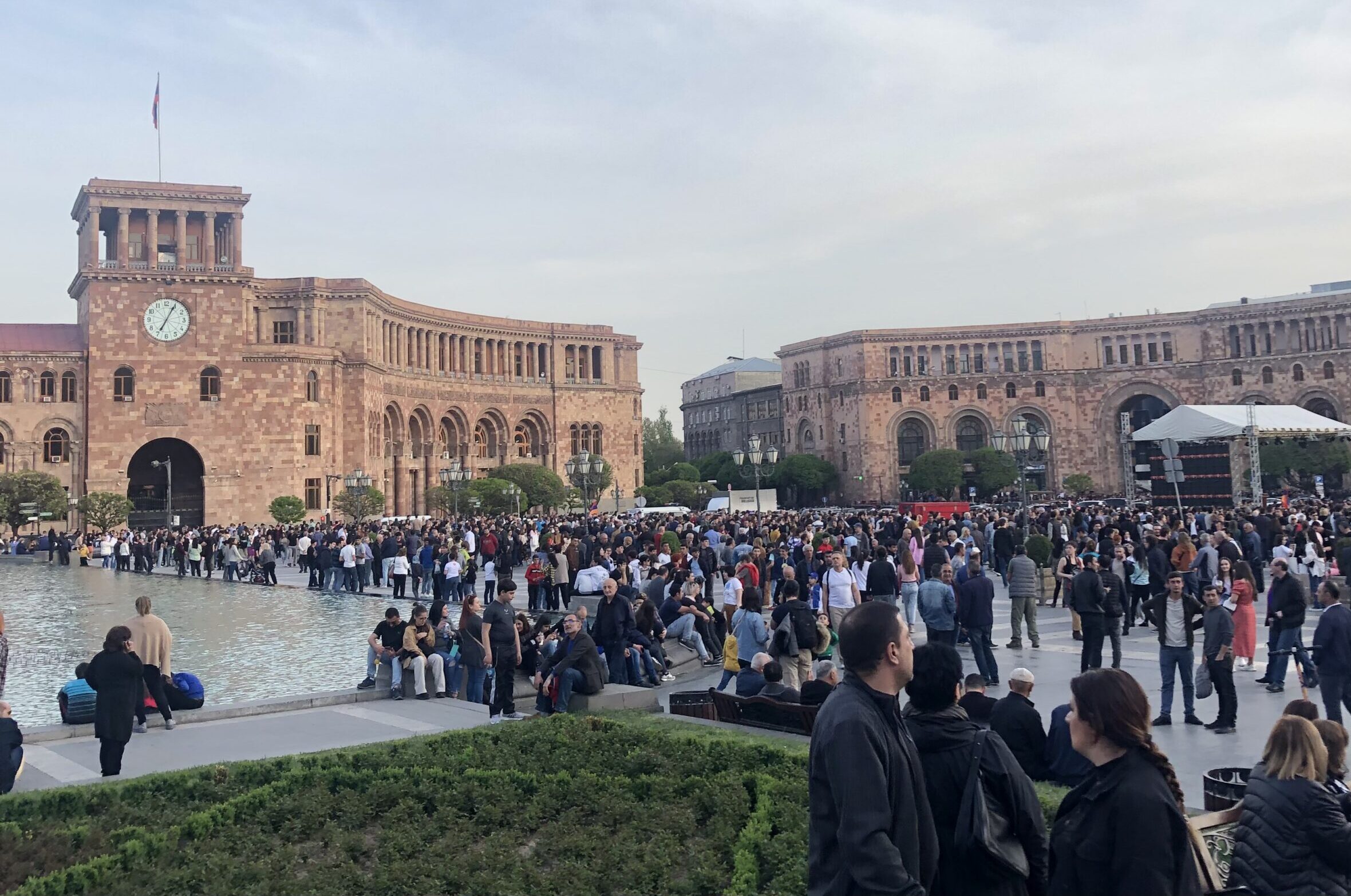
For the first time in its history, the European Union held a full summit with Armenia. The meeting, which took place in Yerevan on 4–5 May 2026, was not merely a diplomatic milestone for Armenia. It also sent a signal to governments thousands of kilometers away in Central Asia that the trade route linking Asia to Europe through the South Caucasus is becoming more real, and more politically backed, than ever before.
The centerpiece of the summit saw the signing of a “Connectivity Partnership” between Brussels and Yerevan. The European Commission President, Ursula von der Leyen, described Armenia as “uniquely positioned” to connect Europe with the South Caucasus and Central Asia. Under the EU’s Global Gateway program, investments in Armenia are expected to reach €2.5 billion. A further €3 billion is earmarked specifically for the Middle Corridor – the trade route that runs from China across Central Asia, over the Caspian Sea, through the South Caucasus, and into Europe.
“We will support your integration into key transport networks like the Trans-Caspian Corridor. It is a route that is also of strategic importance for Europe, given the growing flows of trade between our two regions,” von der Leyen stated.
A Route That Is Already Moving Fast
The Middle Corridor, formally known as the Trans-Caspian International Transport Route (TITR), has grown at a pace that few predicted. Cargo volumes rose 70 percent in the first nine months of 2024 alone, reaching 3.4 million tons. By the end of that year, the total had climbed to 4.1 million tons – up from just 350,000 tons in 2021. The World Bank projects that the route could handle up to 11 million tonnes a year by 2030.
It’s important to maintain some perspective. These numbers are small fry when compared to the billions of tons of trade that moves between Europe and Asia by sea. However, the Middle Corridor does offer important diversification, particularly given the spillover effects of wars in the Middle East and piracy in the Red Sea.
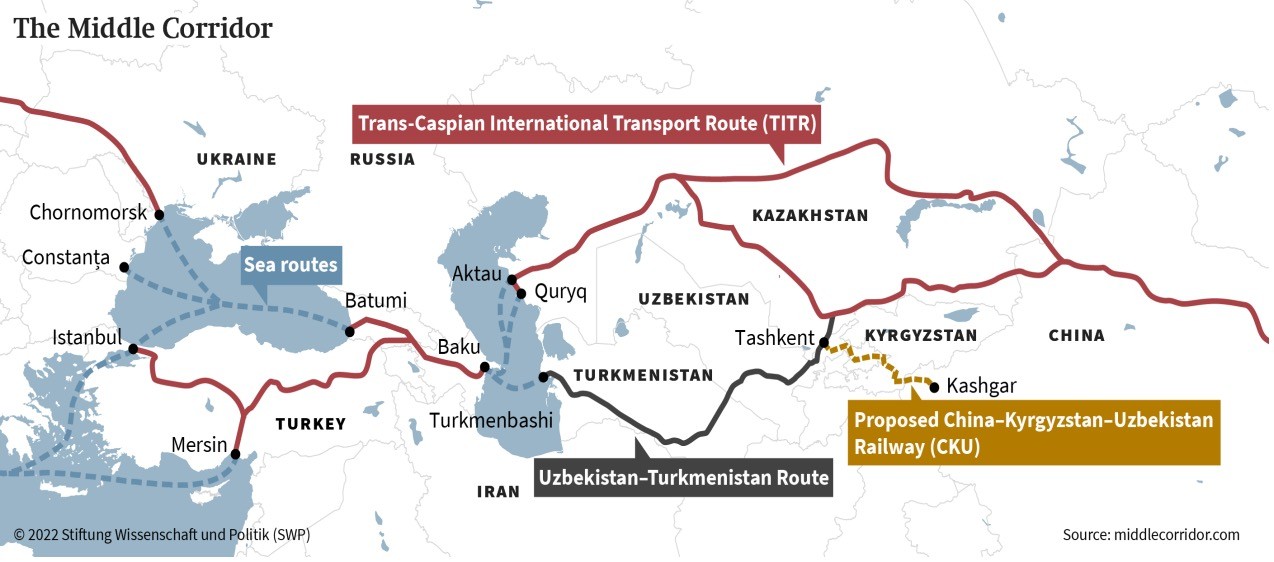
Image: Trans Caspian International Transport Route and it’s southern part, China-Kyrgyzstan-Uzbekistan Railway project. Source: middlecorridor.com
Where Uzbekistan Stands
For Uzbekistan, the Middle Corridor is both an opportunity and a work in progress. In January 2025, President Mirziyoyev signed a decree to upgrade road and rail connectivity, and in September 2024, Tashkent co-founded the Eurasian Transport Route Association alongside Austria, Azerbaijan, China, Kyrgyzstan, Tajikistan, and Turkey. In December 2024, Uzbekistan sent its first block train all the way to Brazil – through Turkmenistan, Azerbaijan, and the Georgian port of Poti – proving the route is operationally viable.
But costs remain a challenge. Shipping a 40-foot container via the Middle Corridor currently costs between $3,500 and $4,500, compared to $2,800–$3,200 on the Northern Corridor through Russia. Europe, meanwhile, accounts for only around 3 percent of Uzbekistan’s exports and 13 percent of its imports — a share that Tashkent wants to grow significantly.
The China–Kyrgyzstan–Uzbekistan (CKU) railway — a $8 billion, 573-kilometre project whose joint construction company was established in July 2024 — is the most consequential single piece of infrastructure in play. Once complete, it will give Uzbekistan an alternative means to access China by rail, bypassing Kazakhstan. As a 2025 analysis by Trends Research noted, the CKU will reduce transit time between China and Europe and lower export costs for the Fergana Valley — Uzbekistan’s industrial heartland.
Where Armenia Fits In
For three decades, Yerevan has been cut off from regional logistics networks after Azerbaijan and Turkey closed their borders in the early 1990s. The EU summit this week marks the clearest signal yet that this isolation is ending.
Armenian Foreign Minister Ararat Mirzoyan, speaking at an EU connectivity ministerial in Luxembourg last October, framed the stakes directly: “Being at the crossroads, Armenia can play a crucial role in the chain connecting Europe, the South Caucasus, and Central Asia.” He also echoed von der Leyen’s earlier assessment that opening Armenia’s borders with Azerbaijan and Turkey would be, in the Commission President’s words, a “game-changer” for the entire corridor.
Such an endeavor is likely to be contingent on the Armenian elections, which take place on June 7. Current Prime Minister Nikol Pashinyan is bidding to earn himself a two-thirds majority in the country’s parliament, which will enable him to change the constitution to remove Armenia’s claims on the Azerbaijani territory of Nagorno-Karabakh. Azerbaijan has made this a prerequisite for any final agreement on opening the TRIPP route through Armenia.
But he has his work cut out to achieve this. Russia has acted in its traditional role of spoiler, funneling money to various opposition parties in order to try to keep Armenia within its orbit.
Should Pashinyan prevail, the combined southern route, combining the China-Kyrgyzstan-Uzbekistan railway and the TRIPP corridor through Armenia, could allow cargo to be transported from Kashgar to European markets in about 10-14 days – about 900 kilometers shorter than the existing northern routes – which could reduce land costs per container by 20-30 percent compared to current prices.
It’s a prize that many in Central Asia are quietly hoping for.
The views expressed in this article are those of the author and do not necessarily reflect the official policy or position of the publication, its affiliates, or any other organizations mentioned.