Central Asian countries are mobilizing against an emerging water crisis as a United Nations report highlights the vulnerability of mountain water systems to climate change. Identifying ranges like the Tien Shan and the Pamirs, the UN World Water Development Report 2025 – Mountains and Glaciers: Water Towers – warns that rapid glacier melt and erratic snowfall are threatening vital freshwater supplies worldwide. According to the report, mountains provide up to 60% of the world’s annual freshwater flows, with over two billion people depending directly on water from mountain sources.
This risk is particularly acute in Central Asia: a UN drought outlook noted that rising temperatures and shrinking snowpack in the high mountains of Tajikistan and Kyrgyzstan are accelerating glacier retreat, posing a “long-term threat to the region’s water security.” Half of rural mountain communities in developing countries already face food insecurity, and receding glaciers could impact two-thirds of all irrigated agriculture globally – a dire scenario for Central Asia’s irrigation-dependent economies.
Rivers like the Amu Darya and Syr Darya are fed by glacier runoff and support downstream agriculture, hydropower, and municipal needs in Uzbekistan, Kazakhstan, and Turkmenistan. But climate-driven glacial retreat, inefficient irrigation, and aging infrastructure have already pushed the region toward a breaking point.

Lake Karakul in Tajikistan is expanding due to melting glaciers; image: TCA, Stephen M. Bland
Kazakhstan Steps Up
Leading the regional response, Kazakhstan has launched sweeping reforms to modernize its water infrastructure and governance. The country has committed to building 42 new reservoirs, refurbishing 14,000 kilometers of irrigation canals, and investing heavily in digital water monitoring and conservation.
Established in September 2023, the Ministry of Water Resources and Irrigation is coordinating the overhaul under an updated national Water Code. The government has also launched an integrated water portal, hydro.gov.kz, and pledged to digitize more than 3,500 kilometers of canals for precise flow tracking. In an address at the Astana International Forum, Deputy Prime Minister Kanat Bozumbayev framed water as a “powerful driver of cooperation, sustainable development and regional stability,” urging closer regional coordination.
Kazakhstan is also leading environmental restoration efforts. As the current chair of the International Fund for Saving the Aral Sea (IFAS), it is overseeing projects to rehabilitate the North Aral Sea, including raising the Kokaral Dam to restore water levels and fisheries. In 2024 alone, local irrigation reforms in Kyzylorda saved 200 million cubic meters of water, which was redirected toward the shrinking sea.

The Kokaral Dam in Kazakhstan; image: TCA, Stephen M. Bland
International Support and Financing
Kazakhstan’s strategy has been backed by a plethora of international partners. The European Bank for Reconstruction and Development (EBRD) has financed over €255 million in water and wastewater projects in Kazakhstan, including a €96.4 million sovereign loan for a new treatment plant in Aktobe. Meanwhile, the Eurasian Development Bank (EDB) and UNDP have launched a regional partnership to expand access to modern irrigation, digitize water flows, and establish training centers.
“We must act very quickly and together,” EDB Chairman Nikolay Podguzov stated. “We have only five years to get the region ready and avoid severe water shortages.”
Regional Landscape: Mixed Progress
Elsewhere in Central Asia, progress is uneven. Uzbekistan has committed to climate-smart water management with a $125 million program supported by the Asian Development Bank to digitize canals and introduce water metering. With approximately 88% of irrigation canals losing water through leakage, the country faces steep challenges. However, a landmark agreement with Kazakhstan and Kyrgyzstan to co-develop the Kambarata-1 hydropower project on the Naryn River signals a new era of cooperation on shared water resources.
Kyrgyzstan and Tajikistan hold much of the region’s glacial reserves, but suffer from outdated irrigation networks and inconsistent river flows due to erratic weather conditions. Tajikistan has committed to small-scale reservoirs, drip irrigation, and data-driven water use monitoring under UNDP guidance. Kyrgyzstan, with support from the Green Climate Fund, is upgrading hydropower and rural water systems to improve its resilience.
Yet climate vulnerability is growing. In 2024, a UN ESCAP report projected annual GDP losses of 1.3% across the region due to water-related climate impacts. Meanwhile, the Executive Director of the United Nations Environment Programme, Inger Andersen, has warned that up to five million people face the prospect of displacement by 2050 if no coordinated action is taken.
Turkmenistan and Transboundary Risks
In Turkmenistan, water stress is severe, exacerbated by profligate water use, particularly in agriculture and infrastructure projects. The country uses nearly all available freshwater, with 92% allocated to agriculture, much of it routed through the inefficient Karakum Canal.
Despite acknowledging the crisis, reforms have lagged. Analysts warn that Afghanistan’s construction of the Qosh Tepa Canal threatens to divert up to 30% of the Amu Darya’s flow, potentially slashing water supplies to Uzbekistan and Turkmenistan, worsening environmental degradation of the Aral Sea, and triggering economic, social, and geopolitical ripple effects across all of Central Asia.
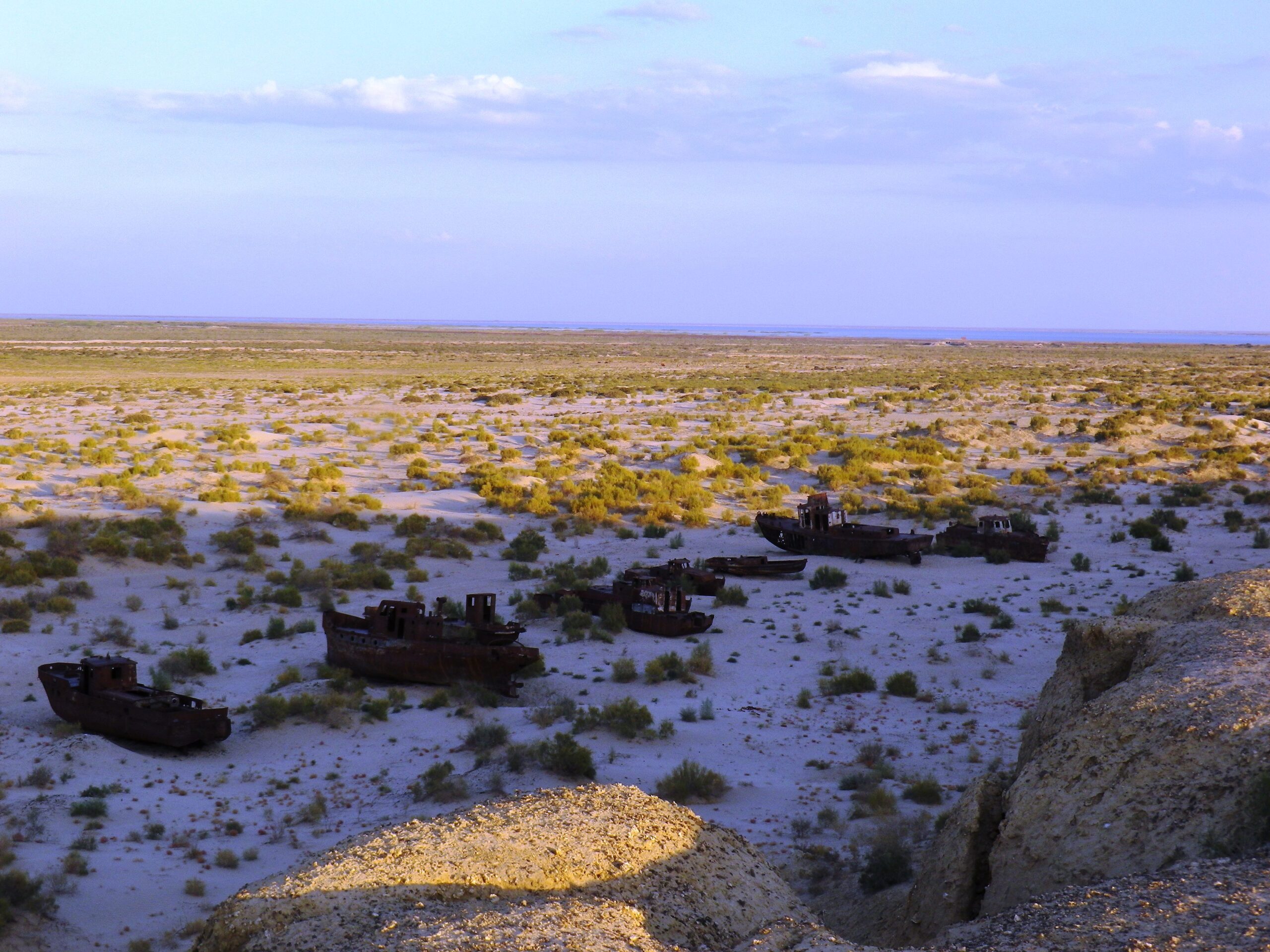
Desert ships on the former Aral Sea in Uzbekistan; image: TCA, Stephen M. Bland
Need for Coordination
Despite longstanding tensions over shared rivers, the countries of Central Asia are returning to dialogue. The IFAS platform has been revived to promote joint projects, while Kazakhstan has increased hydrological data sharing. Events such as the Astana International Forum are also serving to foster a consensus around water as a shared regional priority.
The UN report calls for investing in mountain communities to safeguard headwaters and for the strengthening of cross-border institutions. It warns that the region could lose 30% of its freshwater resources by 2050 if climate trends and infrastructure neglect continue.
With major investment in Kazakhstan, rising cooperation on new dams, and the backing of global donors, Central Asia may be poised to shift from a fragmented crisis response toward integrated, climate-resilient water governance.