• KGS/USD = 0.01144 0%
  • KZT/USD = 0.00196 -0%
  • TJS/USD = 0.10899 -0%
  • UZS/USD = 0.00008 -0%
  • TMT/USD = 0.28490 0%
  • KGS/USD = 0.01144 0%
  • KZT/USD = 0.00196 -0%
  • TJS/USD = 0.10899 -0%
  • UZS/USD = 0.00008 -0%
  • TMT/USD = 0.28490 0%
  • KGS/USD = 0.01144 0%
  • KZT/USD = 0.00196 -0%
  • TJS/USD = 0.10899 -0%
  • UZS/USD = 0.00008 -0%
  • TMT/USD = 0.28490 0%
  • KGS/USD = 0.01144 0%
  • KZT/USD = 0.00196 -0%
  • TJS/USD = 0.10899 -0%
  • UZS/USD = 0.00008 -0%
  • TMT/USD = 0.28490 0%
  • KGS/USD = 0.01144 0%
  • KZT/USD = 0.00196 -0%
  • TJS/USD = 0.10899 -0%
  • UZS/USD = 0.00008 -0%
  • TMT/USD = 0.28490 0%
  • KGS/USD = 0.01144 0%
  • KZT/USD = 0.00196 -0%
  • TJS/USD = 0.10899 -0%
  • UZS/USD = 0.00008 -0%
  • TMT/USD = 0.28490 0%
  • KGS/USD = 0.01144 0%
  • KZT/USD = 0.00196 -0%
  • TJS/USD = 0.10899 -0%
  • UZS/USD = 0.00008 -0%
  • TMT/USD = 0.28490 0%
  • KGS/USD = 0.01144 0%
  • KZT/USD = 0.00196 -0%
  • TJS/USD = 0.10899 -0%
  • UZS/USD = 0.00008 -0%
  • TMT/USD = 0.28490 0%
08 December 2025

Kazakhstan to Supply Uranium to Slovakia Under New Memorandum

Kazakhstan’s national nuclear company, Kazatomprom, has signed a memorandum of understanding with Slovenské elektrárne a.s. (SEAS), Slovakia’s largest electricity producer, paving the way for future uranium exports to the Central European country.

According to a company statement, the memorandum outlines the potential supply of natural uranium concentrate and, eventually, uranium dioxide (UO₂), to fuel Slovakia’s nuclear reactors. The agreement also sets the stage for identifying additional areas of long-term cooperation between the two energy firms.

SEAS operates Slovakia’s two nuclear power plants, Bohunice and Mochovce, which collectively run five VVER-440 reactors. The company generates over 70% of Slovakia’s electricity. A controlling 66% stake in SEAS is held by Slovak Power Holding, with the remaining 34% owned by the Slovak government.

“With the signing of this memorandum, we are taking an important step towards strengthening cooperation with our European partners,” said Meirzhan Yusupov, Chairman of the Board of Kazatomprom. “Slovakia is one of the countries where nuclear energy plays a key role in ensuring a sustainable energy supply. We hope this agreement lays the foundation for strong and mutually beneficial relations.”

Branislav Stricek, CEO and Chairman of SEAS, emphasized the importance of diversifying nuclear fuel sources and expressed confidence in the long-term potential of partnering with the world’s largest uranium producer.

Kazatomprom maintained its position as the leading global producer of natural uranium in 2024, accounting for 21% of total output, up from 20% in 2023. The company’s net profit reached $2.1 billion in 2024, marking a 95% increase year-on-year. Kazakh uranium is currently exported to markets across China, Southeast Asia, Europe, and the Americas.

This new agreement with SEAS follows several recent deals with European energy providers. In February 2025, Kazatomprom signed its first uranium supply contract with Swiss firms Axpo Power AG and Kernkraftwerk Leibstadt AG to fuel the Beznau and Leibstadt nuclear power plants. In April, The Times of Central Asia, reported that the company had also entered into a similar agreement with Czech energy giant ČEZ.

China Overtakes Russia as Tajikistan’s Top Trading Partner for the First Time

For the first time in over two decades, China has become Tajikistan’s largest trading partner, surpassing Russia in bilateral trade volume, according to newly released data from the Tajikistan Statistics Agency.

A New Leader in Foreign Trade

Between January and May 2025, trade between Tajikistan and China reached $964 million, an increase of nearly 30% compared to the same period in 2024. China’s share in Tajikistan’s total foreign trade stood at 24.8%, edging ahead of Russia’s 23.2%.

This surge was driven largely by Chinese exports to Tajikistan, which totaled $787 million. Tajik exports to China reached $177 million, leaving a significant trade imbalance in China’s favor, though the overall volume of bilateral engagement continues to rise rapidly.

Russia had held the position of Tajikistan’s leading trade partner for more than 20 years. However, during the first five months of 2025, total trade between the two countries reached approximately $900 million. Of that, only $42 million represented Tajik exports to Russia, while Russian imports totaled $858 million. Despite a 9.3% increase year-on-year, the growth was insufficient to maintain its top position.

Uzbekistan Reemerges as a Key Player

Historically, Uzbekistan was Tajikistan’s main trade partner during the 1990s. In 1995, trade between the two countries reached $250 million, double the combined trade volume with other post-Soviet states at the time. However, political tensions toward the end of the decade led to a sharp decline, with trade falling to just $13 million by 2014.

Following the election of Shavkat Mirziyoyev as President of Uzbekistan in 2016, bilateral relations have markedly improved. Trade between Tajikistan and Uzbekistan is once again on the rise, reaching $238 million in the first five months of 2025.

China: Tajikistan’s Leading Investor and Creditor

China’s growing economic influence in Tajikistan extends beyond trade. It is now the country’s largest foreign investor, having overtaken Russia in 2017. According to the State Committee for Investment and State Property Management, accumulated Chinese investment in Tajikistan totaled $5.1 billion as of Q2 2025. In comparison, Russian investments stand at approximately $2 billion, less than half.

China is also Tajikistan’s largest external creditor. As of early 2025, Dushanbe’s debt to Beijing stood at around $1 billion, representing nearly one-third of the country’s total external debt.

This strategic pivot in Tajikistan’s economic orientation reflects a broader regional trend. Across Central Asia, Beijing continues to expand its footprint through a combination of trade, infrastructure investment, financial lending, and diplomatic engagement.

Declining Birth Rates in Central Asia Tied to Crisis in Reproductive Freedom

Birth rates across Europe and Central Asia are falling sharply, accompanied by aging populations and the migration of young people in search of better opportunities. In response, many governments have introduced financial incentives to encourage childbirth. However, the United Nations Population Fund (UNFPA) warns in its State of World Population 2025 report that these measures address symptoms, not causes. The real issue, the report contends, is a crisis of reproductive freedom.

The report, compiled in partnership with the polling agency YouGov, surveyed over 14,000 people across 14 countries, including Germany and Hungary. Its findings highlight a deep disconnect between people’s reproductive intentions and their lived realities: 32% reported experiencing an unplanned pregnancy, while 23% said they were unable to have children when they wanted. Among respondents over the age of 50, nearly one-third (31%) reported having fewer children than they had hoped.

Economic insecurity emerged as the leading barrier to planned parenthood. Financial hardship was cited by 39% of respondents, followed by job instability (21%), lack of suitable housing (19%), and concerns over war, pandemics, or climate change (19%). Relationship-related issues were also significant: 14% said they lacked a partner, while 10%, mostly women, said their partners did not contribute enough at home.

Although Central Asia continues to report fertility rates above the global average, the region is not immune to this trend. The report notes a steady decline in birth rates across much of Central Asia, including Kazakhstan, which is experiencing a multi-year downturn despite having one of the region’s higher fertility rates. UNFPA emphasizes that these patterns reflect underlying socio-economic constraints, not shifting cultural values.

Rather than framing the issue as one of declining birth rates, UNFPA urges a shift in perspective from “why aren’t people having more children?” to “why can’t people have the families they want?” Reproductive freedom, the report argues, means being able to decide freely and securely when, and how many children to have. This requires stable employment, access to quality healthcare and housing, and genuine gender equality.

UNFPA calls on governments, particularly in Eastern Europe and Central Asia, to focus less on raising fertility rates and more on protecting individual rights. Key policy recommendations include greater investment in public health systems, affordable housing, decent work opportunities, and stronger protections against violence and discrimination.

“The real crisis is that millions of people can’t build the families they want, not because they don’t want children, but because they can’t afford to have them,” the report states.

As The Times of Central Asia previously reported, four out of five Central Asian countries are currently experiencing declining fertility. The exception is Uzbekistan, where birth rates remain high and continue to climb.

In 2023, Uzbekistan recorded a fertility rate of 3.4 children per woman, the highest in the region. It was followed by Tajikistan (3.1), Kazakhstan (3.0), and Kyrgyzstan and Turkmenistan (each at 2.7). Uzbekistan also posted the region’s highest number of births last year, approximately 962,000, representing a 14% increase compared to 2020. By contrast, Kazakhstan registered 388,400 births in 2023, continuing a downward trajectory that began in 2021.

Kyrgyzstan Launches New Agro-Industrial Zone with $24 Million Investment

Kyrgyzstan has begun construction of a new agro-industrial zone in the Chui region as part of a broader effort to modernize agriculture, boost food production, and attract foreign investment. The facility is being developed by Kyrgyz Agroholding JSC in the village of Nurmanbet, just east of the capital Bishkek.

Speaking at the capsule-laying ceremony on July 12, Deputy Prime Minister and Minister of Agriculture Bakyt Torobaev described the initiative as a critical step toward enhancing the country’s agricultural resilience and food sovereignty.

“This is a large-scale initiative that will strengthen our agricultural sector, create jobs, and help ensure food security,” Torobaev said.

The event also marked the signing of two major investment agreements totaling $24 million:

  • A $12 million deal with South Korea’s DOD Company to support joint projects in meat livestock farming, logistics, and modern agricultural technologies.
  • A separate $12 million agreement with Asyl Teri LLC to construct a tannery capable of processing up to 24 tons of animal hides per day.

The Chui agro-industrial zone is expected to significantly increase the value of Kyrgyz agricultural products while drawing additional investment into a sector that already contributes nearly 18% of the nation’s GDP and employs almost half of its workforce.

Government officials emphasize that the new zone will offer improved infrastructure, greater market access, and cutting-edge technologies to farmers and agribusinesses, enhancing Kyrgyzstan’s competitiveness in regional food production.

Melting Mountains, Drying Futures: Central Asia Confronts Water Emergency

Central Asian countries are mobilizing against an emerging water crisis as a United Nations report highlights the vulnerability of mountain water systems to climate change. Identifying ranges like the Tien Shan and the Pamirs, the UN World Water Development Report 2025 – Mountains and Glaciers: Water Towers – warns that rapid glacier melt and erratic snowfall are threatening vital freshwater supplies worldwide. According to the report, mountains provide up to 60% of the world’s annual freshwater flows, with over two billion people depending directly on water from mountain sources.

This risk is particularly acute in Central Asia: a UN drought outlook noted that rising temperatures and shrinking snowpack in the high mountains of Tajikistan and Kyrgyzstan are accelerating glacier retreat, posing a “long-term threat to the region’s water security.” Half of rural mountain communities in developing countries already face food insecurity, and receding glaciers could impact two-thirds of all irrigated agriculture globally – a dire scenario for Central Asia’s irrigation-dependent economies.

Rivers like the Amu Darya and Syr Darya are fed by glacier runoff and support downstream agriculture, hydropower, and municipal needs in Uzbekistan, Kazakhstan, and Turkmenistan. But climate-driven glacial retreat, inefficient irrigation, and aging infrastructure have already pushed the region toward a breaking point.

Lake Karakul in Tajikistan is expanding due to melting glaciers; image: TCA, Stephen M. Bland

Kazakhstan Steps Up

Leading the regional response, Kazakhstan has launched sweeping reforms to modernize its water infrastructure and governance. The country has committed to building 42 new reservoirs, refurbishing 14,000 kilometers of irrigation canals, and investing heavily in digital water monitoring and conservation.

Established in September 2023, the Ministry of Water Resources and Irrigation is coordinating the overhaul under an updated national Water Code. The government has also launched an integrated water portal, hydro.gov.kz, and pledged to digitize more than 3,500 kilometers of canals for precise flow tracking. In an address at the Astana International Forum, Deputy Prime Minister Kanat Bozumbayev framed water as a “powerful driver of cooperation, sustainable development and regional stability,” urging closer regional coordination.

Kazakhstan is also leading environmental restoration efforts. As the current chair of the International Fund for Saving the Aral Sea (IFAS), it is overseeing projects to rehabilitate the North Aral Sea, including raising the Kokaral Dam to restore water levels and fisheries. In 2024 alone, local irrigation reforms in Kyzylorda saved 200 million cubic meters of water, which was redirected toward the shrinking sea.

The Kokaral Dam in Kazakhstan; image: TCA, Stephen M. Bland

International Support and Financing

Kazakhstan’s strategy has been backed by a plethora of international partners. The European Bank for Reconstruction and Development (EBRD) has financed over €255 million in water and wastewater projects in Kazakhstan, including a €96.4 million sovereign loan for a new treatment plant in Aktobe. Meanwhile, the Eurasian Development Bank (EDB) and UNDP have launched a regional partnership to expand access to modern irrigation, digitize water flows, and establish training centers.

“We must act very quickly and together,” EDB Chairman Nikolay Podguzov stated. “We have only five years to get the region ready and avoid severe water shortages.”

Regional Landscape: Mixed Progress

Elsewhere in Central Asia, progress is uneven. Uzbekistan has committed to climate-smart water management with a $125 million program supported by the Asian Development Bank to digitize canals and introduce water metering. With approximately 88% of irrigation canals losing water through leakage, the country faces steep challenges. However, a landmark agreement with Kazakhstan and Kyrgyzstan to co-develop the Kambarata-1 hydropower project on the Naryn River signals a new era of cooperation on shared water resources.

Kyrgyzstan and Tajikistan hold much of the region’s glacial reserves, but suffer from outdated irrigation networks and inconsistent river flows due to erratic weather conditions. Tajikistan has committed to small-scale reservoirs, drip irrigation, and data-driven water use monitoring under UNDP guidance. Kyrgyzstan, with support from the Green Climate Fund, is upgrading hydropower and rural water systems to improve its resilience.

Yet climate vulnerability is growing. In 2024, a UN ESCAP report projected annual GDP losses of 1.3% across the region due to water-related climate impacts. Meanwhile, the Executive Director of the United Nations Environment Programme, Inger Andersen, has warned that up to five million people face the prospect of displacement by 2050 if no coordinated action is taken.

Turkmenistan and Transboundary Risks

In Turkmenistan, water stress is severe, exacerbated by profligate water use, particularly in agriculture and infrastructure projects. The country uses nearly all available freshwater, with 92% allocated to agriculture, much of it routed through the inefficient Karakum Canal.

Despite acknowledging the crisis, reforms have lagged. Analysts warn that Afghanistan’s construction of the Qosh Tepa Canal threatens to divert up to 30% of the Amu Darya’s flow, potentially slashing water supplies to Uzbekistan and Turkmenistan, worsening environmental degradation of the Aral Sea, and triggering economic, social, and geopolitical ripple effects across all of Central Asia.
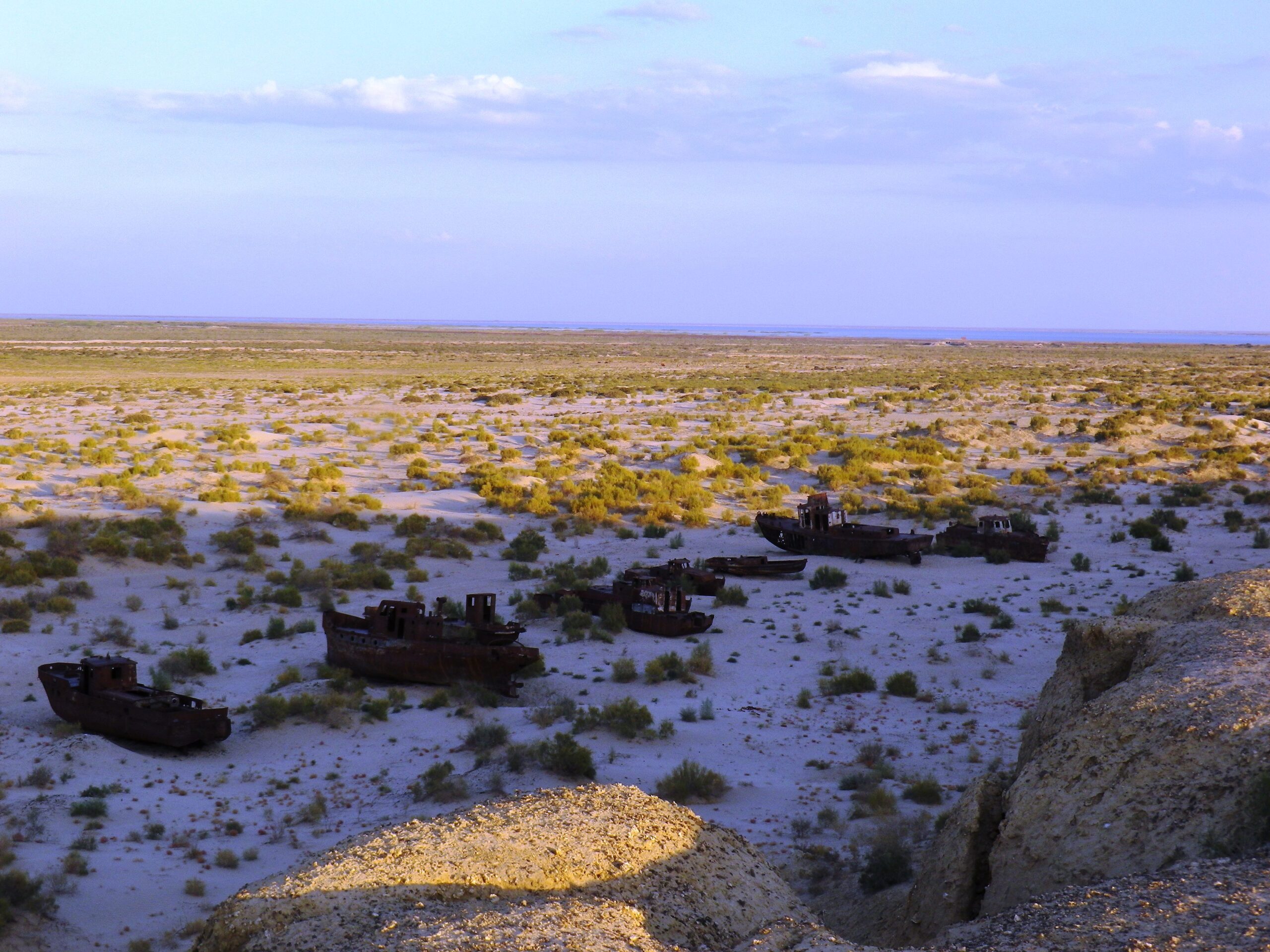
Desert ships on the former Aral Sea in Uzbekistan; image: TCA, Stephen M. Bland

Need for Coordination

Despite longstanding tensions over shared rivers, the countries of Central Asia are returning to dialogue. The IFAS platform has been revived to promote joint projects, while Kazakhstan has increased hydrological data sharing. Events such as the Astana International Forum are also serving to foster a consensus around water as a shared regional priority.

The UN report calls for investing in mountain communities to safeguard headwaters and for the strengthening of cross-border institutions. It warns that the region could lose 30% of its freshwater resources by 2050 if climate trends and infrastructure neglect continue.

With major investment in Kazakhstan, rising cooperation on new dams, and the backing of global donors, Central Asia may be poised to shift from a fragmented crisis response toward integrated, climate-resilient water governance.

Khiva Readies for Melon Festival: A Celebration of Heritage and Harvest

Khiva, the ancient Silk Road city in Uzbekistan’s Khorezm region, will host the traditional Melon Festival, or “Qovun sayli,” from August 8–10. The celebration will be held across the historic Itchan-Kala complex and the Arda Khiva cultural space.

Organized by the State Tourism Committee and the Khorezm khokimiyat (local government), the festival promotes regional identity and agritourism by highlighting Khorezm’s famed melons. Farmers from across the region will exhibit scores of different melon varieties — around 125 types were showcased last year — in pavilions decorated with traditional designs.

More than a fruit fair, the festival offers puppet shows, folk music, national costume displays, and culinary exhibitions, including Khorezm bread and other regional dishes. Artisans will host workshops on handicrafts such as silk weaving and pottery, giving visitors hands-on exposure to Uzbek heritage and traditions. Evening gala concerts featuring local and international performers will take place on August 8–9 in the Itchan-Kala and conclude on August 10 in Arda Khiva.

Image: TCA, Stephen M. Bland

Qovun sayli will also have a competitive edge, with awards sponsored by the regional khokimiyat and private sponsors recognizing standout agronomists, artisans, and performers.

Image: TCA, Stephen M. Bland

Melons occupy a special place in Uzbek tradition. Over 150 varieties are grown nationwide, many prized for their sweetness and storied past. In Khorezm, melons are more than food — they are cultural icons. Ancient Uzbek kingdoms would send the fruit as gifts by camel caravan to Baghdad, and to the Russian tsars and Mughal emperors. Writing in 1876, British colonel and explorer Frederick Burnaby noted that the “taste was so delicious that anyone only accustomed to this fruit in Europe would scarcely recognize its relationship with the delicate and highly perfumed melons of Khiva.”

The festival has become a cornerstone of Khiva’s cultural calendar, attracting approximately 30,000 foreign and 400,000 domestic visitors in 2024 alone. Tourism officials view Qovun sayli as essential to boosting regional visibility and economic growth, with Khiva’s festivals, including the Lazgi International Dance Festival, a key part of Uzbekistan’s broader push to spotlight cultural tourism.