• KGS/USD = 0.01144 0%
  • KZT/USD = 0.00210 0%
  • TJS/USD = 0.10438 0%
  • UZS/USD = 0.00008 0%
  • TMT/USD = 0.28490 0%
  • KGS/USD = 0.01144 0%
  • KZT/USD = 0.00210 0%
  • TJS/USD = 0.10438 0%
  • UZS/USD = 0.00008 0%
  • TMT/USD = 0.28490 0%
  • KGS/USD = 0.01144 0%
  • KZT/USD = 0.00210 0%
  • TJS/USD = 0.10438 0%
  • UZS/USD = 0.00008 0%
  • TMT/USD = 0.28490 0%
  • KGS/USD = 0.01144 0%
  • KZT/USD = 0.00210 0%
  • TJS/USD = 0.10438 0%
  • UZS/USD = 0.00008 0%
  • TMT/USD = 0.28490 0%
  • KGS/USD = 0.01144 0%
  • KZT/USD = 0.00210 0%
  • TJS/USD = 0.10438 0%
  • UZS/USD = 0.00008 0%
  • TMT/USD = 0.28490 0%
  • KGS/USD = 0.01144 0%
  • KZT/USD = 0.00210 0%
  • TJS/USD = 0.10438 0%
  • UZS/USD = 0.00008 0%
  • TMT/USD = 0.28490 0%
  • KGS/USD = 0.01144 0%
  • KZT/USD = 0.00210 0%
  • TJS/USD = 0.10438 0%
  • UZS/USD = 0.00008 0%
  • TMT/USD = 0.28490 0%
  • KGS/USD = 0.01144 0%
  • KZT/USD = 0.00210 0%
  • TJS/USD = 0.10438 0%
  • UZS/USD = 0.00008 0%
  • TMT/USD = 0.28490 0%

Central Asia Records Over 6% Growth as Trade with Russia Expands

Central Asian economies concluded 2025 with growth exceeding 6%, significantly outpacing major developed markets such as the United States and the Eurozone, where expansion stood at approximately 1.6% and 1.1%, respectively, according to Turkish newspaper Yeni Şafak. The figure aligns with the World Bank who puts regional expansion at 6.2% and the Eurasian who Development Bank (EDB) estimates growth at 6.6%.

Economists attribute the region’s performance to strong domestic demand, active state investment programs, infrastructure development, and rising exports of raw materials and industrial goods. Kazakhstan and Uzbekistan accounted for the largest contributions to overall growth, supported by large-scale public investment initiatives and expanding foreign trade.

By contrast, the U.S. and European economies experienced slower growth amid high interest rates, inflationary pressures, and weaker consumer demand.

Uzbek economist Mirkomil Kholboyev, writing on his Telegram channel, said the trend reflects deeper structural factors. “In general, the average real growth in Central Asia has almost always been higher than in the United States or Europe, with the exception of 2021,” he wrote. “Beyond short-term effects, lower-income countries like ours tend to grow faster than high-income economies.

In wealthier countries, the return on additional capital has declined, while in our region capital remains scarce, allowing investments to generate higher returns. Demographic growth is also higher here, and the steady expansion of the labor force serves as an additional driver of economic growth.”

Trade data indicate that Central Asia’s economic ties with Russia have strengthened in recent years. In 2021, the region accounted for 3.2% of Russia’s imports. By the first 10 months of 2025, that share had risen to 4.6%. Over the same period, Central Asia’s share of Russian exports increased from 5.6% to 7%.

Overall, during the first 10 months of 2025, Central Asia ranked as Russia’s third-largest import partner and fourth-largest export destination. Before the war in Ukraine, the region ranked seventh among Russia’s import partners and fourth in exports.

Although Russia’s economy remains significantly larger, reaching approximately $2.1 trillion in 2024 and exceeding the combined size of Central Asian economies by about 4.4 times, the increase in trade shares over the past four years is notable. Kholboyev also noted that part of the rise in imports is attributable to re-export activity.

Foreign Internet Platforms Paid Nearly $18 million in Taxes in Kazakhstan in January

Foreign digital platforms transferred nearly $18 million to Kazakhstan’s state budget in digital services tax, commonly known as the “Google tax”, in January 2026, according to the press service of the State Revenue Committee under the Ministry of Finance.

Kazakhstan has applied the digital services tax since 2022. Over this period, 120 foreign companies have registered as taxpayers in the country, including 22 in 2025. Total revenue from the Google tax since its introduction has reached approximately $277.5 million. Of that amount, $117.5 million was collected in 2025, and more than $17.75 million in January 2026 alone.

Under the Tax Code, second-tier banks and payment organizations are required to provide tax authorities with information on foreign companies that have undergone conditional registration. This data is used to assess the completeness and timeliness of VAT payments in e-commerce and the provision of digital services to individuals in Kazakhstan.

Based on comparisons of bank data, payment system information, and actual VAT payments, tax authorities conduct desk audits. If arrears or underpayments are identified, notifications outlining the discrepancies are issued.

Additional enforcement measures came into force on January 1, 2026. Under Article 89 of the Tax Code, state authorities are now authorized to block the internet resources of foreign marketplaces that fail to comply with desk audit notifications or evade VAT registration requirements.

The State Revenue Committee emphasized that these measures are intended to ensure a level playing field for domestic and foreign market participants, improve tax compliance in the digital sector, and reduce the shadow economy without conducting on-site tax inspections.

As previously reported by The Times of Central Asia, international companies including Google, Apple, Netflix, and Amazon have already registered in Kazakhstan under the Google tax regime. In May 2025, the U.S. company OpenAI also completed tax registration in the country.

Kazakhstan’s First Agro Techno-Park Opens in Astana

Kazakhstan’s first agro techno-park has begun operations in Astana, creating a new infrastructure platform for the development and implementation of high-tech solutions in the agro-industrial complex (AIC). The project was launched at Saken Seifullin Kazakh Agrotechnical Research University and is aimed at supporting innovation in the Akmola region, one of the country’s key grain-producing areas.

According to the Ministry of Agriculture, the agro techno-park will serve as a hub for business incubation, startup support, and the piloting of modern agricultural technologies, with their subsequent introduction into Kazakhstan’s agribusiness sector.

The agro techno-park covers approximately 1,000 square meters. Its facilities include a production and engineering unit with a metalworking workshop for experimental and pilot projects, office space for resident companies, and a full-cycle laboratory complex. The site also houses the Kazakh-Australian Innovation Center for Molecular and Genetic Research on Agricultural Crops, as well as laboratories dedicated to agro-biotechnology and microbiology, physical and chemical analysis, and analytical research.

“Today, it is extremely important that scientific solutions do not remain within the walls of laboratories but reach agricultural producers and deliver tangible economic results. The agro techno-park should become a link between scientists and agribusiness,” Agriculture Minister Aidarbek Saparov said during his visit to the new facility.

University Rector Kanat Tireuov said the agro techno-park lays the foundation for a new culture of technological entrepreneurship in the agro-industrial sector, supports the training of a new generation of specialists, and helps attract investment into applied scientific research. Its activities are expected to accelerate the market introduction of new crop varieties and hybrids, biological products, and engineering solutions, increase the sustainability of agricultural production, and strengthen the sector’s export potential.

The Times of Central Asia previously reported that Kazakhstan significantly increased its exports of processed, high-tech agricultural products last year.

Kazakhstanis Spend 57% of Their Household Budgets on Food

Despite reported growth in certain macroeconomic indicators, the financial situation of Kazakhstani households continues to deteriorate, according to analysts at Finprom.kz, who note a sharp increase in the share of food expenditures, now accounting for more than half of total consumer spending.

In the third quarter of 2025, food expenditures reached 57.2% of overall household consumer spending, the highest level since 2021. A higher figure was recorded only in 2020, the first year of the COVID-19 pandemic, when the share stood at approximately 58%.

For comparison, in developed countries, food spending typically accounts for 10-15% of household budgets. In international practice, a level above 50% is generally regarded as an indicator of significant pressure on household incomes.

Regionally, the burden is even more pronounced. The highest share of food expenditures between June and September 2025 was recorded in the Zhetysu region, at 65.8%. In the Turkestan region, the figure was 65.3%, and in the Almaty region, 62.2%. These regions are largely agriculturally oriented and have less diversified economies.

The rising share of food expenditures is considered a key socio-economic indicator. An increase in this share reduces the resources available for education, healthcare, housing, and long-term savings or investment.

The gap between urban and rural areas persists. In the third quarter of 2025, food spending accounted for 58.7% of total expenditures in rural areas, compared to 56.5% in urban areas.

In absolute terms, urban food expenditures increased by 15.5% year-on-year, while rural expenditures rose by 11%. In cities, the largest increases were recorded in spending on meat and meat products (22.3%), fruit (18.6%), vegetables (16.8%), and oils and fats (16.4%). In rural areas, growth was more moderate, and spending on some categories, such as sugar and confectionery, declined.

Differences are also evident in dietary structure. Rural residents spend more on bread and cereals, about $176 compared to $139 among urban residents, while urban households allocate more to dairy products, at $118 versus $93 in rural areas.

The increase in the food burden has already been accompanied by a reduction in non-food spending. In urban areas, the share of non-food expenditures fell from 26% to 22.2%, and in absolute terms from $492 to $450. The sharpest declines were observed in spending on automotive goods and fuel, telecommunications, household appliances, home repairs, and interior renovation. At the same time, spending on medicines increased.

The Language Nobody Wants to Speak About: Russian’s Uneasy Place in Central Asia’s Cultural Conversation

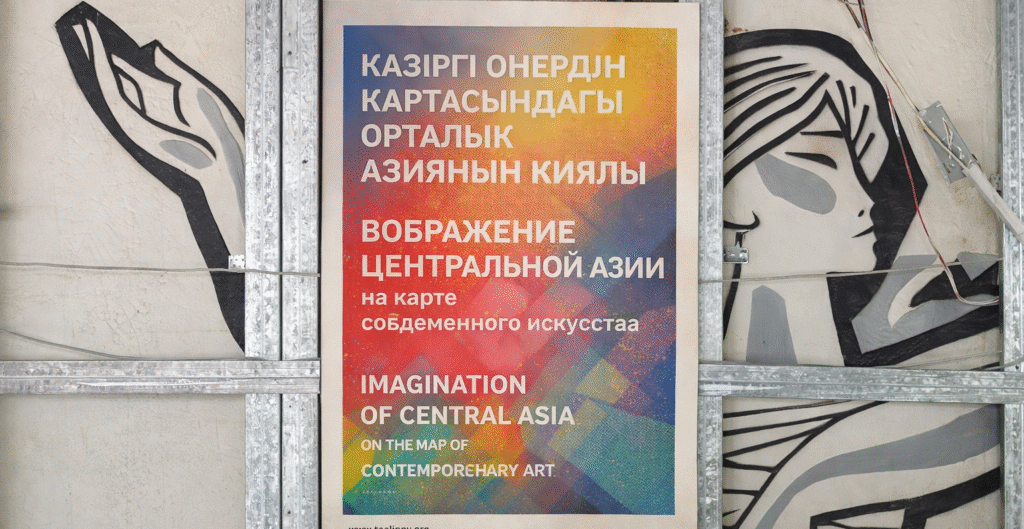
Rhetoric in segments of the Russian media has sharpened debates over sovereignty and influence across Central Asia, pushing these concerns beyond policy circles and into everyday conversations. The region is reassessing not only pipelines and alliances, but language itself. In politics, this shift is visible and symbolic. In culture, it is more difficult to discern. The Russian language still shapes how Central Asian art is funded, circulated, and institutionally processed, even as institutions distance themselves from Moscow’s influence.

This contradiction sits at the heart of contemporary cultural life in the region. Artists produce work rooted in Kazakh, Uzbek, Kyrgyz, Tajik, or Turkmen histories. They title exhibitions in local languages. They speak passionately about decolonial futures and cultural sovereignty. But when the catalogue is written, the grant application submitted, or the curatorial text sent abroad, the language quietly shifts. First to Russian, sometimes to English, and only occasionally does it remain in the local language.

This is not nostalgia, but a structural inheritance. Russian remains the shared professional language of much of the urban cultural sector.

Edward Lemon, President of the Oxus Society for Central Asian Affairs, argues that the language’s endurance reflects both ideology and pragmatism.

“While local languages have become much more widespread as the Central Asian republics have strengthened their nationhood and as there has been an increase in anti-Russian sentiments since the invasion of Ukraine, Russian language use remains widespread,” Lemon told TCA. “Despite the ideological imperative to reduce reliance on Russian, there are some pragmatic reasons why it remains prominent. High levels of migration to Russia, particularly from Uzbekistan, Kyrgyzstan, and Kazakhstan, mean that a basic competence in the language is essential to survival for many Central Asians. Russian remains a language of interethnic communication, particularly in Kazakhstan, where ethnic Russians, for the most part, are reluctant to speak Kazakh.

While English has become more widespread and some of the Central Asian languages are mutually intelligible, Russian retains a status as a diplomatic, business, and civil society language for those working in multiple countries. Russia also remains a language of education. Over 200,000 Central Asians study in Russia, by far the largest destination in the world. Russian-language schools remain prominent at every level in Central Asia, from kindergarten to graduate schools. In short, while the usage of Russian is in slow decline, its position is relatively entrenched.”

For cultural institutions, this reality means that distancing from Moscow politically does not automatically sever the linguistic infrastructure through which grants are written, exhibitions travel, and contracts are signed.

Naima Morelli, an arts writer focused on contemporary art across Asia-Pacific and the Middle East, argues that the issue is less about elimination than coexistence.

“For me, it makes sense that Russian continues to function as a practical operating language across Central Asia’s cultural infrastructure, as an inherited connective tissue of sorts. In the hypothesis of getting rid of it, the most obvious alternative for a shared language for exchanges across countries in Central Asia is English, which the global art world – in Central Asia as elsewhere – already widely employs and often considers more ‘neutral.’ But is any language truly neutral? As I see it, English carries its own hierarchies of power,” Morelli told TCA.

“Of course, Russian does not bear the same perceived neutrality. The colonial legacy the Russian language carries is, in fact, addressed in the work of many Central Asian artists. Carrying something from the past, even something tied to a painful history, can still be productive and somewhat enriching, if we are able to repurpose it. We can see it clearly in Soviet architecture, so why not in the language? I think that instead of erasing Russian altogether, what would be ideal – albeit not so easy to achieve – is a polyphony: a cultural field where Kazakh, Uzbek, Kyrgyz, Russian, and English coexist, and are used depending on the context, reflecting what is the extremely layered identity of the region today.”

Beyond institutional circles, however, the position of the Russian language has gradually weakened, particularly among younger generations educated primarily in national languages. In parts of the region, especially Uzbekistan and Turkmenistan, its role in schooling and public life has narrowed, while English increasingly attracts urban youth seeking international opportunity.

Yet for many artists, Russian is simply the most efficient way to be legible. National languages are emotionally central, but institutionally uneven. Terminology for contemporary art, critical theory, conservation, or curatorial practice is often underdeveloped, inconsistently translated, or unfamiliar to decision makers. Writing a proposal in Kazakh or Uzbek can feel like an act of cultural assertion, but also a risk. Russian offers precision, shared references, and the assurance that a jury will understand exactly what is being proposed.

English occupies a different position. It is the primary language of global art markets, biennials, international foundations, and increasingly of youth. But the level of fluency required for contract negotiations, conceptual writing, and institutional correspondence remains limited to a relatively small cohort of artists and administrators. For those who possess it, English can function as a passport.

This produces a quiet linguistic ladder that few institutions openly acknowledge. Local languages serve identity and symbolism. Russian underpins operation and legitimacy. English delivers visibility and international validation. The uncomfortable truth is that ascending this hierarchy often determines who is seen, funded, or invited abroad.

The consequences of this system become clearest when language policies change. When institutions announce a switch away from Russian towards national languages, the move is usually framed as progressive and overdue. But access does not expand evenly. Older audiences educated in Soviet or early post-Soviet systems often lose their ability to engage with contemporary exhibitions. Independent artists from rural regions, who rely on Russian as a professional lingua franca, can find themselves cut off from institutional conversations that now presume fluency in a standardized national language they may not fully command.

These tensions are not abstract. In Uzbekistan, Alisher Qodirov, a member of parliament, recently criticized the continued dominance of Russian in public services and education, arguing that reliance on Russian language schools and administration undermines the status of Uzbek as the state language and weakens cultural sovereignty. This reflects a broader regional discomfort: even where national languages are legally prioritized, Russian often remains embedded in institutional practice and professional life. The friction lies not between culture and politics, but between symbolism and administrative reality.

Grant cycles and exhibition seasons, which often launch in February and March, are where these tensions surface most clearly. Calls for proposals quietly specify language requirements. In many cases, applications, correspondence, and legal contracts continue to default into Russian. Contracts are drafted in Russian legal language, even when public-facing mission statements emphasize linguistic revival and cultural sovereignty. The gap is rarely acknowledged publicly. The region operates in pragmatic multilingualism. Decolonization is the rhetoric; institutions remain bilingual or trilingual, and international correspondence often defaults to English. Language shapes authority. The language of funding and evaluation determines which narratives travel. National languages are visible in culture but are still consolidating their role in contracts, critiques, and institutional power. Russian is declining symbolically, but operationally persistent.

From Security Threat to Economic Partner: Central Asia’s New ‘View’ of Afghanistan

Afghanistan is quickly becoming more important to Central Asia, and the third week of February was filled with meetings that underscored the changing relationship. There was an “extraordinary” meeting of the Regional Contact Group of Special Representatives of Central Asian countries on Afghanistan in the Kazakh capital Astana. Also, a delegation from Uzbekistan’s Syrdarya Province visited Kabul, and separately, Uzbekistan’s Chamber of Commerce organized a business forum in the northern Afghan city of Mazar-i-Sharif.

A Peaceful and Stable Future for Afghanistan

The meeting in Astana brought together the special representatives of Kazakhstan, Kyrgyzstan, Tajikistan, and Uzbekistan for Afghanistan. The group was formed in August 2025. There was no explanation for why the fifth Central Asian country, Turkmenistan, chose not to participate.

The purpose of the Astana meeting was to coordinate a regional approach to Afghanistan.

Comments made by the representatives showed Central Asia’s changing assessment of its southern neighbor.

Kazakhstan’s special representative, Yerkin Tokumov, said, “In the past [Kazakhstan] viewed Afghanistan solely through the lens of security threats… Today,” Tokumov added, “we also see economic opportunities.”

Business is the basis of Central Asia’s relationship with the Taliban authorities. Representatives noted several times that none of the Central Asian states officially recognizes the Taliban government (only Russia officially recognizes that government). But that has not stopped Kazakhstan and Uzbekistan, in particular, from finding a new market for their exports in Afghanistan.

Uzbekistan’s special representative, Ismatulla Ergashev, pointed out that his country’s trade with Afghanistan in 2025 amounted to nearly $1.7 billion. Figures for Kazakh-Afghan trade for all of 2025 have not been released, but during the first eight months of that year, trade totaled some $335.9 million, and in 2024, amounted to $545.2 million. In 2022, Kazakh-Afghan trade reached nearly $1 billion ($987.9 million).

About 90% of trade with Afghanistan is exports from Kazakhstan and Uzbekistan. For example, Kazakhstan is the major supplier of wheat and other grains to Afghanistan, and Uzbekistan is the biggest exporter of electricity to Afghanistan. Kyrgyzstan’s trade with Afghanistan is significantly less, but from March 2024 to March 2025, it came to some $66 million. To put that into perspective, as a bloc, the Central Asian states are now Afghanistan’s leading trade partner, with more volume than Pakistan, India, or China.

Kazakhstan’s representative, Tokumov, highlighted Afghanistan’s strategic value as a transit corridor that could open trade routes between Central Asia and the Indian Ocean. Kyrgyzstan’s representative, Turdakun Sydykov, said the trade, economic, and transport projects the Central Asian countries are implementing or planning are a “key condition for a peaceful and stable future for Afghanistan and the region as a whole.”

The group also discussed humanitarian aid for Afghanistan. All four of these Central Asian states have provided humanitarian aid to their neighbor since the Taliban returned to power in August 2021.

Regional security was also included on the agenda in Astana, but reports offered little information about these discussions.

A few days before the opening of the meeting in Astana, Russian Ambassador to Kyrgyzstan Sergei Vakunov spoke about the airbase in Kant, Kyrgyzstan, used by the Russian-led Collective Security Treaty Organization (CSTO). Vakunov said the base was capable of handling any “security threat to member states along the southern flank.” Vakunov was almost certainly referring to Tajikistan, which is the southern flank of the CSTO and shares a 1,350-kilometer border with Afghanistan.

Since last summer, there have been several deadly clashes along a section of the Tajik-Afghan border, including two incidents that left at least five Chinese workers in the area dead. Tajikistan’s Counter-Narcotics Agency reported in early February that drug interdiction efforts along the border with Afghanistan in 2025 led to the seizure of 2.742 tons of narcotics, more than 50% higher than in 2024.

The other Central Asian countries, including Turkmenistan, have engaged with the Taliban leadership since the first days after the group’s return to power. Tajikistan has taken a slower, cautious path in its relations and remains the only country in Central Asia where the ambassador from the Ashraf Ghani government that preceded the Taliban is still occupying the embassy.

However, the Afghan consulate in the eastern Tajik border town of Khorog is staffed by Taliban representatives. Tajikistan’s embassy in Kabul remains open, and the Tajik ambassador met with Taliban Foreign Minister Amir Khan Muttaqi at the start of February to discuss border security.

The presence of the Tajik representative at the Astana meeting is a further encouraging sign that Tajikistan is joining with its Central Asian neighbors to create a common policy toward Afghanistan.

Business with Uzbekistan

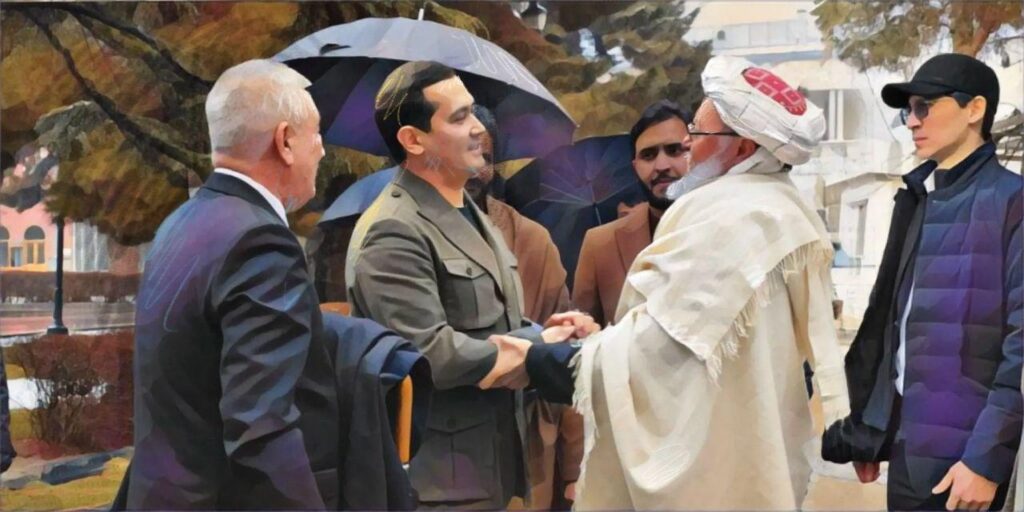
A delegation from Uzbekistan’s Syrdarya Province visited Kabul for a February 16-18 business forum.  Syrdarya Governor Erkinjon Turdimov led the delegation. Deputy advisor to the Uzbek president, also director of the International Institute for Central Asia, Javlon Vahabov, was also there.

The Uzbek delegation met with several top Taliban officials, including Foreign Minister Muttaqi and Minister of Industry and Trade Nuriddin Azizi. Governor Turdimov also met with the governor of Afghanistan’s northern Balkh Province, Muhammad Yusuf Wafa, to discuss trade. Balkh is the only Afghan province that directly borders Uzbekistan.

Wafa is becoming a point man for the Taliban’s relations with Central Asia. The Balkh governor visited Tajikistan in October 2025 and met with Tajik security chief Saymumin Yatimov.

The forum ended with Uzbek and Afghan representatives signing 25 deals worth some $300 million. The agreements covered “construction, food products, agriculture, furniture production, textiles, and pharmaceutical cooperation.”

The provincial capital of Balkh is Mazar-i-Sharif.  Uzbekistan’s Chamber of Commerce brought together more than 150 Afghan businessmen and representatives from more than 50 companies from Uzbekistan for a business forum in Mazar-i-Sharif, also conducted from February 16-18. Preliminary agreements worth potentially more than $200 million were signed.

A Window of Opportunity

The Central Asian states share the goals of increasing trade with Afghanistan and opening up routes through that country that connect them to Pakistani ports on the Arabian Sea. Afghanistan’s northern neighbors are also well aware that security and stability in Afghanistan are important in Central Asia. Since the five Central Asian countries became independent in late 1991, they have been contending with instability and uncertainty along the southern border.

The situation in Afghanistan currently, while far from ideal, is nonetheless the most stable it has been in all the years of independence in Central Asia. Figures for Kazakh-Afghan and Uzbek-Afghan trade demonstrate for all of Central Asia the potential of engaging with Afghanistan.