• KGS/USD = 0.01143 -0%
  • KZT/USD = 0.00192 -0%
  • TJS/USD = 0.10820 0.19%
  • UZS/USD = 0.00008 0%
  • TMT/USD = 0.28575 0%
  • KGS/USD = 0.01143 -0%
  • KZT/USD = 0.00192 -0%
  • TJS/USD = 0.10820 0.19%
  • UZS/USD = 0.00008 0%
  • TMT/USD = 0.28575 0%
  • KGS/USD = 0.01143 -0%
  • KZT/USD = 0.00192 -0%
  • TJS/USD = 0.10820 0.19%
  • UZS/USD = 0.00008 0%
  • TMT/USD = 0.28575 0%
  • KGS/USD = 0.01143 -0%
  • KZT/USD = 0.00192 -0%
  • TJS/USD = 0.10820 0.19%
  • UZS/USD = 0.00008 0%
  • TMT/USD = 0.28575 0%
  • KGS/USD = 0.01143 -0%
  • KZT/USD = 0.00192 -0%
  • TJS/USD = 0.10820 0.19%
  • UZS/USD = 0.00008 0%
  • TMT/USD = 0.28575 0%
  • KGS/USD = 0.01143 -0%
  • KZT/USD = 0.00192 -0%
  • TJS/USD = 0.10820 0.19%
  • UZS/USD = 0.00008 0%
  • TMT/USD = 0.28575 0%
  • KGS/USD = 0.01143 -0%
  • KZT/USD = 0.00192 -0%
  • TJS/USD = 0.10820 0.19%
  • UZS/USD = 0.00008 0%
  • TMT/USD = 0.28575 0%
  • KGS/USD = 0.01143 -0%
  • KZT/USD = 0.00192 -0%
  • TJS/USD = 0.10820 0.19%
  • UZS/USD = 0.00008 0%
  • TMT/USD = 0.28575 0%
13 December 2025

Gods and Demons of Central Asia

In today’s dynamic world, Central Asia is emerging as a trendsetter in fashion, culture, lifestyle, and worldview. The ancient Tengrian faith, deeply rooted in Central Asian mythology and superstitions, may soon resurface creatively among the region’s people, though it is unlikely to be reinstated as an official religion. While some in Kazakhstan attempt to distance themselves from Abrahamic religions, Tengrism remains a vital part of the cultural heritage, featuring gods, demigods, and dark entities that shaped the beliefs of our ancestors during the pre-Islamic era.
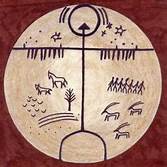
 

photo: pininterest: Tengri’s domain


Divine entities

According to Tatar scientist and writer Gali Rahim, shamanism attributes significant roles to various spirits and deities. Among the Turkic peoples, the supreme deity is Tengri, the eternal blue sky. Rahim’s lectures on “The Folklore of the Kazan Tatars,” presented at the East Pedagogical Institute in the 1920s, describe Tengri as the primary god in Turkic cosmology, with the earth and humanity emerging from the union of the sky and the earth.

Umai, the goddess associated with motherhood and children, stands next in importance. Ancient Turkic inscriptions and symbolic artifacts, such as the stone carving discovered in 2012 in the Zhambyl district of Almaty, Kazakhstan, depict her as a protective figure for children. Teleut pagans represented her as a silver-haired, young woman who descended from heaven on a rainbow to guard children with a golden bow, and the Kyrgyz appealed for her help during childbirth and when children fell ill. Motifs dedicated to Umai by Shorian shamans, were positioned around cradles. Boys’ cradles were pierced with an arrow,  girls’ with a spindle, and wooden arrows were placed within the those of both.

Another prominent character common to Turkic, Mongolian, and Altaic mythology is Erlik or Yerlik Khan. Ruler of the underworld, the horned deity presides over the realm of the dead from a palace of black mud or blue-black iron on the bank of the Toibodym, a river of human tears. A single horsehair bridge is guarded by monsters known as dyutpa whilst the palace is protected by Erlik’s sentries or elchi, brandishing pike poles known as karmak. His breath, carried by a tan, a light warm breeze, was believed to paralyze anyone who inhaled it, which is why the Khakas term for paralysis, tan sapkhany, literally means “wind blow.”

Kudai (Khudai), also known as Ulgen, is another central deity who, alongside his brother Erlik, created the land, its vegetation, mountains, and seas. Kudai created man from clay, and Erlik gave him his soul. Kudai created a dog but it was Erlik who clothed it in hair. Whilst Kudai created the first animals, the horse, the sheep, and the cow, Erlik created the camel, the bear, the badger, and the mole. Kudai brought down lightning from the sky and commanded thunder. In a dispute over who was the mightiest creator, Kudai won. The brothers parted ways, and after producing nine sons, from whom the tribes of Kpchak, Mayman, Todosh, Tonjaan, Komdosh, Tyus, Togus, Cousin, Kerdash originate, Kudai became creator of humanity.


Demons and Evil Forces

The Turkic pantheon also includes various demonic entities. Al Basty, evil female spirits, were believed to cause illnesses and nightmares. Zhalmauyz Kempir, similar to the Russian Baba-Yaga, is a forest-dwelling creature, often described as having seven heads, few teeth and an appetite for human flesh, that preys on lost people. Zheztyrnak, a female demon with copper claws and an eagle’s beak, and Kuldyrgysh, a siren-like spirit that tickles men to death, are other fearsome figures. In Tajik and Uzbek folklore,  Ajina, a goat-headed giant who lies in wait for naughty children in ash piles and empty houses, and the werewolf -like Gul Yoboni, are but two more malevolent spirits that illustrate the region’s rich and diverse mythology.

This overview of Turkic mythology reveals a heritage as captivating and complex as the celebrated legends of the Mediterranean. Just as Greek mythology incorporates elements from various ancient cultures, it is possible that Turkic mythological beings have influenced other pantheons.


Uzbekistan to Start Industrial Production of Hydrogen

Sanoat Energetika Guruhi (Saneg), one of the largest private oil and gas companies in Uzbekistan, announced on August 21 that the Ferghana Oil Refinery is to produce industrial hydrogen by transferring its related assets to Air Products, a world-leading industrial gases company.

The Ferghana Refinery is currently undergoing comprehensive modernization to both enhance its output and help the government of Uzbekistan diversify energy sources by industrializing hydrogen production.

Saneg’s operations at the refinery currently account for about 80% of the country’s oil production and 22% of its proven gas reserves and the acquisition its industrial hydrogen assets for $140 million by Air Products, promises to widen the commercial use of the product in Uzbekistan.

Saneg’s founder Bakhtiyor Fazilov commented: “This agreement with Air Products represents another significant step forward in our long-term modernization plans for the Ferghana Refinery with the world leader in hydrogen production… and contribute to one of the Uzbekistan government’s main priorities, strengthening our nation’s energy security by increasing domestic hydrogen supplies.”

Reporting on the transaction, Seifi Ghasemi, Chairman, President, and CEO at Air Products, stated: “As the world’s largest hydrogen supplier and a leader in hydrogen fueling infrastructure, Air Products’ solutions bring safe and reliable hydrogen to hydrogen-powered applications worldwide. Our advanced technology and expertise in hydrogen production will enhance the refinery’s capabilities and support the growth of Central Asia’s oil and gas industry. This will also aid Uzbekistan in achieving more sustainable and energy-independent operations, contributing to a cleaner future for the Republic.”

Kazakhstan Accredits Chargé D’Affaires of Afghanistan

The Kazakh Foreign Ministry has announced that the country has accredited a chargé d’affaires of Taliban-led Afghanistan to expand trade, economic, and humanitarian cooperation between the two countries.

On August 21 in Astana, Deputy Minister of Foreign Affairs Alibek Bakayev met with Muhammad Ur Rehman Rahmani, head of Afghanistan’s diplomatic mission in Kazakhstan. Bakayev stated that Kazakhstan had accredited Mr. Muhammad Rahmani as chargé d’affaires.

Early in June, Kazakhstan’s President Kassym-Jomart Tokayev announced that his country had removed the Taliban from its list of terrorist organizations, stressing that the move was made to develop trade and economic ties with Taliban-led Afghanistan.

In recent years, Kazakhstan has made efforts to increase trade with Afghanistan and participate in Afghan transport and connectivity projects in cooperation with Uzbekistan and Turkmenistan.

Kazakhstan has also advocated for consolidating international efforts to provide assistance to Afghanistan and resolve its complex humanitarian problems. To this end, Kazakhstan proposed establishing the UN Regional Centre for Sustainable Development for Central Asia and Afghanistan in Almaty.

Banks Suspend Transfers between Kyrgyzstan and Russia

More than a dozen banks in Kyrgyzstan have suspended money transfers to Russia to avoid falling under secondary sanctions, which could lead to blocked operations and loss of access to international financial markets. The list of banks involved includes large and regional institutions.

By suspending transfers, the banks aimed to reduce risks associated with international payment systems such as SWIFT, which can be used to pressure financial institutions linked to Russia. The situation became more complicated after several Western countries began to monitor financial transactions related to Russia and apply sanctions to banks that continue such transactions.

Nevertheless, some banks in Kyrgyzstan have found ways to maintain financial flows between the two countries by using transfers that are less dependent on international systems. For example, Optima Bank and Aiyl Bank employ alternative systems that are not subject to Western sanctions.

Inter-country remittances play an essential role in the Kyrgyz economy, contributing to economic stability and supporting the well-being of many families. The imposition of restrictions could significantly impact the country, especially since numerous households in Kyrgyzstan depend on remittances from Russia for a significant portion of their income.

In June, several banks in Kyrgyzstan suspended work with Russian money transfer systems amid the expansion of U.S. sanctions. At the time, Mbank explained that the temporary restriction was caused by “volatility of the exchange rate and possible sharp fluctuations in the currency market.” In addition to MBank, restrictions were imposed by Doscredobank, KICB, Keremet Bank, Kompanion Bank, RSK Bank, KCB Bank, and Bai-Tushum Bank, but later lifted by some to resume accepting transfers from Russia.

Villages Evacuated After Lake Bursts in Kyrgyzstan

On August 21, 2024, a mountain lake, Zyndan, burst in the Ton district of the Issyk-Kul region of Kyrgyzstan. This caused a sharp rise in the water level in the Ton River and led to flooding of nearby settlements, including Tuura-Suu village and a section of the Tuura-Suu – Temir-Kanat highway.

A state of emergency was declared due to the threat of flooding. More than 400 residents of Tuura-Suu village were evacuated and temporarily accommodated in schools in the neighboring towns of Eshperov and Ak-Sai. Using special equipment, rescuers and local authorities channeled Lake Zyndan’s waters into the Ton River bed to prevent further destruction.

Ministry of Emergency Situations officials, police, and local government officials are continuing to monitor the situation around the clock. Two excavators and three loaders, as well as other necessary equipment to repair the consequences of the breach, are involved in the operation.

The breach was caused by intense precipitation and glacial melt, which increased pressure on the lake and led to its erosion. This event attracted the attention of local authorities and international organizations concerned about climate change and its impact on the region.

Yesterday, TCA reported on a meeting between the heads of the national emergency departments of Kyrgyzstan, Kazakhstan, Tajikistan and Uzbekistan which was held last week in Cholpon-Ata, Issyk-Kul, which was aimed at broadening cooperation. Following this meeting, powerful mudslides caused by heavy rain struck the region once again, flooding the streets of Cholpon-Ata.


ADB Gives Grant to Support Women in Tajikistan

The Asian Development Bank (ADB) has approved $17.5 million in grant assistance to improve women’s agricultural skills and food security in Tajikistan.

The project, which aims to support women farmers, will cover six districts in Khatlon province (Bokhtar, Farkhor, Kulyab, Panj, Shahritus, and Vose), the country’s largest agricultural region.

ADB’s Director General for Central and West Asia, Eugene Zhukov, said the bank views women as critical agents of change, and the project aims to increase their role in agriculture. The project will provide women access to modern resources, including drying plants, greenhouses, water-saving technologies, and training in financial management and production technologies.

Particular emphasis is placed on climate-resilient farming practices to reduce vulnerability to climate change impacts such as drought and heat stress. The project will also establish small-scale crop processing and storage centers to increase the value of crops in the market.

In addition, the project will create digital platforms for the training and trading of agricultural products. It is also expected to address social problems faced by women, such as gender-based violence. Under the guidance of the Women and Family Committee, a shelter offering counseling, a referral system, and training and entrepreneurship opportunities will be opened.

ADB has supported Tajikistan for 26 years, serving as the country’s largest donor. During this time, Tajikistan has received over $2.6 billion from ADB, of which more than $2 billion was provided through grants. Since 2018, the country has received the bank’s financial assistance exclusively on a grant basis.