Central Asia has made a striking impression at this year’s Venice Biennale. At the 61st International Art Exhibition, Kazakhstan, Uzbekistan, and Kyrgyzstan have each claimed visible space through national pavilions that speak to different realities: environmental devastation, shifting cultural identity, memory, and the long afterlife of Soviet power.
The national pavilions are essential viewing for art lovers. During the Biennale, Venice also fills with officially recognized exhibitions outside the main venues and national pavilions. Known as Collateral Events, these shows are staged across the city in palaces, churches, foundations, and museums.
Among the most compelling this season is “Instruments of the Mind” by Uzbek artist Vyacheslav Akhunov. Housed in the Neo-Gothic rooms of Palazzo Franchetti on the Grand Canal, the exhibition surveys decades of his career.
Widely regarded as one of Central Asia’s most significant conceptual artists, Akhunov has developed a rigorous and wide-ranging practice since the 1970s. He has worked across drawing, text, installation, collage, and performance.
The exhibition spans five decades but avoids a conventional chronological structure. Instead, it centers on the unrealized, foregrounding censorship, bureaucratic delay, and the near-total lack of institutional support in Uzbekistan that prevented many of Akhunov’s projects from being fully realized for decades.
That emphasis also points to a wider shift. It shows the distance between the conditions under which Akhunov worked for much of his career and the significant cultural investment Uzbekistan is making today, particularly in contemporary art.
As a result, several works conceived as drawings in the 1970s and kept in studio drawers ever since are presented here as full-scale installations for the first time.
This fine-tuned curation presents the work of a seminal artist while also reflecting on the evolution of a country’s cultural landscape. The exhibition is curated by Sara Raza, Chief Curator and Artistic Director of the Centre for Contemporary Arts Tashkent, one of the leading authorities on the region’s contemporary art development.
“Instruments of the Mind is not about the past,” Akhunov has said. “It is about how thought survives.” The exhibition takes its title from a deconstructed reading of the Sanskrit word mantra, from manas, meaning mind, and tra, meaning tool. Language is positioned here as an instrument of consciousness.
The show’s range is wider than that etymology suggests. It moves between introspection and absurdity, spiritual devotion and political satire, the intimate and the monumental.
Mantras for Art
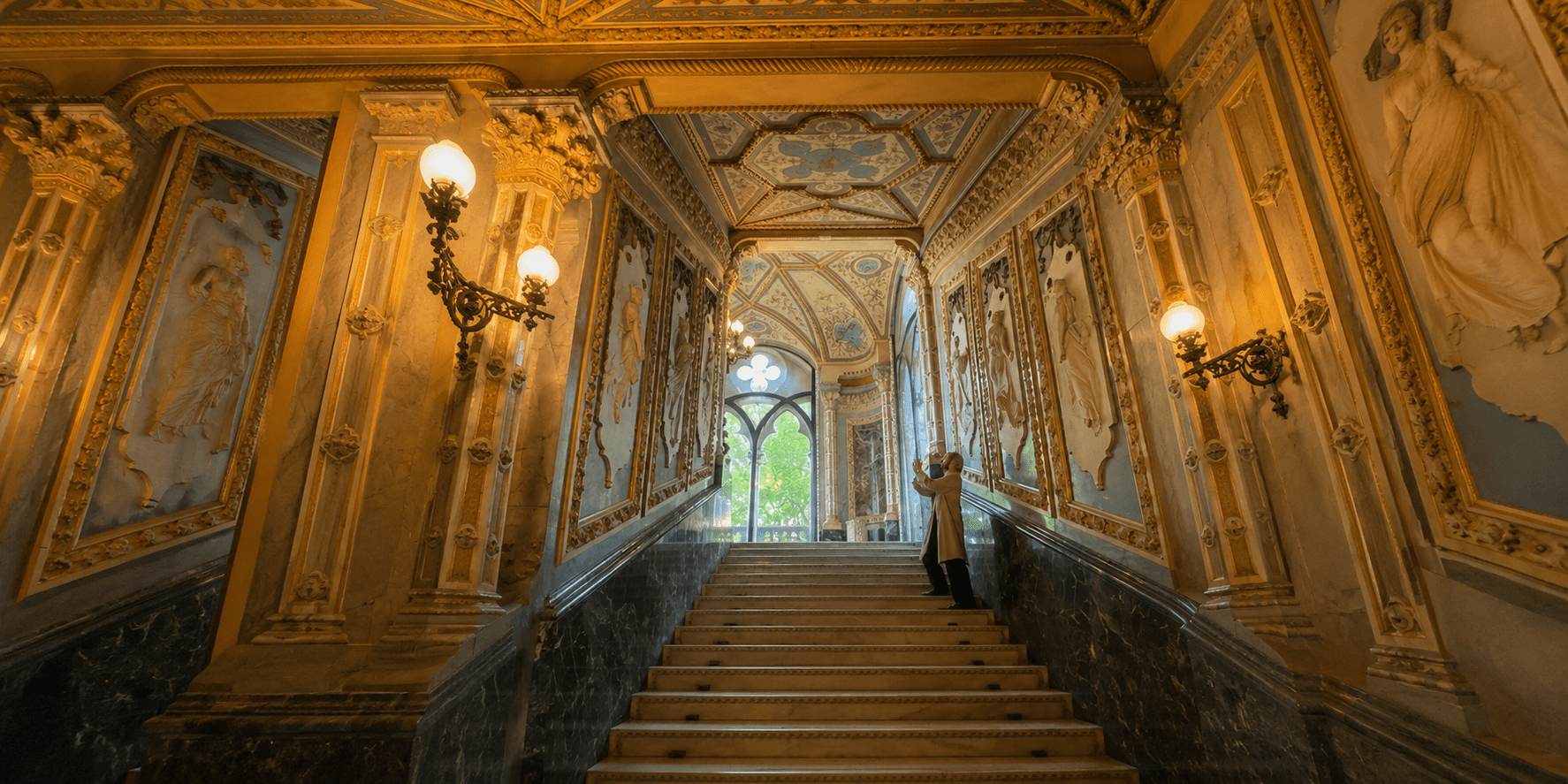
Palazzo Franchetti, a striking building with a marble staircase, intricate floral decorations, and frescoed ceilings, welcomes visitors with a work that functions as a rite of passage.
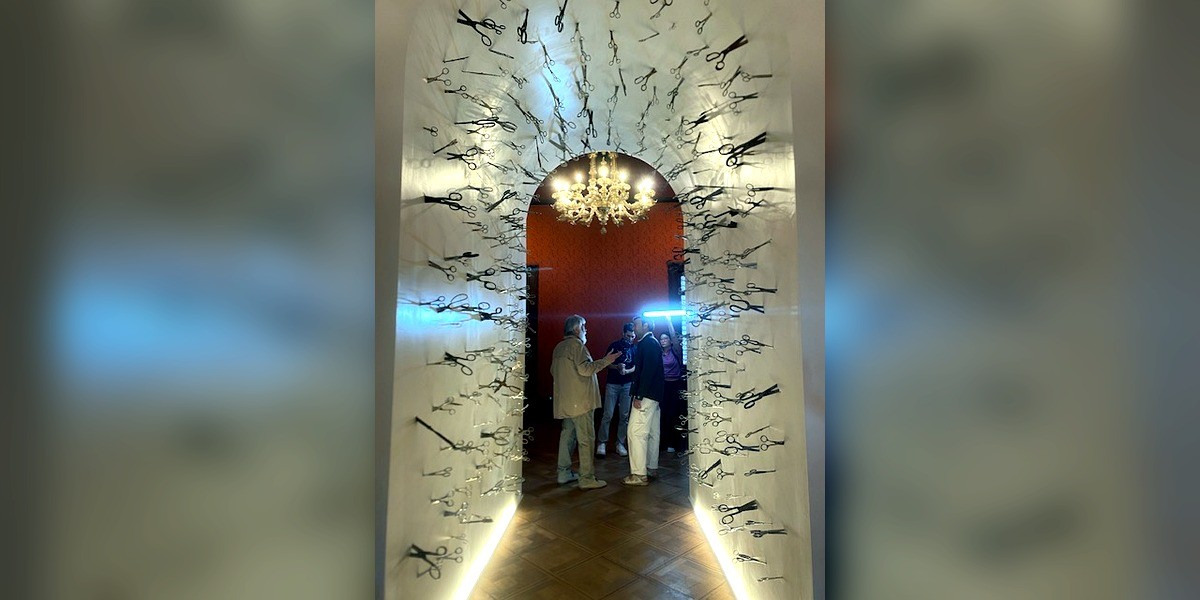
“Triumphal Arch” (1979/2026) transforms the entrance corridor into a tunnel covered with hundreds of real scissors: household scissors, surgical clamps, nail scissors, ribbon-cutting shears, chrome-plated and painted, tiny and oversized, all fixed to the wall. To enter the show, visitors must walk through this bristling passage.
The work originates from a 1979 drawing. Its conceptual target is the grandiose Soviet ribbon-cutting ceremony, a televised ritual performed at the inauguration of projects that often went unfinished or were c trapped in bureaucratic delay. Akhunov takes the instrument of that ceremony and multiplies it to absurdity, building the arch from the tools of its own symbolic function. The scissors cut nothing. Instead, they are immobilized by the arch. The triumphal passage leads nowhere.
The political and the spiritual are never entirely separate in Akhunov’s practice, and nowhere is this clearer than in “1M²” (1976/2007).
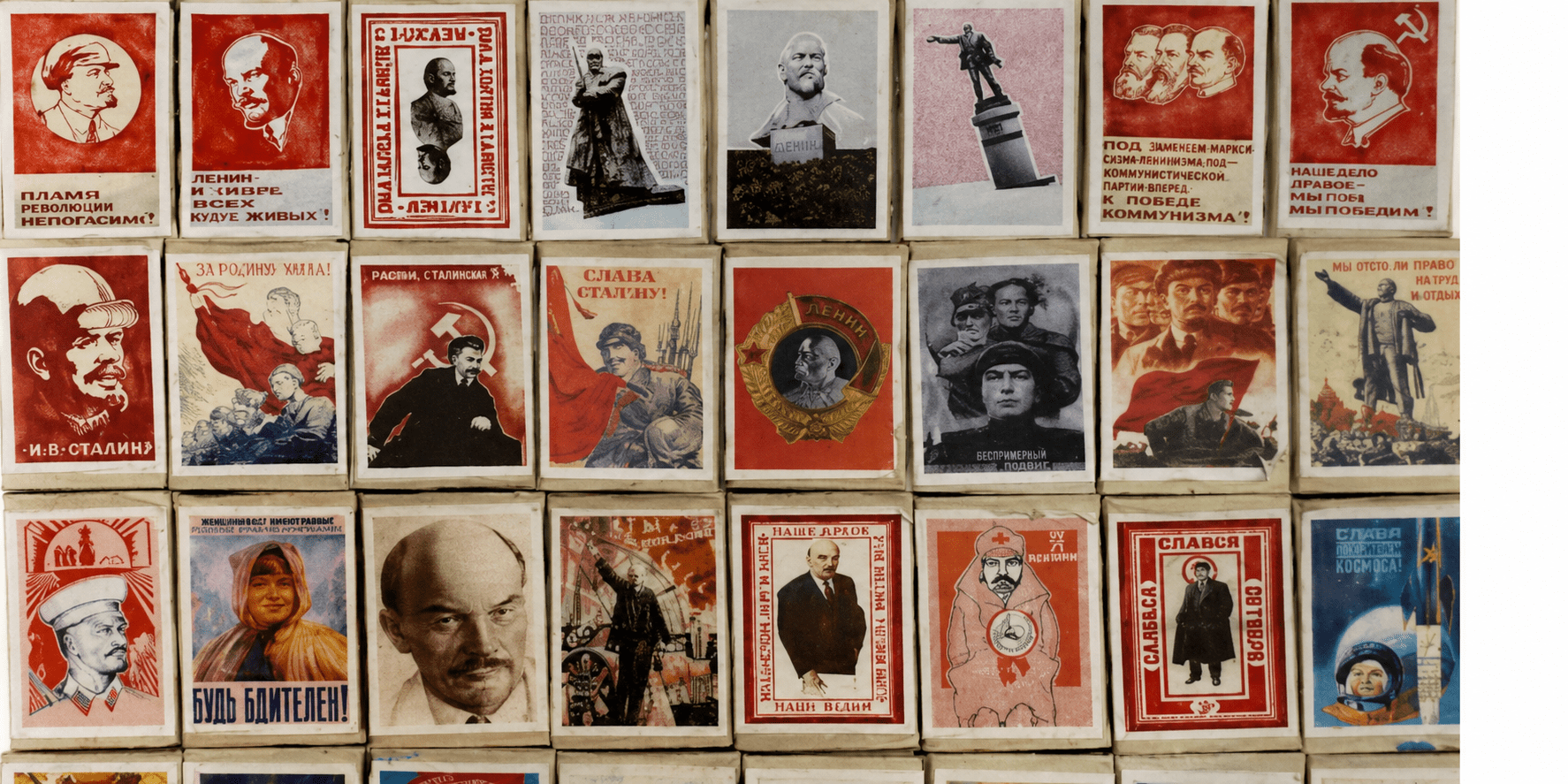
On a low platform roughly one square meter in size, some 400 Soviet matchboxes stand upright, their inner trays pulled partially open to form a dense, crowd-like field. Inside each box are images from Soviet everyday life: Lenin’s portrait, Cyrillic slogans, revolutionary posters, Kremlin towers, cosmonaut iconography, and Socialist Realist workers. Together they form a miniature ideological city, a civilization compressed into a tabletop.
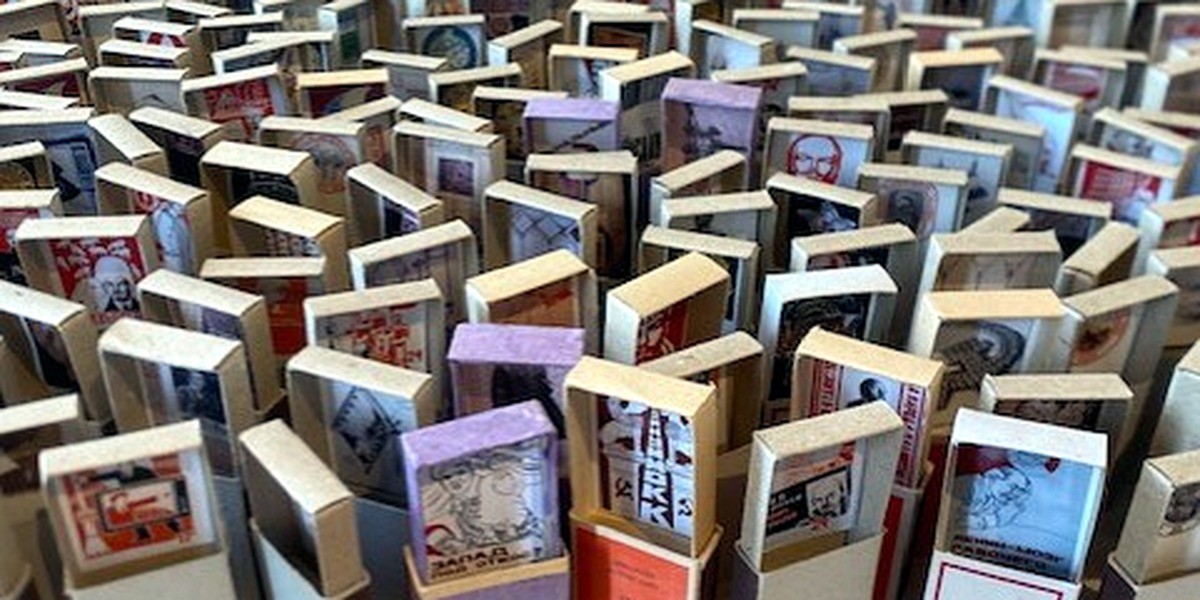
What makes the work disquieting is its intimacy. The matchbox was one of the most ubiquitous domestic objects in Soviet life, present on kitchen counters and in coat pockets. Akhunov recognized it as a carrier of state messaging that entered the home without being received as propaganda. Assembled in their hundreds, the boxes stop being objects and become something closer to a crowd: anonymous and repetitive from the outside, potentially incendiary from within.
What Am I Doing Here?
The same understanding of ideology as a matter of small formats animates a second installation. A stepped, skyscraper-like structure, taller than a standing adult, is built from hundreds of small printed cards bearing Soviet propaganda imagery. Stalin’s portrait dominates the base. Brezhnev occupies the middle registers. Lenin arrives at the apex. Red Army posters, medals, hammer-and-sickle motifs, and Cyrillic slogans fill the gaps.
The monument-like structure reads as a timeline of Soviet history stratified into a form reminiscent of a Constructivist tower, with all its utopian aspiration. From a distance, it has seductive visual coherence. Close up, each card is a fragment of mass-produced kitsch.
On the opposite wall of the same room, two lines of warm-white neon script in Cyrillic cursive are mounted high on the wall, their glow reflected in the parquet below. An elaborate Murano chandelier hangs overhead. The sentences read: Что я здесь делаю? What am I doing here? And Что я? What am I?
These are questions of existential displacement, the perennial questions of a Central Asian artist working at the margins of Soviet culture, speaking from Tashkent to Moscow, and from the periphery toward the center.
In the palatial Venetian context, they gain another dimension. What is this work doing here, in this city, in this building? In Akhunov’s hands, neon carries less of the self-conscious irony associated with its Western lineage from Bruce Nauman and more of a direct existential pressure. The questions are rooted in an Uzbek and Soviet context, but Venice changes their charge.
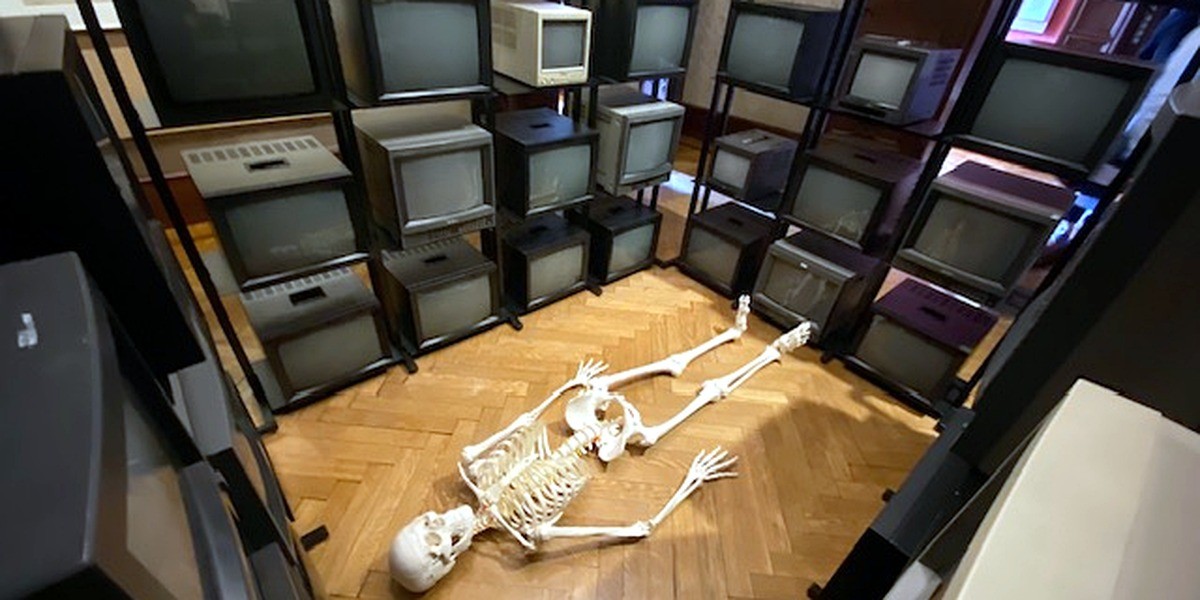
The exhibition’s deepest room, both literally and conceptually, is given to “House of Eternity/Sarcophagus” (1986/2026). The 1986 drawing that generated it is displayed nearby: a quietly rendered pen-and-ink image of a tomb chamber, its walls lined with television sets arranged in stepped tiers, a skeleton seated at its center on a throne. It is a vision of media as burial, the screen as the wall of the crypt.
Forty years later, Akhunov has built it. A darkened chamber, visible only through gaps in towering shelving units, is enclosed on all sides by stacked CRT monitors: gray, black, obsolete, their screens dead and blank. On the parquet floor within, a full-size medical skeleton lies sprawled and disarticulated, face upward. The televisions that once transmitted the Soviet Union into the domestic interior, its sport, parades, news, and propaganda, now form the walls of a tomb. The skeleton is not identified. It could be the viewer, the citizen, the regime, or all three at once.
The work is funny in the way very serious things sometimes are. It is also reminiscent of Gino De Dominicis, an Italian artist familiar to many Venetian viewers, who approached existential themes through deadpan humor.
It is also one of the most precisely constructed critiques of broadcast media as an instrument of ideological enclosure that contemporary art has produced. The fact that it was conceived in 1986, the year of Chornobyl and the year Gorbachev launched glasnost, and realized only now makes the timing feel less like coincidence than inevitability.
The Role of Memory
Memory, treated as a material that can be handled, worn down, and destroyed, runs through several rooms. “Cases Filled with Sand” (1993), presented alongside the related series “Suitcases and Shifting Sands” (1974/2026), occupies an entire room with vintage suitcases displayed open on shelves: brown leather, metal, canvas, each from a different decade.
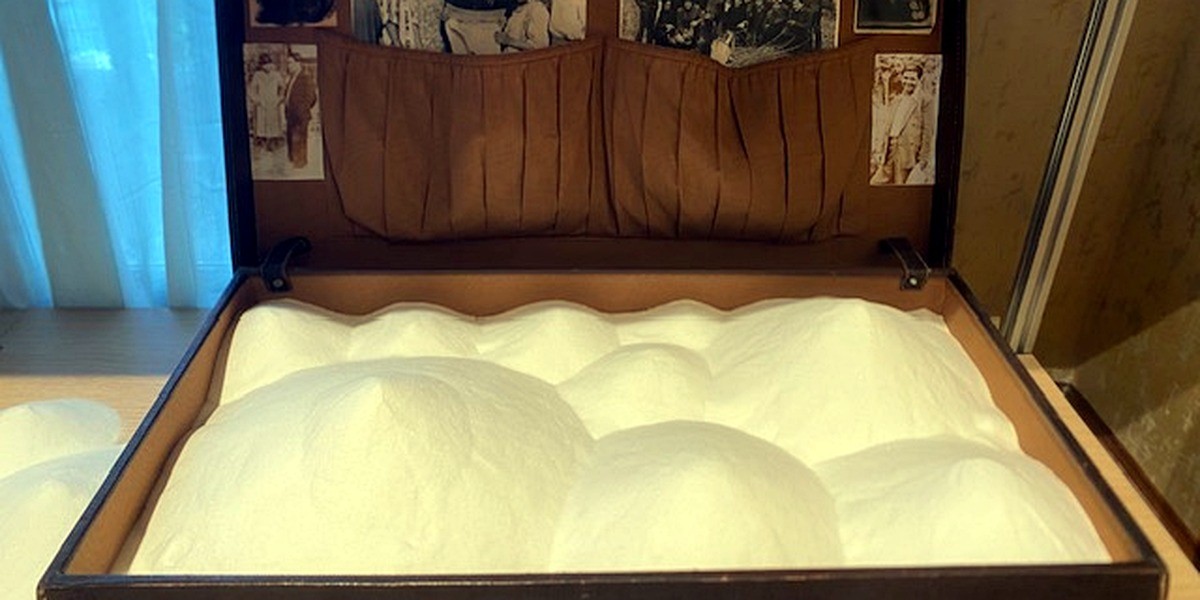
Inside each suitcase, white sand has been shaped into mounded forms resembling small dunes or pyramids. The inner lids are lined with black-and-white family photographs: group portraits, a woman in traditional dress, a soldier, figures clustered in an indeterminate landscape.
The suitcase is the object of migration and departure made permanent. For Akhunov, who made frequent journeys between Tashkent, Kyrgyzstan, and Moscow during the 1970s, it carries both personal memory and an archetypal landscape of origin, compressed into sand. The desert travels with you, sealed inside the case.
On the adjacent wall, a triptych of large canvases depicts the same motif, rows of open suitcases containing sand mounds, in sepia monochrome, with the patient repetition of a serial work. Below them, preparatory sketches trace the idea’s development from drawing to object, reminding the viewer that for Akhunov the distance between a drawing and an installation can span decades.
A similar theme appears in the adjacent room, with works such as “Worn” (2021) and “In Memory (Of)” (2023-24). These present dense grids of tiny vintage photographs in pale wooden frames, each set against a black mount. The images, again portraits, group photographs, and figures in landscapes, have been physically rubbed to varying degrees. Some retain legibility. Others have been worn down to a ghost of silver gelatin. A few have disappeared almost entirely into abstraction.
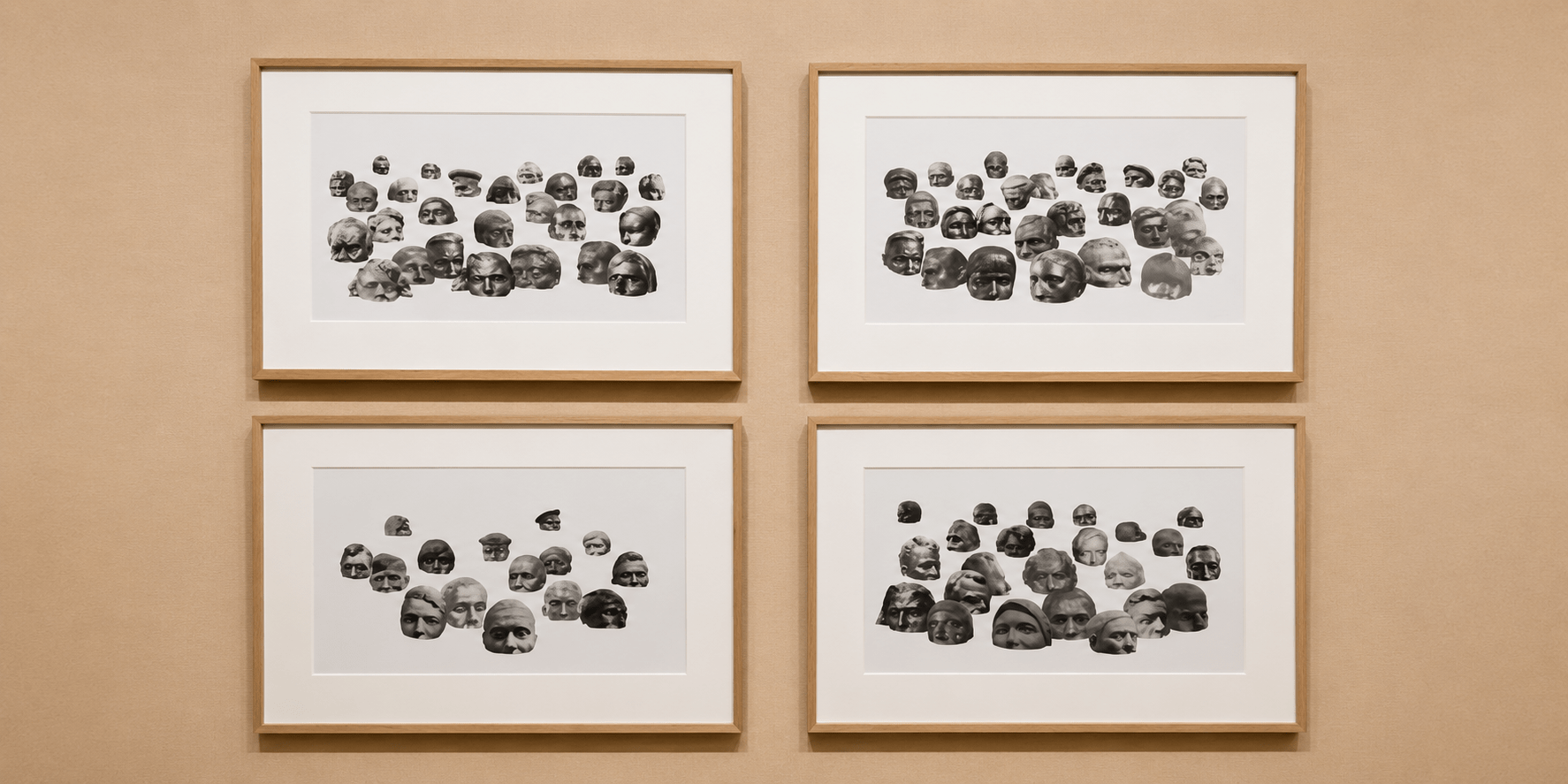
The erasure is manual and deliberate, friction applied to the surface of the photograph as an enactment of forgetting. What remains is not the image, but the evidence that it once existed.
“Erasure of Memory” (2021) extends this logic into language. Displayed flat under glass, sheets of paper are covered in dense Cyrillic handwriting, over which an erasing instrument has been applied, rubbing the text toward illegibility. The script survives in patches, readable in places and dissolved in others.
Together, these works are historical and sharply current. They can be read against Uzbekistan’s changing cultural landscape and Central Asia’s growing presence in the global contemporary art conversation.
In this sense, “Instruments of the Mind” is not only an introduction to one of Central Asia’s most important artists, though it serves that function well for audiences encountering Akhunov for the first time. It also shows that conceptual art from the Soviet periphery was not simply derivative of Western movements. Shaped by censorship, isolation, and different institutional pressures, it developed in parallel.
As Akhunov himself has put it: “Much of this work began in the 1970s, in a time when ideas often had to exist quietly, even invisibly. Returning to these works now, alongside more recent ones, I see them as part of a continuous conversation with memory, humour, and spiritual persistence.” At Palazzo Franchetti, that conversation is finally audible.
Instruments of the Mind by Vyacheslav Akhunov is on display at the Palazzo Franchetti, San Marco, Venice until 22 November 2026.