The current trajectory of freight transport highlights the growing scale of global containerization and its significant potential for expansion. Containerization could offer a more efficient solution for transporting bulk cargo for Kazakhstan, a major exporter of raw materials. However, to realize this potential, the country must address a range of internal and external challenges.
Container shipping enables door-to-door delivery with minimal risk of damage and faster handling, making it a reliable mode of transport both domestically and internationally. Its advantages include increased transport efficiency, safety, and cost savings. As such, containerized cargo transport, or “containerization”, is becoming increasingly relevant both in Kazakhstan and around the world.
Despite its global prominence, containerization in Kazakhstan remains underdeveloped. Satjan Ablaliyev, Deputy Minister of Transport of the Republic of Kazakhstan, said in an interview with The Times of Central Asia, containerized freight made up only 6.73% of the country’s total cargo turnover in 2024. Domestic container traffic was just 0.16%. Yet, container shipping significantly reduces the time and costs associated with loading and unloading across various transport modes, such as sea, rail, and road, while also protecting cargo from damage and theft, simplifying paperwork, and minimizing transport costs.
This also helps avoid delays caused by shortages of freight wagons, which is particularly relevant in Kazakhstan during peak seasons such as meeting winter heating needs or harvest time. Global experience has shown that container transport is suitable even for bulk, liquid, and perishable goods.
Several factors are currently hindering the development of containerization in Kazakhstan:
- Insufficient number of railway stations equipped to receive and handle container cargo;
- Higher tariffs for container transportation compared to traditional wagon-based freight;
- Limited and uneven access to infrastructure and resources for market participants.
To address these issues, Kazakhstan needs to expand its transport infrastructure and reform its tariff and regulatory policies.
Corridors of the future
The bulk of Kazakhstan’s container traffic comes from transit. According to national rail operator Kazakhstan Temir Zholy (KTZ), the volume of transit cargo in 2024 reached 27.5 million tons, with container transit alone growing by 59%, hitting 1.4 million TEUs.
Kazakhstan is betting on the development of overland multimodal transit across its territory. Recent global events such as the COVID-19 pandemic, disruptions in global supply chains due to geopolitical tensions, and increased attacks on shipping in the Red Sea have exposed the vulnerability of maritime trade routes (e.g., the Suez Canal, which handles about 30% of global container traffic). These challenges have prompted major container operators to rapidly reroute maritime shipping and explore alternative land-based transit corridors.
As land routes gain importance, competition among transit countries is intensifying. Many are now investing in infrastructure along international transport corridors to facilitate multimodal logistics. Ablaliyev pointed out that these factors have made Kazakhstan an increasingly attractive route for containerized cargo. Between 2020 and 2024, Kazakhstan’s container traffic rose from 876,000 TEUs to 1.395 million TEUs. In the first five months of 2025 alone, the figure reached 565,400 TEUs.
To further grow transit container flows, Kazakhstan is investing in large-scale logistics infrastructure projects, streamlining administrative procedures, and strengthening partnerships with international stakeholders. By 2030, the country aims to increase total transit volumes to 74 million tons, with container transit reaching 2 million tons.
Ambitions and Infrastructure Gaps
Kazakhstan’s freight system still reflects its Soviet industrial legacy, which was tailored to transporting raw materials (coal, ore, grain, construction materials, chemicals, etc.) by rail in traditional wagons. As a result, only about 11% of freight stations are currently equipped to handle containers.
Significant investment is needed to modernize these stations for container handling, storage, and sorting, and the associated costs will largely fall on industrial, agricultural, and commercial enterprises. Therefore, government incentives and private sector involvement will be crucial for developing container infrastructure.
According to Ablaliyev, export-import freight volumes have more than doubled in the past five years. Ablaliyev cited the launch of Kazakhstan’s first container train carrying non-ferrous metals, operated by Kedentransservice and KazZinc in March 2024, as well as a container shipment of Kazakh grain to Vietnam’s Hai Phong port in May 2024.
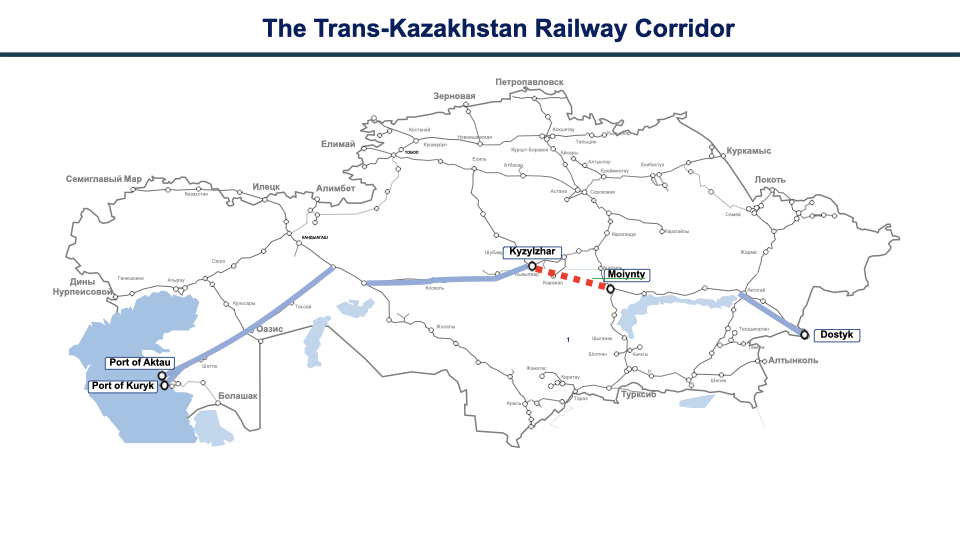
To improve container logistics, Kazakhstan is also investing in terminal infrastructure. In June 2025, the first phase of a new container hub was launched at the Port of Aktau. The project will boost the port’s capacity from 70,000 to 240,000 TEUs, offering services such as transshipment, storage, repair, and integration with rail logistics. Meanwhile, the Sarzha multifunctional marine terminal at the Port of Kuryk is another project that is set to open in 2026, with a capacity of up to 10 million tons.
“These large-scale projects on the Caspian Sea coast reflect investor confidence in long-term growth in container shipping,” Ablaliyev stated.
The Almaty region, which borders China, remains the leading region for container logistics expansion, both in traffic volume and infrastructure development, meanwhile. Its geographic position makes it a key hub for redistributing freight to the CIS and Europe.
Tariffs: A Drag on Growth
A major constraint remains the cost of container transport, which is more than twice as high as shipping in standard wagons. Meanwhile, KTZ’s container tariffs do not fully cover the actual service costs. The company continues to transport socially important goods (wheat, coal, ore), which comprise about 70% of its cargo, at below cost.
Where is efficiency lost?
A key logistical challenge is the imbalance between loaded and empty containers along major transit routes like China–Europe–China, as well as in export-import traffic. For example, there is a higher volume of cargo going from China to Europe than in the reverse direction. A similar imbalance exists for Kazakh exports.
This trend has a negative impact on transportation costs and efficiency. According to Ablaliyev, the solution to the problem of backhauling containers and the imbalance between export and import container flows lies in three things: the continued active development of the Trans-Caspian International Transport Route; the construction of both domestic and cross-border terminal infrastructure in Kazakhstan, which would allow for the consolidation and redistribution of container traffic; and the launch of a digital transport corridor featuring the Tez Customs electronic customs clearance system, with real-time cargo tracking capabilities.
“Thanks to large-scale infrastructure projects, the digitization of logistics processes, and the involvement of international logistics operators, Kazakhstan is creating the conditions to increase the share of backhaul container loading,” Ablaliyev emphasized, while also noting a positive trend in reducing the current imbalance.
Modernizing by Rail
Kazakhstan exports 80–85 million tons of cargo annually, of which 20–22 million tons are moved via containers. This requires 120,000–130,000 containers and about 5,000 additional rail platforms. Currently, according to Ablaliyev, the country has around 12,000 platforms. By 2028, it plans to open 7,000 more.
As for container stockpiles, Ablaliyev emphasized that since most container shipments are international, maintaining a large inventory within Kazakhstan is inefficient. The idea of producing containers domestically has also been shelved due to high production costs, which are estimated to be twice as high as in neighboring China.
Meanwhile, industry experts predict a technological shift in container design: from passive “boxes” to smart, autonomous units capable of real-time tracking and transmitting data on temperature, humidity, vibration, and internal movement, along with predictive arrival estimates.
According to Ablaliyev, the introduction of digital technologies in this area will enhance the transparency, efficiency, and responsiveness of logistics processes. Key initiatives include the implementation of electronic railway bills to enable data exchange among all participants in international container transport and reduce paper-based documentation, as well as the development of an integrated digital system for tracking and managing logistics. This system will allow for real-time monitoring of the location of container trains and feeder vessels, facilitating coordination between rail and maritime services and improving the overall responsiveness of freight flow management.
In addition, the use of modern digital planning tools and real-time communication systems is planned to synchronize schedules, reduce idle times during loading and unloading, and optimize the use of logistical resources.
Prospects
Current global trends have shown that containerized cargo transport is optimal, safe, and efficient. For Kazakhstan in particular, after facing restrictions on cargo transit due to military conflict along routes through Russia, which historically accounted for over 70% of the country’s exports, there was an urgent need to redirect transport flows to alternative routes that were not initially prepared to handle such volumes. In this context, containerization also offers a way to structure logistics more effectively along these new transport corridors.
Given the current global and regional instability and the potential for unforeseen disruptions in the future, it is essential to develop resilient and technologically advanced transport models that can minimize risks and respond to emerging challenges over the long term.