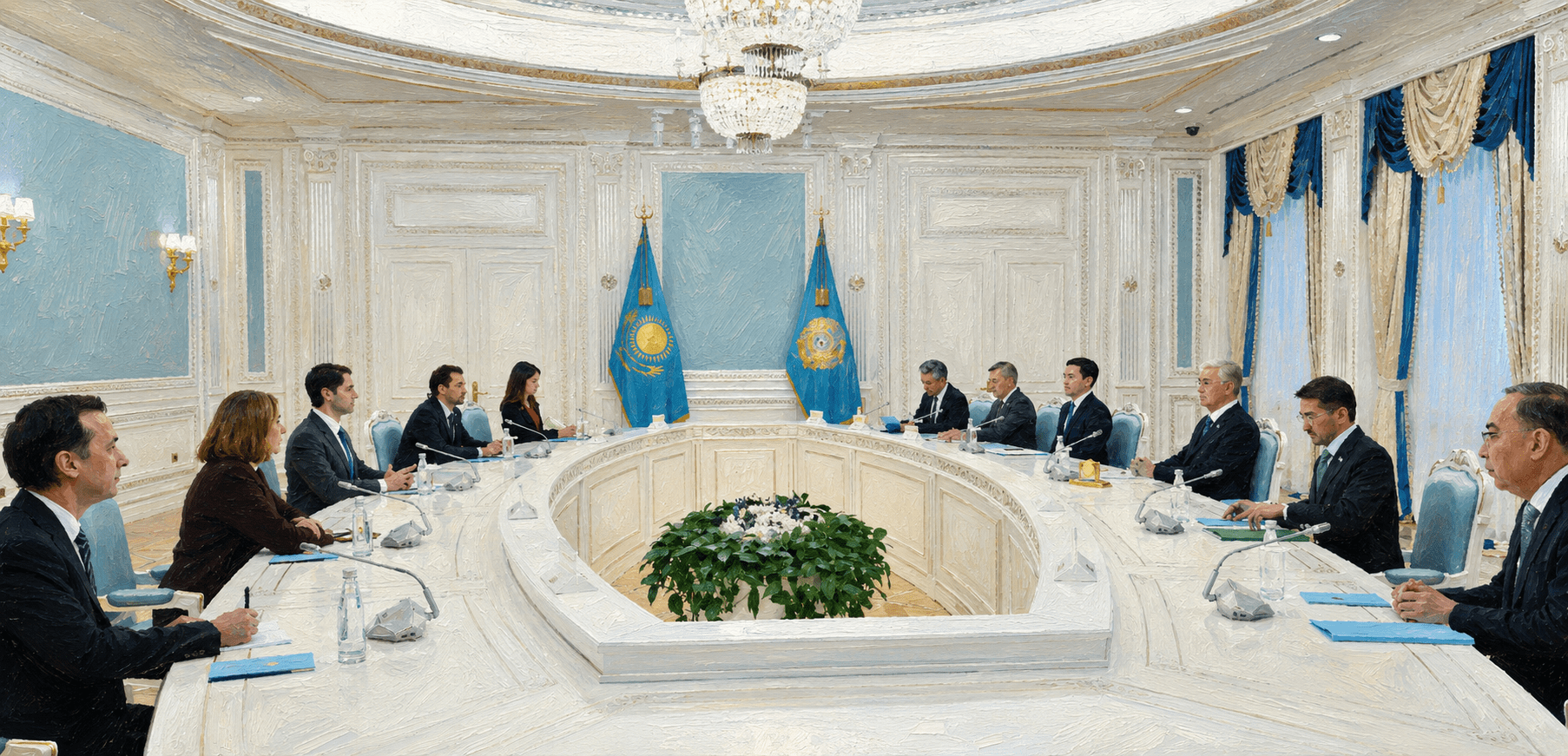
Kazakh President Kassym-Jomart Tokayev met on June 15 with Ben Black, chief executive officer of the U.S. International Development Finance Corporation (DFC), as Astana seeks to expand economic cooperation with Washington and attract more strategic investment.
The DFC, the U.S. government’s international investment arm, mobilizes private capital in support of foreign-policy and economic-development priorities. A permanent DFC presence in Kazakhstan would give U.S. investors and Kazakh authorities a more direct channel for structuring and financing projects in priority sectors.
Welcoming Black, Tokayev described the visit as a continuation of agreements reached during talks in Washington in November 2025, and an important step toward deepening Kazakhstan’s multifaceted partnership with the United States.
Tokayev said relations between Astana and Washington had intensified since President Donald Trump returned to office.
“We fully support the bold vision and pragmatic diplomatic approach of the U.S. President. Kazakhstan plays an active role in advancing key American initiatives, including the Abraham Accords, the Board of Peace, the TRIPP initiative, and other projects. Together, these efforts have given new momentum to our enhanced strategic partnership, which is stronger today than ever before,” Tokayev said.
The Trump Route for International Peace and Prosperity (TRIPP) has become important to Kazakhstan’s transport agenda because a southern Caucasus route could broaden options for the Middle Corridor rather than replace existing Azerbaijan-Georgia links.
Tokayev added that Kazakhstan’s political and economic reforms are aimed at shifting the country from a resource-dependent model to a diversified, knowledge-based economy, and noted that the DFC’s investment priorities align closely with Kazakhstan’s development agenda.
Black thanked Tokayev for the reception and described his meetings with Kazakhstan’s business community in Almaty as productive and substantive.
Tokayev emphasized the importance of translating political agreements into practical results and reaffirmed Kazakhstan’s readiness to implement joint investment projects.
The two sides discussed prospects for cooperation in critical minerals, transport connectivity, agriculture, digitalization, and artificial intelligence. They also reviewed the possibility of opening a permanent DFC office in Kazakhstan.
The meeting followed several days of U.S.-Kazakhstan critical minerals diplomacy in Astana. The Times of Central Asia reported that the United States convened a C5+1 Critical Minerals Dialogue on June 10, where U.S. Special Envoy Sergio Gor said Washington saw Central Asia as a partner in diversifying access to strategic materials and highlighted the DFC’s potential role in critical minerals, telecommunications, and Trans-Caspian infrastructure.
David Fogel, Assistant Secretary of Commerce and Director General of the United States and Foreign Commercial Service, told delegates at the Astana Mining & Metallurgy Congress on June 11-12 that Washington was moving “from dialogue to strategic execution” in the region’s critical minerals industry.
Fogel noted that the United States had brought an unusually large delegation to Kazakhstan, including representatives of more than 20 U.S. companies and senior officials, underscoring growing American interest in the country’s mining, metallurgy, and industrial sectors.
Those discussions fit Kazakhstan’s attempt to move beyond extraction. Astana is seeking to position its mining sector around processing, technology transfer, and higher-value manufacturing, while linking critical minerals to transport connectivity, artificial intelligence, and broader industrial modernization.
For Washington, a DFC office in Kazakhstan would signal a more institutionalized economic presence in the region at a time when the United States, China, the European Union, and other powers are competing to shape supply chains and transit routes. For Astana, the key question is whether a stronger DFC role can turn recent diplomatic momentum into financed projects, technology partnerships, and lasting investment.