• KGS/USD = 0.01144 0%
  • KZT/USD = 0.00196 -0%
  • TJS/USD = 0.10899 -0%
  • UZS/USD = 0.00008 -0%
  • TMT/USD = 0.28490 0%
  • KGS/USD = 0.01144 0%
  • KZT/USD = 0.00196 -0%
  • TJS/USD = 0.10899 -0%
  • UZS/USD = 0.00008 -0%
  • TMT/USD = 0.28490 0%
  • KGS/USD = 0.01144 0%
  • KZT/USD = 0.00196 -0%
  • TJS/USD = 0.10899 -0%
  • UZS/USD = 0.00008 -0%
  • TMT/USD = 0.28490 0%
  • KGS/USD = 0.01144 0%
  • KZT/USD = 0.00196 -0%
  • TJS/USD = 0.10899 -0%
  • UZS/USD = 0.00008 -0%
  • TMT/USD = 0.28490 0%
  • KGS/USD = 0.01144 0%
  • KZT/USD = 0.00196 -0%
  • TJS/USD = 0.10899 -0%
  • UZS/USD = 0.00008 -0%
  • TMT/USD = 0.28490 0%
  • KGS/USD = 0.01144 0%
  • KZT/USD = 0.00196 -0%
  • TJS/USD = 0.10899 -0%
  • UZS/USD = 0.00008 -0%
  • TMT/USD = 0.28490 0%
  • KGS/USD = 0.01144 0%
  • KZT/USD = 0.00196 -0%
  • TJS/USD = 0.10899 -0%
  • UZS/USD = 0.00008 -0%
  • TMT/USD = 0.28490 0%
  • KGS/USD = 0.01144 0%
  • KZT/USD = 0.00196 -0%
  • TJS/USD = 0.10899 -0%
  • UZS/USD = 0.00008 -0%
  • TMT/USD = 0.28490 0%
08 December 2025

Kazakhstan to Grant Amnesty to More Than 15,000 Inmates and Offenders

Kazakhstan’s Senate has passed a bill granting amnesty to more than 15,000 individuals in connection with the 30th anniversary of the country’s Constitution. The draft law, which has been approved by both chambers of parliament, will take effect once it is signed by President Kassym-Jomart Tokayev.

According to the bill, approximately 4,100 individuals currently serving sentences will be fully released from criminal liability, while the sentences or penalties of an additional 11,000 convicts will be reduced or softened. However, only a small fraction of those covered by the amnesty, fewer than 1,000, are expected to be released from prison.

As explained by MP Abzal Kuspan, 632 of those eligible for full release are currently incarcerated. The remaining 3,500 individuals to be released are to be placed under the supervision of the probation service and are serving non-custodial sentences.

The amnesty targets individuals convicted of minor or moderate offenses, particularly those who have not caused harm or who have compensated for any damage caused. It also applies to socially vulnerable groups.

Among those eligible are 833 women, of whom 109 will be released and 724 will have their sentences reduced. Only four of the 75 convicted minors in Kazakhstan will be granted amnesty, due to the fact that most underage offenders are serving sentences for serious or particularly serious crimes.

“The reason is that minors in our country are mostly convicted of serious and particularly serious offenses,” Kuspan explained.

The amnesty explicitly excludes individuals convicted of serious or particularly serious crimes, including corruption, terrorism, extremism, crimes against the sexual integrity of minors, torture, repeat offenses, and those serving life sentences.

Currently, 624 people in Kazakhstan are imprisoned for corruption-related crimes, 294 for terrorism, 96 for extremism, and 48 for torture. In total, over 40,000 individuals are held in the country’s criminal justice system, which includes 63 penal institutions and 16 pre-trial detention centers. Of these, approximately 33,000 are convicted prisoners, while 7,000 are awaiting trial.

In recent years, the Kazakh authorities have introduced a series of reforms aimed at strengthening the protection of the rights of detainees and convicts. These efforts are part of a broader push to improve transparency and accountability in the justice system.

The Hearth of Hospitality: The Importance of the Chaikhana in Central Asia

“Every meal begins with tea and ends with tea. Every guest is welcomed with tea. Every festival and every ceremony – from the celebration of birth to wedding to funeral – must feature tea” – Ketan Desai.

Across Central Asia, the chaikhana, or teahouse, holds a cherished place in the region’s social and cultural fabric. Beyond serving cups of steaming tea, it represents history, hospitality, and a space where the rhythms of daily life unfold.

For Central Asians, tea isn’t just a drink; it’s a way of life. Every pour, sup, and serving is steeped in tradition. Green tea is considered supreme in the east, while black tea holds court in the west. The offering of tea isn’t just polite, it’s a heartfelt symbol of welcoming and friendship, and to turn it down is practically a cultural crime. Tea is always poured into a piala, a small ceramic or porcelain bowl similar to the Chinese gaiwan or the Japanese chaiwan, but with its own unique steeped allure.

A Link to History

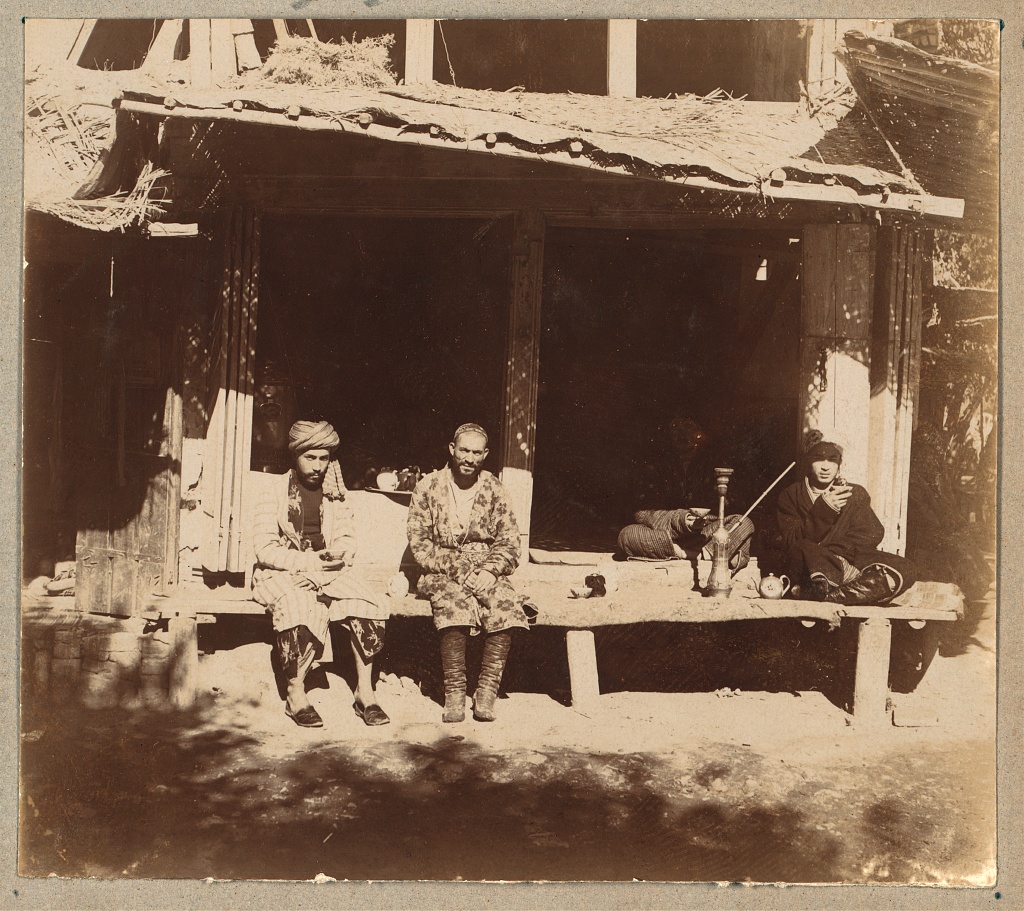
Chaikhana, Samarkand, 1905; image: Prokudin-Gorskiĭ

The chaikhana has roots stretching back centuries, intertwined with the history of the Silk Road. These teahouses sprang up along trade routes as places where merchants, travelers, and locals could rest and exchange goods, ideas, and stories. Over time, chaikhanas became hubs of cultural exchange, bearing silent witness to the blending of a rich tapestry of traditions.

Central Asia is a region shaped by the collapse of the Soviet Union and subsequent episodes of democratization, political coercion, and repression. Throughout history, the chaikhana also played a role in the region’s intellectual life. Much like coffeehouses in Europe, these spaces often served as platforms for debate, poetry readings, and the airing of progressive ideas.

These venues often feature private rooms with enclosed spaces or pull-down shades and outdoor spots with canopies or yurt-like structures, ensuring discretion for guests. Unlike typical restaurants or cafes, which rarely offer such private arrangements, teahouses allow organizations to hold meetings comfortably and confidentially. Teahouses serve a dual purpose by balancing privacy with public engagement, making them invaluable to those seeking both discretion and societal visibility.

Bukhara Chaikhana; image: Joepyrek

Teahouses serve as neutral spaces where the general public and government can freely interact. They offer a safe space for open discussions, even for government employees, highlighting their unique role in fostering dialogue. The subversive potential of teahouses cannot be overlooked, as debates frequently occurred outside formal governmental frameworks. They have quietly allowed people to organize and challenge institutional power in subtle yet meaningful ways.

Tradition and Architecture

Chaikhanas are more than just teahouses; they’re cultural treasures enriched by stunning architecture. From simple wooden benches in rural areas to urban teahouses adorned with intricate carvings, colorful tiles, and ornate patterns, these spaces are as much about artistry as they are about tea.

The interiors feature low tables and cushions, encouraging leisurely conversations and fostering a warm, communal atmosphere. Whether beside a flowing stream or under a carved ceiling, they are designed to make you pause, sip, and savor the moment.

The Chaikhana in Art and Painting: A Cultural Symbol Through Creative Expression

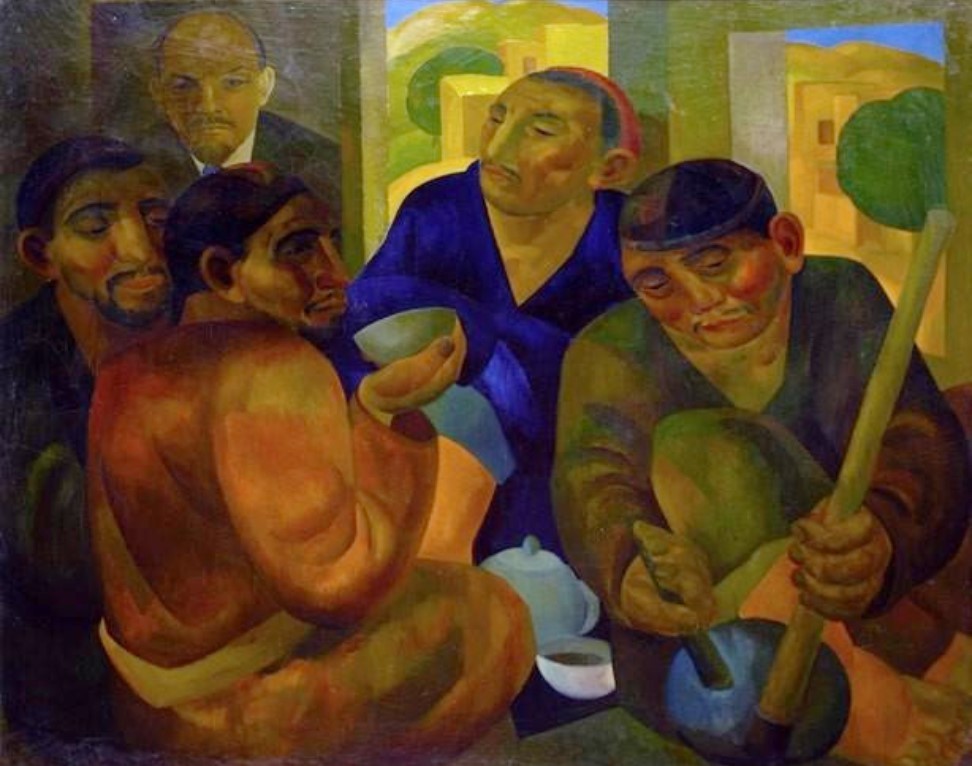
Aleksandr Volkov, Chaikhana with a Portrait of Lenin

Whether through vivid paintings or evocative literature, the chaikhana has emerged as a profound muse for creators across eras and captivated artists and storytellers for generations. Artists have long been drawn to its cozy charm and its role as a social hub. Historical paintings vividly portray these teahouses as dynamic spaces where lively conversations unfold and contemplation takes place. The details speak to the vibrancy of daily life, depicting the pouring of tea into delicate porcelain cups or patrons reclining against intricately carved wooden walls.

A hallmark of these artworks is their masterful use of light, color, and texture. With warm, earthy tones, artists invoke the atmosphere of these teahouses. Richly detailed rugs, ornate teapots, and trays of traditional sweets are constant features, illustrating the significance of cordiality and ritual. Often, these teahouses are depicted nestled beneath shady trees, surrounded by people savoring the simpler joys of life.

Writers often use the teahouse as a symbolic setting to explore themes of community, wisdom, and nostalgia. From classical poets like Alisher Navoi celebrating it as a nucleus for intellectual exchange to modern authors lamenting lost traditions, the chaikhana is deeply woven into literary narratives.

Beyond the written word, the teahouse is a vital backdrop in folk tales, where friendships are formed, disputes resolved, and life lessons shared. It also inspires traditional music and performance art, historically serving as venues for songs and stories that resonate with themes of love, loss, and life. Even today, select chaikhanas keep these traditions alive through music and occasional dance performances, celebrating human connection and interaction.

Novruz Palace; image: TCA, Stephen M. Bland

Choikhona Kokhi Navroz, also known as Novruz Palace, is an architectural marvel in Dushanbe, Tajikistan, and the largest teahouse in Central Asia. Originally built solely as a teahouse, this multi-domed structure with intricate hand-carved details has transformed into a grand palace. Constructed at a staggering cost of $60 million – equivalent to about 1% of the nation’s GDP at the time – the once-exclusive citadel that catered to fat cats and dignitaries now welcomes locals and tourists to its lavish halls. It serves as both a cultural symbol and a popular spot for enjoying traditional Tajik tea and cuisine.

Preserving Identity in Modern Times

Osh Bazaar Chaikhana, Bishkek; image: TCA, Jonathan Campion

Despite the sweeping influence of modernization and globalization, these traditional teashops remain vital in both villages and urban centers. While coffee shops and fast-food chains have gained popularity, the attraction of the chaikhana endures as a cultural touchstone.

Present-day chaikhanas in cities blend old-world aesthetics with contemporary conveniences, ensuring the tradition evolves to suit modern times. Historically, these have been male-dominated areas; however, the landscape is changing. It’s now common to find women enjoying tea and chats in these former forbidden spaces.

Organizations like Chai Khana – a visual multimedia platform – are taking this shift even further by actively working to reclaim these spaces and create a more inclusive environment that bridges gender and cultural divides. Today, the chaikhana is not just a relic of the past but a symbol of how tradition can adapt for an inclusive future.

The Battle for Control Over Central Asia’s Digital Future

Central Asia is digitalizing quickly. Governments across the region have invested in smart cities, 5G, and AI-powered platforms. Kazakhstan ranks 24th in the world in global e-government indexes, and in Tashkent and Bishkek, young, tech-savvy populations are pushing for innovation.

But such progress is not without risks. A new report from the German Marshall Fund (GMF), a Washington-based think tank, outlines how Central Asia is becoming ever more reliant on Chinese and Russian technology. These two countries, the report argues, are using digital tools not just to supply infrastructure but to shape how governments in the region manage data, surveillance, and speech. Beijing and Moscow’s tech exports act as snares, tying customers into their own economies.

“Central Asian governments are aware of these challenges,” Dylan Welch, the author of the report and a China analyst at the GMF, told The Times of Central Asia. But he notes that it can be difficult to convince policymakers to prioritize the dangers of such overexposure.

“For the national leaders, their imperative is to deliver economic growth because they have these young, dynamic populations that need jobs… if they don’t deliver on that, then they’re in for a long period of instability at home,” he said.

This makes Chinese and Russian offers to develop their digital industries extremely tempting.

An Entrenched Presence

The report coincides with a flurry of Russian and Chinese engagement in the region. Over the weekend, Kazakhstan announced that between them, Beijing and Moscow will be responsible for delivering a new generation of nuclear reactors to the country, currently leaving French and Korean alternatives out in the cold.

Then came this week’s visit of Chinese President Xi Jinping to Astana for a summit with the five Central Asian leaders.

On the digital front, one notable announcement from this summit included a plan to develop an Artificial Intelligence Cooperation Center in Kyrgyzstan. China has used the term “Digital Silk Road” to describe its investments in Central Asia, and it has built much of the physical infrastructure behind the region’s digitization drive.

For its part, Russia has exported its software, legal models and surveillance practices. Taken together, these systems are helping local governments tighten control over digital life.

“This strategic integration makes it more difficult for regional states to diversify in the future, even though many continue to pursue multi-vector foreign policies aimed at balancing global partnerships,” Yunis Sharifli, Non-Resident Fellow at the China-Global South Project, told TCA.

Where the Vulnerabilities Lie

The report uses a “technology stack” framework to explain the problem. This framework looks at five layers: network infrastructure, data storage, consumer devices, digital platforms, and government policies. Across these layers, it argues, Central Asia is exposed to Chinese and Russian influence.

Take Kazakhstan. It may be the most advanced digital economy in the region, but most of its internet traffic still passes through Russia. Telecom firms across the region are also required to install a Russian-made surveillance technology known as SORM (System for Operative Investigative Activities), which can intercept internet traffic.

“As a message or a data packet is traveling through a network, it passes through a collection point managed by the telecom company,” explained Welch. “It’s captured and decrypted by SORM, and then, near or at the same moment of capture, sent along to the end receiver who doesn’t necessarily know that their messages have been read already.”

He adds that well-known “encrypted” messenger apps like Telegram or WhatsApp are not immune.

“There have been enough reported cases by investigative journalists who focus on Russia that the Russian state definitely has the ability to decrypt or access such messages,” he said.

User data on other apps is also vulnerable to Kremlin snooping. In 2023, Russia passed a law allowing the Federal Security Service (FSB) real-time access to user data and locations on the ubiquitous Yandex Go ride-hailing app.

In the legal realm, Russia sets the norms, with many Central Asian countries, notably Kyrgyzstan, cut-and-pasting laws enacted by the Russian Duma, sometimes verbatim. This includes a 2024 version of the “foreign agents” law used in Russia to target NGOs and media.

In terms of hardware and physical infrastructure, China plays a more prominent role. Chinese companies dominate the market for surveillance cameras, telecom equipment, 5G, and cloud storage. In Uzbekistan, Huawei built the national data center that runs its e-government services, putting sensitive data at risk of exposure or disruption.

“China’s expanding digital footprint in the region has coincided with heightened cybersecurity threats,” said Sharifli. He points to a Distributed Denial of Service (DDoS) attack in Kazakhstan in May, which he says has been linked to Chinese actors. He adds that Uzbekistan has similarly experienced a dramatic spike in cybercrime linked to Chinese hackers, “including attempted intrusions into sensitive government systems like the Ministry of Foreign Affairs.”

Can the Risks be Reduced?

Central Asian states are not walking blindly into dependency, and Kazakhstan is leading diversification efforts. In March, it signed an agreement with Azerbaijan to build a new fiber-optic cable across the Caspian Sea to avoid routing data through Russia – a development which would also provide an alternative for internet traffic from Uzbekistan and Kyrgyzstan.

Last week, Astana also announced a deal with U.S. firm SpaceX to receive Starlink satellite internet, after a protracted battle over data storage. It has signed further satellite broadband agreements with European firms Eutelsat and OneWeb.

Welch argues that while satellite internet is no substitute for the speed and price of fiber-optic cables, they do offer a useful back-up service.

“From a developmental perspective, satellite internet is important for connecting rural areas that are really hard to reach. Also, in the case of a conflict like you’ve seen in Ukraine, those services can be an important backup if telecommunications networks fail,” he said.

Meanwhile, Kyrgyzstan and Uzbekistan have resisted Chinese hegemony by banning apps such as TikTok (although anecdotal evidence suggests it is still popular in both countries and accessed by VPN).

Tech DIY

All three countries are also investing in creating their own tech hubs. The most recent of these to launch, Kyrgyzstan’s High Technology Park (HTP), seeks to offer legal and financial incentives to attract businesses and entrepreneurs.

“Through HTP, the country has created a special economic zone that exempts resident companies from VAT, corporate tax, and sales tax – a significant advantage for startups and outsourcing firms seeking cost efficiency,” Azis Abakirov, the park’s director, told TCA.

His pitch to investors is that operational costs in Kyrgyzstan are very low and the country has a growing pool of English-speaking talent.

The country has also launched a Digital Nomad Visa, available to citizens from the EU, United Kingdom, United States, Japan, and Korea. While this is nothing new, an eye-catching element is that this visa does not stipulate a minimum salary – in contrast to Kazakhstan, whose Digital Nomad Visa requires that applicants earn $3,000 or more a month.

“This means professionals can open a business, set up a bank account, and access public services with minimal bureaucracy,” said Abakirov. “These combined factors make Kyrgyzstan a practical and legally accessible base for Western tech operations.”

The Need for State Aid

Outside actors are also stepping in. At April’s summit in Samarkand, the European Union announced €12 billion in new investments for Central Asia, including €100 million for satellite internet.

But despite Central Asia rolling out the welcome mat, Western firms face real hurdles to compete. Regulatory requirements are burdensome – including from their own governments.

“We’re operating in a part of the world where it’s very common for technology to get rerouted either to Russia for the war machine or as a backdoor to China on chip controls,” said Welch. “None of these companies wants to get in trouble with the U.S. government.”

This adds an extra layer of risk for companies that are already nervous about investment due to perceptions of corruption. Many conclude that the profit margins and relatively small market size are simply not worth their time.

Welch believes this is where private Western companies are at a disadvantage compared to the state-backed Russian and Chinese giants, who often invest for strategic purposes.

“We’re asking a lot of these private companies to go into these geopolitically risky areas, and then we get upset with them when they’re not competing,” he said. He compares the €100 million EU investment package in satellite internet to the figures that Chinese firms are pumping in.

“We’re talking about a multi, multi-billion-dollar enterprise to upgrade and modernize the region’s tech infrastructure using Chinese fiber optics, data centers, telecommunications equipment… So, €100 million is a great start, but it is a drop in the bucket compared to that scale of investment.”

Opinion: The U.S. Dollar Loses Its Luster as the Uzbek Som Shines

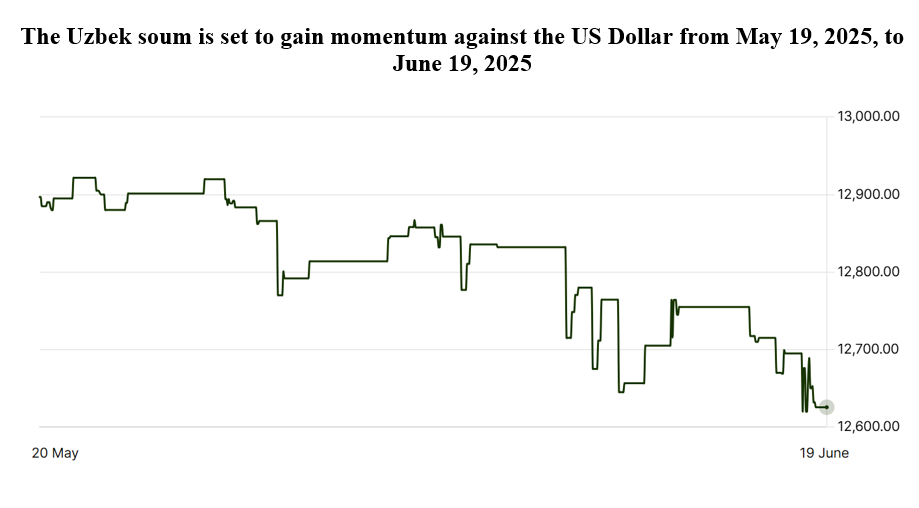
From May 20, 2025, to June 19, 2025, the U.S. dollar declined from 12,885 Uzbek som to 12,625 som, reaching its lowest level since early December 2023. This trend is anticipated to persist. Over the past 30 days, the dollar has depreciated by 2.08% against the som.

The Central Bank of Uzbekistan adheres to a flexible exchange rate mechanism, commonly referred to as a floating exchange rate. This approach allows the value of the Uzbek som to be primarily influenced by market forces of supply and demand, rather than being fixed or pegged to another currency. In the context of Uzbekistan, the Central Bank defines the market-determined exchange rate, permitting the som to fluctuate freely based on the interactions between buyers and sellers in the foreign exchange market.

In 2017, Uzbekistan transitioned to a flexible exchange rate regime, aligning the som with market conditions and narrowing the gap between the official and parallel exchange rates. This move is expected to enhance export competitiveness, as noted by the European Bank for Reconstruction and Development (EBRD). While the market predominantly determines the exchange rate, the Central Bank reserves the right to intervene in the foreign exchange market to mitigate excessive fluctuations or address significant imbalances. However, it does not maintain a fixed exchange rate. The primary objective of the Central Bank is to uphold price stability, ensuring low and stable inflation. The flexible exchange rate regime empowers the Central Bank to utilize interest rates as a tool to influence inflation and manage the overall economy. Since 2020, the Central Bank of Uzbekistan has been implementing an inflation targeting framework that guides its monetary policy decisions, including those related to the exchange rate.

Uzbekistan has recently achieved a remarkable milestone, with its international reserves soaring to an unprecedented $49.6 billion, primarily driven by a substantial increase in gold prices. This significant figure, recorded at the end of last week, represents the highest level of international reserves since the Central Bank of Uzbekistan began tracking this data in 2013.

Uzbekistan has been on a remarkable journey of financial growth, marked by a sustained increase in its reserves over the past five months. Since the beginning of the year, the country’s reserves have increased by an impressive $8.48 billion, reaching a new historic high of $49.66 billion. In May alone, the reserves saw a substantial boost of $410.2 million, translating to a 0.8% increase compared to April.

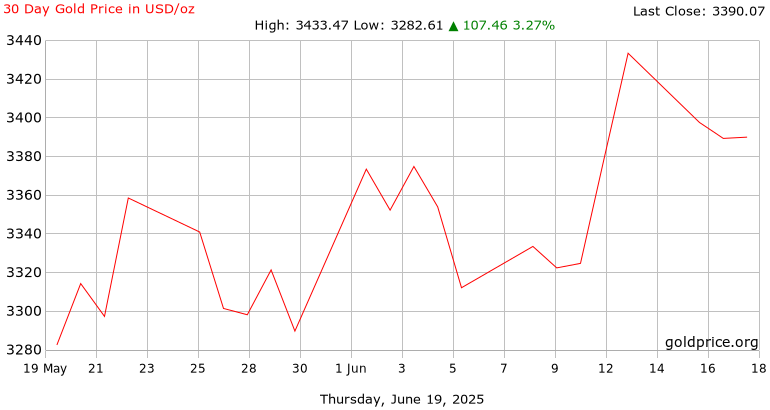
This consistent upward momentum not only highlights the resilience of Uzbekistan’s economy but also demonstrates its ability to adapt and thrive in a dynamic global landscape. Central to this financial ascent has been the role of gold, which has enjoyed significant demand due to its elevated prices in international markets. Over the last month, gold prices surged by 3.27%, rising from $3,280 to $3,390.07 per ounce. When examining the broader trends, it is evident that gold has significantly appreciated, with a striking 25.5% increase since the start of this year and an even more impressive 41.3% surge over the past year. Factors contributing to the strong performance of gold include changes in U.S. trade policies under President Donald Trump, a growing preference among several nations to transact internationally using non-dollar currencies, and ongoing geopolitical tensions in the Middle East, especially between Iran and Israel.

From February to April, Uzbekistan maintained an active approach by selling approximately 12 tons of gold each month. However, there was a significant decline in sales in May, which plummeted to just 30,000 troy ounces, equivalent to approximately 0.9 tons. Currently, the total physical volume of gold held in the country’s reserves stands at 11.43 million troy ounces, or 355.5 tons, marking the lowest level since June 2022.

Despite the reduced physical volume, the value of gold within the reserves increased by $2.2 million in May, reaching a total of $37.65 billion. In addition to gold, Uzbekistan’s foreign currency reserves also experienced noteworthy growth, adding $411.9 million to reach a total of $11.44 billion, the highest level since December 2022. In a strategic effort to diversify its financial portfolio, the Central Bank of Uzbekistan has been proactive in making investments; in May alone, it allocated an additional $2.4 million into securities, boosting the overall value of its securities holdings to $706.3 million. These strategic decisions reflect Uzbekistan’s unwavering commitment to fortifying its economic foundation and enhancing the stability of its international reserves for the future.

How can we interpret the recent appreciation of the Uzbek som? Over the past month, the U.S. dollar has experienced a decline against many currencies, including the som, as illustrated above. The Uzbek som has notably gained strength, reaching a point it hasn’t seen against the dollar in recent times. According to various sources, this shift marks the som’s best performance in the last ten months, showcasing a decrease in the dollar’s value when measured against the som. This trend is reflected in daily trading results and can be attributed to several influencing factors. Increased remittances from abroad, a rise in foreign investment, stabilization of currencies among trading partners, and a surge in global gold prices are all contributing elements to this upward trajectory.

While predicting short-term exchange rate dynamics can be challenging, there is a reasonable expectation for the Uzbek som to maintain a stable exchange rate against the dollar into 2025. It is essential to note that this appreciation of the Uzbek currency may not necessarily impact the export of local manufacturing products, as the country’s primary resources are derived from minerals and gold. From a policy perspective, this development presents an intriguing opportunity. The passage highlights the critical need to develop a high-skilled education system, aligning with President Shavkat Mirziyoyev’s vision of establishing Tashkent as a leading financial center in the near future. However, it raises an important question: Are the education leaders in Uzbekistan sufficiently equipped to achieve this ambitious objective?


The views expressed in this article are those of the author and do not necessarily reflect the official policy or position of the publication, its affiliates, or any other organizations mentioned.

Uzbekistan Joins BRICS Bank, Strengthening Global Ties

Uzbekistan’s bid to join the New Development Bank (NDB), commonly known as the BRICS Bank, has been officially approved, marking a notable step for the country as it seeks to enhance its engagement within the global financial and economic framework. Established by Brazil, Russia, India, China, and South Africa, the NDB aims to finance sustainable development projects and offer alternatives to traditional Western-led financial institutions such as the IMF and the World Bank.

Membership was also approved for Colombia, with applications from Ethiopia and Indonesia currently under review.

A New Opportunity for Uzbekistan

Uzbekistan’s membership in the BRICS Bank provides a potential avenue to strengthening economic ties with major emerging markets. The country’s strategic position in Central Asia and its natural resources present opportunities for investments in infrastructure, renewable energy, and agriculture, aligning with the bank’s priorities on sustainable development.

Uzbekistan’s recent economic reforms aimed at liberalization and improved governance make the BRICS Bank a practical partner for securing diversified funding sources for large-scale initiatives.

Role of the BRICS Bank and Implications

The NDB focuses on funding projects in emerging economies to promote growth while reducing dependence on traditional Western lenders. Since its inception in 2014, the bank has supported initiatives in renewable energy, infrastructure, and technology. The inclusion of Uzbekistan indicates the NDB’s interest in expanding its reach beyond its founding members.

Uzbekistan’s entry into the BRICS Bank takes place in the context of shifts in the global economic landscape, as countries seek new financial partnerships. For Uzbekistan, this step aligns with its foreign policy approach of maintaining balanced ties with global powers while engaging with the West, the Middle East, and neighboring countries.

China, a driving force within the NDB and the Belt and Road Initiative (BRI), sees Uzbekistan’s strategic location as beneficial for advancing regional trade and connectivity, while Russia could view the membership as a positive development for maintaining close regional ties while navigating geopolitical challenges.

Shared Priorities

For the NDB, Uzbekistan offers a gateway to further investments in Central Asia, aligning with its mission to support emerging markets.

For Uzbekistan, meanwhile, membership represents a significant development in its integration into international financial networks, potentially opening up opportunities for sustainable development projects that could contribute to the country’s economic growth and strengthen its global standing.

The BRICS summit in 2025 will be held in Rio de Janeiro on July 6 and 7.

Moody’s Upgrades Outlook on Uzbekistan’s Credit Rating to Positive

Moody’s Ratings has revised Uzbekistan’s credit outlook from stable to positive, while affirming its long-term issuer rating at Ba3, a level that denotes speculative or non-investment grade status. The improved outlook reflects increased confidence in the country’s ongoing structural reforms and governance improvements.

According to Moody’s, Uzbekistan’s efforts to strengthen public sector governance and liberalize key sectors such as energy could enhance policy effectiveness and lay the foundation for sustainable economic growth. Recent steps include restructuring the supervisory boards of all state-owned enterprises (SOEs) and banks, with an increased presence of independent members. The government is also advancing legislation on conflict of interest, asset declaration, and whistleblower protections, measures that signal a broader commitment to transparency.

The energy sector reforms highlight the government’s readiness to undertake challenging but necessary changes. Tariffs have risen sharply as part of a phased plan to achieve full cost recovery by 2027-2028. While inflationary pressures persist, the government has sought to mitigate their impact through targeted increases in public sector wages and pensions and by scaling back subsidies.

Privatization remains central to Uzbekistan’s reform strategy. The government plans to reduce the state’s share in the banking sector from 65% to 46%, following the successful privatization of Ipoteka Bank. The recently established National Investment Fund, managed by Franklin Templeton, will oversee holdings in 18 major enterprises. Initial public offerings are planned for several large firms, including Navoi, Uzbekistan’s largest taxpayer.

Moody’s forecasts GDP growth of 5.8% in 2025 and 5.7% in 2026, supported by increased investment in energy and transport infrastructure under the Uzbekistan 2030 Strategy and rising levels of foreign direct investment. The fiscal deficit declined to 3.3% of GDP in 2024 and is projected to remain below 3% in the coming years.

Although Uzbekistan’s public debt remains moderate, liabilities linked to SOE borrowing and public-private partnership (PPP) projects are increasing. To manage these risks, the government has imposed caps on new PPPs and now requires official approval for external borrowing by state-owned entities.

Moody’s also pointed to persistent institutional weaknesses, low per capita income, and governance concerns, as well as regional geopolitical risks. However, the agency noted that if current reform momentum continues and economic indicators improve further, an upgrade to the country’s credit rating is possible.

Uzbekistan’s credit profile is bolstered by its diversified economy, strong growth outlook, and prudent fiscal management. With continued reforms and growing investor confidence, the country appears increasingly well-positioned for long-term economic stability.