• KGS/USD = 0.01144 0%
  • KZT/USD = 0.00194 -0%
  • TJS/USD = 0.10877 -0%
  • UZS/USD = 0.00008 0%
  • TMT/USD = 0.28571 0%
  • KGS/USD = 0.01144 0%
  • KZT/USD = 0.00194 -0%
  • TJS/USD = 0.10877 -0%
  • UZS/USD = 0.00008 0%
  • TMT/USD = 0.28571 0%
  • KGS/USD = 0.01144 0%
  • KZT/USD = 0.00194 -0%
  • TJS/USD = 0.10877 -0%
  • UZS/USD = 0.00008 0%
  • TMT/USD = 0.28571 0%
  • KGS/USD = 0.01144 0%
  • KZT/USD = 0.00194 -0%
  • TJS/USD = 0.10877 -0%
  • UZS/USD = 0.00008 0%
  • TMT/USD = 0.28571 0%
  • KGS/USD = 0.01144 0%
  • KZT/USD = 0.00194 -0%
  • TJS/USD = 0.10877 -0%
  • UZS/USD = 0.00008 0%
  • TMT/USD = 0.28571 0%
  • KGS/USD = 0.01144 0%
  • KZT/USD = 0.00194 -0%
  • TJS/USD = 0.10877 -0%
  • UZS/USD = 0.00008 0%
  • TMT/USD = 0.28571 0%
  • KGS/USD = 0.01144 0%
  • KZT/USD = 0.00194 -0%
  • TJS/USD = 0.10877 -0%
  • UZS/USD = 0.00008 0%
  • TMT/USD = 0.28571 0%
  • KGS/USD = 0.01144 0%
  • KZT/USD = 0.00194 -0%
  • TJS/USD = 0.10877 -0%
  • UZS/USD = 0.00008 0%
  • TMT/USD = 0.28571 0%
16 December 2025

Opinion: Is Uzbekistan Importing a Future Crisis?

Once hidden from the view of international investors, Uzbekistan is rapidly rewriting its economic narrative. Over the past eight years, the nation attracted over $113 billion in foreign investment, drawing financial firms and mutual funds eager to seize the momentum of Tashkent’s trade liberalization and its ambition to double GDP by 2030. And rightly so; 40% of the country’s population, which is the largest in Central Asia, is under the age of 25, while its gold production is within the top ten globally.

Uzbekistan is in its breakout moment. With Uzbek bonds receiving a further upgrade to a BB rating from both Fitch and S&P Global, comparisons to Vietnam or Indonesia no longer seem aspirational.

However, the question remains: Is Uzbekistan ready to set foot on the financial global stage, and, more importantly, is it structurally equipped to stay there?

Amidst its sweeping economic transformation, IMF officials have warned the administration to remain vigilant against economic shocks beyond its control: volatile commodity prices, contractions in foreign investor liquidity, and consequently, tighter external financing. These warnings are not theoretical. They come from decades of IMF experience with financial crises in other emerging markets, such as the Latin American debt crises in the 1980s, the “Tequila Crisis” in 1994, and the “Asian Flu” in 1997.

In those historic cases, newly liberalized economies suffered not because they lacked growth, but because they lacked a defense against the liquidity cycle. The economic reality is that global capital flows are often driven by decisions made in New York or London, not Tashkent.

This economic phenomenon is often explained by the “liquidity model,” which argues that changes in exogenous liquidity conditions – driven by the economic situation of investor countries – shape capital flows into emerging markets. Thus, without sufficient financial market depth, emerging capital markets cannot absorb external shocks. And when global liquidity tightens, these flows can abruptly reverse, resulting in prolonged economic instability and loss of monetary sovereignty.

The sequence unfolds as follows: capital inflows surge and balance-sheet vulnerabilities quietly build up; then an external shock – such as a monetary tightening in the creditor economy – causes inflows to slow; the local currency depreciates; and a feedback spiral of declining confidence and weakening balance sheets pushes the economy into crisis. Currency loses trust, struggles to recover, and money flees.

Some initial signs of this pattern can be observed in Uzbekistan’s current boom. The economy is increasingly reliant on foreign borrowing: external debt as a share of GDP rose from 24.7% in 2017 to 61.4% in 2024, reaching $78.5 billion by June 2025. According to CEIC benchmarks, this

level is already comparable to Poland’s 51.8% and Malaysia’s 69.9%, and now exceeds Kazakhstan’s 59.2%, reflecting growing dependence on financing from the World Bank, Eurobond investors, and major East Asian institutions.

High debt levels alone do not necessarily imply instability. They can reflect efforts to accelerate domestic development. The real source of fragility in past crises was not the volume of debt but its denomination. When obligations are in foreign currencies, a country becomes acutely sensitive to the economic conditions of its lenders.

To illustrate, if the Uzbek Som were to depreciate suddenly due to a commodity price shock, such as a drop in gold, the public would likely rush to buy dollars, creating a feedback loop that weakens the currency even further. Simultaneously, the cost of servicing foreign debt would spike, as every dollar of repayment would require more Som. Today, approximately 60% of Uzbekistan’s government debt is denominated in U.S. dollars.

To ensure rapid recovery from inevitable external shocks, Tashkent must shift its strategy from pure growth to structural resilience. This requires building fiscal buffers now to allow for counter-cyclical spending during downturns, rigorously stress-testing the banking sector to prevent systemic credit freezes, and maintaining a flexible exchange rate to act as a natural safety valve against global volatility.

Is Uzbekistan importing a future financial crisis? In practice, no country can be fully immunized against global volatility. Yet, history has proven that the FDI model is indispensable for rapidly improving the standards of living for citizens. The question is not if Uzbekistan should take the money, but how it manages the flow and prepares for the worst-case scenario.


The views expressed in this article are those of the author and do not necessarily reflect the official policy or position of the publication, its affiliates, or any other organizations mentioned.

Nomad TV: Russia’s Latest Media Venture in Kyrgyzstan

Kyrgyzstan has a new TV station. At first glance, it’s the kind of cozy, local news channel satirized in 2004’s Anchorman. The headline item on December 10th was the fact that it had snowed in Bishkek, with the on-screen reporter treading around the city asking residents whether they felt cold.

“Not really,” is the general response, given that plummeting temperatures are hardly a new phenomenon in the Kyrgyz capital.

“What kind of precautions did you take against the weather?” the reporter asks one gentleman.

“Put on a hat and gloves,” comes the droll reply.

This piece is followed by an interview with a representative of the city’s police service, advising people to tread carefully on the icy pavements.

Similar soft news items follow: an interview on the progress of Asman eco-city on Lake Issyk Kul; the modernization of a factory in Bishkek; and the announcement of a new coach for the national football team.

These are hardly stories to make waves. Indeed, most people in Bishkek are unaware of the new channel’s existence.

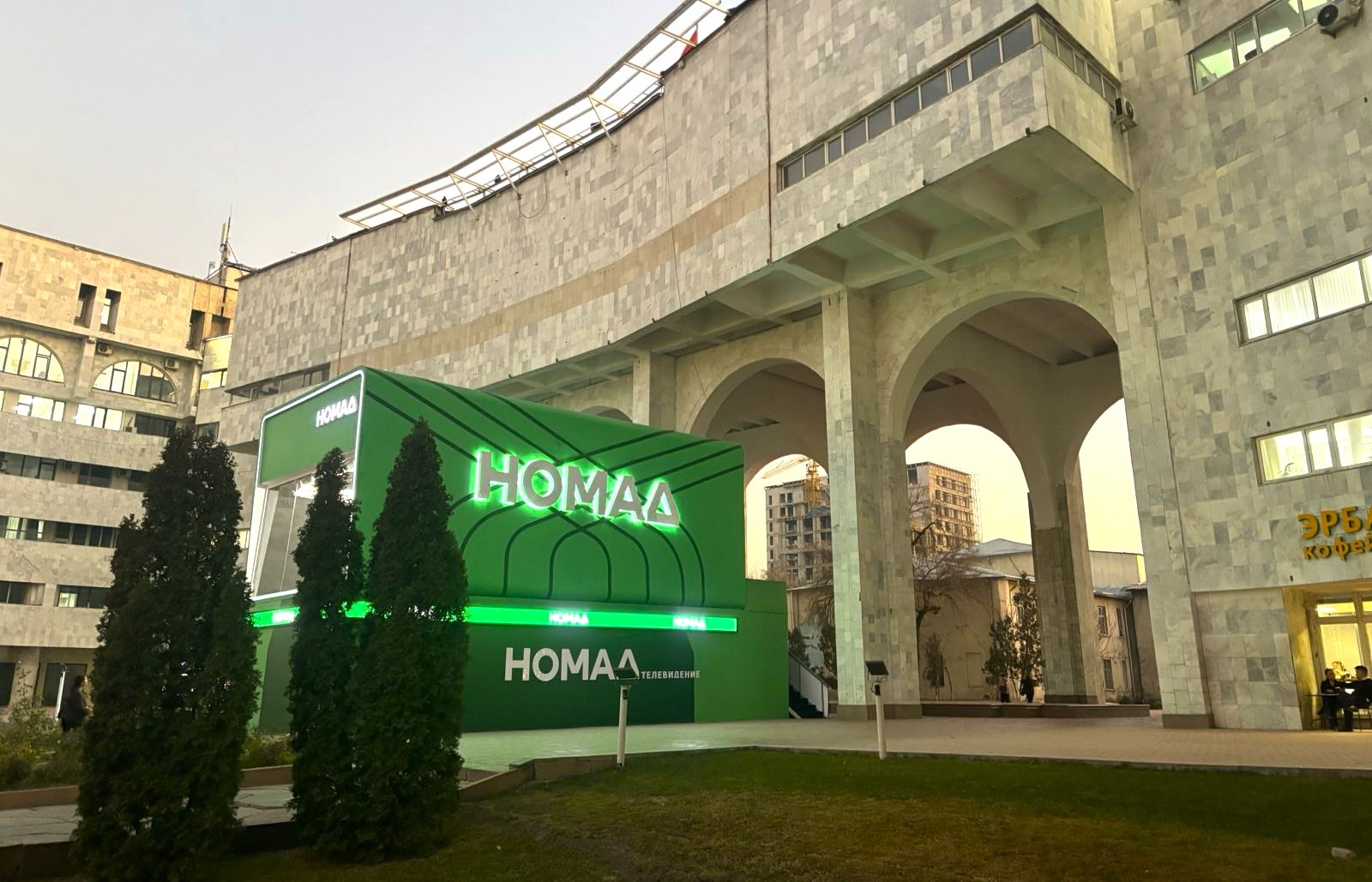
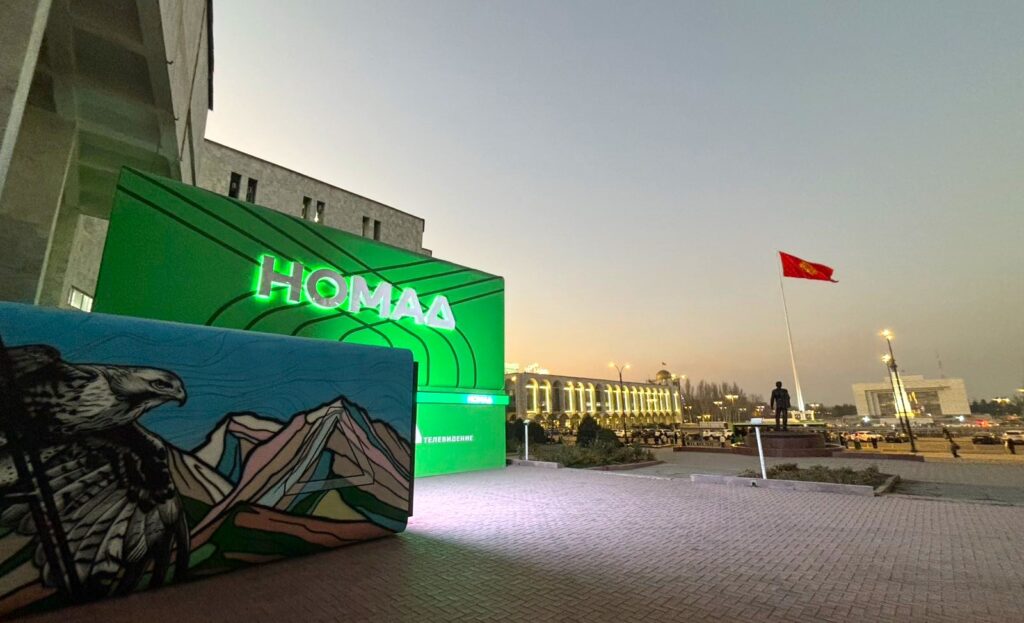
“It hasn’t been a major discussion point; the only presence that I felt is this huge, green box that has been installed on the central square,” Nurbek Bekmurzaev, the Central Asian editor of Global Voices, told The Times of Central Asia, referring to the broadcaster’s temporary studio at the heart of the city.

Yet Nomad is one of the best-funded media outfits in the country, offering salaries twice as high as those paid by rival organizations. And, in one form or another, it seems clear that the money is coming from the Russian state.

So why has the Kremlin, which is hardly underrepresented in Kyrgyzstan’s media sphere, decided to throw such sums at a local news station?

Nomad TV’s temporary studio on Ala-Too square in the heart of Bishkek; image: TCA, Joe Luc Barnes

A Bold Start

Nomad’s initial coverage was not so banal. On November 23, the channel began broadcasting with a cascade of high-profile interviews linked to Vladimir Putin’s state visit to Kyrgyzstan on November 25-27.

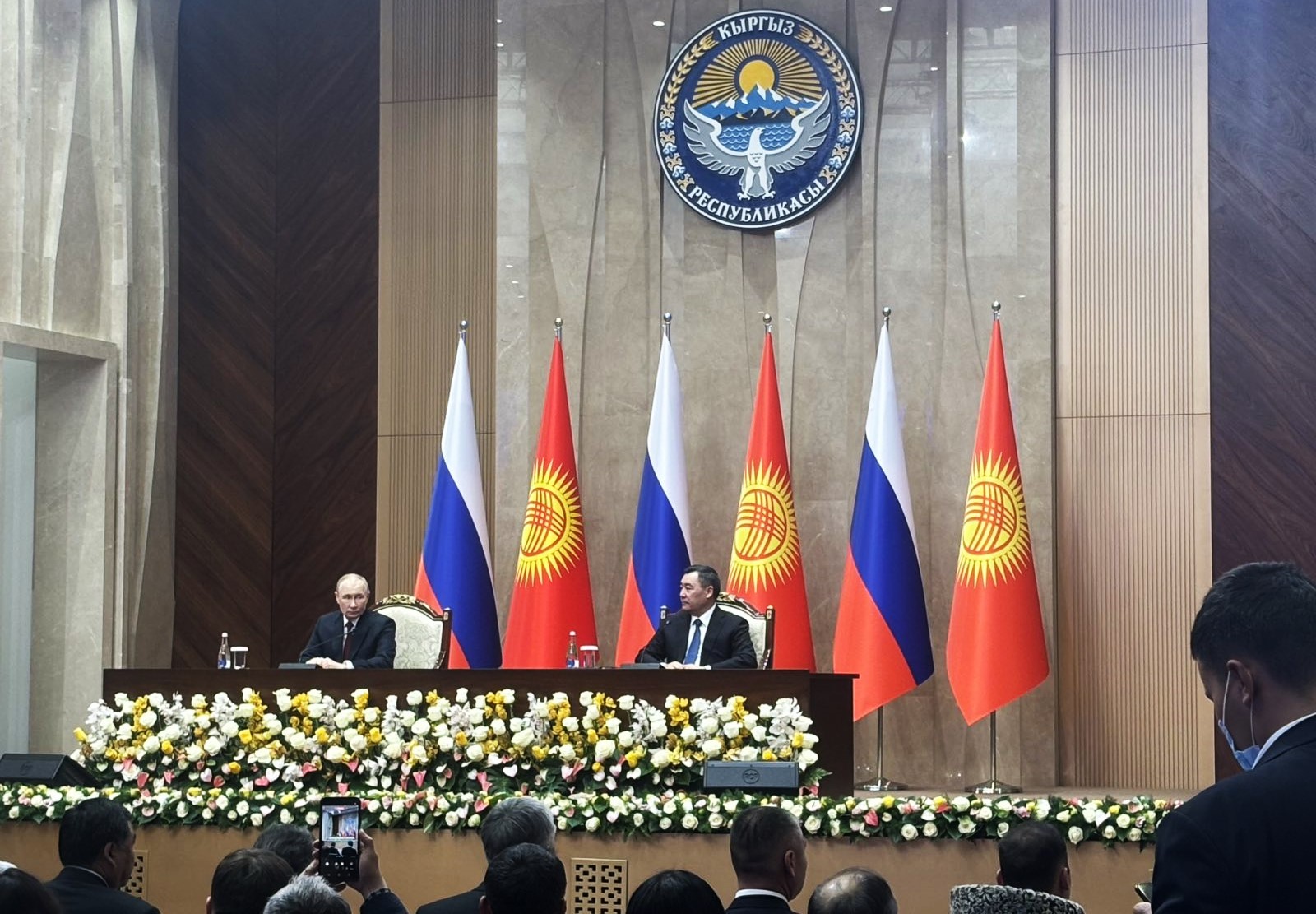
This followed a lavish launch ceremony at the city’s opera house, attended by Russian Foreign Ministry spokeswoman, Maria Zakharova, and the Kyrgyz deputy Prime Minister Edil Baisalov. Putin himself lauded the new channel in his speech on November 26, and gave its chief editor, Natalia Korolevich, an exclusive interview the following day.

This followed a feverish autumn, which the broadcaster had spent poaching talent from newsrooms around Bishkek.

This included Mirbek Moldabekov, a veteran broadcaster from the state television channel, UTRK; the head of Sputnik in Kyrgyzstan, Erkin Alimbekov; and his wife, Svetlana Akmatalieva, a journalist from the National TV and Radio Corporation. The channel’s producer is Anna Abakumova, a former RT journalist who gained fame reporting from Russian-occupied territories in Ukraine.

These aggressive recruitment tactics have split the profession in Kyrgyzstan. Journalist Adil Turdukolov asserted in an interview with Exclusive.kz that anyone who has chosen to work for Nomad “is not particularly concerned with the moral or civic aspects [of the job].”

Others in the media industry told TCA under condition of anonymity that the campaign against journalists joining the new channel “has become a little hysterical.”

Vladimir Putin’s state visit to Kyrgyzstan on November 26, where he praised the launch of Nomad TV; image: TCA, Joe Luc Barnes

A Warm Welcome

While Russia is hardly unique in having state media in Kyrgyzstan – Britain’s publicly-funded BBC operates a Kyrgyz service, while the United States Congress currently still funds Radio Azattyk (RFE/RL) – Rashid Gabdulhakov, associate professor at the University of Groningen, notes the contrasting reception that Nomad has received when compared to other foreign media.

“The claim that Nomad TV is ‘just another media outlet’ free to operate like any other is misleading,” he told TCA.

When Azattyk was defunded by the White House in March 2025, Kyrgyzstan’s President Sadyr Japarov responded favorably: “People do not need information from Azattyk… Trump and Musk’s decision should be supported,” he said, having accused the media outlet of disinformation.

Meanwhile, independent media in Kyrgyzstan, such as Kloop and Temirov Live, have been designated extremist organizations. “Former employees were prosecuted for having worked there,” said Gabdulhakov. “Even liking or sharing Kloop’s content can now carry risks.”

He contrasts that with the fact that leading politicians are eager to appear in interviews with Russia’s new channel.

“Nomad offers something politically convenient: predictable, Kremlin-aligned messaging that also flatters the ruling regime in Bishkek, as long as it stays within the boundaries acceptable to Moscow,” he said.

Russia’s Wider Media Ambitions

Russian television channels such as Channel One, Russia 24, Kultura, and Zvezda already broadcast in Kyrgyzstan, and coffee shops such as Vanilla Sky offer a free copy of the state newspaper Rossiyskaya Gazeta. So what purpose is being served by the creation of another channel?

Temur Umarov, research fellow at the Carnegie Russia Eurasia Center in Berlin, believes that money lies at the root of it. “I don’t think anyone in Russia is thinking about it strategically, except as a means of pitching it to decision makers; it’s much more about money,” he told TCA, asserting that the channel is a means of “washing out the resources that Russia has for the purposes of particular people in the media machine.”

Others suspect that it might be a means of restoring influence on social media. Channels funded by the Russian state were removed from YouTube in 2022.

Although Nomad is evidently linked to the Russian state, given its access to the Russian president and the number of employees linked to Kremlin media, its funding sources are grey, and it is officially designated a Kyrgyz-Russian joint project.

An investigation by Azattyk revealed Nomad’s links to the shadowy non-profit organization, Evrasia, funded by Moldovan oligarch Ilan Shor and chaired by Russian Duma speaker Vyacheslav Volodin. The organization, which opened a Russian Cultural Center in Bishkek just before Putin’s visit, has already been at the heart of a disinformation campaign in the 2024 elections in Moldova, and is said to be in charge of training the new recruits for Nomad TV.

The funding appears to be grey enough, however. The channel has not yet fallen foul of YouTube, where it has over 6,000 subscribers, while on its Instagram account, this figure has risen to more than 20,000. While these figures are modest, they may represent a test case in how to spread Russian influence abroad.

The use of these U.S. platforms is rather ironic given that Instagram has been designated as extremist by Moscow and is banned within Russia. Meanwhile, YouTube’s speed has been affected by Rozkomnadzor, the country’s internet censor, making its use difficult without a VPN.

Such hypocrisy is not unique to Russia, with Chinese state media also making use of YouTube to spread their own state narrative despite banning it at home – CGTN alone has 3.6 million subscribers. In this case, “influence strategy takes precedence over ideological consistency,” said Gabdulhakov.

Nomad’s launch in Kyrgyzstan was quickly followed by a larger Russian campaign elsewhere – on December 5, RT opened a new bureau in India, based in New Delhi.

Is there an audience?

While RT’s operation in New Delhi suggests the Kremlin sees scope for pushing its narrative in the global south, Nomad’s style is quite different. Unlike RT, there is little in the way of foreign wars, hordes of migrants, or sensationalist polemics. The thunderous, frenetic music is nowhere to be heard either.

For all the fanfare of the launch, the high-level interviews, and the glitzy studio, Nomad’s offerings have focused on the local and the everyday. When there is no news, the channel rebroadcasts NTV, another Russian state channel.

And there are further doubts about the potential audience. Although there is a Kyrgyz option on the channel, the main broadcasting language is Russian, and according to Bekmurzaev, “most people don’t understand Russian well enough to listen to news and debates.”

That said, the channel’s Kyrgyz language Instagram page has seen far faster growth than its Russian equivalent, suggesting that social media may be the long-term play.

“TV is dead,” says Umarov bluntly. “Everyone is going from TV to socials.”

Umarov is also unconvinced about Moscow’s desire to influence the Kyrgyz population. “I would be surprised if it became an effective tool to spread the Kremlin’s message,” he said.

“The Kremlin thinks that the audience doesn’t really matter. As long as there is an understanding among the elites, the Kremlin is happy. It doesn’t really need the support of the population.”

Kazakhstan Proposes Creation of UN Water Agency to Tackle Global Resource Challenges

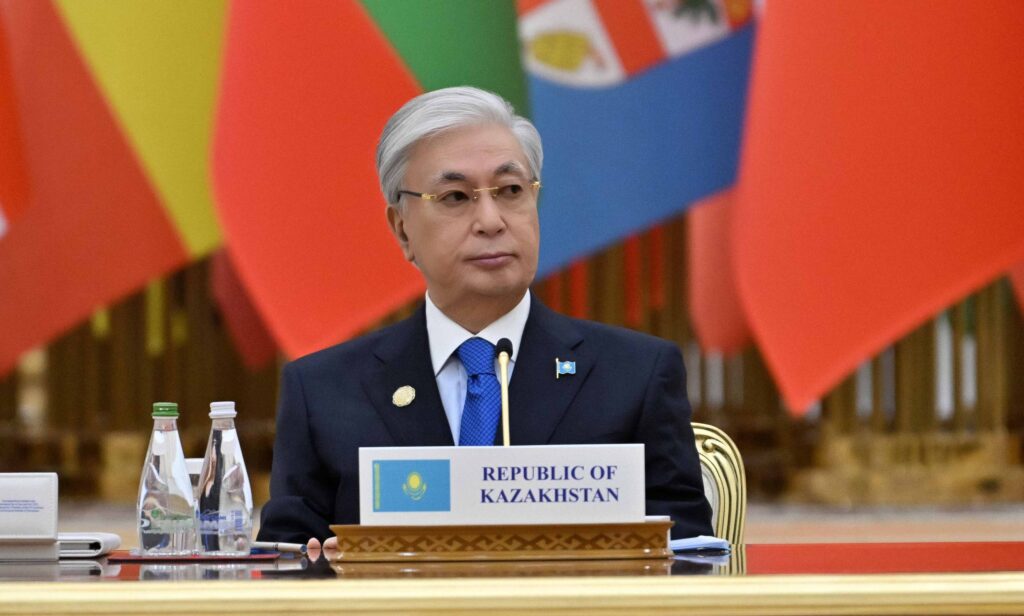
At a forum marking the International Year of Peace and Trust and the 30th anniversary of Turkmenistan’s permanent neutrality, Kazakhstan’s President Kassym-Jomart Tokayev proposed establishing a specialized United Nations body dedicated to the rational use of water resources.

In his address, Tokayev emphasized the urgent need for enhanced global coordination in managing water diplomacy, noting that the current UN framework lacks a dedicated agency focused solely on water-related issues. UN-Water currently functions as a coordination mechanism rather than a specialized agency, bringing together more than 30 UN entities and dozens of international organizations involved in water and sanitation. Unlike bodies such as the World Health Organization or the Food and Agriculture Organization, it has no independent mandate, budget, or enforcement capacity, a limitation long cited by water policy experts.

“Kazakhstan proposes the establishment of an International Water Organization that could consolidate all existing mandates of various UN organizations,” he said during the forum in Ashgabat.

Central Asia is among the regions most exposed to water stress, with climate change, aging infrastructure, and competing national demands placing increasing pressure on shared river basins. Disputes over transboundary water use have periodically strained relations among regional states, making water diplomacy a persistent strategic concern. Tokayev suggested transforming the current UN-Water mechanism, a coordinating platform comprising 36 UN entities and 47 international organizations, into a fully-fledged UN agency with a specialized mandate on water and sanitation.

“The implementation of such an initiative is fully in line with the UN’s Sustainable Development Goals and, of course, is in the interests of the entire international community,” he stated.

The President also announced that Astana will host a Regional Environmental Summit in April 2026, during which Kazakhstan plans to initiate international consultations on forming the proposed global water organization.

“I am confident that, with shared political will, water-related challenges can begin to be addressed systematically rather than in a piecemeal manner, as is currently the case,” he said.

Tokayev stressed that in light of intensifying water scarcity, water conservation and rational usage have become critical priorities, not only for Kazakhstan but for all Central Asian nations. The Caspian Sea has experienced sustained water-level decline over recent decades, a trend scientists attribute to climate change, reduced river inflows, and rising evaporation. The issue has emerged as a growing concern for coastal states due to its implications for fisheries, energy infrastructure, and regional economic stability.

He also highlighted the pressing need to address transboundary water use and the deteriorating ecological conditions of the Aral and Caspian Seas. Tokayev advocated for enhancing the effectiveness of the International Fund for Saving the Aral Sea through joint, compromise-based regional efforts and proposed that Russia be invited to join the Fund as an observer.

“The current rate of the Caspian Sea’s shallowing threatens to become irreversible,” he warned, “which would trigger a chain reaction of environmental, socio-economic, and even political consequences.”

Kazakhstan has already taken a leading role in regional initiatives to preserve the Caspian ecosystem. The country previously proposed a special intergovernmental program to combat the degradation and shrinking of the Caspian Sea. Tokayev urged the global community to support Kazakhstan’s efforts to safeguard this vital and unique body of water.

Any effort to establish a new specialized UN agency would require broad international consensus, approval by the UN General Assembly, and agreement on funding and governance structures — a process that typically takes years. Tokayev framed the proposal as a starting point for consultations rather than an immediate institutional change.

Uzbek Student Among Two Killed in Brown University Shooting

Two students were killed, and nine others were injured in a shooting on the campus of Brown University in Providence, Rhode Island, a tragic event that has drawn international attention. Uzbekistan’s Ministry of Foreign Affairs has confirmed that one of the deceased was an Uzbek national.

The shooting occurred overnight on December 13-14 at the Ivy League institution. The death of Muhammad Aziz Umurzoqov was first reported by family members through a fundraising appeal on the GoFundMe platform and later officially confirmed by the press secretary of Uzbekistan’s Foreign Ministry.

In the GoFundMe statement, Umurzoqov was remembered as a kind, intelligent, and compassionate young man who dreamed of becoming a neurosurgeon. “He always lent a helping hand to anyone in need without hesitation,” the family wrote. As of 10:30 a.m. Uzbekistan time on December 15, donations had reached $171,326. The family stated that a portion of the funds would be donated to charity in his name.

Initial reports from CNN, citing law enforcement sources, indicated that a 24-year-old man from Wisconsin had been detained in connection with the incident. However, Brown University later clarified that the man had been released. In an official statement, the university said Providence police had found “no basis” to consider him a person of interest, a conclusion also confirmed by the Rhode Island Attorney General.

Brown University confirmed that two students were fatally shot, while nine others sustained injuries ranging from minor to critical. Law enforcement authorities have stated there is no immediate threat to the campus or surrounding community, though the investigation remains ongoing.

Providence police are leading the investigation in coordination with local, state, and federal agencies. In response, Brown University has significantly increased its on-campus police presence, with the Department of Public Safety more than doubling its staff. Authorities have established a dedicated tip line and urged anyone with relevant information to contact the Providence Police Department.

University officials have reiterated their commitment to campus safety and urged students, faculty, and staff to remain alert as the investigation progresses.

Organization of Turkic States Discusses Key Eurasian Energy Projects

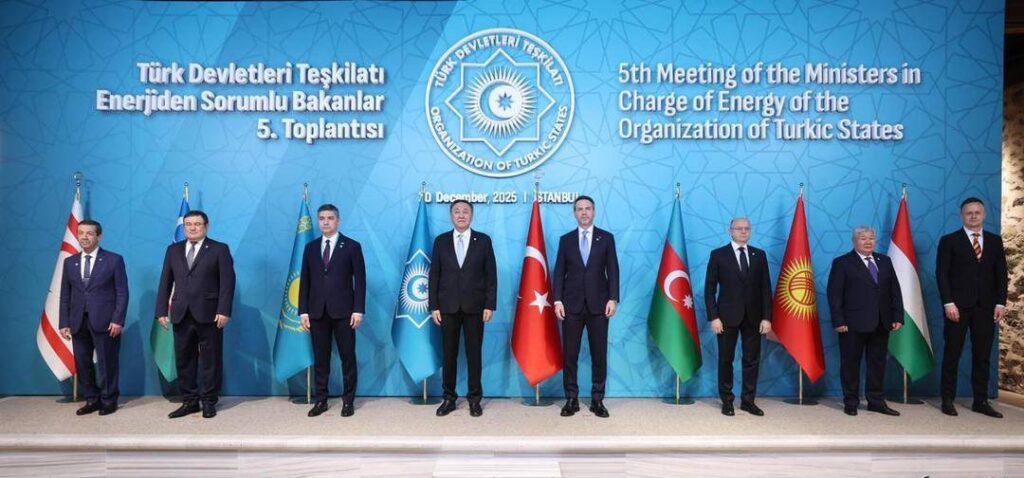
At the 5th meeting of ministers responsible for energy within the Organization of Turkic States (OTS), held on December 10 in Istanbul, OTS Secretary General Kubanychbek Omuraliev outlined major joint energy initiatives underway among member states.

Founded in 2009, the OTS comprises Azerbaijan, Kazakhstan, Kyrgyzstan, Turkey, Uzbekistan, and Turkmenistan. Hungary and Northern Cyprus participate as observer states.

Omuraliev touched upon the following projects:

  • Major oil and gas routes such as the Baku-Tbilisi-Ceyhan (BTC) oil pipeline, Baku-Tbilisi-Erzurum (BTE) gas pipeline, South Caucasus Pipeline, Trans-Anatolian Natural Gas Pipeline (TANAP), Trans Adriatic Pipeline (TAP), and the Iğdır-Nakhchivan gas pipeline;
  • A strategic partnership between Azerbaijan, Kazakhstan, and Uzbekistan to develop and transmit green energy;
  • The Azerbaijan-Georgia-Turkey-Bulgaria Green Energy Corridor, which extends the Central Asia-Azerbaijan corridor and opens new avenues for energy exports to Europe;
  • Construction of the Kambarata-1 Hydropower Plant in Kyrgyzstan, a project jointly developed with Kazakhstan and Uzbekistan; and
  • A planned Black Sea submarine cable to transmit renewable energy.

Omuraliev emphasized that enhanced intra-OTS cooperation bolsters both the economic potential of member states and regional energy security.

Ministers at the meeting noted the significant fossil fuel and clean energy resources held by OTS members and observers, describing the region as a strategic energy bridge between Asia and Europe. They stressed that advancing practical cooperation is essential amid growing global energy demand and the accelerating energy transition.

Participants agreed to move forward with joint projects under the OTS framework, including the establishment of a Regional Center for Technologies and Green Initiatives.

As previously reported by The Times of Central Asia, on December 5, the Board of Governors of the Turkic Investment Fund announced in Bishkek that the fund will begin operations in the first quarter of 2026.

The Turkic Investment Fund is the first dedicated financial institution jointly established by OTS member states. Headquartered in Istanbul, its mandate is to promote economic cooperation, boost intra-regional trade, and support sustainable development by financing major joint initiatives across the region.

Ashgabat Hosts Forum Marking International Year of Peace and Trust

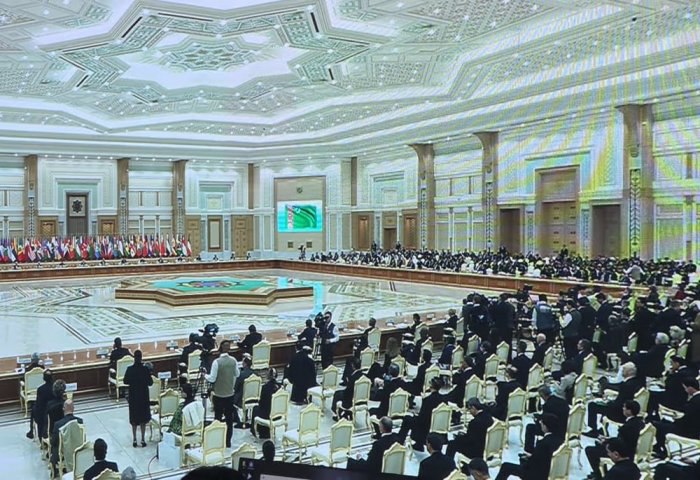
An international forum marking the 30th anniversary of Turkmenistan’s permanent neutrality has opened at the Maslahat Köşgi Palace in Ashgabat. The event has drawn high-level delegations and representatives of international organizations.

Among those attending are President of Turkmenistan Serdar Berdimuhamedov, President of Russia Vladimir Putin, and the presidents of Turkey and Iran, Recep Tayyip Erdogan and Masoud Pezeshkian.

The forum has also brought together the presidents of the Central Asian states, including President of Kazakhstan Kassym-Jomart Tokayev, President of Kyrgyzstan Sadyr Japarov, President of Uzbekistan Shavkat Mirziyoyev, and President of Tajikistan Emomali Rahmon. Other participants include Prime Minister of Pakistan Mian Muhammad Shehbaz Sharif, Prime Minister of Georgia Irakli Kobakhidze, and Prime Minister of Azerbaijan Ali Asadov, along with other heads of state and government.

In his opening address, President Berdimuhamedov said neutrality has provided a strong foundation for Turkmenistan’s sustainable development. He noted that the country’s foreign policy is guided by principles of peace, trust, and mutual respect, and that Turkmenistan’s approach to neutrality reflects long-standing traditions of good neighborliness and harmony.

The forum is being held as a broad international dialogue and is expected to open new opportunities for promoting global peace and expanding international cooperation.

Ahead of the forum’s opening, President Berdimuhamedov and visiting foreign leaders took part in a ceremonial flower-laying at the Monument of Neutrality in Ashgabat as part of the official events commemorating the country’s neutral status.

Turkmenistan’s permanent neutrality was formally recognized by a United Nations General Assembly resolution on December 12, 1995. In 2017, at Ashgabat’s initiative, the General Assembly designated December 12 as International Neutrality Day.

In 2025, the United Nations declared the International Year of Peace and Trust. In this context, the Peace and Trust forum is being held on December 12 in Ashgabat with the participation of leaders from member states of the Organization of Turkic States.