• KGS/USD = 0.01144 0%
  • KZT/USD = 0.00211 0%
  • TJS/USD = 0.10438 0%
  • UZS/USD = 0.00008 0%
  • TMT/USD = 0.28490 0%
  • KGS/USD = 0.01144 0%
  • KZT/USD = 0.00211 0%
  • TJS/USD = 0.10438 0%
  • UZS/USD = 0.00008 0%
  • TMT/USD = 0.28490 0%
  • KGS/USD = 0.01144 0%
  • KZT/USD = 0.00211 0%
  • TJS/USD = 0.10438 0%
  • UZS/USD = 0.00008 0%
  • TMT/USD = 0.28490 0%
  • KGS/USD = 0.01144 0%
  • KZT/USD = 0.00211 0%
  • TJS/USD = 0.10438 0%
  • UZS/USD = 0.00008 0%
  • TMT/USD = 0.28490 0%
  • KGS/USD = 0.01144 0%
  • KZT/USD = 0.00211 0%
  • TJS/USD = 0.10438 0%
  • UZS/USD = 0.00008 0%
  • TMT/USD = 0.28490 0%
  • KGS/USD = 0.01144 0%
  • KZT/USD = 0.00211 0%
  • TJS/USD = 0.10438 0%
  • UZS/USD = 0.00008 0%
  • TMT/USD = 0.28490 0%
  • KGS/USD = 0.01144 0%
  • KZT/USD = 0.00211 0%
  • TJS/USD = 0.10438 0%
  • UZS/USD = 0.00008 0%
  • TMT/USD = 0.28490 0%
  • KGS/USD = 0.01144 0%
  • KZT/USD = 0.00211 0%
  • TJS/USD = 0.10438 0%
  • UZS/USD = 0.00008 0%
  • TMT/USD = 0.28490 0%

TRIPP and the Middle Corridor After Vance

U.S. Vice President J.D. Vance’s Armenia and Azerbaijan tour is being sold as a “peace dividend” for the South Caucasus, but for Central Asia, the significance is the infrastructure potential of the Trump Route for International Peace and Prosperity (TRIPP). Vance’s trip is another move in positioning the new Caucasus transit route for the Middle Corridor. His visit necessarily focuses on the Armenia–Azerbaijan fix, but recent diplomatic context makes clear that it is at least equally a Central Asia to Europe proposition.

Current constraints on Trans-Caspian connectivity have been the shortage of dependable shipping capacity across the Caspian, port access, and border processing times. As the European Commission pointed out last week, traffic has surged since 2022, but the next jump depends on targeted investment and practical fixes along the route.

The Middle Corridor’s Central Asian Axis through Kazakhstan and Uzbekistan

Kazakhstan’s recent moves treat the bottlenecks as practical engineering and scheduling problems. The dredging project at Kuryk aims to deepen the port approach channel to five meters to support year-round navigation. Work is scheduled for early 2026 and backed by ERSAI Caspian Contractor LLC, a joint venture between Saipem and the Kazakhstan-based business group ERC Holdings. ERSAI is a major industrial port and fabrication yard operator specializing in offshore construction, logistics, and port services in the Caspian Sea. The dredging project is tied to broader terminal and shipyard expansion designed to create a key industrial hub.

Shipping capacity is the other half of that story. A plan reported late last year envisages six ferries on the Kuryk–Alat line, with the first two entering service in the first half of 2026 and additional vessels added through 2028. Even if timelines slip, the point is to create a predictable schedule.

Uzbekistan’s connectivity push has been running on two tracks at once: east to west via the Caspian, and southward toward ports beyond Central Asia. In Washington, a delegation from Tashkent, led by Foreign Minister Bakhtiyor Saidov, a week ago signed a memorandum with the United States on critical minerals and rare earths. This move treats extraction and processing as a supply-chain partnership rather than a one-off investment pitch.

At the same time, Uzbekistan has been pushing rule-making with corridor partners, not waiting for outsiders to do it. On February 10, Azerbaijan, Turkmenistan, Uzbekistan, and Georgia signed a protocol covering digitalization and freight development along the Middle Corridor, including shared methods for tracking delays and pinch points. This is in line with the necessary streamlining of paperwork.

TRIPP as the South Caucasus Link for Central Asia

TRIPP is meant to make the Caucasus segment less fragile by adding a second path, other than the recently renovated and expanded Baku–Tbilisi–Kars railway route. The U.S-backing and institutional presence are meant to create confidence and reliability. Armenia’s own published implementation framework describes a TRIPP Development Company with an initial 49-year development term and a proposed 74% U.S. share, while stating that Armenian sovereignty, law enforcement, customs, and taxation authority remain intact. This satisfies domestic Armenian political demands to move goods faster without formally transferring jurisdiction.

Vance’s Yerevan package was built to signal that the United States will underwrite Armenia’s strategic pivot with material assistance. A civil nuclear cooperation agreement is foreseen under a 123 framework, with figures that point to billions in potential exports and longer-term fuel and service ties, as Armenia looks to replace the aging Metsamor plant. A “123 Agreement” is a legally binding, negotiated framework under Section 123 of the U.S. Atomic Energy Act of 1954 authorizing significant civil nuclear trade, technology transfers, and fuel supply between the United States and a partner nation. Although this is not connectivity in the narrow sense, it is the kind of capital commitment that makes a corridor promise feel less reversible.

In Baku, the anchor was a Charter on Strategic Partnership that explicitly links cooperation to regional connectivity and the Trans-Caspian International Transport Route, alongside security and trade priorities. Local reporting and regional outlets have also highlighted maritime security cooperation, including patrol boats meant to protect Azerbaijan’s Caspian waters, which is where Middle Corridor reliability begins to look like naval policy.

For Central Asia, TRIPP’s practical meaning is as a way to reduce single-route dependence in the Caucasus segment while pulling “critical minerals” into the same conversation as rail schedules and port depth. That link was reinforced earlier this month in Washington, where Vance used a critical minerals gathering to push the idea of a U.S.-led trade bloc for minerals and rare earths, explicitly courting Kazakhstan and Uzbekistan as partners.

The Connectivity Agenda

The most useful way to read Vance’s trip is as an attempt at further integration of the South Caucasus segment into Central Asia’s already-moving connectivity agenda. Kazakhstan is increasing port access and ferry capacity; Uzbekistan is writing operating rules with partners and courting supply-chain capital; the EU is mapping where investment actually pays off. TRIPP is being introduced as the missing link that could make those efforts cohere into a route with robust redundancy.

The next phase will depend upon whether Kazakhstan’s shippers, Uzbekistan’s exporters, and logistics firms can treat the route as a normal commercial baseline rather than an episodic workaround. The EU’s effort to reduce exposure to Russia-centric routes and Central Asia’s efforts to secure more than one dependable path for goods and minerals to European buyers have made the Middle Corridor the favored link. TRIPP’s significance here is less as a U.S. initiative and more as a new routing option that Kazakhstan and Uzbekistan can use to strengthen and attract increased processing and logistics investment while reducing vulnerability to sudden disruptions.

At a strategic level, TRIPP also signals the return of corridor politics as a structuring principle for cooperative relationships. In the 1990s logic, security reassurance was paired with major transport and energy projects; this logic is now reappearing as critical minerals and supply-chain resilience now complement oil, gas, and pipeline diplomacy. Competitive responses from Russia and Iran are evident, but the point is for Armenia and Azerbaijan to manage this together, with U.S. help, and to prevent corridor development from turning into a permanent contest. For Central Asia, the outcome that matters most is TRIPP’s contribution to making trans-Caspian transit predictable enough that investment decisions in Kazakhstan and Uzbekistan treat the route as reliable.

On the Eve of Valentine’s Day: Customs of Love and Marriage in Central Asia

On the eve of Valentine’s Day, Central Asia is once again debating whether to celebrate the holiday or regard it as a symbol of foreign influence. Yet the region has its own rich and diverse customs related to love, matchmaking, and marriage.

Accusations of Alien Influence and “Corruption”

Valentine’s Day, like Halloween, spread to the former Soviet republics after the collapse of the USSR. In the first decades, young people embraced the new holidays. In recent years, however, critics have increasingly argued that commemorating a Catholic saint in a format centered on romantic love contradicts the traditions of the region’s peoples.

For example, in Kazakhstan last year, deputies of the Mazhilis, the lower house of parliament, sharply criticized Valentine’s Day. Some deputies argued that it corrupts young people, promotes “free love,” and even carries “homosexual overtones.” 

It is worth noting that Kazakhstan recently adopted legislation prohibiting so-called “propaganda of non-traditional sexual relations.” The Spiritual Administration of Muslims of Kazakhstan has also stated that Valentine’s Day promotes alien values and encourages promiscuity.

Gratitude for Raising a Daughter

Many matchmaking and marriage customs remain common across Central Asia, particularly the significant role of the bride’s and groom’s parents in ceremonies and celebrations. While traditions have evolved, many are still practiced in modern engagements and weddings.

The well-known custom of paying bride price, kalym, has been preserved, though it has undergone significant change. Today, kalym varies depending on the wealth of the families. It may include apartments or cars, or it may amount to several hundred dollars. Importantly, kalym is now generally regarded as financial support for the young family and, as a rule, remains at the disposal of the bride and groom. Historically, in Kazakhstan and Kyrgyzstan, kalym was paid in livestock, and wedding celebrations could last more than a month. 

One of the main Kazakh wedding rituals is the groom’s visit to the bride’s village or, in modern practice, her home. Before his first visit, the groom sends gifts to the bride’s family, known as Ilu,  an expression of gratitude for raising their daughter.

In some regions of Kazakhstan, this ritual is called ana suty (“mother’s milk payment”). In the past, it included horses, camels, sheep, and riding equipment for the bride’s father. Today, it may consist of any valuable gift, and jewelry is often presented to the women in the bride’s family. The bride traditionally gives the groom a scarf as a symbol of her purity. Festivities then begin, with singing and dancing.

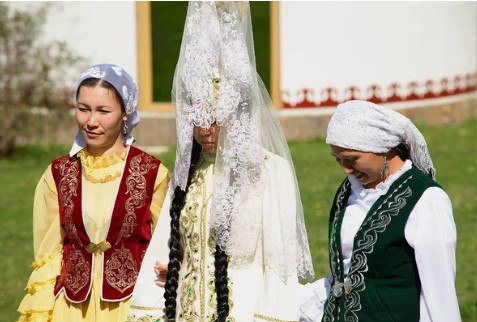
Kazakh traditions often involve two weddings: one at the bride’s home and one at the groom’s. The bride’s farewell from her family home remains especially significant, reflecting her relatives’ wishes for her future life. Today, this ceremony is often held in a restaurant. The bride does not wear a white wedding dress at the farewell celebration but appears in an elegant outfit and a traditional headdress known as a saukele.

During the farewell, the groom and his friends are subjected to playful pranks, for which they must pay with gifts or money. One of the oldest traditions is the performance of the zhar-zhar song contest. A group of women sings about the sorrow of parting and the uncertainties of married life, while a group of men responds with reassurance. Historians trace this tradition to pre-Islamic times, when marriages were sealed with community approval and communal singing.

Today, the main wedding ceremony begins with the official registration of marriage at a government office.

According to custom, the groom’s relatives were once not permitted to see the bride before the wedding. When she entered her husband’s home, the betashar (face-revealing) ceremony was performed, symbolizing her introduction to her new family and married life. Traditionally, the mother-in-law removed the bride’s shawl and cut it into pieces, symbolizing wishes for many children. Today, betashar is largely a ceremonial tradition, as families are typically well acquainted beforehand.

Religious Kazakh couples may also hold a marriage ceremony in a mosque on the same day. Modern weddings have incorporated European-style elements, including decorated car processions and visits to scenic locations.

Kyrgyz wedding customs closely resemble Kazakh traditions, with distinctive features of their own. For example, kulak choyu is a popular custom in which children playfully pull the groom’s ears until they receive money. Another ritual, chachyla, involves showering the newlyweds with sweets as the bride enters the groom’s home, symbolizing wishes for prosperity and happiness. 

No Wedding Without Pilaf

In Uzbekistan, similar to European custom, the bride holds a kiz osh before the wedding, a women-only celebration comparable to a bachelorette party. The bride presents gifts to her friends. A similar men-only celebration is held at the groom’s home. The number of guests may reflect the family’s social standing. 

This is followed by nikah-tui, the religious wedding ceremony conducted by an imam. The couple vows mutual respect and allegiance to each other and their families. The bride wears a traditional dress and veil, believed to protect her from the evil eye. The imam must obtain the bride’s consent, often communicated through a female representative.

Relatives then bid farewell to the bride before the traditional wedding feast begins. The main dish is pilaf, typically prepared by men. The celebration includes music, dancing, and abundant food.

In Tajikistan, matchmaking also plays a central role. During this process, the wedding date and the size of the mahr and kalina (dowry) are agreed upon. Neighbors and relatives attend the engagement ceremony, where rituals such as fotiha (a prayer marking the beginning of an undertaking) and nonshikanon (breaking of flatbread) are performed. The most respected elder breaks the bread and offers prayers for the couple’s future. The bride’s family distributes safedi, white fabric symbolizing purity and chastity. 

In Turkmenistan, wedding customs are carefully preserved while incorporating modern elements.

Scarves play a significant role. At the gelin toy (wedding at the bride’s home), women carry gifts and sweets wrapped in scarves. Upon departure, they receive bundles of equal value. In men’s competitions, winning a scarf is considered a prestigious prize. The wedding procession, once composed of camels and horses and now of cars, is decorated with colorful scarves that are later distributed to guests and drivers.

One of the most complex elements of a Turkmen wedding is the ritual transition from girlhood to womanhood. The bride’s braids are tucked behind her back; a small scarf is removed and replaced with a larger one. Occasionally, a child attempts to seize the old scarf. The mother-in-law returns it to the bride for a small ransom. The bride keeps the scarf until her own child marries, when it is passed on to the next generation.

Thus, despite debates over foreign holidays devoted to love, Central Asia continues to preserve its distinctive traditions of matchmaking and marriage.

Amid Questions, Tajikistan’s Presidency Says Rahmon Has Upcoming Meetings  

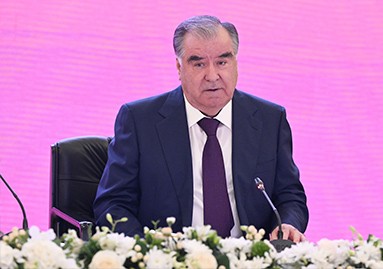
President Emomali Rahmon of Tajikistan has several meetings in the coming days, his office said this week, following reports that the leader had not been seen in public this month.

Rahmon, 73, will meet Zou Jiayi, head of the Asian Infrastructure Investment Bank, as well as Kazakhstani Foreign Minister Yermek Kosherbayev, who will visit Tajikistan, the presidential office said on Wednesday. Zou took up her job as president of the Beijing-based bank last month. Kosherbayev, who assumed his position in September, was scheduled to visit Kyrgyzstan on Thursday and Friday, media in Kyrgyzstan reported.

“Several other events are also planned with the participation of the Leader of the Nation, His Excellency Emomali Rahmon, which we will report on in more detail,” the Tajikistan’s presidential office said.

Rahmon’s Telegram channel showed video of him presiding over a meeting with law enforcement officials on January 28. But reports that he had not been seen in public since then stirred online speculation about his whereabouts and health. Similar unverified reports about the president have occasionally circulated in the past, in a country where the government tightly controls the flow of information.

Rahmon has been president of Tajikistan since 1994. His son Rustam Emomali is chairman of the National Assembly and would take over as interim president if his father is unable to serve.

Kyrgyzstan Moves to Expand Domestic and International Rail Tourism

Rail transport is expected to play a greater role in Kyrgyzstan’s tourism strategy as authorities seek to promote railways as an affordable and comfortable travel option for both domestic and international visitors.

On February 11, the national railway operator Kyrgyz Temir Jolu and the Tourism Development Support Fund of the Kyrgyz Republic signed a memorandum of cooperation aimed at the sustainable development of domestic and international tourism through rail infrastructure and passenger services. The agreement provides for joint promotional campaigns and coordinated railway tourism projects.

According to Kyrgyz Temir Jolu Chief Executive Officer Azamat Sakiev, rail-based tourism has demonstrated steady growth since the launch of dedicated tourist trains in partnership with travel companies in 2021. He said the company is prioritizing domestic routes while working to restore demand for cross-border rail travel.

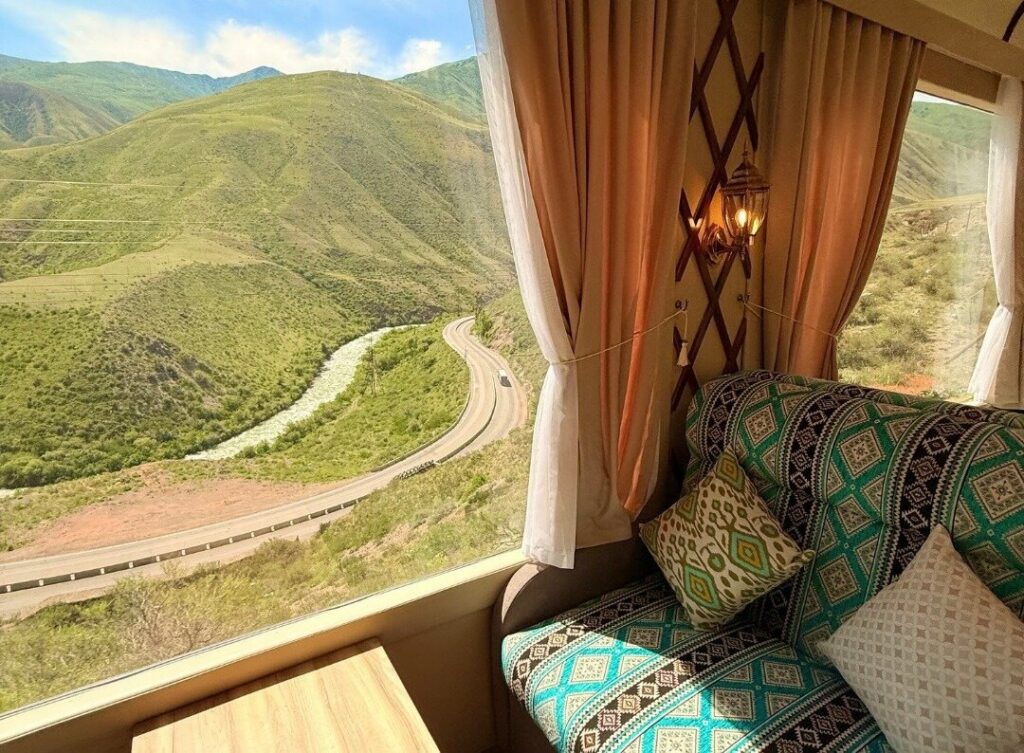
New routes are planned for this year, alongside continued modernization of rolling stock. Refurbished railcars featuring traditional interior design have already entered service, aimed at strengthening the country’s tourism brand and enhancing the passenger experience. Following the upgrades, the company reports a noticeable increase in traveler interest.

Kyrgyz Temir Jolu has introduced luxury and VIP compartment cars on the Bishkek-Balykchy line serving the Issyk-Kul region. Last year, the route was extended to the Balykchy Beach stop, providing passengers with direct access to the lakeshore during the summer tourist season. In 2025, the route carried 116,122 passengers, up 31% compared to 2024.

Kyrgyzstan’s rail network remains limited, largely reflecting Soviet-era infrastructure. The main line runs from the Kazakh border through Bishkek to Balykchy. Despite these constraints, the country hosted 27 international tourist trains between 2022 and 2025, bringing visitors from Europe, Asia, and the United States, indicating growing global interest in rail-based travel to Kyrgyzstan.

Rail tourism is also expanding at the regional level. Kazakhstan and Uzbekistan recently extended their joint Jibek Joly tourist train route to include Dushanbe, strengthening cross-border rail tourism links in Central Asia. Meanwhile, British operator Golden Eagle Luxury Trains has launched The Grand Silk Road, a 22-day luxury rail journey connecting major Silk Road destinations across the region.

Foreign Capital Inflows to Tajikistan Jump by One-Third, Approaching $7 Billion

Foreign investment in Tajikistan increased sharply in 2025, rising by more than one-third compared to the previous year, as the authorities also announced new investment agreements and long-term development strategies extending to 2040.

Speaking at a press conference, Sulton Rahimzoda, chairman of the State Committee for Investment and State Property Management of the Republic of Tajikistan, said that by the end of 2025, total foreign capital inflows had reached $6,925.3 million. This represents an increase of $1,798.6 million, or 35.1%, compared to 2024. In absolute terms, the economy attracted nearly $1.8 billion more in foreign investment than a year earlier.

According to the committee, $3,031.0 million of the total came from post-Soviet states in 2025, accounting for 43.8% of overall foreign investment. At the same time, countries outside the former Soviet Union accounted for the majority share. Tajikistan received $3,894.3 million from these countries, or 56.2% of total inflows. Investment from this group increased by $731.3 million year over year, or 23.1%.

Authorities attributed the growth in foreign capital to improvements in the regulatory framework. On the initiative of the State Committee, a new version of the Law of the Republic of Tajikistan “On Investments and Stimulation of Investment Activity,” dated May 14, 2025, No. 2173, was adopted.

Additional momentum came from the International Investment Forum “Dushanbe Invest – 2025,” held on October 14-16, where more than 50 cooperation agreements worth a combined $4.1 billion were signed.

Uzbekistan Approves Feasibility Study for Trans-Afghan Railway

President Shavkat Mirziyoyev has approved an intergovernmental agreement on the joint development of a feasibility study for the construction of the Trans-Afghan railway, which will link Uzbekistan, Afghanistan, and Pakistan.

According to the presidential resolution, the agreement between Uzbekistan’s Ministry of Transport, Afghanistan’s Ministry of Public Works, and Pakistan’s Ministry of Railways provides for the preparation of technical and economic documentation for a new railway line from Naibabad to Kharlachi. The document formalizes cooperation on the next stage of the long-discussed regional transport corridor.

Under the resolution, Uzbekistan’s Ministry of Foreign Affairs has been instructed to notify the Afghan and Pakistani sides that all necessary domestic procedures required for the agreement’s entry into force have been completed.

The Trans-Afghan railway project was first proposed by Tashkent in December 2018 as a strategic initiative to provide Central Asia with direct access to Pakistani seaports. The original concept envisaged extending Afghanistan’s rail network from Mazar-i-Sharif through Kabul and Logar province before crossing into Pakistan. An earlier proposed route was expected to pass through Nangarhar province and the Torkham border crossing into Peshawar.

In July 2023, however, Uzbekistan, Pakistan, and Afghanistan agreed on a revised alignment. The updated route will run from Termez to Naibabad, then through Maidan Shahr and Logar to Kharlachi, excluding the previously discussed Torkham crossing. Once connected to Pakistan’s railway network, cargo will be able to reach the Pakistani ports of Karachi, Gwadar, and Qasim.

The railway is expected to stretch approximately 647 kilometers. According to recent statements by Uzbek officials, the estimated construction cost is $6.9 billion, although earlier projections ranged from $4.6 billion to $7 billion.

The project is regarded by the participating countries as a key component of efforts to strengthen regional connectivity and expand trade routes between Central and South Asia.