Kazakhstani colorist Yerlan Tanay has built an international career in post-production, working with major companies including The Mill and Company 3. Now based in Los Angeles and working freelance, he has experienced both the opportunities and instability of Hollywood’s highly competitive market. His long-term goal is to move further into feature films.
Tanay career changed after he began sharing his work on Instagram, where he was approached about joining The Mill. In this interview with The Times of Central Asia, he explains how that move opened the door to Hollywood and what he learned inside leading post-production studios.
TCA: You have worked as a colorist for eight years, including three years in Hollywood. You were initially invited to join the renowned British post-production company The Mill, which had an office in Los Angeles. How did they find you?
Tanay: I was invited by Paul Yacono, the head of The Mill’s Los Angeles office. He is a well-known Australian colorist who has lived and worked in the United States for many years. He graded films for David Fincher and Chloé Zhao and also worked on major series such as House of Cards and music videos for international artists. We met on Instagram and spent almost two years simply communicating, following each other’s work, and occasionally discussing projects. Then one day, he wrote to me: “Would you like to have a Zoom call? We have an offer for you.” During the call, he asked whether I would consider moving to the United States. He then explained that a position had opened and that they were looking for a colorist from outside the American market; someone with a different professional background. It came as a complete surprise to me.
TCA: So, Instagram literally changed your career?
Tanay: Yes, absolutely. A producer once told me something very simple: “You do good work, but nobody knows who you are.” That was when I realized I needed somewhere to show my work. To be honest, I was skeptical about Instagram at first. I thought it was a platform where people posted pictures of food or makeup, not a place for a professional portfolio. But once I started posting my projects regularly, things gradually changed. My audience grew, people began noticing me, and then job offers started coming in. I was probably also fortunate to enter the platform at a time when professionals were only beginning to use Instagram actively for work.
TCA: Last year, The Mill ran into financial difficulties and was sold and restructured. What changed for you?
Tanay: I spent two very productive years there, but I had to leave together with the old team. After that, I received an offer from Company 3. To give you an idea, it is one of the companies that sets the standard for color grading in global cinema. If you ask any good cinematographer or director what Company 3 is, there is no need to explain it. Everyone knows the brand. You could say Company 3 is the Christopher Nolan of the color-grading world. They work with leading Hollywood directors, from Denis Villeneuve to Martin Scorsese and Quentin Tarantino. They have two large offices in Los Angeles. One of them was in the same building as Netflix, literally one floor above. Netflix producers could simply go upstairs and review the color grading. Everything was arranged for maximum convenience.
TCA: Do you still work there?
Tanay: No. Unfortunately, because of the crisis in the industry, the company began cutting costs. It had to reduce either salaries or staff, and I was laid off. I worked there for only a little over six months, but that was enough for me to understand how the entire system operates from the inside. It is now much easier for me to work with other international companies because I understand how everything is organized at the highest level.
TCA: Are you taking a break from work now?
Tanay: No, I moved into freelance work. When I lost my job at Company 3, I was not even upset. On the contrary, I thought that I would finally be able to spend more time at home. By then, my daughter had been born, while working for a company meant a nine-to-five schedule and only 15 days of annual leave. I spent a great deal of time at work and very little with my family.
TCA: Professionally, did that feel like a step backward or a step forward?
Tanay: More like a step forward. As a freelancer, I now have even more projects than I did at Company 3. The circle of people I work with has become much broader. My network has expanded, and I have started working with new directors and cinematographers. It is now much easier for me to find projects. In fact, I do not even look for them, they find me. Once the best-known studios appeared on my résumé, I gained a certain professional status, so to speak. People began trusting me with major international advertising projects.

TCA: Do you still live in Los Angeles?
Tanay: Yes. Simply because it is one of the world’s biggest centers of the film industry. It is much easier to meet people there, build relationships, and find new projects. When people see that you are already working in Los Angeles, they are much more willing to collaborate with you. The industry is constantly looking for new talent.
TCA: How does the freelance market in Hollywood work? How difficult is it to become part of the industry?
Tanay: It is extremely difficult. America has always attracted talented people from all over the world, but moving there is one thing; actually establishing yourself is something completely different. My professional background and reputation played a huge role. If I had not had The Mill and Company 3 on my résumé, it would have been much harder. At the same time, some of my clients found me before I joined those companies. After I left, my network of clients and industry contacts only continued to grow.
TCA: Was there a moment when you felt you had truly been recognized in the U.S.?
Tanay: I think so. When I moved from Kazakhstan to America and started working for companies that every colorist in the world dreams of joining, I felt for the first time that my work had genuinely been recognized. But today, I see that as just one stage of the journey, not the destination. There are much higher goals ahead. I still want to work on a major Hollywood feature alongside outstanding directors and cinematographers making films that truly matter. Of course, many people have the same ambition, and the competition is enormous. That is why I do not expect everything to happen overnight. The important thing is to keep working and never stop moving forward.
TCA: So, you plan to build your career in the U.S.?
Tanay: Yes, as long as I have the opportunity. I enjoy working there because you are surrounded by people you once only dreamed of meeting and collaborating with. In Kazakhstan, recognition can come much faster. The market is smaller, competition is lower, and talented professionals sometimes have an easier path to success. America is the exact opposite. But that is precisely why I want to work there. I want to compete with people who are considered the very best in their profession.
TCA: Because strong competition pushes you to improve faster?
Tanay: Absolutely. It forces you to sharpen your skills much more quickly and refine your craft. Decisions that once took hours, days, or even weeks eventually become almost instinctive. You develop your craft to the point where many professional decisions happen automatically, and each project makes you just a little bit better. That is what professional growth means to me.
TCA: How important is English for someone in your profession? Can a technical specialist succeed without speaking the language fluently?
Tanay: Color grading is not just a technical profession; it is also a creative one. Working in film means communicating constantly with directors, cinematographers, and producers. You need to understand exactly what they want you to achieve, so strong English is essential. I still believe my English is not good enough, even though many people tell me otherwise. When I first arrived in America, it sometimes took me almost a minute to process what someone had said. Today, everything happens much faster, but I continue studying because any obstacle to communication slows down the work. I try to eliminate anything that prevents me from doing my job faster and better.
TCA: How does the color-grading process differ between Hollywood and Kazakhstan? Is it really like comparing two completely different worlds?
Tanay: In Kazakhstan, the key creative decisions are usually made by the director and the cinematographer. Producers become involved much less often. In Hollywood, especially on major studio productions, producers are active participants in the process. They usually focus on making sure the image is not too dark, that actors’ faces remain clearly visible, and that the picture looks visually appealing and accessible to audiences.
TCA: Do you still work on Kazakh films, or has working with Hollywood equipment and the latest technology changed your focus?
Tanay: I still work on Kazakh films, depending on the project. The software and equipment are important, of course, but honestly, you can produce excellent work even on an inexpensive monitor. What really matters is following the technical standards, so viewers see exactly the image that the director and cinematographer intended.
TCA: Has anything about working in Hollywood surprised you? Screenwriter Gulzhan Toktogul, who studied in the U.S., has said that talent alone is not enough and that professionals must also be people others want to work with. Do you agree?
Tanay: Absolutely. No one is indispensable. If someone is difficult to work with, there will always be another professional who can do the job just as well while making the entire team feel comfortable. I think that in our part of the world there is still a tendency to excuse almost anything if someone is considered a genius. In America, that attitude is much less common. People value talent, of course, but they also value professionalism, communication skills, the ability to listen, and being a good teammate.
TCA: Are there distinct schools of color grading around the world? For example, British, American, or Asian?
Tanay: I would not say there are distinct schools, but British colorists have long been regarded as some of the best in the industry. That may be because post-production developed earlier in the United Kingdom than elsewhere. Companies such as The Mill, MPC, Framestore, and many others helped establish an exceptionally strong professional environment. Outstanding colorists can be found all over the world. When I worked at Company 3, about half of my colleagues were Americans, while the rest came from countries including South Korea, Kazakhstan, Japan, Denmark, India, and Ukraine. In the end, where you are from matters far less than how well you do your job.
TCA: Is advertising still the main focus of your work in the U.S.?
Tanay: Yes, for now.
TCA: Is it true that you have worked on music videos for Kanye West?
Tanay: Yes, we worked on several projects together. One of them, however, was never released. After watching the finished video, Kanye said he did not want a single cut in it. He wanted the entire video to appear as one continuous shot. As a result, the whole project was reshot in a single take using a very unusual high-speed film camera originally designed to capture nuclear explosions. Filming took place on one of the roughest streets in Los Angeles, where sex workers, homeless people, and drug users actually live. A long camera track was installed, allowing the entire video to be filmed in one uninterrupted take. The cinematographer was Xiaolong Liu, who later worked with Aisultan Seitov. He was the one who brought Aisultan to our team, and together we created the LUT, or Look-Up Table, for the film. A LUT establishes the visual foundation for a movie, commercial, or music video before the final color grading begins.
TCA: Many people would probably mention working with Kanye West first when talking about their career. Why do you not?
Tanay: I do not know. I have never really thought of it that way. Yes, I have graded music videos for Kanye West, Ivan Dorn, the Kazakh band Irina Kairatovna, and many other artists. I have worked with most of Kazakhstan’s major musicians as well. But I have never judged projects by the fame of the people involved. To me, they are all talented artists. Some simply have larger audiences than others, but that does not determine the value of their work. What has always interested me most is the person behind the project and the project itself; not how famous the name is.
TCA: Can great color grading turn an average film into an outstanding one?
Tanay: No. A film has to be genuinely good to begin with. It may be beautifully shot and technically flawless, but if it lacks a compelling story or an emotional core, no amount of color grading can save it. When that happens, you stop paying attention to the story and start noticing the technical details instead because the film itself no longer holds your attention.
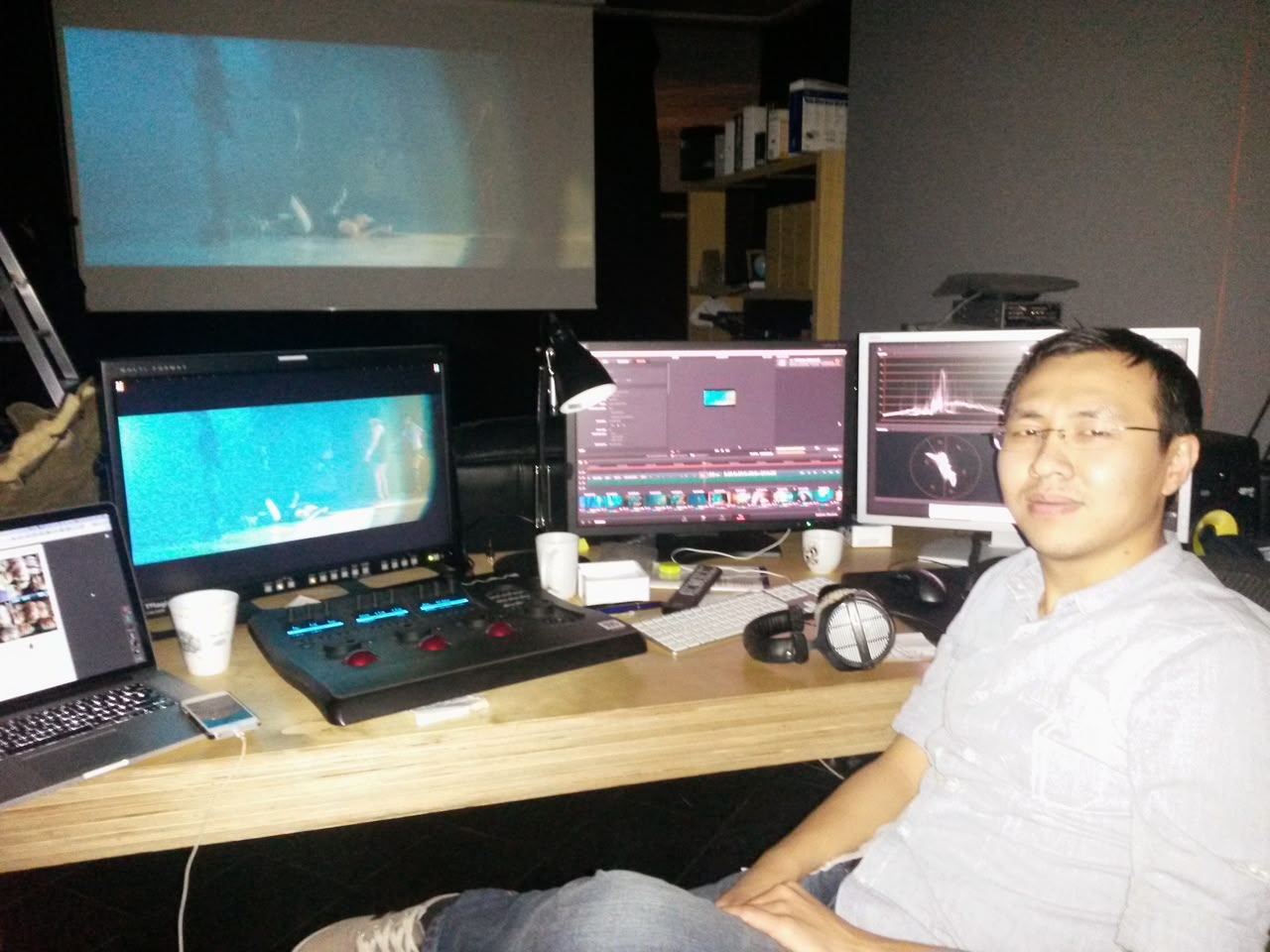
TCA: When audiences notice beautiful color grading, is that a compliment? Or does it mean the colorist’s work has become too obvious?
Tanay: When I go to the cinema, I try to switch off the technical part of my brain. There was a time when my profession had almost conditioned me to notice everything; where someone’s eyes had been enhanced, where contrast had been pushed too far, why a particular color decision had been made. That happens much less often now. I consciously try to suppress the urge to analyze everything and simply experience the film as an ordinary viewer.
TCA: So you can no longer watch films like everyone else?
Tanay: I am working on it. The first time I watch a film, I try not to analyze it technically. But if I see it a second time, then it becomes a professional viewing. That is when I start paying close attention to the image, how scenes were matched, what visual techniques were used, and what creative decisions were made during the color-grading process.
TCA: Do you notice things that almost nobody except another colorist would see?
Tanay: Absolutely. When I watched The Brutalist, one particular scene stood out. Up to that point, the lighting had been completely consistent, but then, in the son’s office, the sunlight outside suddenly looked noticeably different. Later, during a discussion with the film’s cinematographer, Lol Crawley, I asked him why that happened. He immediately smiled and asked, “You actually noticed that?” I said I had. It turned out they had spent a great deal of time trying to solve that exact problem during color grading but were never completely satisfied with the result. Meanwhile, a friend of mine who also works in film but is not a colorist; did not notice anything unusual at all.
TCA: So professional deformation really does exist?
Tanay: It does. If a film fails to engage me emotionally, I start entertaining myself by looking at how it was made. Instead of following the story, I focus on the lighting, the cinematography, the composition of the shots, and the choices made during color grading. At that point, I stop watching the film as a viewer and begin dissecting it as a professional.
TCA: Which films have impressed you the most specifically because of their color grading?
Tanay: If we are talking purely about the visual work, I would name The Fall by Tarsem Singh and The Brutalist by Brady Corbet. The Fall is extraordinary in its use of color and incredibly bold visual choices. The Brutalist impressed me with its scale, its range of color palettes, and the fact that the filmmakers did not try to make the entire film look visually uniform. In many films, you immediately recognize a dominant color scheme that remains consistent throughout. The Brutalist constantly evolves visually, and from a professional standpoint, that is fascinating. On a personal level, I was much more deeply moved by the Kazakh film Bauryna Salu, directed by Askhat Kuchinchirekov, probably even more than by The Brutalist. It is an exceptionally well-made film, both from a directing standpoint and in terms of its cinematography. I also think the color work is outstanding.
TCA: What are your plans for the near future? What projects are you working on next?
Tanay: Right now, I am in Kazakhstan simply to spend time with my family and friends. After that, it is back to work. I want to keep doing projects, continue moving toward my goals, and keep focusing on what matters most. Perhaps that does not sound especially ambitious, but at this stage of my life, the most important thing is simply to keep doing what I love and keep moving forward.