Kazakhstan’s fuel market is moving into a new phase after the end of the government freeze on AI-92 gasoline and diesel. Pump prices have risen by small amounts so far. Retail prices are rising cautiously amid growing pressure from neighbors where fuel costs more. Kazakhstan still has some of the cheapest gasoline in the region, but that advantage creates a risk: cheap fuel attracts cross-border demand and makes it harder to fund the refining capacity the country says it needs.
On October 16, 2025, Kazakhstan’s government introduced a moratorium on further increases in AI-92 gasoline and diesel as part of a wider anti-inflation package. The decision also put the Energy Ministry, the competition agency, and regional authorities in charge of keeping supplies stable. The measure came after inflation and tariff reforms had raised concerns about household costs.
The freeze ended on April 1, 2026, but by mid-April, the Energy Ministry was still trying to calm expectations. Kazinform cited Vice Minister of Energy Kaiyrkhan Tutkyshbayev on April 14 as saying most prices had risen mainly by one tenge after the moratorium was lifted, and that the state would not allow a sharp jump. The tone matched what drivers were seeing: a controlled rise rather than a sudden reset. The memory of January 2022, when an LPG price jump helped spark unrest, still hangs over fuel policy.
The end of the freeze also fed into inflation expectations. National Bank Governor Timur Suleimenov warned in April that renewed growth in fuel prices and utility tariffs had to be handled cautiously, because a sharp reset could reverse the slowdown in inflation. The National Bank later said reforms in utility tariffs and fuel prices accounted for 32.9% of household inflation expectations in March. That made the fuel moratorium more than a pump-price measure: it was one of the state’s main tools for containing expectations while inflation remained in double digits.
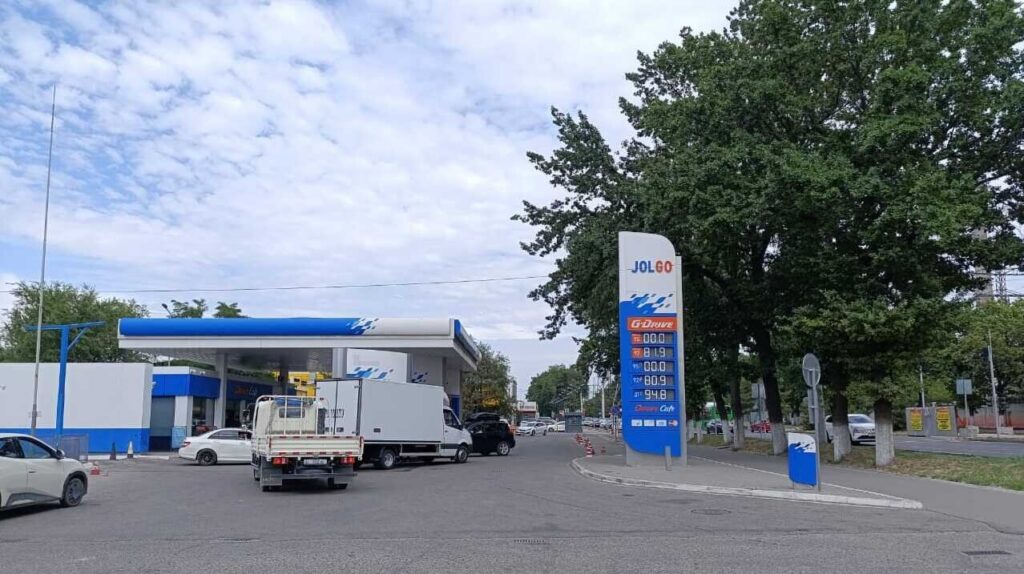
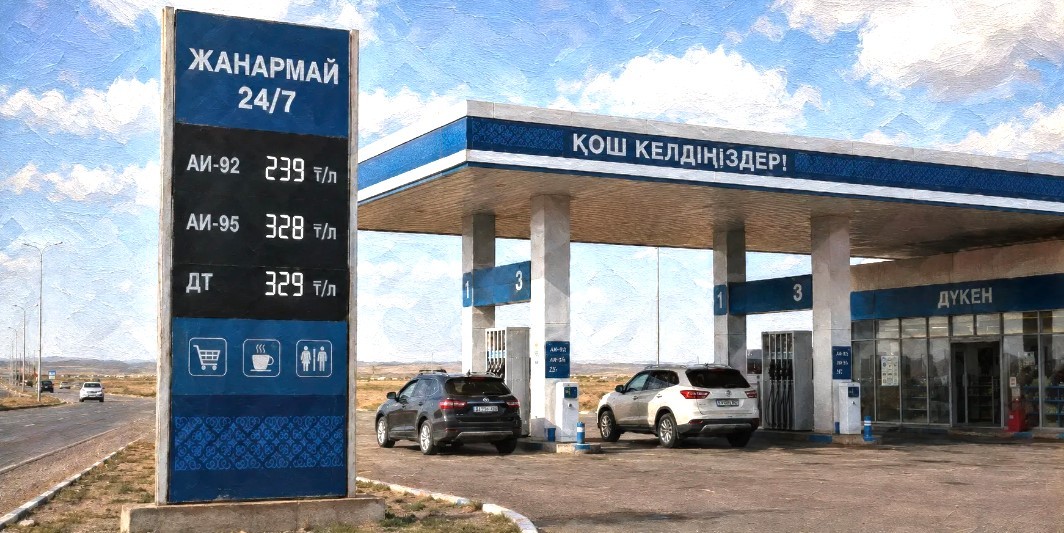
An April 9 check by Tengri Auto found that most filling stations in Almaty and the surrounding area were still selling fuel close to the previous price range. Several major networks, however, had already moved AI-92 toward 240 tenge per liter. AI-95, which was not covered by the main freeze, had risen to 328 tenge at one network.
A Kazinform market check published on May 25 showed the same gradual pattern. AI-92 was listed at 238-239 tenge per liter in Astana, 238-241 tenge in Almaty, and 224-227 tenge in Shymkent. Diesel stood at 329 tenge in Astana, 330-337 tenge in Almaty, and 332-335 tenge in Shymkent. The figures point to a market that is moving, but still under close control.
Fuel is also feeding into Kazakhstan’s broader inflation picture. The Bureau of National Statistics put annual inflation at 10.6% in April 2026. Petrol prices were up 16.1% year-on-year and added 0.53 percentage points to annual price growth. Transport as a category added 1.1 percentage points. Fuel is one of the costs households notice most directly, and its effects spread through freight, food distribution, agriculture, taxis, and public services.
Fuel in Kazakhstan remains cheap by regional and global standards. GlobalPetrolPrices put Kazakhstan’s 95-octane gasoline at 322 tenge per liter, or $0.684, on May 18. The database placed the same grade of gasoline at $0.977 in Kyrgyzstan and $1.125 in Uzbekistan. That gap helps drivers at home, but it also encourages gray exports and cross-border leakage.
The problem is structural as well as immediate. Kazakhstan is a major oil producer, but that does not guarantee cheap gasoline. The country depends on three large refineries at Pavlodar, Shymkent, and Atyrau. A 2025 refining strategy says demand is still growing, while the government wants to expand future exports. That requires investment, and low domestic prices make investment harder when input and maintenance costs rise.
The government has tried to keep supplies inside Kazakhstan, while avoiding sudden retail increases. Export limits have formed part of that approach. On April 30, the Ministry of Energy extended restrictions on the export of gasoline, diesel, and some oil products. The order includes a May 21-November 21 ban on road exports to Eurasian Economic Union states. Such controls can slow leakage, but they do not remove the price gap.
Across Central Asia, fuel markets are being shaped by price gaps and import dependence.
Russia adds another layer of pressure. Moscow has banned gasoline exports until the end of July 2026, although the restriction does not cover supplies under intergovernmental fuel agreements. That exemption can protect some contracted supplies, but regional prices can still be affected when Russian refining output falls. In May, Reuters reported that several central Russian refineries had halted or reduced output after Ukrainian drone attacks, and that the affected plants accounted for more than 30% of Russia’s gasoline output and about 25% of diesel production.
Kyrgyzstan has less capacity to absorb supply shocks. Fuel stocks in mid-May covered only about 1 to 1.5 months, against the annual demand of roughly 1.6 million tons. In Bishkek, AI-92 averaged 78.4 som per liter ($0.90); AI-95 cost 84.4 som ($0.97); and diesel stood at 91.9 som ($1.05). A temporary tax relief plan covering May 15 to September 30 would cut VAT on AI-92 to 8%, set VAT on diesel at zero, and remove diesel excise.
Uzbekistan is facing a different version of the same strain. On April 7, AI-92 gasoline on the Uzbek commodity exchange reached 13.49 million soums per ton ($1,062), setting a record high for a second straight day. Since the start of April, AI-92 had risen almost 6.2%. Diesel eased after a sharp spike, but it was still more than 11% higher for the month. Supplies under intergovernmental agreements are outside Russia’s export ban, but exchange prices suggest that the market remains tight.
Tajikistan has fewer domestic buffers. In October 2025, Reuters reported that Ukrainian strikes on Russian refineries had contributed to higher fuel prices in a country that relies heavily on Russian supplies. Prices in Dushanbe rose that month for AI-92, A-95, diesel, and LPG. The incident showed how disruptions in Russia can quickly ripple through Central Asian markets.
Kazakhstan is better placed than its southern neighbors because it produces oil and refines much of its own fuel. However, it is also in a more politically delicate position because low fuel prices have become part of public expectations. The government can slow increases and restrict exports, but it cannot keep domestic prices apart from refinery costs, regional demand, and Russian supply risks forever. The likely path is a gradual rise, with officials trying to keep each increase small enough that drivers notice the cost without feeling a sudden shock.