Opinion – Kazakhstan’s New Constitution Sends a Key Signal for Global Partners

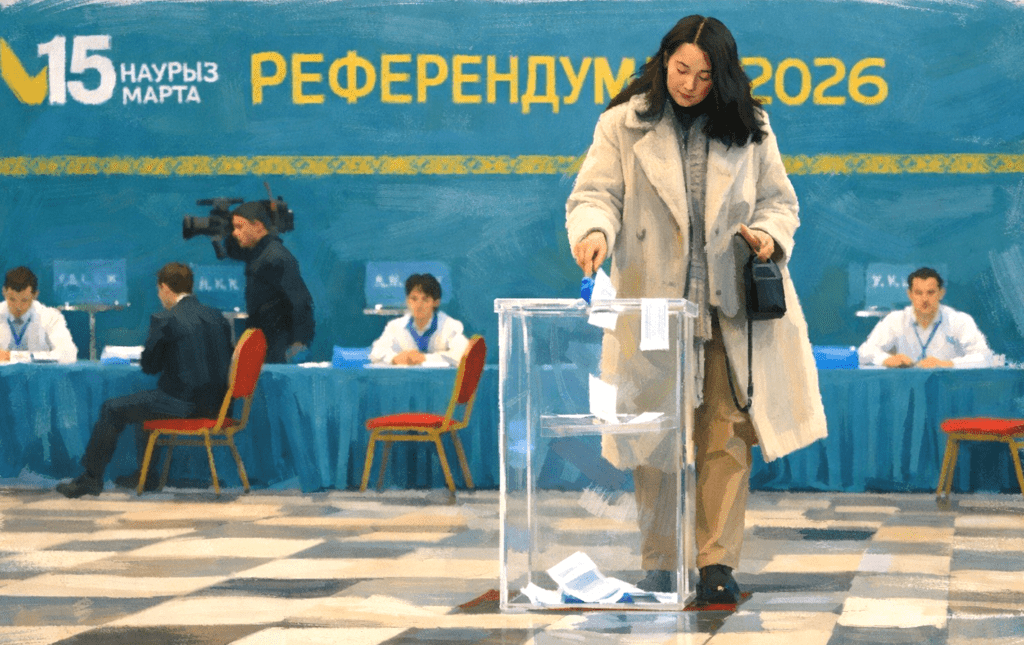
In a nationwide referendum on March 15, over 87% of voters approved a new constitution for Kazakhstan. It was a significant victory for President Tokayev and his administration, all the more so because voter turnout exceeded 73%.
Kazakhstan’s new constitution is a key signal for global partners. It replaces the old bicameral system with a unicameral legislature, establishes the Halyk Kenesi (People’s Council), an advisory body intended to promote national dialogue, and creates a vice presidency to provide for clearer succession at the top of the state.
The new constitution is the outcome of a strategy that has been building for some time. Now, backed by a clear majority, Kazakhstan’s leadership is seeking to strengthen governance by redistributing power, lessening political ambiguity, and grounding politics in shared values—however difficult that may be to accomplish. All of this is being pursued despite—and perhaps because of—the nation’s history of corruption and nepotism.
Kazakhstan’s constitutional reforms were deliberate, structural measures designed to reorient the country’s governmental machinery toward what supporters describe as the common good. That, at least, is the stated intention, reflected in a slogan often used by backers of the new constitution: “A strong president, an influential parliament, and an accountable government.”
Some outside observers have viewed the new constitution favorably, framing it as an effort to streamline governance and clarify institutional roles, while others have warned that the changes could impede sociopolitical progress and human rights by prioritizing stronger governance. Some also see the reforms as signaling a move toward more restrictive political practices.
These alarmist interpretations are overstated.
Astana’s constitutional reforms fit into an ongoing political effort, using the law to strengthen civic involvement and the well-being of the community as a whole, not just individual interests. The new constitution did not emerge ex nihilo for the purpose of freezing elite advantages at the expense of the people, as others in Kazakhstan and the broader region have done in the past. That interpretation of constitutional change in Central Asia overlooks the government’s broader reform agenda, whatever its perceived shortcomings.
In his March 31 article, A New Constitution for a Just, Strong, and Prosperous Kazakhstan, President Tokayev framed Kazakhstan as a rules-oriented state, emphasizing rights, judicial independence, and impartial institutions—an approach that stands out regionally despite open questions about follow-through.
Tokayev emphasized that “The new constitution is about people, not just better government.” The constitution’s largest section is dedicated to protecting freedoms and rights based on common sense and traditional values, including privacy, personal data, private property, and home inviolability. Judicial independence is reinforced to ensure that all citizens receive qualified, impartial defense – at least that’s the intent. Amendments require a public referendum, ensuring that fundamental choices remain popular. Religious liberty is guaranteed in a secular society.
The constitution also presents Kazakhstan as a more attractive and predictable place to do business, for both domestic and foreign investors. The constitution, according to Tokayev, “sets clear rules for economic activity.” As such, the reforms create a political culture that aims to be transparent and investor-friendly, using the opportunity to boost entrepreneurship while curbing economic predation, including abusive rent-seeking or elite wealth hoarding that flourished under a previously uneven playing field favoring entrenched interests. In turn, the measures are framed as helping create a fuller, more welcoming economic environment. Tokayev states that “Kazakhstan is already the leading destination for foreign direct investment (FDI) in Central Asia, attracting nearly 70% of the region’s FDI.”
A new political architecture built on unity and responsibility
Kazakhstan’s constitutional reforms are designed around the idea that nations thrive when citizens pair civic participation with moral virtue and personal responsibility. Supporters argue that this focus is essential to meeting the demands of citizenship in an increasingly turbulent and unmoored world. The new constitution also reflects a broader governing philosophy: that radical individualism, whether cultural or economic, is not conducive to nation-building.
Not everyone accepts Kazakhstan’s view that political reform is most effective when anchored in both human dignity and traditional moral values within a market economy oriented toward the common good; that premise, however, is persuasive. Astana’s attempt to tie democratic stability to moral education grounded in traditional values echoes Alexis de Tocqueville, a theme I explored in my earlier article, Tokayev’s National Kurultai Address: A Moral Message, Not a Political One.
For this reason, some Western observers find the new constitution unsettling. Where they expect to find an emphasis on metrics of efficiency and order, which are “means to an end” rather than “ends in themselves,” this constitution focuses on Kazakhstan’s people and the common good. Moreover, critics overlook the extent to which tradition and family shape Kazakh society. After all, the aim of any constitution ought to be the well-being of the nation and its citizens.
For example, Article 30 states unambiguously that marriage will no longer be considered a union of two people but rather is “a voluntary and equal union of a man and a woman.” It further codifies that “the care and upbringing of children shall be the natural right and duty of parents” and that “adult able-bodied children shall be obliged to care for their incapacitated parents.” Supporters of traditional marriage have welcomed these measures, whereas critics—especially activists backing a broader definition like Kazakhstan’s earlier formulation of “a union of any two people” have been disappointed by the changes and opposed them.
Article 6, which requires that information on funds and assets received by non-profit organizations from foreign sources be publicly accessible under Kazakh law, has also alarmed critics, who argue that it could stifle independent civil society. Supporters, by contrast, present it as a transparency measure to protect against foreign-backed influence activities by state or non-state actors.
In the end, Kazakhstan’s leadership understands that the success or failure of its constitutional reforms will be measured by results over time: stable employment, decent wages, openness, public safety, and national unity. If the reforms are to succeed, they will have to deliver for both elites and, more importantly, ordinary citizens—in public life, at work, and at home. On that test, Kazakhstan appears to be moving in the right direction, though the outcome will depend on what follows.
The views expressed in this article are those of the author and do not necessarily reflect the official policy or position of the publication, its affiliates, or any other organizations mentioned.